
Pulp Fiction, 1883 · page 14 of 24
Beadle's New York Dime Library, No. 244 — page 14: what you’re looking at
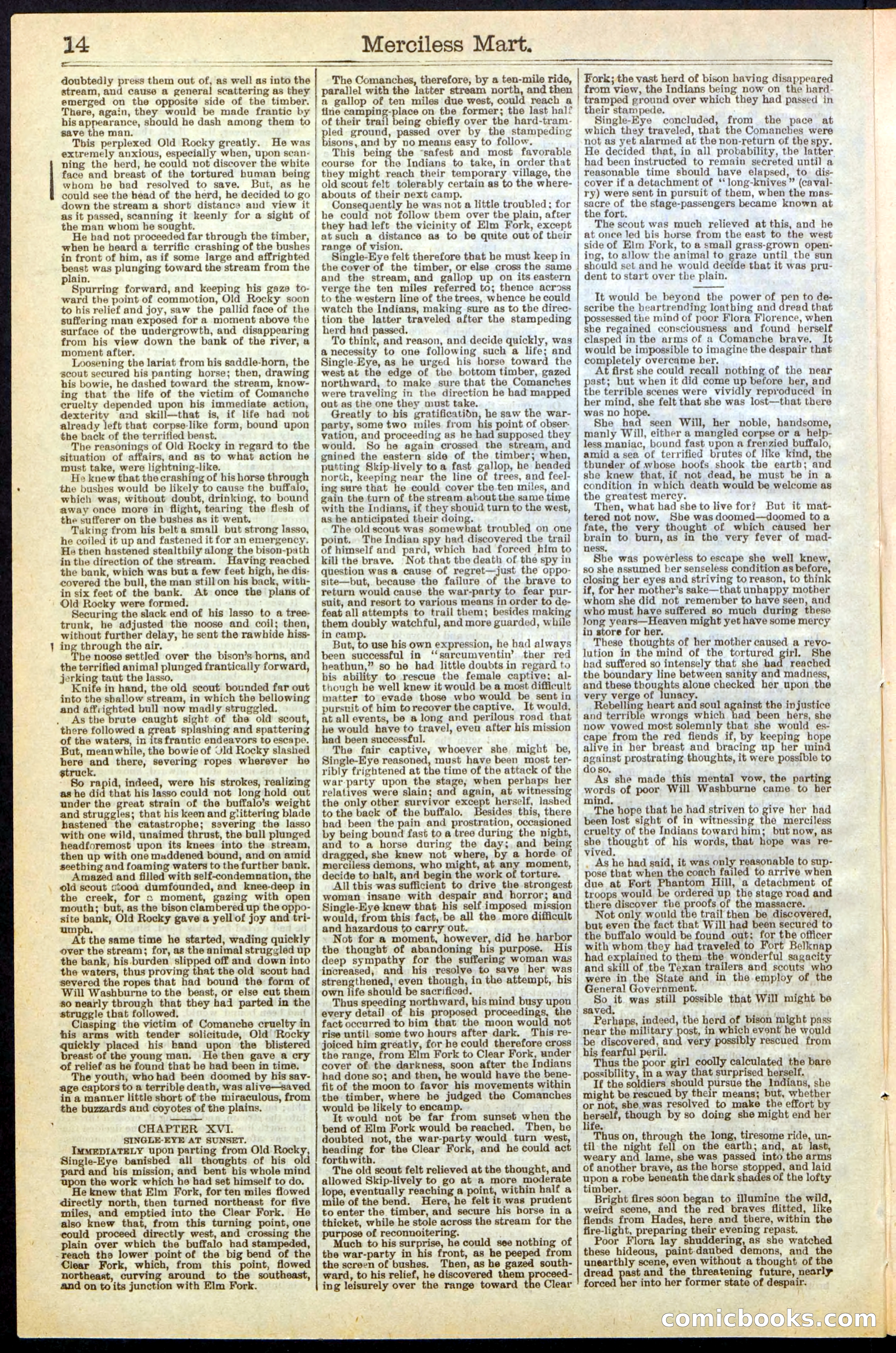
A restored page from Pulp Fiction, 1883. Page through the whole issue in the reader above.
📄 Transcribed text from this page (OCR, searchable)
Machine-transcribed from the original scan — historical spelling and the odd misread are preserved.
“—-~- s* ’ As 14 + doubtedly press them out of, as well as into the stream, and cause a general scattering as they emerged on the opposite side of the timber. There, again, they would be made frantic by his appearance, should he dash among them to save the man. This perplexed Old Rocky greatly. He was extremely anxious, especially when, upon scan- ning the herd, he could not discover the white face and breast of the tortured human being whom be bad resolved to save. But, as he could see the head of the herd, he decided to go down the stream a short distance and yiew it as it passed, scanning it keenly for a sight of the man whom he sought. He had not proceeded far through the timber, when he heard a terrific crashing of the bushes in front of him, as if some large and affrighted a was plunging toward the stream from the plain. Spurring forward, and keeping his gaze to- ward the point of commotion, Old Rocky soon to his relief and joy, saw the pallid face of the suffering man exposed for a moment above the surface of the undergrowth, and disappearing from his view down the bank of the river, a moment after. Loosening the lariat from his saddle-horn, the scout secured his panting horse; then, drawing his bowie, he dashed toward the stream, know- ing that the life of the victim of Comanche cruelty depended upon his immediate action, dexterity and skill—that is, if life had not already left that corpse-like form, bound upon the back of the terrified beast. The reasonings of Old Rocky in regard to the situation of affairs, and as to what action he must take, were lightning-like. He knew that the crashing of his horse through the bushes would be likely to cause the buffalo, which was, without doubt, drinking, to bound away once more in flight, tearing the flesh of the sufferer on the bushes as it went, Tuking from his belt a small but strong lasso, he coiled it up and fastened it for an emergency. He then hastened stealtbily aongine bison-path in the direction of the stream. aving reached the bank, which was but a few feet high, he dis- covered the bull, the man still on his back, with- in six feet of the bank. At once the plans of Old Rocky were formed. Securing the slack end of his lasso to a tree- trunk, he adjusted the noose and coil; then, without further delay, he sent the rawhide hiss- 1 ing through the air. be noose settled over the bison’s horns, and the terrified animal plunged frantically forward, jerking taut the lasso, Knife in hand, the old scout bounded far out into the sballow stream, in which the bellowing and affvighted bull now madly struggled. . As the brute caught sight of the old scout, there followed a great splashing and spattering of the waters, in its frantic endeavors to escape. But, meanwhile, the bowie of Uld Rocky slashed here and there, severing ropes wherever he struck. So rapid, indeed, were his strokes, realizing as he did that his lasso could not long hold out under the great strain of the buffalo’s weight and struggles; that his keen and giittering blade hastened the catastrophe; severing the lasso with one wild, unaimed thrust, the bull plunged headforemost upon its knees into the stream, then up with one maddened bound, and on amid seething and foaming waters to the further bank. Amazed and filled with self-condemnation, the . old scout ctood dumfounded, and knee-deep in the creek, for 2 moment, gazing with open mouth; but, as the bison clambered up the oppo- site “sap. Old Rocky gave a yellof joy and tri- ump At the same time he started, wading quickly over the stream; for, as the animal struggled up the bank, his burden slipped off and down into the waters, thus proving that the old scout had severed the ropes that had bound the form of Will Washburne to the beast, or else cut them 80 nearly through that they bad parted in the struggle that followed. Clasping the victim of Comanche cruelty in his arms with tender solicitude, Old Rocky quickly placed his band upon the blistered breast of the young man. He then gave a cry of relief as he found that he had been in time. The youth, who had been doomed by his sav- age captors to a terrible death, was alive—saved in a manner little short of the miraculous, from the buzzards and coyotes of the plains. CHAPTER XVI. SINGLE-EYE AT SUNSET. IMMEDIATELY upon parting from Old ven # Single-Eye banisbed all thoughts of his o chia and his mission; and bent bis whole mind upon the work which he had set himself to do. He knew that Elm Fork, for ten miles flowed directly north, then turned northeast for five miles, and emptied into the Clear Fork. He also knew that, from this turning point, one could proceed directly west, and crossing the plain over which the buffalo had stampeded, -reach the lower point of the big bend of the Clear Fork, which, from this point, flowed northeast, sare around to southeast, and on toits junction with Elm Fork. Rnmallegs (tae ee The Comanches, therefore, by a ten-mile ride, parallel with the latter stream north, and then a gallop of ten miles due west, could reach a firie camping-place on the former; the last hal? of their trail being chiefly over the hard-tram- a ground, passed over by the stampeding isons, and by no meaus easy to follow. This being the “safest and most favorable course for the Indians to take, in order that they might reach their temporary village, the old scout felt tolerably certain as to the where- abouts of their next camp. Consequently be was not a little troubled; for he could not follow them over the plain, after they had left the vicinity of Elm Fork, except at such a distance as to be quite out of their | range of vision. Single-Eye felt therefore that be must keep in the cover of the timber, or else cross the same and the stream, and gallop up on its eastern verge the ten miles referred to; thence across to the western line of the trees, whence he could watch the Indians, making sure as to the direc- tion the latter traveled after the stampeding herd had passed, To think, and reason, and decide quickly, was a necessity to one following such a life; and Single-Eye, as be urged his borse toward the west at the edge of the bottom timber, gazed northward, to make sure that the Comanches were traveling in the direction he bad mapped out as the one they must take. Greatly to bis gratificatidn, he saw the war- party, some two miles from his point of obser- vation, and proceeding as he had supposed they would. So he again crossed the stream, and gained the eastern side of the timber; when, putting Skip-lively to a fast gallop, he headed north, keeping near the line of trees, and feel- ing suré that he could cover the ten miles, and gain the turn of the stream about the same time with the Indians, if they shouid turn to the west, as he anticipated their doing. The old scout was somewbat troubled on one point. The Indian spy had discovered the trail of himself and pard, which had forced him to kill the brave. Not that the death of the spy in question was a cause of regret—just the oppo- site—but, because the failure of the brave to return would cause the war-party to fear pur- suit, and resort to various means in order to de- feat all attempts to trail them; besides making them doubly watchful, and more guarded, while in camp. But, to use his own expression, he had always been successful in ‘‘sarcumventin’ ther red heathun,” so he had little doubts in regard to his ability to rescue the female captive; al- though he well knew it would be a most difficult matter to evade those who would be sent in pursuit of him torecover the captive. It would, at all events, be a long and perilous road that he would have to travel, even after his mission had been successful. The fair captive, whoever she might be, Single-Eye reasoned, must have been most ter- ribly frightened at the time of the attack of the war party upon the stage; when perbaps her relatives were slain; and again, at witnessin the only other survivor exeere herself, lashe< to the back of the buffalo. ides this, there bad been the pain and prostration, occasioned by being bound fast to a tree during the night, and to a horse during the day; and being dragged, she knew not where, by a horde of merciless demons, who might, at any moment, decide to halt, and begin the work of torture. All this was sufficient to drive the strongest woman insane with despair and horror; and Single-Eye knew that his self-imposed mission would, from this fact, be all the more difficult and hazardous to carry out. Not for a moment, however, did he harbor the thought of abandoning his purpose. His deep sympathy for the suffering woman was increased, and his resolve to save her was strengthened,’ even though, in the attempt, bis own life should be sacrificed. Thus speeding northward, bis mind busy upon every detai] of his proposed proceedings, the fact occurred to bim that the moon would not rise until some two hours after dark. This re- joiced him greatly, for he could therefore cross the range, from Elm Fork to Clear Fork, under cover of the darkness, soon after the Indians had done so; and then, he would have the bene- fit of the moon to favor his movements within the timber, where he judged the Comanches would be likely to encamp. It would not be far from sunset when the bend of Elm Fork would be reached. Then, he doubted not, the war-party would turn west, heading for the Clear Fork, and he could act forthwith. The old scout felt relieved at the thought, and allowed Skip-lively to go at a more moderate lope, eventually reaching a point, within half a mile of the bend. Here, he felt it was prudent to enter the timber, and secure his horse in a thicket, while he stole across the stream for the pu of reconnoitering. Maths to his surprise, he could see nothing of the war-party in his front, as he peeped from the screen of bushes. Then, as he gazed south- ward, to his relief, he discovered them proceed- ing leisurely over the range toward the Clear | —_ + | | } ' ' ee er ee Fork; the vast herd of bison having disappeared from view, the Indians being now on the hard- tramped ground over which they had passed in their stampede. Single-Eye concluded, from the pace at which they traveled, that the Comanches were not as yet alarmed at the non-return of the spy. He decided that, in all probability, the latter had been instructed to remain secreted until a reasonable time should bave elapsed, to dis- cover if a detachment of ‘‘long-knives ” (caval- ry) were sent in pursuit of them, when the mas- sacre of the stage-passengers became known at the fort. The scout was much relieved at this, and he at once led bis hurse from the east to the west side of Elm Fork, to a small grass-grown open- ing, to allow the animal to graze until the sun should set and he would decide that it was pru- dent to start over the plain. It would be beyond the power of pen to de- scribe the beartrending loathing and dread that possessed the mind of poor Flora Florence, when she regained consciousness and found herself clasped in the arms of a Comanche brave. It would be impossible to imagine the despair that completely overcame her. At first she could recall nothing of the near past; but when it did come up before her, and the terrible scenes were vividly reproduced in her mind, she felt that she was lost—that there was no og She had seen Will, her noble, handsome, manly Will, either a mangled corpse or a help- less maniac, bound fast upon a frenzied buffalo, amid a sea of terrified brutes of like kind, the thunder of whose hoofs shook tbe earth; and she knew that, if not dead, he must be in a condition in which death would be welcome as the greatest mercy. Then, what had she to live for? But it mat- tered not now. Sbe was doomed—doomed to a fate, the very thought of which caused her brain to burn, as in the very fever of mad- ness. She was powerless to escape she well knew, so she assumed her senseless condition as before, closing ber eyes and striving to reason, to think if, for her mother’s sake—that unhappy mother whom she did not remember to have seen, and who must have suffered so much during these Jong years—Heaven might yet have some mercy in store for ber. These thoughts of her mother caused a revo- lution in the mind of the tortured girl. She bad suffered so intensely that she bad reached the boundary line between sanity and madness, and these thoughts alone checked her upon the very verge of lunacy, Rebelling heart and soul ay: the injustice and terrible wrongs which had been hers, she now vowed most solemnly that she would es- cape from the red fiends if, by keeping hope alive in her breast and bracing up her mind apatites prostrating thoughts, it were possible to 0 so. As she made this mental vow, the parting words of poor Will Washburne came to her mind, The hope that he had striven to give her had been lost sight of in witnessing the merciless cruelty of the Indians toward him; but now, as she aaa of his words, that hope was re- vived. _ As he had said, it was only reasonable to sup- pose that when the coach failed to arrive when due at Fort Phantom Hill, a detachment of troops would be ordered up the stage road and there discover the proney of the massacre. Not only would the trail then be discovered, but even the fact that Will had been secured to the buffalo would be found out; for the officer with whom they had traveled to Fort Belknap had explained to them the wonderful sagacity and skill of the Texan trailers and scouts who were in the State and in the employ of the General Government. — FO. it was still possible that Will might be saved, Perhaps, indeed, the herd of bison might pass near the military post, in which event he would be discovered, and very possibly rescued from his fearful peril. Thus the poor girl coolly calculated the bare possibility, in a way that surprised herself. If the soldiers should pursue the Indians, she might be rescued by their means; but, whether or not, she. was resolved to make the effort by herself, though by so doing she might end her fe. Thus on, through the long, tiresome ride, un- til-the night fell on the earth; and, at last, weary and lame, she was passed into the arms of another brave, as the horse stopped, and laid upon a robe beneath the dark sh of the lofty timber. Bright fires soon began to illumine the wild, weird scene, and the red braves flitted, like ro prom Hades, ae and there, within the re-light, preparing their evening repast. Poor Flora lay shuddering, as she watched these hideous, paint-daubed demons, and the unearthly scene, even without a thought of the dread past and the threatening future, nearly forced her into her former state of despair. : : Nicboo = ~) ee ee O