
Pulp Fiction, 1883 · page 6 of 32
Beadle's Dime Library, No. 240 — page 6: what you’re looking at
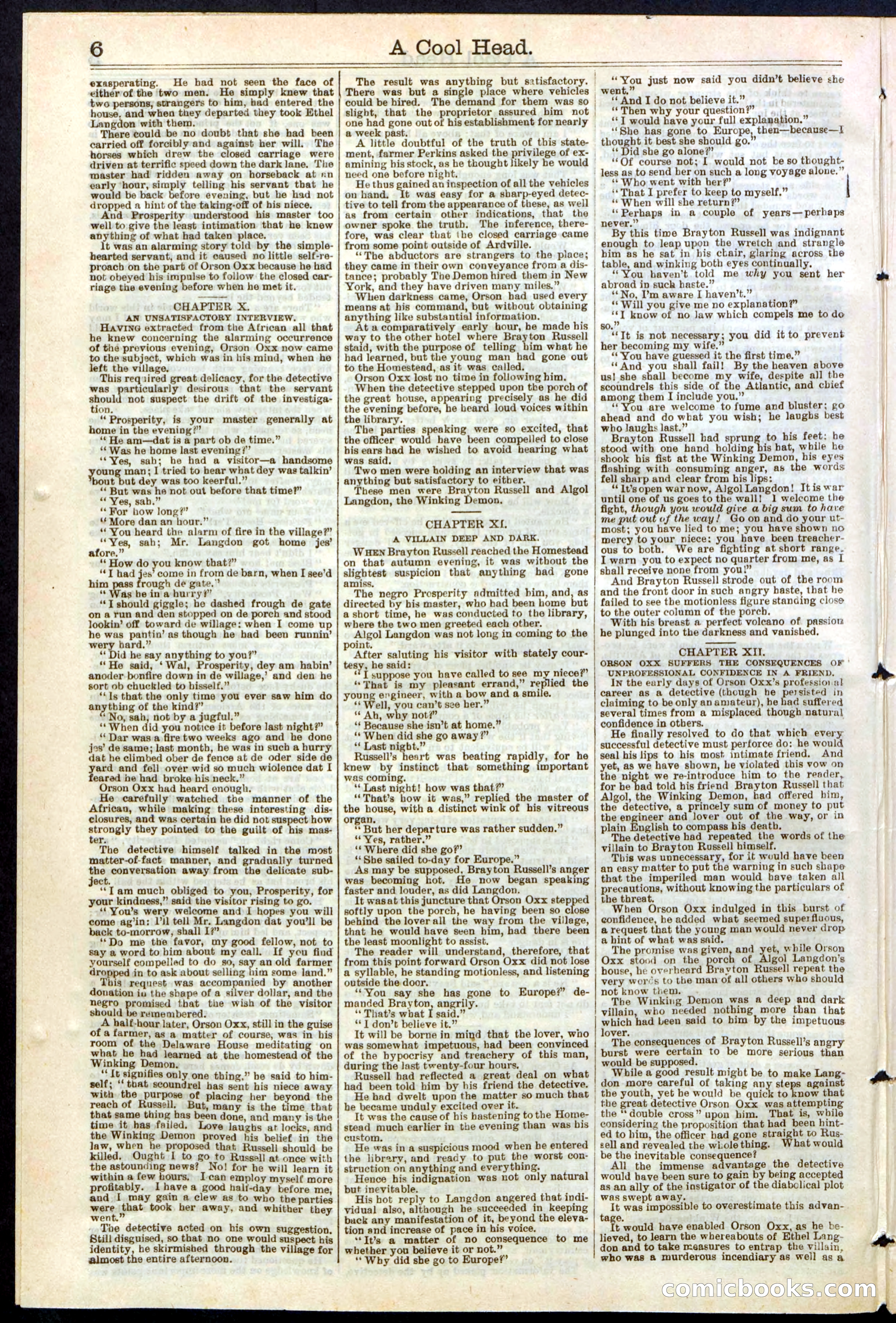
A restored page from Pulp Fiction, 1883. Page through the whole issue in the reader above.
📄 Transcribed text from this page (OCR, searchable)
Machine-transcribed from the original scan — historical spelling and the odd misread are preserved.
exasperating. He had not seen the face of either of the two men. He simply knew that two persons, strangers to him, bad entered the house. and when they departed they took Ethel Langdon with them. There could be no doubt that she had been carried off forcibly and against her will. The horses which drew the closed carriage were driven at terrific speed down the dark lane, The master had ridden away on horseback at «n early ‘hour, simply telling his servant that he would be back before evening, but he had not dropped a bint of the taking-off of his niece. And Prosperity understood his master too well to give the least intimation that he knew anything of what had taken place. lt was an alarming story told by the simple- hearted servant, and it caused no little self-re- proacb on the part of Orson Oxx because he had not obeyed his impulse to follow the closed car- riage the evening before when he met it. CHAPTER X. AN UNSATISFACTORY INTERVIEW. HavIne extracted from the African all that he knew concerning the alarming occurrence of the previous evening, Orson Oxx now came to the subject, which was in his mind, when he left the village, This required great delicacy, for the detective was particularly desirous that the servant peer not suspect the drift of the investiga- on. “ Prosperity, is your master generally at home in the evening?” ‘‘ He am—dat is a part ob de time.” ‘Was he home last evening?’ ‘*'Yes, sah; he had a visitor—a handsome esa, pe I tried to hear what dey was talkin’ bout but dey was too keerful.” ‘‘ But was he not out before that time?” “Yes, sab.” ‘For how long?’ ‘* More dan an hour.” ** You heard the alarm of fire in the village?” “Yes, sah; Mr. Langdon got home jes’ afore.” ** How do you know that?” sie I had jes ae in from de barn, when I see’d m rou é gate. $s Was he pa. be hurry?’ ‘‘T should giggle; be dashed frough de gate on a run and den stopped on de porch and stood lookin’ off toward de willage: when I come up he was pantin’ as though he had been runnin’ wery bard.” “‘ Did he say anything to you?” ‘He said, ‘Wal, Prosperity, dey am habin’ anoder bonfire down in de willage,’ and den he sort ob chuckled to bisself.” ‘‘Is that the only time you ever saw him do anytbing of the kind?” ‘No, sah; not by a jugful.” “When did you notice it before last night?” ‘‘ Dar was a fire two weeks ago and he done jes’ de same; last month, he was in such a hurry dat he climbed ober de fence at de oder side de ard and fell over wid so much wiolence dat I eared be had broke his neck.” Orson Oxx had heard enough. He carefully watched the manner of the African, while making these interesting dis- closures, and was certain he did not suspect how eee they pointed to the guilt of his mas- r The detective himself talked in the most matter-of-fact manner, and gradually turned coed conversation away from the delicate sub- ect. ‘*Tam much obliged to you, Prosperity, for your kindness,” said the visitor rising to go. ‘‘ You’s wery welcome and I hopes you will come ag’in: 111 tell Mr. Langdon dat you’ll be back to-morrow, shall 1?” ‘*Do me the favor, my good fellow, not to say a word to bim about my call. If you find yourself compelled to do so, ~ an old farmer dro in to ask about selling bim some land.” bis request was accompanied by another donation ia the shape of a silver dollar, and the negro promised that the wish of the visitor should be remembered. A half-hour later, Orson Oxx, still in the guise of a farmer, as a matter of course, was in bis room of the Delaware House meditating on what he had learned at the homestead of the Winking Demon, it signifies only one thing,” be said to him- self; ‘‘ that scoundrel bas sent his niece away with the purpose of placing her beyond the reach of Russell. But, many is the time that that same thing has been done, and many is the time it has failed. Love laughs at locks, and the Winkie Demon proved his belief in the law, when he proposed that Russell should be killed. Ought I to go to Russell at once with the astounding news? No! for he will learn it within a few hours. Ican employ myself more profitably. Ihave a good half-day before me and I may gain a clew as to who the parties were that took her away, and whither they "The d tecti ted h be detective acted on his own su tion. Still disguised, so that no one would anes his identity, he skirmished through the village for almost the entire afternoon. A Cool Head. The result was anything but satisfactory. There was but a single place where vehicles could be hired. The slight, that the proprietor assured him not one had gone out of his establishment for nearly a week past. A little doubtful of the truth of this state- ment, farmer Perkins asked the privilege of ex- amining bis stock, as he thought likely be would need one before night. emand for them was S0 | | He thus gained an inspection of all the vehicles | on hand. It was easy for a sbarp-eyed detec- tive to tell from the appearance of these, as well as from certain other indications, that the | owner spoke the truth. The inference, there- fore, was clear that the closed carriage came | from some point outside of Ardville. ‘““The abductors are strangers to the place; they came in their own conveyance from a dis- tance; probably The Demon hired them in New York, and they have driven many miles.” When darkness came, Orson had used every means at his command, but without obtaining anything like substantial information. At a comparatively early hour, be made his way to the other hotel where Brayton Russell staid, with the purpose of telling bim what he had learned, but the young man bad gone out to the Homestead, as it was called. Orson Oxx lost no time in following him. When the detective stepped upon the porch of the great house, appearing precisely as he did the evening before, he beard loud voices within the library. The parties speaking were so excited, that the officer would have been compelled to close his ears had he wished to avoid hearing what was said. Two men were holding an interview that was anything but satisfactory to either. These men were Brayton Russell and Algol Langdon, the Winking Demon, CHAPTER XI. A VILLAIN DEEP AND DARK. WHEN Brayton Russell reached the Homestead on that autumn evening, it was without the slightest suspicion that anything had gone amiss. The negro Prosperity admitted him, and, as directed by his master, who had been home but a short time, he was conducted to the library, where the two men greeted each other. Algol Langdon was not long in coming to the point. After saluting his visitor with stately cour- tesy, he said: ‘'T suppose you have called to see m “That is my pleasant errand,” ne young engineer, with a bow and a smi ‘* Well, you can’t see ber.” ** Ah, why not?” ‘‘ Because she isn’t at home.” ‘* When did she go away?” ** Last nigbt.” Russell’s heart was beating rapidly, for he knew by instinct that something important was coming. ‘** Last night! how was that?” ‘‘That’s bow it was,” replied the master of the house, with a distinct wink of his vitreous organ. ‘* But her departure was rather sudden.” “Yes, rather.” ‘* Where did she go?’ ‘She sailed to-day for Europe.” As may be supposed, Brayton Russell’s anger was becoming hot. He now began speaking faster and louder, as did Langdon. It wasat this juncture that Orson Oxx stepped softly upon the porch, he having been so close behind the lover all the way from the village, that he would have seen him, had there been the least moonlight to assist. The reader will understand, therefore, that from this point forward Orson Oxx did not lose a syllable, he standing motionless, and listening outside the door. ‘“You say she has gone to Europe?” de- manded Brayton, angrily. “'That’s what I said.” “* 1 don’t believe it.” It will be borne in mind that the lover, who was somewhat impetuous, had been convinced of the hypocrisy and treachery of this man, during the last twenty-four hours, Russell had reflected a great deal on what had been told him by his friend the detective. He had dwelt upon the matter so much that he became unduly excited over it. It was the cause of his hastening to the Home- stead much earlier in the evening than was bis custom. He was in a suspicious mood when he entered the library, and ready to put the worst con- struction on anything and everything. ied the y niece?” e —_ " | ; oo ome ae - “You just now said you didn’t believe che went,” ‘‘ And I do not believe it.” “Then why your question?’ ‘‘T would have your full explanation.” ‘‘She has gone to Europe, then—because—l thought it best she should go.” ‘* Did she go alone?’ ‘‘Of course not; I would not be so thought- less as to send ber on such a long voyage alone.” ‘* Who went with her?” ‘*That I prefer to keep to myself.” ‘When will she return?’ ‘‘Perhaps in a couple of years—perhaps never.” By this time Brayton Russell was indignant enough to leap upon the wretch and strangle him as he sat in his chair, glaring across the table, and winking both eyes continually. ‘“You haven't told me why you sent her abroad in such haste.” ‘* No, I’m aware I haven't.” ‘“ Will you give me no explanation?” aa know of no Jaw which compels me to do ‘‘Tt is not necessary; you did it to prevent her becoming my wife.” ‘‘-You have guessed it the first time.” ‘‘And you shall fail! By the heaven above us! she shall become my wife, despite all the scoundrels this side of the Atlantic, and chief among them I include you.” ‘You are welcome to fume and bluster; go ahead and do what you wish; he laughs best who laughs last.” , Brayton Russell bad per Ung. to his feet: he stood with one hand_holding bis hat, while he shook his fist at the Winking Demon, his eyes flashing with consuming anger, as the words fell sharp and clear from his lips: ‘It’s open war now, Algol Langdon! It is war until one of us goes to the wall! 1 welcome the fight, though you would give a big sum to have me put out of the way! Go on and do your ut- most; you have lied to me; you have shown no mercy to your niece: you have been treacher- ous to both. We are fighting at short range. I warn you to expect no quarter from me, as | shall receive none from you)” And Brayton Russell strode out of the room and the front door in such angry haste, that he failed to see the motionless figure standing close to the outer column of the porch. With his breast a perfect voleano of passion he plunged into the darkness and vanished, CHAPTER XII. ORSON OXX SUFFERS THE CONSEQUENCES OF UNPROFESSIONAL CONFIDENCE IN A FRIEND. In the early days of Orson Oxx’s professional career as a detective (though he persisted in claiming to be only an amateur), he had suffered several times from a misplaced though natural confidence in otbers. He finally resolved to do that which every successful detective must perforce do: he would seal his lips to his most intimate friend. And yet, as we have shown, he violated this vow on the night we re-introduce him to the reader, for he bad told his friend Brayton Russell that Algol, the Winking Demon, had offered him, the detective, a princely sum of money to put the engineer and lover out of the way, or in plain English to compass bis death, The detective had repeated the words of the villain to Brayton Russell himself. This was unnecessary, for it would have been an easy matter to pe the warning in such shape that the imperiled man would bave taken all precautions, without knowing the particulars of the threat. When Orson Oxx indulged in this burst of confidence, he added what seemed superfluous, a request that the young man would never drop a hint of what was said. The promise was given, and yet, while Orson Oxx stood on the orch of gol Langdon’s house, he overheard Brayton Russell repeat the very words to the man of all others who should not know them. The Winking Demon was a deep and dark villain, who needed nothing more than that which had Leen said to him by the impetuous lover. The consequences of Brayton Russell’s angry burst were certain to be more serious than would be supposed. | While a good result might be to make Lang- don more careful of taking any steps against the youth, yet be would be cui to Sow that the great detective Orson Oxx was attempting the “double cross” upon him. That is, while considering the proposition that had been hint- ed to him, the officer had gone straight to Rus- eell and revealed the whole thing. hat would be the inevitable consequence? All the immense advantage the detective Hence his indignation was not only natural | would bave been sure to gain by being accepted but inevitable. ty His hot reply to Langdon angered that indi- vidual also, although he suc ed in keeping buck any manifestation of it, beyond the eleva- tion and increase of pace in his voice. “It’s a matter of no consequence to me whether you believe it or not.” ‘* Why did she go to Europe?’ | ta as an ally of the instigator of the diabolical plot was swept away. , It was impossible to overestimate this advan- e. it would have enabled Orson Oxx, as he be- lieved, to learn the whereabouts of Ethel Lang- don and to take measures to entrap the villain, who was & murderous incendiary as well as a “S GOmicdoo (E(0)