
Pulp Fiction, 1883 · page 2 of 32
Beadle's New York Dime Library, No. 239 — page 2: what you’re looking at
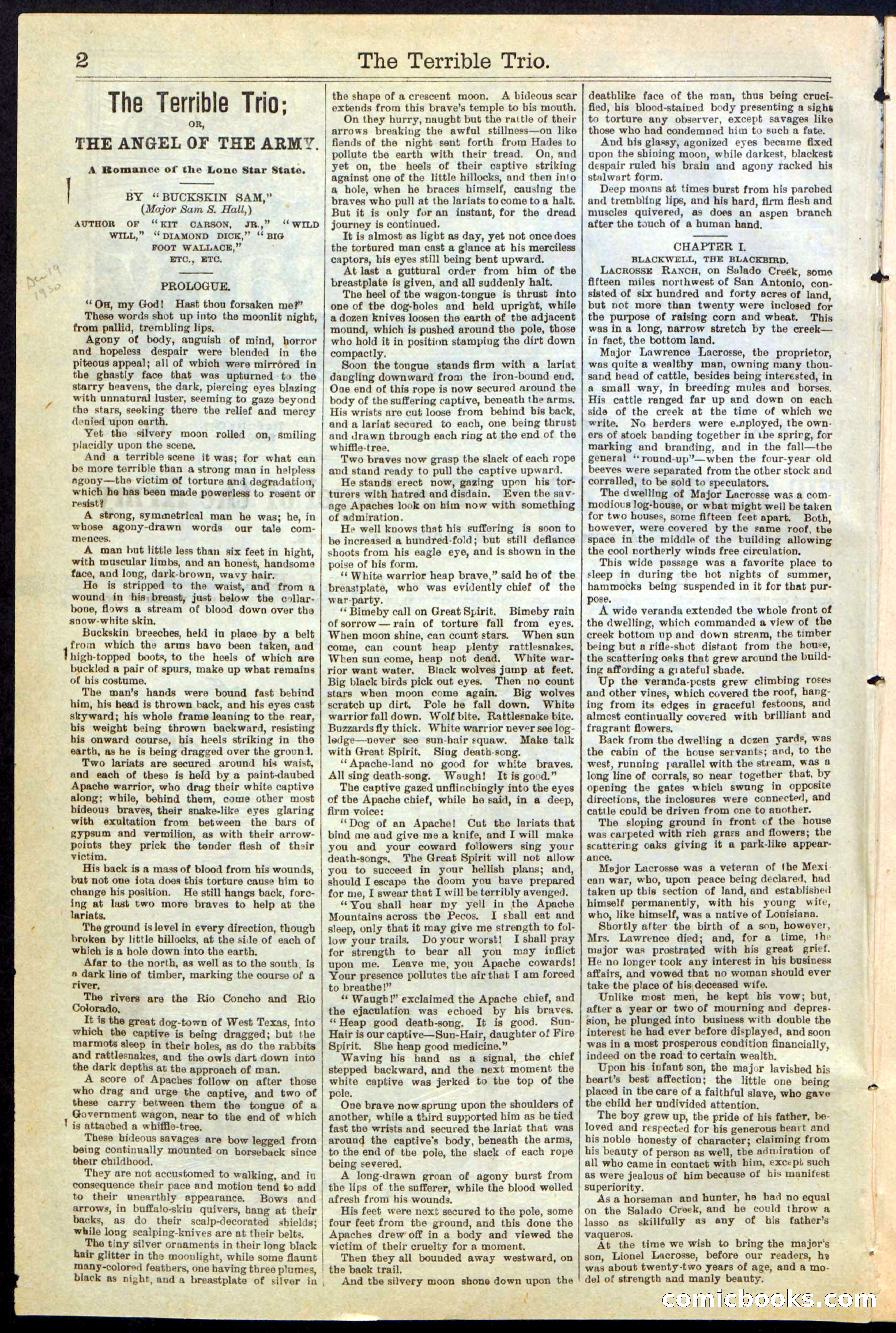
A restored page from Pulp Fiction, 1883. Page through the whole issue in the reader above.
📄 Transcribed text from this page (OCR, searchable)
Machine-transcribed from the original scan — historical spelling and the odd misread are preserved.
4 mY i Pl 2 rts Ot ee mmm ee ee ee The Terrible Trio: THE ANGEL OF THE ARMY. A Bomance of the Lone Star State. | BY “BUCKSKIN SAM,” ! ' is attached a (Major Sam S. Hall,) AUTHOR OF “KIT CARSON, JR.,” WILL,” ‘DIAMOND DICK,” “ BIG FOOT WALLACE,” ETC., ETC. PROLOGUE. “Ou, my God! Hasf thou forsaken me?” These words shot up into the moonlit night, from pallid, trembling lips. Agony of body, anguish of mind, horror and hopeless despair were blended in the piteous appeal; all of which were mirréred in the ghastly face that was upturned to the starry heavens, the dark, piercing eyes blazing with unnatural luster, seeming to gaze beyond the stars, seeking there the relief and mercy denied upon earth. Yet the silvery moon rolled on, smiling placidly upon the scene, And a terrible scene it was; for what can be more terrible than a strong man in helpless agony—the victim of torture and degradation, which he has been made powerless to resent or resist? A strong, symmetrical man he was; he, in whose agony-drawn words our tale com- mences. A man but little less than six feet in hight, with muscular limbs, and an honest, handsome face, and long, dark-brown, wavy hair. He is stripped to the waist, and from a wound in his, breast; just below the collar- bone, flows a stream of blood down over the snow-white skin, Buckskin breeches, held in place by a belt from which the arms have been taken, and high-topped boots, to the heels of which are buckled a pair of spurs, make up what remains of bis costume, The man’s hands were bound fast behind him, his head is thrown back, and his eyes cast skyward; his whole frame leaning to the rear, his weight being thrown backward, resisting his onward course, his heels striking in the earth, as he is being dragged over the grovni, Two lariats are secured around his waist, and each of these is held by a paint-daubed Apache warrior, who drag their white captive along; while, behind them, come other most hideous braves, their snake-like eyes glaring with exultation from between the bars of gypsum and vermilion, as with their arrow- points they prick the tender flesh of their victim. His back is a mass of blood from his wounds, but not one iota does this torture cause him to change his position. He still hangs back, forc- ing at last two more braves to help at the ~ lariats. The ground is level in every direction, though broken by little billocks, at the side of each of which is a bole down into the earth. Afar to the north, as well as to the south. is a dark line of timber, marking the course of a river, The rivers are the Rio Concho and Rio Colorado, It is the great dog-town of West Texas, into which the captive is being dragged; but the marmots sleep in their holes, as do the rabbits and rattlesnakes, and the owls dart down into the dark depths at the approach of man. A score of Apaches follow on after those who drag and urge the captive, and two of these carry between them the tongue of a Government wagon, near to the end of which whiffle-tree, These bideous savages are bow legged fromm being continually mounted on horseback since their childbood., They are not accustomed to walking, and iu consequence their pace and motion tend to add to their unearthly appearance. Bows and arrows, in buffalo-skin quivers, hang at their | backs, as do their scalp-decorated shields; while long scalping-knives are at their belts. The tiny silver ornaments in their long black hair glitter in the moonlight, while some flaunt The Terrible Trio. a the shape of acrescent moon. A hideous scar extends from this brave’s temple to bis mouth. On they hurry, naught but the rattle of their arrows breaking the awful stillness—on like fiends of the night sent forth from Hades to pollute the earth with their tread. On, and yet on, the heels of their captive striking against one of the little hillocks, and then into a hole, when he braces himself, causing the braves who pull at the lariats to come to a halt. But it is only for an instant, for the dread ‘WILD | journey is continued. It is almost as light as day, yet not once does the tortured man cast a glance at his merciless captors, his eyes still being bent upward. At last a guttural order from him of the breastplate is given, and all suddenly halt. The heel of the wagon-tongue is thrust into one of the dog-holes and held upright, while a dozen knives loosen the earth of the adjacent mound, which is pushed around the pole, those who hold it in position stamping the dirt down compactly, Soon the tongue stands firm with a lariat dangling downward from the iron-bound end, One end of this rope is now secured around the body of the suffering captive, beneath the arms. His wrists are cut loose from behind bis back, and a lariat secured to each, one being thrust and drawn through each ring at the end of the whiffle-tree. Two braves now grasp the slack of each rope and stand ready to pull the captive upward. He stands erect now, gazing upon bis tor- turers with hatred and disdain. Even the sav- age Apaches look on him now with something of admiration. He well knows that his suffering is soon to be increased a bundred-fold; but still defiance shoots from his eagle eye, and is shown in the poise of his form, ‘¢ White warrior heap brave,” said he of the breastplate, who was evidently chief of the war-party. ‘* Bimeby call on Great Spirit. Bimeby rain of sorrow —rain of torture fall from eyes. When moon shine, can count stars. When sun come, can count heap plenty rattlesnakes. When sun come, heap not dead. White war- rior want water. Black wolves jump at feet. Big black birds pick out eyes. Then no count stars when moon come again. Big wolves scratch up dirt, Pole he fall down. White warrior falldown. Wolf bite. Rattlesnake bite. Buzzards fly thick. White warrior never see log- ledge—never see sun-hair squaw. Make talk with Great Spirit. Sing death-song. ‘‘Apache-land no good for white braves, All sing death-song. Waugh! It is good.” The captive gazed unflincbingly into the eyes of the Apache chief, while he said, in a deep, firm voice: ‘Dog of an Apache! Cut the lariats that bind me and give mea knife, and I will make you and your coward followers sing your death-songs, The Great Spirit will not allow you to succeed in your hellish plans; and, should I escape the doom you bave prepared for me, I swear that I will be terribly avenged. ‘You shall hear my yell in the Apache Mountains across the Pecos. I shall eat and sleep, only that it may give me strength to fol- low your trails. Do your worst! I shall pray for strength to bear all you may inflict upon me. Leave me, you Apache cowards! Your presence pollutes the air that I am forced to breathe!” “‘ Waugh!” exclaimed the Apache chief, and the ejaculation was echoed by his braves. “Heap good death-song. It is good. Sun- Hair is our captive—Sun-Hair, daughter of Fire Spirit. She heap good medicine.” Waving his hand as a signal, the chief stepped backward, and the next moment the white captive was jerked to the top of the pole. One brave now sprung upon the shoulders of another, while a third supported him as he tied fast the wrists and secured the lariat that was around the captive’s body, beneath the arms, to the end of the pole, the slack of each rope being severed, A long-drawn groan of agony burst from the lips of the sufferer, while the blood welled afresh from his wounds. His feet were next secured to the pole, some | four feet from the ground, and this done the Apaches drew off in a body and viewed the victim of their cruelty for a moment. Then they all bounded away westward, on many-colored feathers, one having three plumes, | the back trail. black as night, and a breastplate of silver in , And the silvery moon shone down upon the _— deatblike face of the man, thus being cruci- fied, his blood-stained body presenting a sight to torture any observer, except savages like those who had condemned him to such a fate. And his glassy, agonized eyes became fixed upon the shining moon, while darkest, blackest despair ruled his brain and agony racked his stalwart form. Deep moans at times burst from his parched and trembling lips, and his hard, firm flesh and muscles quivered, as does an aspen branch after the touch of a human hand, CHAPTER I. BLACKWELL, THE BLACKBIRD, LACROSSE Rancu, on Salado Creék, some fifteen miles northwest of San Antonio, con- sisted of six hundred and forty acres of land, but not more than twenty were inclosed for the purpose of raising corn and wheat. This was in a long, narrow stretch by the creek— in fact, the bottom land. Major Lawrence Lacrosse, the proprietor, was quite a wealthy man, owning many thou- sand bead of cattle, besides being interested, in a small way, in breeding mules and borses. His cattle ranged far up and down on each side of the creek at the time of which we write. No berders were e.sployed, the own- ers of stock banding together in the sprirg, for marking and branding, and in the fall—the general **round-up’—wbhen the four-year old beeves were separated from the other stock and corralled, to be sold to speculators. The dwelling of Major Lacrosse was a com- modious log-bouse, or what might well be taken for two houses, some fifteen feet apart. Both, however, were covered by the same roof, the space in the middle of the building allowing the cool northerly winds free circulation. This wide passege was a favorite place to sleep in during the bot nights of summer, hammocks being suspended in it for that pur- pose. : A wide veranda extended the whole front of the dwelling, which commanded a view of the creek bottom up and down stream, the timber being but a rifle-shot distant from the house, the scattering oaks that grew around the build- ing affording a giateful shade. Up the veranda-posts grew climbing roses and other vines, which covered the roof, hang- ing from its edges in graceful festoons, and almost continually covered with brilliant and fragrant flowers, Back from the dwelling a dozen yards, was the cabin of the house servants; and, to the west, running parallel with the stream, was a long line of corrals, so near together that, by opening the gates which swung in opposite directions, the inclosures were connected, and cattle could be driven from one to another. The sloping ground in front of the house was carpeted with rich grass and flowers; the scattering oaks giving it a park-like appear- ance. Mejor Lacrosse was a veteran of the Mexi can war, who, upon peace being declared, had taken up this section of Jand, and established himself permanently, with his young wite, who, like himself, was a native of Louisiana. Shortly after the birth of a son, howeyer, Mrs. Lawrence died; and, for a time, the major was prostrated with his great grief. He no longer took any interest in bis business affairs, and vowed that no woman should ever take the place of his deceased wife. Unlike most men, he kept his vow; but, after a year or two of mourning and depres- sion, he plunged into business with double the interest he had ever before displayed, and soon was in a most prosperous condition financially, indeed on the road to certain wealth. Upon his infant son, the major lavished his beart’s best affection; the little one being placed in the care of a faithful slave, who gave the child her undivided attention. The boy grew up, the pride of his father, be- loved and respected for his generous beart and his noble honesty of character; claiming from his beauty of person as well, the admiration of all who came in contact with him, except such as were jealous of him because of bis manifest superiority. As a horseman and hunter, he bad no equal on the Salado Creek, and he could throw a lasso as skillfully as any of his father’s vaqueros. At the time we wish to bring the major‘s son, Lionel Lacrosse, before our readers, hy was about twenty-two years of age, and a mo- del of strength and manly beauty. PN ~ _ * comicbooks. tas ~ nll