
Pulp Fiction, 1883 · page 12 of 32
Beadle's New York Dime Library, No. 239 — page 12: what you’re looking at
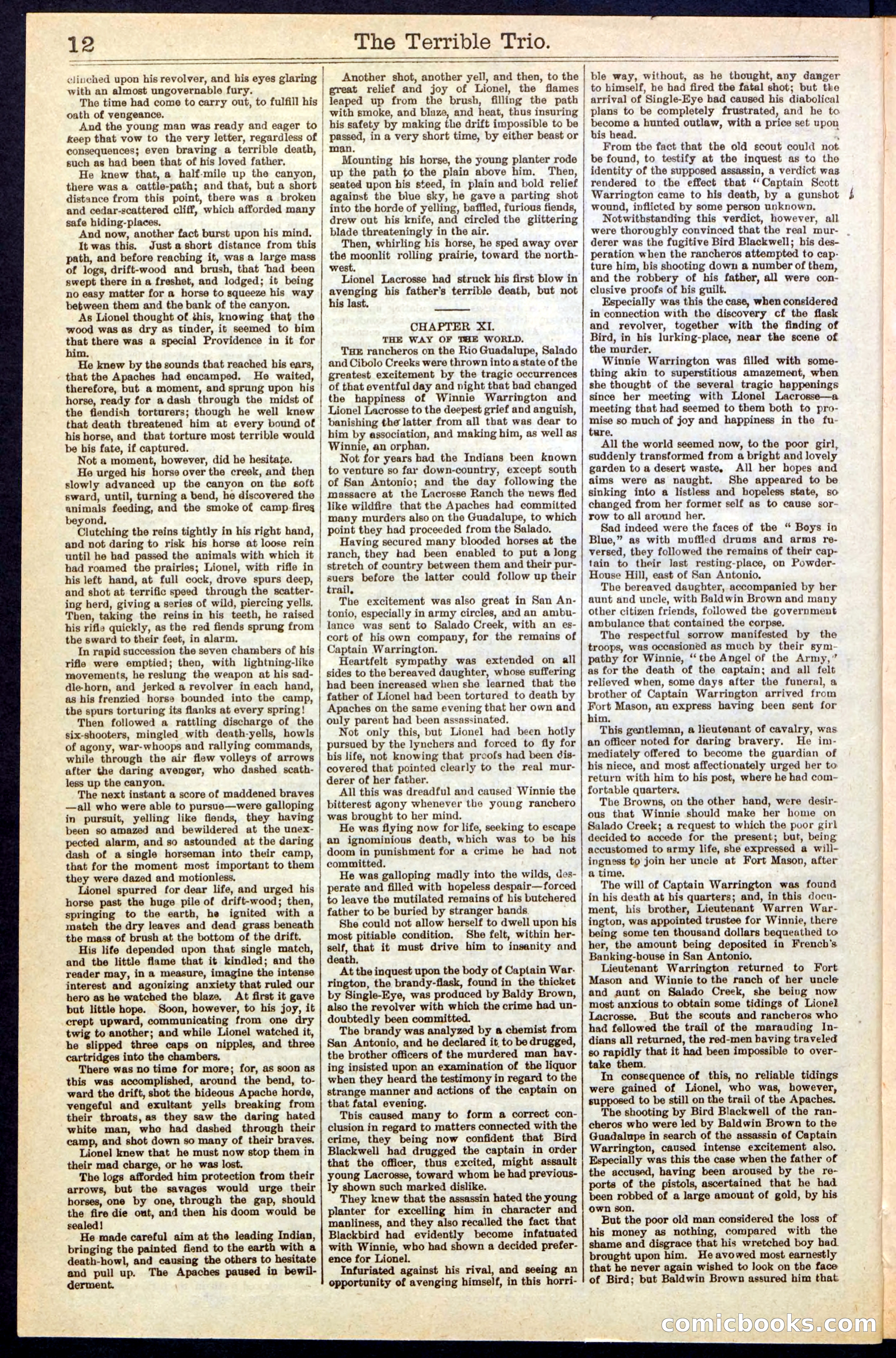
A restored page from Pulp Fiction, 1883. Page through the whole issue in the reader above.
📄 Transcribed text from this page (OCR, searchable)
Machine-transcribed from the original scan — historical spelling and the odd misread are preserved.
aa clinched upon his revolver, and his eyes glaring with an almost ungovernable fury. The time had come to carry out, to fulfill his oath of vengeance. And the young man was ready and eager to keep that vow to the very letter, regardless of consequences; even braving a terrible death, such as had been that of his loved father. He knew that, a half-mile up the canyon, there was a cattle-path; and that, but a short distance from this point, there was a broken and cedar-scattered cliff, which afforded many safe hiding-places. And now, another fact burst upon his mind. It was this. Just ashort distance from this path, and before reaching it, was a large mass of logs, drift-wood and brush, that had been swept there in a freshet, and lodged; it being no easy matter for a horse to squeeze his way between them and the bank of the canyon. As Lionel thought of this, knowing that the wood was as dry as tinder, it seemed to him that there was a special Providence in it for him. He knew by the sounds that reached his ears, - that the Apaches had encamped. He waited, therefore, but a moment, and sprung upon his horse, ready for adash through the midst of the fiendish torturers; though he well knew that death threatened him at every bound of his horse, and that torture most terrible would be bis fate, if captured. Not a moment, however, did he hesitate. He urged his horse over the creek, and then slowly advanced up the canyon on the soft sward, until, turning a bend, he discovered the animals feeding, and the smoke of camp fireg beyond. Clutching the reins tightly in his right band, avd not daring to risk his horse at loose rein until he had passed the animals with which it had roamed the prairies; Lionel, with rifle in his left hand, at full cock, drove spurs deep, and shot at terrific speed through the scatter- ing herd, giving a series of wild, piercing yells. Then, taking the reins in his teeth, he raised his rifle quickly, as the red fiends sprung from the sward to their feet, in alarm. In rapid succession the seven chambers of his rifle were emptied; then, with lightning-like movements, he reslung the weapon at his sad- dle-horn, and jerked a revolver in each hand, as his frenzied horse bounded into the camp, tbe spurs torturing its flanks at every spring! Then followed a rattling discharge of the six-shooters, mingled with death-yells, howls of agony, war-whoops and rallying commands, while through the air flew volleys of arrows after the daring avenger, who dashed scath- less up the canyon. The next instant a score of maddened braves —all who were able to pursue—were galloping in pursuit, yelling like fiends, they having been so amazed and bewildered at the unex- alarm, and so astounded at the daring dash of a single horseman into their camp, that for the moment most important to them they were dazed and motionless. Lionel spurred for dear life, and urged his horse past the huge pile of drift-wood; then, springing to the earth, he ignited with a match the dry leaves and dead grass beneath the mass of brush at the bottom of the drift. His life depended upon that single match, and the little flame that it kindled; and the reader may, in a measure, imagine the intense interest and agonizing anxiety that ruled our hero as he watched the blaze. At first it gave but little hope. Soon, however, to his joy, it crept upward, communicating from one dry twig to another; and while Lionel watched it, he slipped three caps on nipples, and three cartridges into the chambers. There was no time for more; for, as soon as this was accomplished, around the bend, to- ward the drift, shot the hideous Apache horde, vengeful and exultant yells breaking from their throats, as they saw the daring hated white man, who had dashed through their camp, and shot down so many of their braves. Lionel knew that he must now stop them in their mad charge, or he was lost. The logs afforded him protection from their arrows, but the savages would urge their horses, one by one, through the gap, should the fire die out, and then his doom would be sealed} He made careful aim at the leading Indian, bringing the painted fiend to the earth with a death-howl, and causing the others to hesitate and pull up. The Apaches paused in bewil- derment. The Terrible Trio. _—_—_—— Another shot, another yell, and then, to the great relief and joy of Lionel, the flames leaped up from the brush, filling the path with smoke, and blaze, and heat, thus insuring his safety by making the drift impossible to be passed, in a very short time, by either beast or | man. | Mounting his horse, the young planter rode 'up the path to the plain above him. Then, seated upon his steed, in plain and bold relief against the blue sky, he gave a parting shot into the horde of yelling, baffled, furious fiends, drew out his knife, and circled the glittering blade threateningly in the air. Then, whirling his horse, he sped away over the moonlit rolling prairie, toward the north- west. Lionel Lacrosse had struck his first blow in avenging his father’s terrible death, but not his last. CHAPTER XI. THE WAY OF THE WORLD. THE rancheros on the Rio Guadalupe, Salado and Cibolo Creeks were thrown into a state of the greatest excitement by the tragic occurrences of that eventful day and night that bad changed the happiness of Winnie Warrington and Lionel Lacrosse to the deepest grief and anguish, banishing the latter from all that was dear to him by association, and making him, as well as Winnie, an orphan. Not for years bad the Indians been known to venture so far down-country, except south of San Antonio; and the day following the massacre at the Lacrosse Ranch the news fled like wildfire that the Apaches had committed many murders also on the Guadalupe, to which point they had proceeded from the Salado. Having secured many blooded horses at the ranch, they had been enabled to put along stretch of country between them and their pur- suers before the latter could follow up their trail, The excitement was also great in San An- tonio, especially in army circles, and an ambu- lance was sent to Salado Creek, with an es- cort of his own company, for the remains of Captain Warrington. Heartfelt sympathy was extended on all sides to the bereaved daughter, whose suffering had been increased when she learned that the father of Lionel had been tortured to death by Apaches on the same evening that her own and ouly parent had been assassinated. Not only this, but Lionel had been hotly pursued by the lynchers and forced to fly for bis life, not knowing that proofs had been dis- covered that pointed clearly to the real mur- derer of her father. All this was dreadful and caused Winnie the bitterest agony whenever the young ranchero was brought to her mind. He was flying now for life, seeking to escape an ignominious death, which was to be his doom in punishment for a crime he had not committed. He was galloping madly into the wilds, des- perate and filled with hopeless despair—forced to leave the mutilated remains of his butchered father to be buried by stranger bands. She could not allow herself to dwell upon his most pitiable condition. She felt, within her- self, that it must drive him to insanity and death. At the inquest upon the body of Captain War. rington, the brandy-flask, found in the thicket by Single-Eye, was produced by Baldy Brown, also the revolver with which the crime had un- doubtedly been committed. The brandy was analyzed by a chemist from San Antonio, and he declared it to be drugged, the brother officers of the murdered man hav- ing insisted upon an examination of the liquor when they heard the testimony in regard to the strange manner and actions of the captain on that fatal evening. This caused many to form a correct con- clusion in regard to matters connected with the crime, they being now confident that Bird Blackwell had drugged the captain in order that the officer, thus excited, might assault young Lacrosse, toward whom he had previous- ly shown such marked dislike. They knew that the assassin hated the young planter for excelling him in character and manliness, and they also recalled the fact that Blackbird had evidently become infatuated with Winnie, who had shown a decided prefer- ence for Lionel. Infuriated against his rival, and seeing an opportunity of avenging himself, in this horri- ble way, without, as he thought, any danger to himself, he bad fired the fatal shot; but the arrival of Single-Eye bad caused his diabolical plans to be completely frustrated, and he to become a hunted outlaw, with a price set upon bis head. . From the fact that the old scout could not be found, to testify at the inquest as to the identity of the supposed assassin, a verdict was rendered to the effect that ‘‘Captain Scott Warrington came to his death, by a gunshot wound, inflicted by some person unknown, Notwithstanding this verdict, however, all were thoroughly convinced that the real mur- . derer was the fugitive Bird Blackwell; bis des- peration when the rancheros attempted to cap- ture him, bis shooting down a number of them, and the robbery of his father, all were con- clusive proofs of his guilt. Especially was this the case, when considered in connection with the discovery cf the flask and revolver, together with the finding of Bird, in his lurking-place, near the scene of the murder. Winnie Warrington was filled with some- thing akin to superstitious amazement, when she thought of the several tragic happenings since her meeting with Lionel Lacrosse—a meeting that had seemed to them both to pro- mise so much of joy and happiness in the fu- ture. All the world seemed now, to the poor girl, suddenly transformed from a bright and lovely garden to a desert waste, All her hopes and aims were as naught. She appeared to be sinking into a listless and hopeless state, so changed from her former self as to cause sor- row to all around her. Sad indeed were the faces of the “ Boys in Blue,” as with muffled drums and arms re- versed, they followed the remains of their cap- tain to their last resting-place, on Powder- House Hill, east of San Antonio, The bereaved daughter, accompanied by her aunt and uncle, with Baldwin Brown and many other citizen friends, foilowed the government ambulance that contained the corpse. The respectful sorrow manifested by the troops, was occasioned as much by their sym- pathy for Winnie, ‘‘the Angel of the Army,” as for the death of the captain; and all felt relieved when, some days after the funeral, a brother of Captain Warrington arrived from Fort Mason, an express having been sent for him. This gentleman, a lieutenant of cavalry, was an officer noted for daring bravery. He im- mediately offered to become the guardian of his niece, and most affectionately urged her to return with him to bis post, where he had com- fortable quarters. Tbe Browns, on the other hand, were desir- ous that Winnie should make her home on Salado Creek; a request to which the puor girl decided to accede for the present; but, being accustomed to army life, she expressed a will- ingness to join her uncle at Fort Mason, after a time. The will of Captain Warrington was found in his death at his quarters; and, in this docu- ment, his brother, Lieutenant Warren War- ington, was appointed trustee for Winnie, there being some ten thousand dollars bequeathed to her, the amount being deposited in French's Banking-house in San Antonio, Lieutenant Warrington returned to Fort Mason and Winnie to the ranch of her uncle and aunt on Salado Creek, she being now most anxious to obtain some tidings of Lionel Lacrosse. But the scouts and rancheros who had followed the trail of the marauding In- dians all returned, the red-men baving traveled so rapidly that it had been impossible to over- take them. In consequence of this, no reliable tidings were gained of Lionel, who was, however, supposed to be still on the trail of the Apaches. The shooting by Bird Blackwell of the ran- cheros who were led by Baldwin Brown to the Guadalupe in search of the assassin of Captain Warrington, caused intense excitement also, | Especially was this the case when the father of the accused, having been aroused by the re- ports of the pistols, ascertained that he had been robbed of a large amount of gold, by his own son. But the poor old man considered the loss of his money as nothing, compared with the shame and disgrace that his wretched boy had. brought upon him. He avowed most earnestly that he never again wished to look on the face of Bird; but Baldwin Brown assured him that EComicboo C0) (C gS} ae