
Pulp Fiction, 1883 · page 4 of 32
Beadle's Dime Library No. 237 — page 4: what you’re looking at
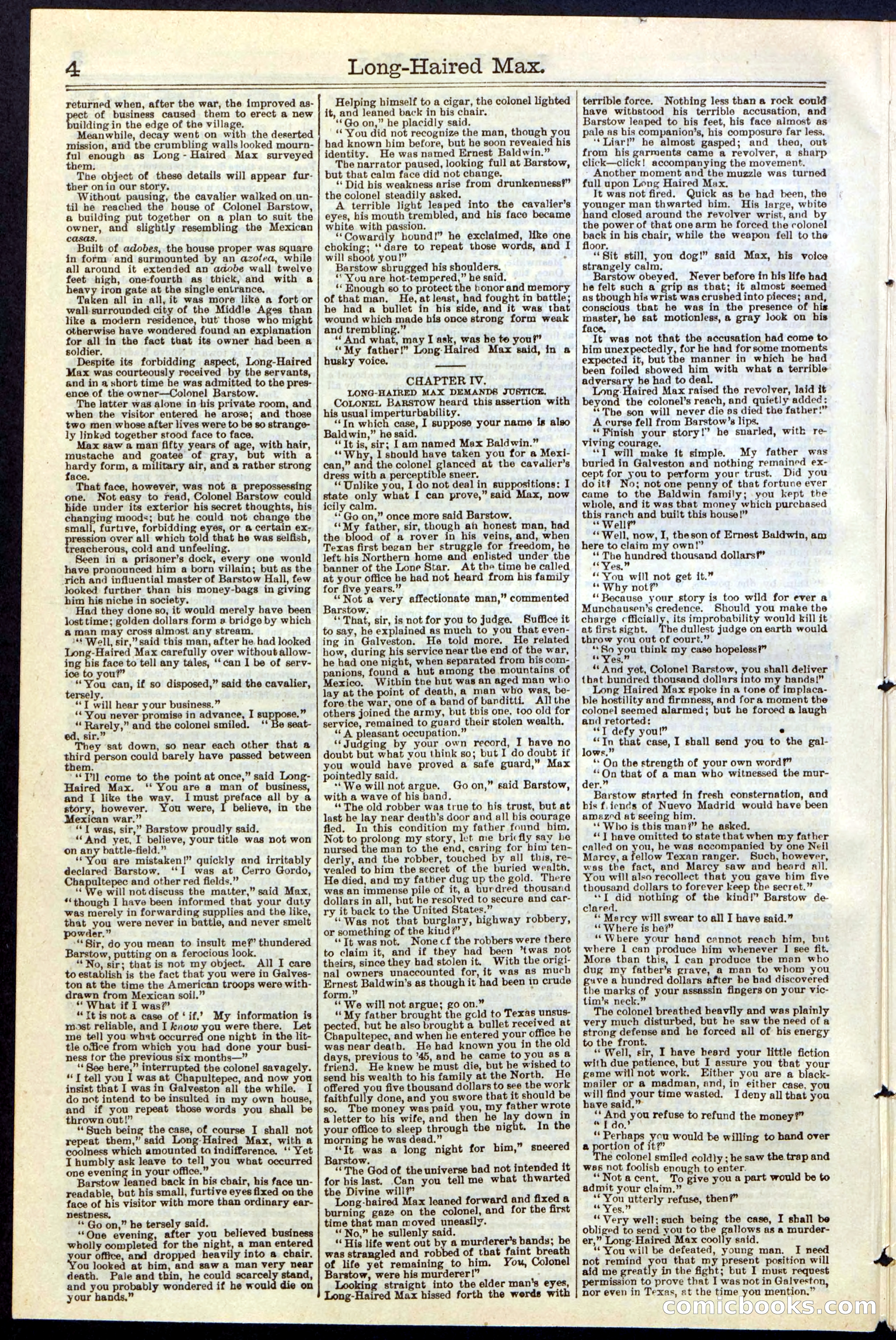
A restored page from Pulp Fiction, 1883. Page through the whole issue in the reader above.
📄 Transcribed text from this page (OCR, searchable)
Machine-transcribed from the original scan — historical spelling and the odd misread are preserved.
bs Long-Haired Max. a returned when, after the war, the improved as- t of business caused them to erect a new uilding in the edge of the village. Meanwhile, decay went on with the deserted mission, and the crumbling walls looked mourn- enough as Long- Haired Max surveyed em. The object of these details will appear fur- ther onin our story. Without pausing, the cavalier walked on un- til he reached the house of Colonel Barstow, a building ge together on a plan to suit the owner, and slightly resembling the Mexican casas. Built of adobes, the house proper was square in form and surmounted by an azofea, while all around it extended an adobe wall twelve feet high, one-fourth as thick, and with a heavy iron gate at the single entrance, Taken all in all, it was more like a fort or wall-surrounded city of the Middle Ages than like a modern residence, but those who might otherwise have wondered found an explanation for all in the fact that its owner had been a soldier. , Despite its forbidding aspect, Long-Haired Max was courteously received by the servants, and in a short time be was admitted to the pres- ence of the owner—Colonel Barstow. The latter was alone in his private room, and when the visitor entered he arose; and those two men whose after lives were to be so strange- ly linked together stood face to face, Max saw a man fifty years of age, with hair, mustache and goatee of gray, but with a hardy form, a military air, and a rather strong ace. That face, however, was not a prepossessin one. Not easy to read, Colonel Barstow coul hide under its exterior his secret thoughts, his changing moods; but he could not change the small, furtive, forbidding eyes, or a certain ex- ression over all which told that he was selfish, reacherous, cold and unfeeling. Seen in a prisoner’s dock, every one would have pronounced him a born villain; but as the ich and influential master of Barstow Hall, few looked further than bis money-bags in giving him his niche in society. Had they done s0, it would merely have been lost time; golden dollars form a. bridge by which a man may cross almost any stream. '¢ Well, sir,” said this man, after he. had looked Long-Haired Max carefully over without allow- ing his face to tell any tales, ‘‘can I be of serv- ice to you?” pla Sie can, if so disposed,” said the cavalier, rsely. “‘T will hear your business.” ‘You never promise in advance, I ee, a: Rarely,” and the colonel smiled. ‘‘ Be seat- » OLE They sat down, so near each other that a pt person could barely have passed between em. '*T1) come to the point at once,” said Long- Haired Max. ‘‘ You are a man of business, and I like the way. I must eee all by a story, however. You were, I believe, in the Mexican war.” ‘*l was, sir,” Barstow proudly said. “And yet, I believe, your title was not won on — battle-field.” ‘*You are mistaken!” quickly and irritably declared Barstow, ‘‘I was at Cerro Gordo, Chapultepec and other red fields.” ‘“ We will not discuss the matter,” said Max, *‘though I have been informed that your duty was merely in forwarding supplies and the like, that you were never in battle, and never smelt powder.” “Sir, do you mean to insult mef’ thundered Barstow, putting on a ferocious look. “No, sir; that is not my object. All I care to establish is the fact that you were in Galves- ton at the time the American troops were with- drawn from Mexican soil.” ** What if I was?” “Tt is nota case of ‘if.’ My information is most reliable, and I know you were there. Let me tell you what occurred one night in the lit- tle ofice from which you had done your busi- ness for the previous six months—” ‘‘ See here,” interrupted the colonel savagely. **T tell you I was at Chapultepec, and now you insist that I was in Galveston all the while. I do net intend to be insulted in my own house, and if you repeat those words you shall be thrown out!” ‘Such being the case, of course I shall not repeat them,” said ere. Forse Max, with a coolness which amounted to indifference, ‘‘ Yet IT humbly ask leave to tell you what occurred one evening in your office.” Barstow leaned back in bis chair, his face un- readable, but his small, furtive eyes fixed on the face of his visitor with more than ordinary ear- nestness, ‘““ Go on,” he tersely said. “One evening, r you believed business wholly completed for the night, a man entered our office, and dropped heavily into a chair. ou looked at him, and saw a man very near death. Pale and thin, he could scarcely stand, and you probably wondered if he would die on your hands,” Helping himself to a cigar, the colonel lighted it, and leaned back in bis chair. ‘*Go on,” he placidly said. ‘You did not recognize the man, though you bad known him before, but he soon revealed his identity. He was named Ernest Baldwin.” The narrator paused, looking full at Barstow, but that calm face did not change, ‘‘ Did his weakness arise from drunkenness?” the colonel steadily asked. A terrible light leaped into the cavalier’s eyes, his mouth trembled, and his face became white with passion. ‘‘Cowardly bound!” he exclaimed, like one choking; ‘‘dare to repeat those words, and I will shoot you!” . Barstow shrugged his shoulders. “You are hot-tempered,” he said. ‘« Fnough so to protect the bonorand memo of that man. He, at least, had fought in battle; be had a bullet in his side, and it was that wound which made his once strong form weak and trembling.” ‘¢ And what, may I ask, was he to you?” ‘““My father!” Long-Haired Max said, in a husky voice, CHAPTER IV. LONG-HAIRED MAX DEMANDS JUSTICE, CoLONEL BaRSTOW heard this assertion with his usual imperturbability. ‘‘In which case, I suppose your name is also Baldwin,” he said. “Tt is, sir; | am named Mex Baldwin.” ‘*Why, 1 should have taken you for a Mexi- can,” and the colonel glanced at the cavalier’s dress with a perceptible sneer. ‘Unlike you, I do not dealin suppositions: I state only what I can prove,” said Max, now icily calm. ‘“Go on,” once more said Barstow. : father, sir, though ah honest man, had the blood of a rover in his veins, and, when Texas first began her struggle for freedom, he left his Northern home and enlisted under the banner of the Lone Star. At the time he called at your office be had not heard from his family for five years.” ““Not a very affectionate man,” commented Barstow. ‘‘That, sir, is not for you to judge. Buffice it to say, he explained as much to you that even- ing in Galveston. He told more. He related how, during his service near the end of the war, he had one night, when separated from bis com- anions, found a hut among the mountains of 7 Witbin the hut was an aged man who lay at the point of death, a man who was, be- fore the war, one of a band of banditti. All the others joined the army, but this one, too old for service, remained to guard their stolen wealth. “A pleasant occupation.” ‘Judging by your own record, I have no doubt but what vou think so; but I do doubt if you would bave proved a safe guard,” Max pointedly said. **We will not argue. with a wave of his band. ‘‘ The old robber was true to his trust, but at last he lay near deuth’s door and all bis courage fled. In this condition my father found bim. Not to prolong my story, let me bricfly say be nursed the man to the end, caring for him ten- derly, and the robber, touched by all this, re- vealed to him the secret of the buried wealth. He died, and my father dug up the gold. There was an immense pile of it, a burdred thousand dollars in all, but he resolved to secure and Car- ry it back to the United States.” ‘“Was not that burglary, highway robbery, or something of the kiud?” “Tt was not. Nonecf the robbers were there to claim it, and if they had been *twas not theirs, since they bad stolen it. With the origi- nal owners unaccounted for, it was as much Ernest Baldwin’s as though it had been in crude form.” “We will not argue; go on.” “My father brought the gold to Texas unsus- pected, but he also brought a bullet received at Chapultepec, and when he entered your offices he was near death. He had known you in the old days, previous to ’45, and he came to you as & friend. He knew be must die, but he wished to send bis wealth to his family at the North. He offered you five thousand dollars to see the work faithfully done, and you swore that it should be so. The money was paid you, my father wrote a letter to his wife, and then he lay down in your office to sleep through the night. In the morning he was dead.” pale “It was a long night for him,” sneered Barstow. “The God of the universe bad not intended it for his last. .Can you tell me what thwarted the Divine will?” Long-haired Max leaned forward and fixed a burning gaze on the colonel, and for the first time that man moved uneasily. “No,” he sullenly said. “ His life went out by a murderer’s bands; he was strangled and robbed of that faint breath of life yet remaining to him. You, Colonel Barstow, were his murderer!” , Heng straight into the elder man’s eyes, Long- Go on,” said Barstow, Max hissed forth the werds with terrible force. Nothing less than a rock could have withstood his terrible accusation, and Barstow leaped to his feet, his face almost as pale as his companion’s, his composure far less, ‘*Liar?’ he almost gasped; and theo, out from his garments came a revolver, a sharp click—click! accompanying the movement. Another moment and the muzzle was turned full upon Long Haired Max. It was not fired. Quick as he had been, the younger man thwarted bim. His large, white and closed around the revolver wrist, and by the power of that one arm he forced the colonel back in his chair, while the weapon fell to the oor. “Sit still, you dog!” said Max, his voice strangely calm. Barstow obeyed. Never before in his life had he felt such a grip as that; it almost seemed as though his wrist was crusbed into pieces; and, conscious that he was in the presence of his pe he sat motionless, a gray look on his ace, It was not that the accusation had come to him unexpectedly, for he had for some moments expected it, but the manner in which he had been foiled showed him with what a terrible adversary he had to deal. Long-Haired Max raised the revolver, laid it beyond the colonel’s reach, and quietly added; “The son will never die os died the father!” A curse fell from Barstow’s lips. ‘Finish your story!’ he snarled, with re- viving courage. ‘‘T will make it simple. My father was buried in Galveston and nothing remained ex- cept for you to perform your trust. Did you doit? No; not one penny of that fortune ever came to the Baldwin family; you kept the whole, and it was that money which purchased this ranch and built this house!” “Well?” ‘* Well, now, I, theson of Ernest Baldwin, am here to claim my own!” *s The hundred thousand dollars?” ‘You will not get it.” ‘* Why not?” ‘‘Because your story is too wild for ever a Munchausen’s credence. Should you make the charge Baign its improbability would kill it at first sight. The dullest judge on earth would throw you out of court.” ‘So you think my case hopeless?” te ag ; ** And yet, Colonel Barstow, you shall deliver that bundred thousand dollars into my hands!” Long Haired Max spoke in a tone of implaca- ble hostility and firmness, and fora moment the colonel seemed alarmed; but he forced a laugh and retorted: “*T defy you!” » ‘‘TIn that case, I shall send you to the gal- lows,” ‘* On the strength of your own word?” 4 “On that of a man who witnessed the mur- er. Barstow started in fresh consternation, and bis f.iencs of Nuevo Madrid would have been amazed at seeing him. ‘‘ Who is this man?” he asked. ‘‘T have omitted to state that when my father called on you, he was accompanied by one Neil Marcy, a fellow Texan ranger. Such, however, was the fact, and Marcy saw and heard all. You will also recollect that you gave him five thousand dollars to forever keep the secret.” ‘“*I did nothing of the kind!” Barstow de- clared. ** Mercy will swear to all I have said.” ‘* Where is he?” ‘“Where your hand cannot reach him, but where 1 can produce him whenever I see fit. More than this, I can produce the man who dug my father’s grave, a man to whom you guve a hundred dollars after be had discovered the marks of your assassin fingers on your vic- tim’s neck.” The colonel breathed heavily and was plainly very much disturbed, but he saw the need of a strong defense and he forced all of his energy to the front. ‘* Well, sir, I have heard your little fiction with due patience, but I assure you that your game will not work, Either you are a black- mailer or a madman, and, in either case, you will find your time wasted. I deny all that you have said,” o pit you refuse to refund the money?” , 0 “Perhaps you would be willing to band over a portion of it?” he colonel smiled coldly ; he saw the trap and was not foolish enough to enter. “Not acent. To give you a part would be to admit your claim.” ‘* You utterly refuse, then?” “ Yes ” “Very well; such being the case, I shall be obliged to send you to the gallows as a murder- er,” Long-Haired Max coolly said. ‘You will be defeated, young man. I need not remind you that my present position will aid me greatly in the fight; but I must request permission to prove that I was not in Galveston nor even in Texas, at the time you mention.” COMGIOOKS (EO)