
Pulp Fiction, 1883 · page 23 of 32
Beadle's Dime Library No. 237 — page 23: what you’re looking at
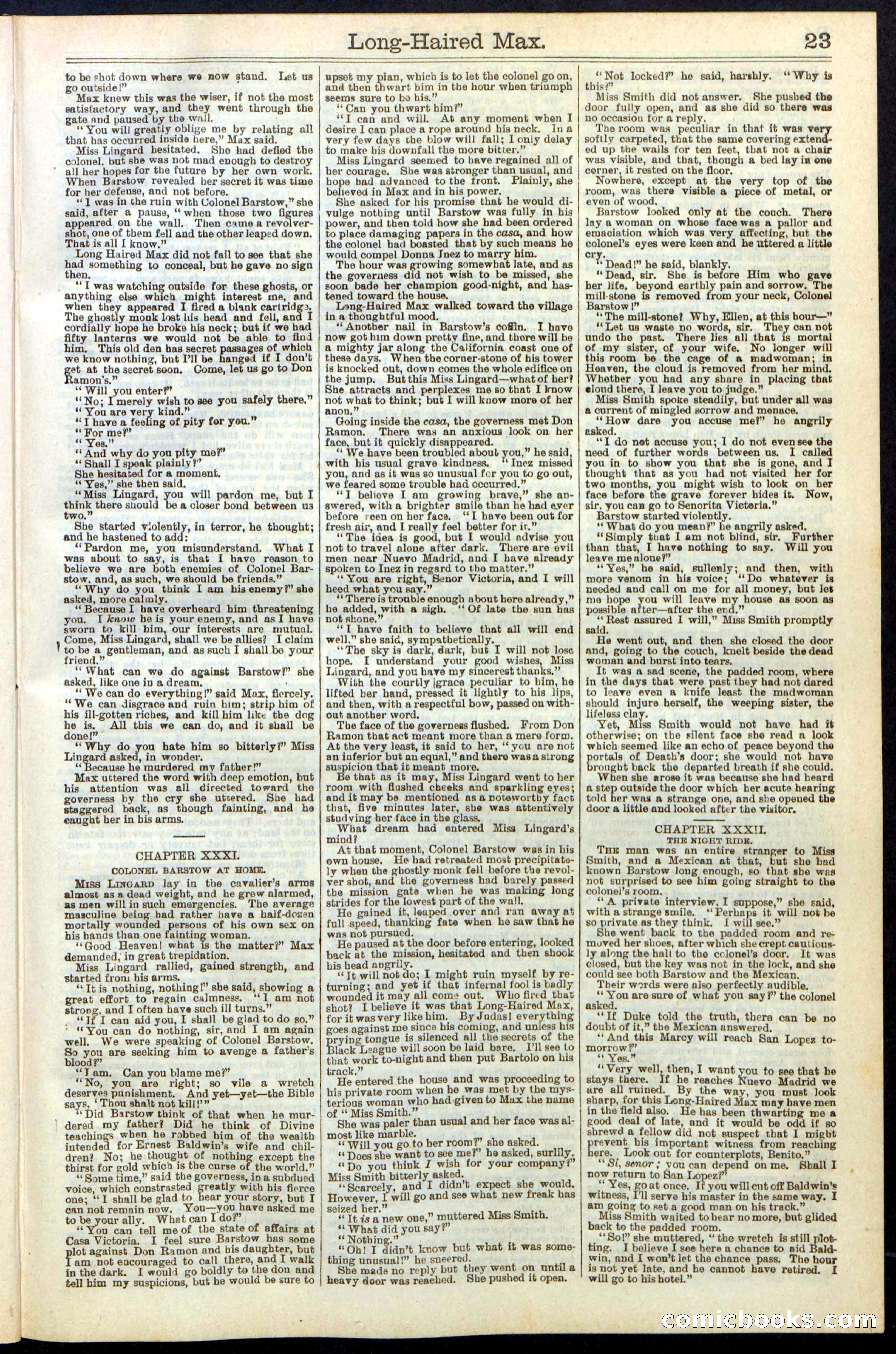
A restored page from Pulp Fiction, 1883. Page through the whole issue in the reader above.
📄 Transcribed text from this page (OCR, searchable)
Machine-transcribed from the original scan — historical spelling and the odd misread are preserved.
er eer 8 -_- to be shot down where we now stand. Let us go outside!” , Max knew this was the wiser, if not the most satisfactory way, and they went through the gate and paused by the wail, ‘You will greatly oblige me by relating all that; has occurred inside here,” Max said. Miss Lingard hesitated. She had defied the colonel, but she was not mad enough to destroy ‘ all her hopes for the future by her own work. When Barstow revealed her secret it was time for her defense, and not before. ‘] was in the ruin with Colonel Barstow,” she said, after a pause, “when those two figures appeared on the wall, Then came a revolver- shot, one of them fell and the other leaped down, That is all I know.” Long Haired Max did not fail to see that she ae something to conceal, but he gave no sign en. ‘I was watching outside for these ghosts, or “anything else which might interest me, and — when they appeared I fired a blank cartridg>. The ahostie monk lost his head and fell, and I cordially hope he broke his neck; but if we had fifty lanterns we would not be able to find him. This old den has secret ges of which we know nothing, but I’ll be hanged if I don’t et at the secret soon, Come, let us go to Don amon’s,”’ ‘Will you enter?” ‘“No; I merely wish to see you safely there,” ‘* You are very kind.” *‘T have a feeling of pity for you.” ‘For me?” a Yes,” ‘‘ And why do you pity me?” ‘‘ Shall I speak plainly?” She hesitated for a moment, ‘* Yes,” she then said, ‘Miss Lingard, ey will pardon me, but I on there should be a closer bond between us wo. She started voleney> in terror, he thought; and he hastened to add: ‘Pardon me, you misunderstand. What I was about to say, is that I have reason to believe we are both enemies of Colonel Bar- stow, and, as such, we should be friends,” ‘“Why do you think I am his enemy?” she asked, more calmly. ‘* Because I have overheard him threatening you. I know beis your enemy, and asI have sworn to kill him, our interests are mutual. Come, Miss Lingard, shall we be allies? I claim to be a gentleman, and as such I shall be your friend.” ‘* What can we do against Barstow?” she asked, like one ip a dream, ‘* We can do everything!” said Max, fiercely. ‘““We can disgrace and ruin him; strip him of his ill-gotten riches, and kill him like the dog he is, All this we can do, and it shall be done!” ‘ Why do yon hate him so bitterly?’ Miss Lingard asked, in wonder. ‘‘ Because he murdered my father!” Max uttered the word with deep emotion, but his attention was all directed toward the governess by the cry she uttered. She had staggered back, as though fainting, and hoe eaught ber in bis arms. CHAPTER XXXI. COLONEL BARSTOW AT HOME. Miss LinGarp lay in the cavalier’s arms almost as a dead weight, and he grew alarmed, as wen willin such emergencies. The average masculine being bad rather have a haif-dozen mortally wounded persons of his own sex on his bands than one fainting woman. ‘‘Good Heaven! what is the matter?” Max demanded, in great trepidation. Miss Lingard rallied, gained strength, and started from bis arms. “Tt is nothing, nothing!” she said, showing a great effort to regain calmness. ‘I am not strong, and I often have such ill turns.” ane i'l can aid you, I shall be glad to do so,” ‘ You can do nothing, sir, and I am again well. We were speaking of Colonel Barstow, So you are seeking him to avenge a father’s blood?” “Tam. Can you blame me?” “No, you are right; so vile a wretch deserves punishment. And yet—yet—the Bible says, ‘ Thou shalt not kill!’” ‘Did Barstow think of that when he mur- | dered my father? Did he think of Divine teachings when he robbed him of the wealth intended for Ernest Baldwin’s wife and chil- dren? No; he thought of betting except the thirst for gold which is the curse of the world.” ‘Some time,” said the governess, ina subdued voice, which constrasted greatly with bis fierce one; “I shall be glad to hear your story, but I can not remain now. You—you have asked me to be your ally, What can I do?” “Yon can tell meof the state of affairs at Casa Victoria. I feel sure Barstow has some lot against Don Ramon and bis daughter, but 4 am not encouraged to call there, and I walk in the dark. I would go boldly to the don and tell him my suspicions, but he would be sure to ——$_——_ Long-Haired Max. EI upset my pian, which is to let the colonel go on, and then thwart bim in the hour when triumph seems sure to be bis.” “Can you thwart him?” ‘“T can and will. At any moment when I desire I can place a rope around his neck. Ina very few days the blow will fall; 1 only delay to make bis downfall the more bitter.” Miss Lingard seemed to bave regained all of her courage. She was stronger than usual, and hope bad advanced to the front. Plainly, she believed in Max and in bis power. She asked for his promise that he would di- vulge notbing until Barstow was fully in his power, and then told how she had been ordered to place damaging papers in the casa, and how the colonel had boasted that by such means he would compel Donna Jnez to marry him. The hour was growing somewhat late, and as the governess did not wish to be missed, she soon bade her champion good-night, and has- tened toward the house, Long-Haired Max walked toward tho village in a thonghtful mood. “‘ Another nail in Barstow’s coffin. I have now got him down pretty fine, and there will be a mighty jar along the California coast one of these days. When thecorner-stone of his tower is knocked out, down comes the whole edifice on the jump. Butthis Miss Lingard—whatof her? She attracts and perplexes me so that I know not what to think; but I will know more of her anon,” Going inside the casa, the governess met Don Ramon. There was an anxious look on her face, but it quickly a a poe “ We have been troubled about ou,” he said, with his usual grave kindness. ‘‘ Inez missed you, and as it was so unusual for you to go out, we feared some trouble had occurred.” ‘*T believe I am growing brave,” she an- swered, witha brighter smile than he had ever before seen on her face. ‘I have been out for fresh air, and [ really feel better for ir.” ‘The idea is good, but I would advise you not to travel alone after dark. There are evil men near Nuevo Madrid, and I bave already spoken to Inez in regard to the matter.” ‘* You are right, Senor Victoria, and I will heed what you say.” ‘‘ There is trouble enough about hore already,” he added, with a sigh. ‘‘ Of late the sun has not shone,” ‘‘L have faith to believe that all will end well,” she saic, sympathetically. ‘‘The sky is dark, dark, but I will not lose hope. I understand your good wishes, Miss Lingard, and you have my sincerest thanks.” With the courtly jgrace peculiar to bim, he lifted ber hand, pressed it lightly to his lips, and then, with a respectful bow, passed on with- out another word. The face of the governess flushed. From Don Ramon that act meant more than a mere form. At the very least, it said to her, ‘‘ you are not an inferior but an equal,” and there wasa strong suspicion that it meant more. e that as it may, Miss Lingard went to her room with flushed cheeks and sparkling eyes; and it may be mentioned as a notewortby fact that, five minutes later, she was attentively studying her face in the glass. What dream had entered Miss Lingard’s mind? At that moment, Colonel Barstow was in bis own house. He had retreated most precipitate- ly when the ghostly monk fell before the revol- ver shot, and the governess had barely passed the mission gate when he was making long strides for the lowest part of the wall. He gained it, leaped over and ran away at full speed, thanking fate when he saw that he was not pursued. ; He paused at the door before entering, looked back at the x oni hesitated and then shook bis head angrily. ‘1 will nob do; I might ruin myself by re- turning; and yet if that infernal fool is badly wounded it may all come out. Who fired that shot? I believe it was that Long-Haired Max, for itwasvery likehim. ByJudas! everything goes against me since his coming, and unless his rying tongue is silenced all the secrets of the Black League will soon be laid bare, Ill see to that work to-night and then put Bartolo on his track.” He entered the house and was proceeding to his private room when he was met by the mys- terious woman who had given to Mux the name ‘‘ Miss Smith.” oN phe was paler than usual and her face was al- most like marble. ‘Will you go to her room?” she asked. ‘‘ Does she want to see me?” he asked, surlily. “Do you think J wish for your company?!” Miss Smith bitterly asked. “Searcely, and I didn’t expect she would. However, I will go and see what new freak has seized her.” ‘It is a new one,” muttered Miss Smith, uc What did you say?” otbing.’ “ On! T ajdn’t know but what it was some- thing unusual!” he sneered. 4 She made no reply but they went on until a heavy door was reached. She pushed it open. 23 “Not locked?’ he said, harshly. ‘ Why is this?” Miss Smith did not answer. She pushed the door fully open, and as she did so there was no occasion for a reply. The room was peculiar in that it was ve softly carpeted, that the same covering exten ed up the walls for ten feet, that not a chair was visible, and that, though a bed lay im one corner, it rested on the floor, Nowhere, except at the very top of the room, was there visible a piece of metal, or even of wood, Barstow looked only at the couch. There lay a woman on whose face was a pallor and emaciation which was very affecting, but the colonel’s eyes were keen and he uttered a little cry. v Dead!” he said, blankly. “Dead, sir. She is before Him who gave ber life, beyond earthly pain and sorrow, The mill-stone is removed from your neck, Colonel Barstow |” “The mill-stone? Why, Ellen, at this bour—” *‘Let us waste no words, sir. They can not undo the past. There lies all that mortal of my sister, of your wife. No longer will this room be the cage of a madwoman,; in Heaven, the cloud is removed from her mind. Whetber you had any share in placing that eloud there, I leave you to judge.” Miss Smith spoke steadily, but under all was a current of mingled sorrow and menace, ‘“‘How dare you accuse mef” he angrily asked. ‘*I do net accuse you; I do not evensee the need of further words between us. I called you in to show you that she is gone, and I thought that as you had not visited her for two months, you might wish to look on her face before the grave forever hides it. Now, sir, you can go to Senorita Victoria,” Barstow started violently. ‘* What do you mean?” he angrily asked. “Simply that I am not blind, sir. Further than that, I have nothing to say. ill you leave me alone?” “Yes,” he said, sullenly; and then, with more venom in his voice; ‘‘Do whatever is needed and call on me for all money, but let me ho ou will leave my house as soon as possible after—after the end.” Seas assured I will,” Miss Smith promptly said, He went out, and then she closed the door and, going to the couch, knelt beside the dead woman and burst into tears. It was a sad scene, the padded room, where in the days that were past they had not dared to leave even a knife least the madwoman should injure herself, the weeping sister, the lifeless clay. Yet, Miss Smith would not have had it otherwise; on the silent face she read a look which seemed like an echo of peace beyond the ortals of Death's door; she would not have rougbt back the departed breath if she could. When she arose it was because she had heard a step outside the door which her acute hearing told her was a strange one, and she opened the door a little and looked after the visitor. CHAPTER XXX, THE NIGHT RIDE. THE man was an entire stranger to Miss Smith, and a Mexican at that, but she had known Barstow long enough, so that she was not surprised to see him going straight to the colonel’s room. “‘A private interview, I suppose,” she said, with a strange smile, ‘Perhaps it will not be so private as they think. I will see.” She went back to the padded room and re- moved her shoes, after which she crept cautious- ly along the hall to the colonel’s door, It was closed, but the key was not in the lock, and she could see both Barstow and the Mexican. Their words were also perfectly audible, ‘You are sure of what you say?” the colonel asked. “*If Duke told the truth, there can be no doubt of it,” the Mexican answered, ‘* And this Marcy will reach San Lopez to- morrow?” “Very well, th I ‘Very we en, 1 want you to see that he stays there. If he reaches Nuevo Madrid we ure all ruined. By the wa sharp, for this Long-Haired Max may have men in the field also. He has been thwarting me a good deal of late, and it would be odd if so shrewd a fellow did not suspect that I might revent bis important witness from reaching ere. | Look out for counterplots, Benito.” Si, senor ; you can depend onme, Shall I now return to San Lopez? ‘Yes, goat once. If you will ent off Baldwin’s witness, I'll serve his master in the same way. I am going to set a good man on his track.” Miss Smith waited to hear no more, but glided back to the padded room. ‘**So!” she muttered, “the wretch is still plot- ting. I believe I see here a chance to aid Bald- win, and I won’t let the chance pass, The hour is not yet late, and he cannot have retired. I will go to his hotel.” » you must look aMliceloyeyve) (E(0) (C <SiG (0)