
Pulp Fiction, 1883 · page 20 of 32
Beadle's Dime Library No. 237 — page 20: what you’re looking at
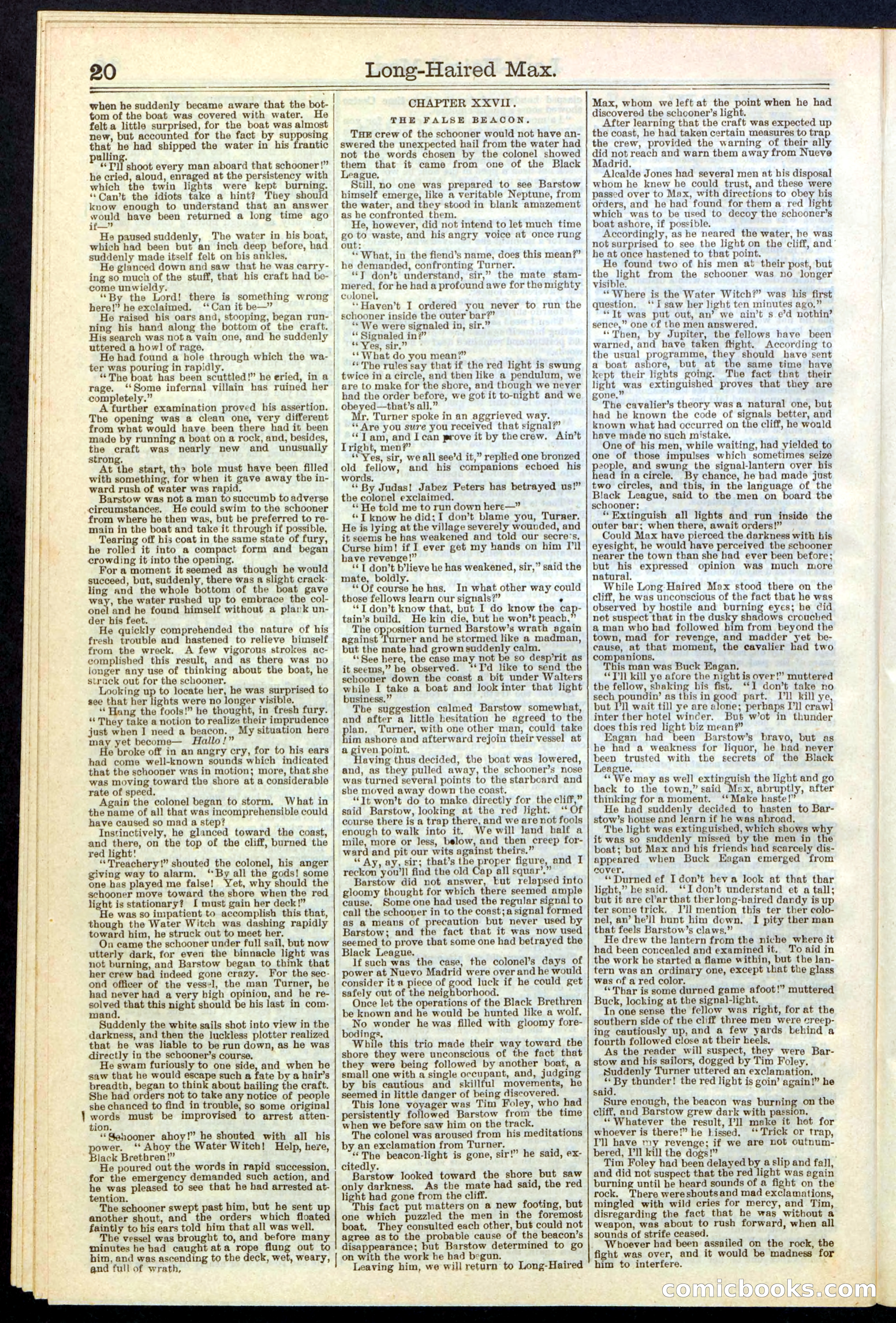
A restored page from Pulp Fiction, 1883. Page through the whole issue in the reader above.
📄 Transcribed text from this page (OCR, searchable)
Machine-transcribed from the original scan — historical spelling and the odd misread are preserved.
“ SS ree ee ee ee ee 20 when he suddenly became aware that the bot- | tom of the boat was covered with water. He felt a little surprised, for the boat was almost new, but accounted for the fact by supposing that he had shipped the water in his frantic pa ‘‘T’]] shoot every man aboard that schooner!” he cried, aloud, enraged at the persistency with which the twin lights were kept Late ‘‘Can’t the idiots take a hint? They should know enough to understand that an answer sone have been returned a long time ago i Fa He paused suddenly, The water in his boat, which had been but an inch deep before, had suddenly made itself felt on bis ankles, He glanced down and saw that he was carry- ing so much of the stuff, that his craft had be- come unwieldy. ‘‘By the Lord! there is something wrong bere!” he exclaimed. ‘Can it be—” He raised his oars and, stooping, began run- ning his hand along the bottom of the craft. His search was not a vain one, and he suddenly uttered a how! of rage. He had found a hole through which the wa- ter was pouring in rapidly. “The boat has been scuttled!” he eried, in a rage. ‘‘Some infernal villain has ruined her completely.” A further examination proved his assertion. The opening was a clean one, very different from what would have been there had it been made by running a boat on a rock, and, besides, the craft was nearly new and unusually strong. At the start, the bole must have been filled with something, for when it gave away the in- ward rush of water was rapid. Barstow was not a man to succumb to adverse circumstances. He could swim to the schooner from where he then was, but be preferred to re- main in the boat and take it through if possible. Tearing off his coat in the same state of fury, he rolled it into a compact form and began crowding it into the opening. For a moment it seemed as though he would succeed, but, suddenly, there was a slight crack- ling and the whole bottom of the boat gave way, the water rushed up to embrace the col- onel and he found himself without a plank un- der his feet. He quickly comprehended the nature of his fresh trouble and hastened to relieve bimself from the wreck. A few vigorous strokes ac- complished this result, and as there was no longer any use of thinking about the boat, he strack out for the schooner, Looking ep to locate her, he was surprised to see that her lights were no longer visible. “ Hang the fools!” he thought, in fresh fury. ‘‘ They take a notion to realize their imprudence just when I need a beacon. My situation here may yet become— Hallo!” e broke off in an angry cry, for to his ears had come well-known sounds which indicated that the schooner was in motion; more, that she was moving toward the shore at a considerable rate of speed. Again the colonel began to storm, What in the name of all that was incomprehensible could have caused so mad a step? Instinctively, he glanced toward the coast, and there, on the top of the cliff, burned the red light! ‘*Treachery!” shouted the colonel, his anger giving way to alarm. ‘“ By all the gods! some one has played me false! Yet, why should the schooner move toward the shore when the red light is stationary? I must gain her deck!” He was so impatient to accomplish this that, though the Water Witch was dashing rapidly toward him, he struck out to meet her. On came the schooner under full sail, but now utterly dark, for even the binnacle light was not burning, and Barstow began to think that her crew bad indeed gone crazy. Yor the sec- ond officer of the vessel, the man Turner, he had never had a very bigh opinion, and he re- solved that this night should be his last in com- mand. Suddenly the white sails shot into view in the darkness, and then the luckless plotter realized that he was liable to be run down, as he was directly in the schooner’s course. He swam furiously to one side, and when he saw that he would escape such a fate by a hair’s breadth, began to think about hailing the craft. She had orders not to take any notice of people she chanced to find in trouble, so some original } words must be improvised to arrest atten- tion. ‘‘Sahooner ahoy!” he shouted with all his wer. ‘*Aboy the Water Witch! Help, here, lack Bretbren!” ; He poured out the words in rapid succession, for the emergency demanded such action, and he was pleased to see that he had arrested at- tention. The schooner swept past him, but he sent up another shout, and the orders which floated faintly to bis ears told him that all was well. The vessel was brought to, and before many minutes he bad caught ata rope flung out to him, and was ascending to the deck, wet, weary, and full of wrath, LLL LBLLL LL LL aaa Long-Haired Max. CHAPTER XXVII. THE FALSE BEACON, Tue crew of the schooner would not have an- swered the unexpected hail from the water had not the words chosen by the colonel showed them that it came from one of the Black League, Still, no one was prepared to see Barstow himself emerge, like a veritable Neptune, from the water, and they stood in blank amazement as he confronted them. He, however, did not intend to let much time go to waste, and his angry voice at once rung out: ‘‘ What, in the fiend’s name, does this mean?” he demanded, confronting Turner. “J don’t understand, sir,” the mate stam- mered, for he had a profound awe for the mighty colonel. ‘*Haven’t I ordered you never to run the schooner inside the outer bar?’ ‘** We were signaled in, sir.” ** Signaled in?’ Yes, ar.” ‘* What do you mean?” ‘* The rules say that if the red light is swung twice in a circle, and then like a pendulum, we are to make for the shore, and though we never had the order before, we got it to-night and we obeyed—that’s all.” Mr, Turner spoke in an aggrieved way. “ Are you sure you received that signal?” ‘“T am, and I can prove it by thecrew, Ain’t Tright, men?” ‘Yes, sir, we all see’d it,” replied one bronzed old fellow, and his companions echoed his words. ‘‘ By Judas! Jabez Peters has betrayed us!” the colonel exclaimed. ‘He told me to run down here—” ‘T know he did; I don’t blame you, Turner. He is lying at the village severely wounded, and it seems he has weakened and told our secre‘s, Curse him! if I ever get my hands on him Pll have revenge!” ‘¢ | don’t b’lieve he has weakened, sir,” said the mate, boldly. *“Of course he has. In what other way could those fellows learn our signals?” ° ‘*T don’t know that, but I do know the cap- tain’s build. He kin die, but he won’t peach.” The opposition turned Barstow’s wrath again against Turner and he stormed like a madman, but the mate had grown suddenly calm. ‘See here, the case may not be so desp’rit as it seems,” he observed. ‘‘I’d like to send the schooner down the coast a bit under Walters while I take a boat and look inter that light business.” The suggestion calmed Barstow somewhat, and after a little hesitation he agreed to the pian Turner, with one other man, could take im ashore and afterward rejoin their vessel at a given point. javing thus decided, the boat was lowered, and, as they pulled away, the schooner’s nose was turned several points to the starboard and she moved away down the coast. ‘‘It won’t do to make directly for the cliff,” said Barstow, looking at the red Jight. ‘Of course there is a trap there, and we are not fools enough to walk into it. We will land half a mile, more or less, below, and then creep for- ward and pit our wits against theirs.” “ Ay, ay, sir; that’s the proper figure, and I reckon you'll find the old Cap all squar’.” Barstow did not answer, but relapsed into gloomy thought for which there seemed ample cause. Some one had used the regular signal to call the schooner in to the coast; a signal formed as a means of precaution but never used by Barstow; and the fact that it was now used seemed to prove that some one had betrayed the Black League. If such was the case, the colonel’s days of power at Nuevo Madrid were over and he would consider it a piece of good luck if he could get safely out of the neighborhood. Once let the operations of the Black Brethren be known and he would be hunted like a wolf. No wonder he was filled with gloomy fore- bodings. While this trio made their way toward the shore they were unconscious of the fact that they were being followed by another boat, a small one with a single occupant, and, judging by bis cautious and skillful movements, he seemed in little danger of being discovered. This lone voyager was Tim Foley, who had persistently followed Barstow from the time when we before saw him on the track, The colonel was aroused from his meditations by an exclamation from Turner, : “The beacon-light is gone, sir!” he said, ex- citedly. Barstow looked toward the shore but saw only darkness. As the mate had said, the red light had gone from the cliff. ‘ This fact put matters on a new footing, but one which puzzled the men in the foremost boat. They consulted each other, but could not agree as to the probable cause of the beacon’s disappearance; but Barstow determined to go |. on with the work he had begun. - Leaving him, we will return to Long-Haired Max, whom we left at the point when he had discovered the schooner’s light. After learning that the craft was expected up the coast, he had taken certain measures to trap the crew, provided the warning of their ally did not reach and warn them away from Nueve Madrid. Alcalde Jones had several men at his disposal whom he knew he could trust, and these were passed over to Max, with directions to obey his orders, and he had found for them a red light which was to be used to decoy the schooner’s boat ashore, if possible. Accordingly, as he neared the water, he was not surprised to see the light on the cliff, and’ he at once hastened to that point. He found two of his men at their post, but the light from the schooner was no longer visible. “Where is the Water Witch?” was his first question. ‘I saw her light ten minutes ago,” “It was put out, an’ we ain’t s e’d nothin’ sence,” one of the men answered, “Then, by Jupiter, the fellows have been warned, and have taken flight. According to the usual programme, they should have sent a boat ashore, but at the same time have kept their lights going. The fact that their light was extinguished proves that they are gone,” The cavalier’s theory was a natural one, but had be known the code of signals better, and known what had occurred on the cliff, he would have made no such mistake. One of his men, while waiting, had yielded to one of those impulses which sometimes seize porns and swung the signal-lantern over his ead in acirele. By chance, he had made just two circles, and this, in the language of the Black League, said to the men on board the schooner: *Extinguish all lights and run inside the outer bar; when there, await orders!” Could Max have pierced the darkness with his eyesight, he would have perceived the schooner nearer the town than she had ever been before; but his expressed opinion was much more natural. While Long Haired Max stood there on the cliff, he was unconscious of the fact that he was observed by hostile and burning eyes; he cid not suspect that in the dusky shadows crouched a man who had followed him from beyond the town, mad for revenge, and madder yet be- cause, at that moment, the cavalier had two companions. This man was Buck Eagan. ‘*T’ll kill ye afore the night is over!” muttered the fellow, shaking his fist. “‘1 don’t take no sech poundin’ as this in good part. IVll kill ye but I'll wait till ye are alone; perhaps I'll craw inter ther hotel wincer. But w’ot in thunder does this red light biz mean?” Eagan had been Barstow’s bravo, but as he had a weakness for liquor, he had never been trusted with the secrets of the Black Mae ‘We may as well extinguish the light and go back to the town,” said Msx, abruptly, after thinking fora moment. ‘‘ Make haste!” He had suddenly decided to hasten to Bar- stow’s house and learn if he was abroad. The light was extinguished, which shows why it was so suddenly missed by the men in the boat; but Max and his friends had scarcely dis- appeared when Buck Eagan emerged from cover. ‘“Durned ef I don’t hev a look at that thar light,” he said. ‘“‘I don’t understand et a tall; but it are cl’ar that ther long-baired dandy is up ter some trick. J’ll mention this ter ther colo- nel, an’ he’ll hunt him down, I pity ther man that feels Barstow’s claws.” He drew the lantern from the niche wkere it had been concealed and examined it. To aid in the work he started a flame within, but the lan- tern was an ordinary one, except hat the glass was of a red color. “Thar is some durned game afoot!” muttered Buck, locking at the signal-light. In one sense the fellow was right, for at the southern side of the cliff three men were creep- ing cautiously up, and a few yards behind a fourth followed close at their heels. As the reader will suspect, they were Bar- stow and his sailors, dogged by Tim Foley. Suddenly Turner uttered an exclamation. ane thunder! the red light is goin’ again!” he said. Sure enough, the beacon was burning on the cliff, and Barstow grew dark with passion. ‘Whatever the result, ’ll make it hot for whoever is there!” he hissed, ‘Trick or trap, I'll have my revenge; if we are not outnum- bered, V’ll kill the dogs!” Tim Foley had been delayed by a slip and fall, and did not suspect that the red light was again burning until he heard sounds of a fight on the rock. There wereshoutsand mad exclamations, mingled with wild cries for mercy, and Tim, disregarding the fact that he was without a weapon, was about to rush forward, when sounds of strife ceased. Whoever had been assailed on the rock, the fight was over, and it would be madness for him to interfere. . EGoOmiGdoo <S (E(0)