
Pulp Fiction, 1883 · page 16 of 32
Beadle's Dime Library No. 237 — page 16: what you’re looking at
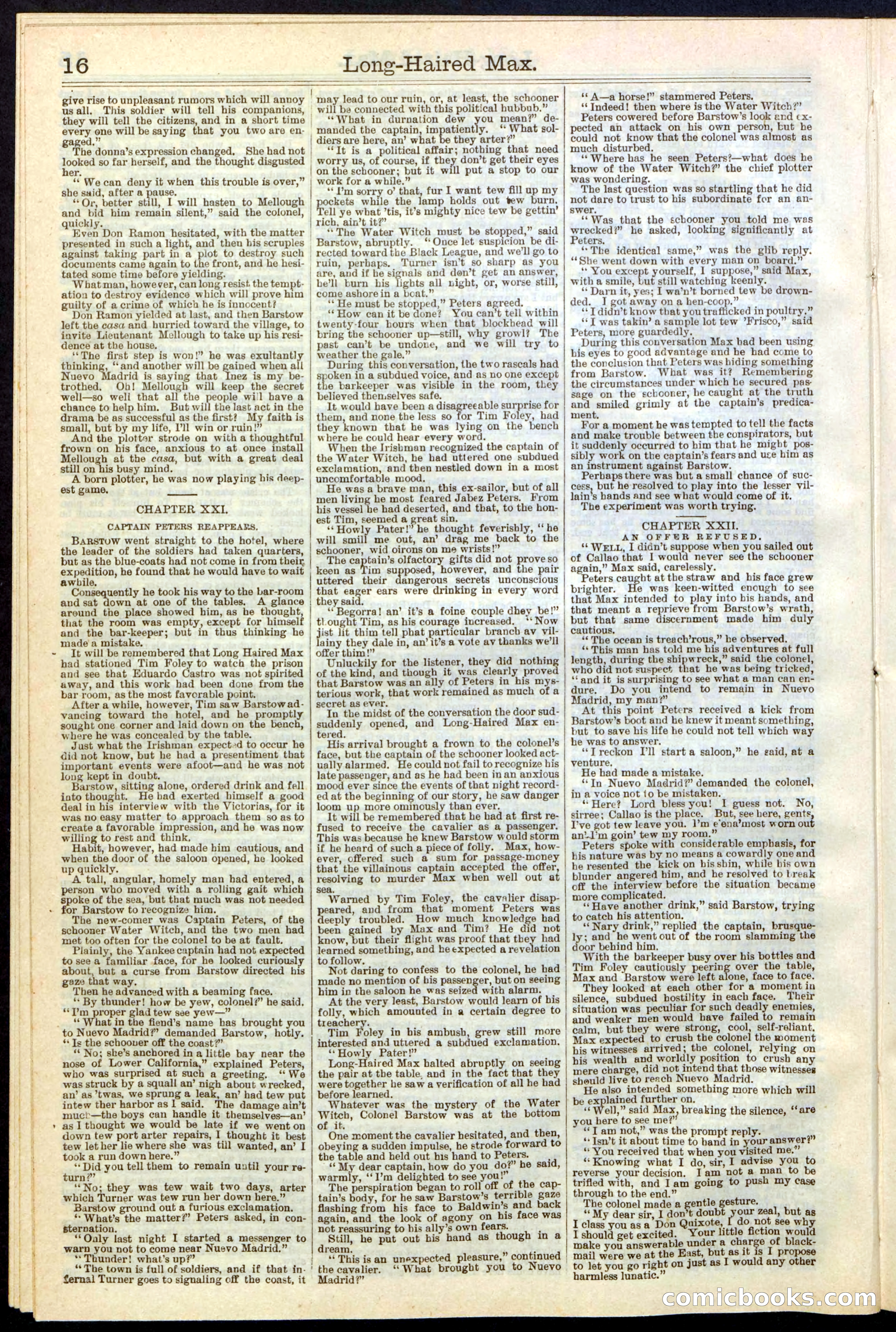
A restored page from Pulp Fiction, 1883. Page through the whole issue in the reader above.
📄 Transcribed text from this page (OCR, searchable)
Machine-transcribed from the original scan — historical spelling and the odd misread are preserved.
wr ee re err ee ee — ~—e e —_-— oS eo oor Sell ne SS ee LPS LEE ¢ te aE a SS ce + 16 give ” to unpleasant rumors which will annoy us all, they will tell the citizens, and in a short time — every one will be saying that you twoare en- manded the captain, impatiently. | diers are here, an’ what gaged. he donna’s expression changed, She had not | worry us, of course, if they don’t get their eyes sOoERe so far herself, and the thought disgusted er. ‘* Wecan deny it when this trouble is over,” she said, after a pause. “Or, better still, I will hasten to Mellough and bid him remain silent,” said the colonel, guickly. Even Don Ramon hesitated, with the matter presented in such a light, and then his scruples against taking part in a plot to destroy such documents came again to the front, and he hesi- tated some time before yielding. What man, however, can long resist. the tempt- ation to destroy evidence which will prove him guilty of a crime of which he is innocent? Don Ramon yielded at last, and then Barstow left the casa and hurried toward the village, to invite Lieutenant Mellough to take up his resi- dence at the house. ‘*The first step is won!” he was exultantl thinking, ‘‘and another will be gained when all Nuevo Madrid is saying that Inez is my be- trothed. Ob! Mellough will keep the secret well—so well that all the people wi!l have a chance to help him. But will the last act in the drama be as successful as the first? My faith is small, but by my life, 11 win or ruin!” And the plotter strode on with a thoughtful frown on his face, anxious to at once install Mellough at the casa, but with a great deal still on his busy mind. A born plotter, he was now playing bis deep- est game, CHAPTER XXI, CAPTAIN PETERS REAPPEARS. Barstow went straight to the hotel, where the leader of the soldiers had taken quarters, but as the blue-coats had not come in from their expedition, he found that he would have to wait awbile, Con and sat down at one of the tables. around the place showed him, as he thought, that the room was empty, except for himself | tl.ought Tim, as his courage increased. and the bar-keeper; but in thus thinking he made a mistake. This soldier will tell his companions, — | . may lead to our ruin, or, at least, the schooner will be connected with this political hubbub.” ‘‘What in durnation dew you mean?” de- ** What sol- they arter?’ “It is a political affair; nothing that need | on the schooner; but it will put a stop to our work for a while.” ‘‘ ’m sorry o’ that, fur I want tew fill up my ockets while the lamp holds out tew burn. ell ye what ’tis, it’s mighty nice tew be gettin’ | rich, ain’t it?” | | | ‘‘The Water Witch must be stopped,” said Barstow, abruptly. “Once let suspicion be di- rected toward the Black League, and we'll go to ruin, perbaps. Turner isn’t so sharp as you are, and if he signals and don’t get an answer, he’ll burn his lights all night, or, worse still, | come ashorein a boat.” ‘* He must be stopped,” Peters agreed. ‘How can it be done? You can’t tell within twenty-four hours when that blockhead will bring the schooner up—still, why growl? The past can’t be undone, and we will try to weather the gale.” During this conversation, the two rascals had sponen in a subdued voice, and as no one except the barkeeper was visible in the room, they believed themselves safe. It would have been a disagreeable surprise for them, and none the less so for Tim Foley, had they known that he was lying on the bench where he could hear every word. When the Irishman recognized the captain of the Water Witch, he had uttered one subdued exclamation, and then nestled down in a most uncomfortable mood. He was a brave man, this ex-sailor, but of all men living he most feared Jabez Peters. From his vessel be had deserted, and that, to the hon- est Tim, seemed a great sin. ‘‘Howly Pater!” he thought feverishly, ‘* he will smill me out, an’ drag me back to the schooner, wid oirons on me wrists!” The captain’s olfactory gifts did not proveso keen as iim supposed, however, and the pair uttered their dangerous secrets unconscious uently he took his way to the bar-room | that na ag ears were drinking in every word A glance | they said. ‘*Begorra! an’ it’s a foine couple dhey be!” ** Now jist lit thim tell phat particular brancb av vil- ainy they dale in, an’ it’s a vote av thanks we'll It will be remembered that Long Haired Max | offer thim!” had stationed Tim Foley to watch the prison and see that Eduardo Castro was not spirited away, and this work had been done from the bar room, as the most favorable point. After a while, however, Tim saw Barstowad- vancing toward the hotel, and he promptly sought one corner and laid down on the bench, where he was concealed by the table. Just what the Irishman expected to occur he did not know, but he had a presentiment that important events were afoot—and he was not long kept in doubt. Barstow, sitting alone, ordered drink and fell into thought. He bad exerted himself a good deal in his interview with the Victorias, for it was no easy matter to approach them so as to create a favorable impression, and he was now willing to rest and think, Habit, however, had made him cautious, and when the door of the saloon opened, he looked up quickly. A tall, angular, homely man had entered, a person who moved with a rolling gait which spoke of the sea, but that much was not needed ‘or Barstow to recognize him. The new-comer was Captain Peters, of the schooner Water Witch, and the two men had met too often for the colonel to be at fault. Plainly, the Yankee captain had not expected to see a familiar face, for he looked curiously about, but a curse from Barstow directed his goze that way. Then he advanced with a beaming face. ‘* By thunder! how be yew, colonel?’ he said, o i ary a glad tew see yew—” ‘* What in the fiend’s name has brought you to Nuevo Madrid?’ demanded Barstow, hotly. nm “Ts the schoover off the coast?” ** No; ske’s anchored in a little bay near the nose of Lower California,” explained Peters, who was surprised at such a greeting, ‘We was struck by a squall an’ nigh about wrecked, an’ as twas, we sprung a leak, an’ had tew put intew ther harbor as I said. The damage ain’t muct—the boys can handle it themselyes—an’ as I thought we would be late if we went on down tew port arter repairs, I thought it best tew let her lie where she was till wanted, an’ I took a run down here.” **Did you tell them to remain until your re- turn?’ ‘No; they was tew wait two days, arter which Turner was tew run her down here.” Barstow ground out a furious exclamation. ‘- What’s the matter?’ Peters asked, in con- sternation. **Oaly last night I started a messenger to warn you not to come near Nuevo Madrid.” ** Thunder! what’s up?” ** The town is full of soldiers, and if that in- the cavalier. fernal Turner goes to signaling off the coast, it Ma Unluckily for the listener, they did nothing of the kind, and though it was clearly proved that Barstow was an ally of Peters in his mys- terious work, that work remained as much ofa secret as ever. In the midst of the conversation the door sud- aol age opened, and Long-Haired Max en- tered, His arrival brought a frown to the colonel’s face, but the captain of the schooner looked act- ually alarmed. He could not fail to recognize his late passenger, and as he had been in an anxious mood ever since the events of that night record- ed at the beginning of our story, he saw danger loom up more ominously than ever, It will be remembered that he had at first re- fused to receive the cavalier as a passenger. This was because he knew Barstow would storm if he heard of such a piece of folly. Max, how- ever, offered such a sum for passage-money that the villainous captain accepted the offer, resolving to murder Max when well out at sea. Warned by Tim Foley, the cavalier disap- peared, and from that moment Peters was deeply troubled. How much knowledge had been gained by Max and Tim? He did not know, but their flight was proof that they had learned something, and he expected a revelation to follow. Not daring to confess to the colonel, he had made no mention of bis passenger, but on seeing him in the saloon he was seized with alarm. At the very least, Barstow would learn of bis folly, which amounted in a certain degree to teachers Tim Foley in bis ambush, grew still more interested and utvered a subdued exclamation. ‘“‘Howly Pater!” Long-Haired Max halted abruptly on seeing the pair at the table, and in the fact that they were together he saw a verification of all he had before learned. Whatever was the mystery of the Water ue Colonel Barstow was at the bottom of it. One moment the cavalier hesitated, and then, obeying a sudden impulse, he strode forward to the table and held out his hand to Peters. ‘‘ My dear captain, how do you do?” be said, warmly, ‘I’m delighted to see you!” The perspiration began to roll off of the cap- tain’s body, for he saw Barstow’s terrible gaze flashing from his face to Baldwin’s and back again, and the look of agony on his face was not reassuring to his ally’s own fears. A 4 Still, he put out his hand as though in a ream. ‘This is an unexpected pleasure,” continued “What brougbt you to Nuevo drid?”’ — Neen ree a ; ; ooo ' ' a De aS — ————$—$ ‘© A—a horse!” stammered Peters, ‘‘ Indeed! then where is the Water Witch?’ Peters cowered before Barstow’s look end cx- ted an attack on his own person, but he could not know that the colonel was almost as much disturbed. ‘‘ Where has he seen Peters?/—what does he know of the Water Witch?’ the chief plotter was wondering. The last question was so startling that he did not dare to trust to his subordinate for an an- swer. ‘‘Was that the schooner you told me was wrecked?” he asked, looking significantly at Peters. **The identical same,” was the glib reply. ‘*She went down with every man on board.” t* Yon Sg yourself, I suppose,” said Max, with a smile, but still watching keenly. ** Darn it, yes; I wa’n’t borned tew be drown- ded. IJ got away on a hen-coop.” ‘‘ T didn’t know that you trafficked in poultry,” ‘* was takin’ a sample lot tew ’Frisco,” said Peters, more guardedly. During this conversation Max had been using his eyes to good advantage and he had come to the conclusion that Peters was hiding something from Barstow. What was it? Remembering the circumstances under which be secured pas- sage on the schooner, he caught at the truth and smiled grimly at the captain’s predica- ment. For a moment he was tempted to tell the facts and make trouble between the conspirators, but it suddenly occurred to him that he might pos- sibly work on the captain’s fears and uce him as an instrument against Barstow. Perbaps there was but a small chance of suc- cess, but he resolved to play into the lesser vil- lain’s hands and see what would come of it. The experiment was worth trying. CHAPTER XXII. AN OFFUR REFUSED. ‘‘ WELL, I didn’t suppose when you sailed out of Callao that I would never see the schooner again,” Max said, carelessly. Peters caught at the straw and his face grew brighter. e was keen-witted enough to see that Max intended to play into bis hands, and that meant a reprieve from Barstow’s wrath, but that same discernment made him duly cautious, ‘The ocean is treach’rous,” he observed. ‘This man has told me his adventures at full length, during the shipwreck,” said the colonel, who did not suspect that he was being tricked, ‘‘and it is surprising to see what a man can en- dure. Do you intend to remain in Nuevo Madrid, my man?” At this point Peters received a kick from Barstow’s boot and he knew it meant something, but to save his life he could not tell which way he was to answer. ‘‘T reckon I'll start a saloon,” he gaid, at a venture, He had made a mistake. ‘“In Nuevo Madrid?’ demanded the colonel, in a voice not to be mistaken. ‘Here? Lord bless you! I guess not. No, sirree; Callao is the place. But, see here, gents I’ve got tew leave you. 1’m e’ena’most worn out an’l’m goin’ tew my room.” ‘ Peters spoke with considerable emphasis, for his nature was by no means a cowardly one and he resented the kick on bisshin, while his own blunder angered him, and he resolved to Lreak off the interview before the situation became more complicated. ‘‘Have another drink,” said Barstow, trying to catch his attention. ‘‘Nary drink,” replied the captain, brusque- ly; and he went out of the room slamming the oor behind him. With the barkeeper busy over his bottles and Tim Foley cautiously peering over the table, Max and Barstow were left alone, face to face. They looked at each other for a moment in silence, subdued hostility in each face. Their situation was peculiar for such deadly enemies, and weaker men would have failed to remain calm, but they were strong, cool, self-reliant, Max expected to crush the colonel the moment his witnesses arrived; the colonel, relying on his wealth and worldly position to crush any mere charge, did not intend that those witnesses sheuld live to rerch Nuevo Madrid. He also intended something more which will be explained further on. ’ ‘¢ Well,” said Max, breaking the silence, ‘‘are you here to see mef ‘**T am not,” was the prompt reply. ‘Isn’t it about time to band in your answer?” “You received that when you visited me.” “Knowing what I do, sir, I advise you to reverse your decision. Iam not a man to be trifled with, and Iam going to push my Case through to the end.” The colonel made a gentle “My dear sir, I don’t doubt your zeal, but as I class you as a Don Quixote, I do not see why I should get excited. Your little fiction would make you answerable under a charge of black- mail were we at the East, but as it is I propose to let you go right on just as I would any other harmless lunatic.” sture. “~~. Se Gomicboo (C S) (E(0) —— —