
Pulp Fiction, 1883 · page 12 of 32
Beadle's Dime Library No. 237 — page 12: what you’re looking at
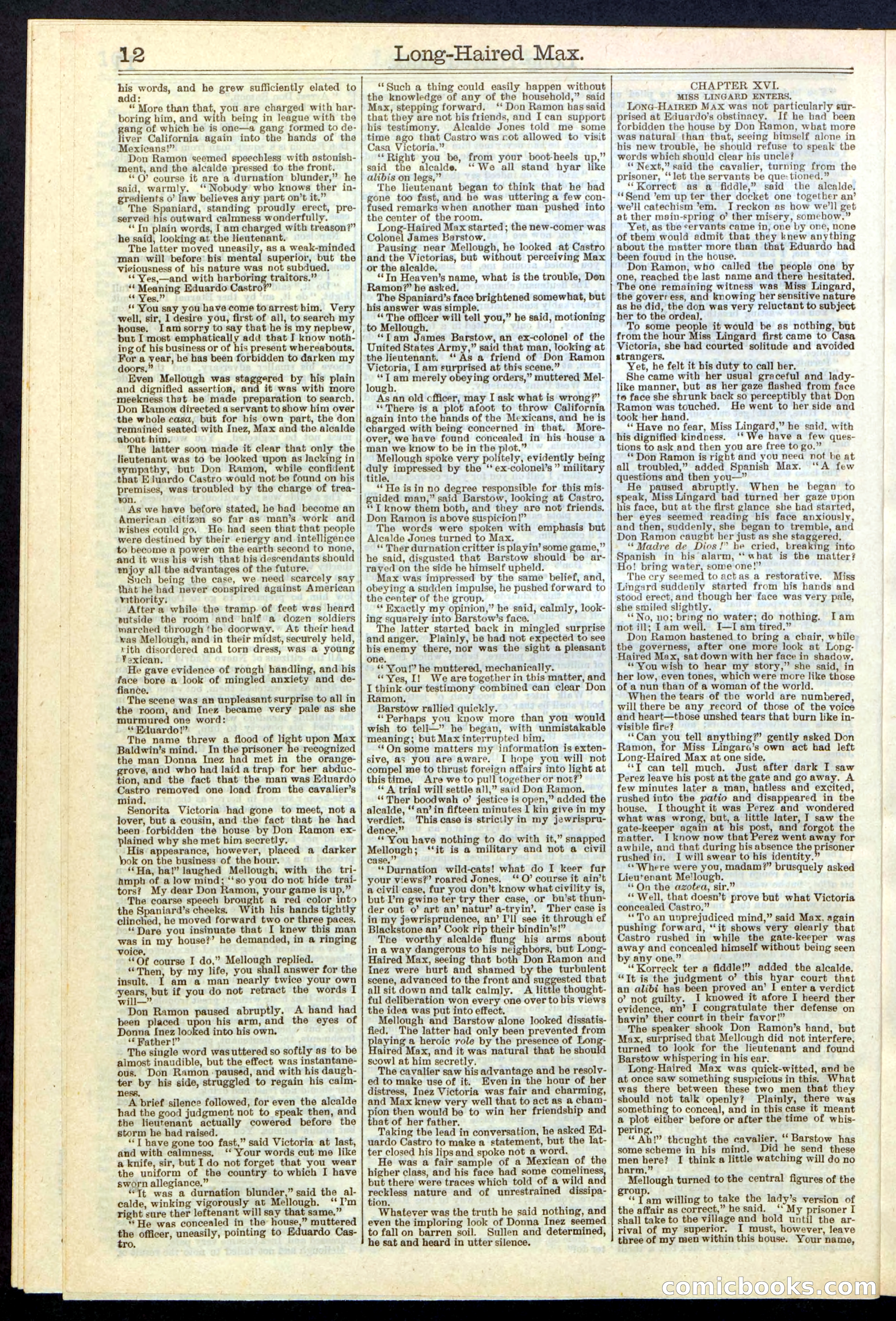
A restored page from Pulp Fiction, 1883. Page through the whole issue in the reader above.
📄 Transcribed text from this page (OCR, searchable)
Machine-transcribed from the original scan — historical spelling and the odd misread are preserved.
_—— > ——_— LL IT 12 ae words, and he grew sufficiently elated to add: “ More than that, you are charged with har- boring him, and with being in league with the gang of which he is one—a gang formed to de- liver California again into the hands of the Mexicans!” Don Ramon seemed speechless with astonish- ment, and the alcalde pressed to the front. ‘“O’ course it are a durnation blunder,” he said, warmly. ‘‘Nobudy who knows ther in- gredients 0’ law believes any part on’t it.” The Spaniard, standing proudly erect, pre- served his outward calmness wonderfully. “In plain words, I am charged with treason?” he said, looking at the lieutenant. The latter moved uneasily, as a weak-minded man will before his mental superior, but the viciousness of bis nature was not subdued, ‘¢ Yes,—and with harboring traitors.” ‘‘ Meaning Eduardo Castro?” “ce Yes.” ‘* You say you have come toarrest him. Very well, sir, 1 desire you, first of all, to search my house. [am sorry to say that he is my nepbew, but I most emphatically add that I know noth- ing of his business or of his present whereabouts. For a year, he has been forbidden to darken my oors. Even Mellough was staggered by his plain and dignified assertion, and it was with more meekness that be made preparation to search. Don Ramon directed a servant to show him over the whole casa, but for his own part, the don remained seated with Inez, Max and the alcalde about him. The latter soon made it clear that only the lieutenant was to be looked upon as lacking in sympathy, but Don Ramon, while confident that Eluardo Castro would not be found on his premises, was troubled by the charge of trea- yon. As we have before stated, he had become an American citizan so far as man’s work and wishes could go. He had seen that that people were destined by their energy and intelligence to become a power on the earth second to none, and it was his wish that bis descendants should enjoy all the advantages of the future. Such being the case, we need scarcely say that he had never conspired against American vithority. Atter a while the tramp. of feet was heard putside the room and half a dozen soldiers marched through ‘he doorway. At their head was Mellough, and in their midst, securely held, vith disordered and torn dress, was a young Yexican. He gave evidence of rough handling, and his face bore a look of mingled anxiety and de- fiance. The scene was an unpleasant surprise to all in the room, and Inez became very pale as she murmured one word: ‘* Eduardo!” The name threw a flood of light upon Max Baldwin’s mind. In the prisoner he recognized the man Donna Inez had met in the orange- grove, and who had laid a trap for her abduc- tion, and the fact that the man was Eduardo pee removed one load from the cavalier’s mind, Senorita Victoria had gone to meet, not a lover, but a cousin, and the fact that he had been forbidden the house by Don Ramon ex- plained why she met him secretly. His appearance, however, placed a darker yok on the business of the hour. ‘‘Ha, hal” laughed Mellough, with the tri- hmph of a low mind; ‘‘so you do not hide trai- tors? My dear Don Ramon, your game is up.” The coarse speech brought a red color into the Spaniard’s cheeks. With his hands tightly clinched, he moved forward two or three paces, ‘‘Dare you insinuate that I knew this man was in my house?’ he demanded, in a ringing voice, “Of course I do,” Mellough replied. “Then, by my life, you shall answer for the insult. am a man nearly twice your own Fa ap if you do not retract the words I will— Don Ramon paused abruptly. A hand had been placed upon his arm, and the eyes of Donna Inez looked into his own. ‘* Father!” The single word was uttered so softly as to be almost inaudible, but the effect was instantane- ous. Don Ramon - paused, and with his daugh- ter by his side, struggled to regain his calm- ness. A brief silence followed, for even the alcalde had the good judgment not to speak then, and the lieutenant actually cowered before the storm he had raised. ‘““T have gone too fast,” said Victoria at last, and with calmness, ‘‘ Your words cut me like a knife, sir, but I do not forget that you wear the uniform of the country to which I have sworn allegiance,” _ “Tt was a durnation blunder,” said the al- calde, winking vigorously at Mellough. “lm right sure ther leftenant will say that same.” **He was concealed in the house,” muttered the officer, uneasily, pointing to Eduardo Cas- tro. Long-Haired Max. “Such a thing could easily happen without the knowledge of any of the household,” said Max, stepping forward. ‘‘ Don Ramon has said that they are not bis friends, and I can support his testimony. Alcalde Jones told me some time ago that Castro was rot allowed to visit Casa Victoria.” ‘*Right you be, from your boot-heels up,” said the alcalde. ‘‘ We all stand hyar like alibis on legs,” The lieutenant began to think that he had gone too fast, and he was uttering a few con- fused remarks when another man pushed into the center of the room, Long-Haired Max started; the new-comer was Colonel James Barstow, Pausing near Mellough, he looked at Castro and the Victorias, but without perceiving Max or the alcalde. ‘‘Tn Heaven’s name, what is the trouble, Don Ramon?” he asked. The Spaniard’s face brightened somewhat, but his answer was simple. “‘ The officer will tell you,” he said, motioning to Mellough. “Tam James Barstow, an ex-colonel of the United States Army,” said that man, looking at the lieutenant. ‘'As a friend of Don Ramon Victoria, I am surprised at this scene.” ; ss — merely obeying orders,” muttered Mel- ough. As an old cfficer, may I ask what is wrong?’ ‘‘There is a plot afoot to throw California again into the hands of the Mexicans, and _he is charged with being concerned in that. More- over, we have found concealed in his house a man we know to be in the plot.” Mellough spoke very politely, evidently being duly impressed by the ‘ ex-colonel’s ” military title. ‘He isin no degree responsible for this mis- guided man,” said Barstow, looking at Castro. ‘*T know them both, and they are not friends. Don Ramon is above suspicion!” The words were spoken with emphasis but Alcalde Jones turned to Max. “« Ther durnation critter is playin’ some game,” he said, disgusted that Barstow should be ar- raved on the side he himself upheld. Max was impressed by the same belief, and, obeying a sudden impulse, he pushed forward to the center of the group. ** Exactly my opinion,” he said, calmly, look- ing squarely into Barstow’s face. The latter started back in mingled surprise andanger. Plainly, he had not expected to see his enemy there, nor was the sight a pleasant one. “You!” he muttered, mechanically. “Yes, I! We aretogether in this matter, and I think our testimony combined can clear Don Ramon. Barstow rallied quickly. “Perhaps you know more than you would wish to tell—” he began, with unmistakable meaning; but Max interrupted bim. ‘*On some matters my information is exten- sive, a5 you are aware. I hope you will not compel me to thrust foreign affairs into light at this time. Are we to pull together or not?’ ‘* A trial will settle all,” said Don Ramon. ‘‘ Ther boodwah o’ jestice is open,” added the alcalde, ‘‘an’ in fifteen minutes 1 kin give in my verdict. This case is strictly in my jewrispru- dence.” ‘You have nothing to do with it,” snapped Mellough; ‘‘it is a military and not a civil case,” ‘‘Durnation wild-cats! what do I keer fur your views?’ roared Jones. ‘‘O’ course it ain’t a civil case, fur you don’t know what civility is, but. I’m gwine ter try ther case, or bu’st thun- der out o’ art an’ natur’ a-tryin’, Ther case is in my jewrisprudence, an’ [ll see it through ef Blackstone an’ Cook rip their bindin’s!” The worthy alcalde flung his arms about in a way dangerous to his neighbors, but Long- Haired Max, seeing that both Don Ramon and Inez were hurt and shamed by the turbulent scene, advanced to the front and suggested that all sit down and talk calmly. A little thought- ful deliberation won every one over to bis views the idea was put into effect. Mellough and Barstow alone looked dissatis- fied. The latter had only been prevented from playing a heroic role by the presence of Long- aired Max, and it was natural that he should svowl at him secretly. The cavalier saw his advantage and he resolv- ed to make use of it. Evenin the hour of her distress, Inez Victoria was fair and charming, and Max knew very well that to act as a cham- pion then would be to win her friendship and that of her father. Taking the lead in conversation, he asked Ed- uardo Castro to make a statement, but the lat- ter closed his lips and spoke not_a word. He was a fair sample of a Mexican of tho higher class, and his face had some comeliness but there were traces which told of a wild and A ney, nature and of unrestrained dissipa- ion. Whatever was the truth he said nothing, and even the imploring look of Donna Inez seemed to fall on barren soil. Sullen and determined, he sat and heard in utter silence. CHAPTER XVI. MISS LINGARD ENTERS. LONG-HAIRED MAX was not particularly sur- prised at Eduardo’s obstinacy. If he had been forbidden the house by Don Ramon, what more was natural than that, seeing himself alone in his new trouble, he should refuse to speak the words which should clear his uncle? ‘* Next,” said the cavalier, turning from the prisoner, ‘‘let the servants be que: tioned.” ‘Korrect as a fiddle,” said the alcalde, ‘*Send ’em up ter ther docket one together an’ we'll catechism "em. J reckon as how we'll get at ther main-spring o’ ther misery, somehow.” Yet, as the servants came in, one by one, none of them would admit that they knew anythin about the matter more than that Eduardo ha been found in the house. Don Ramon, who called the people one by one, reached the last name and there hesitated. The one remaining witness was Miss Lingard, the goverr ess, and knowing her sensitive nature as he did, the don was very reluctant to subject her to the ordeal), To some people it would be as nothing, but from the hour Miss Lingard first came to Casa Victoria, she had courted solitude and avoided strangers. Yet, he felt it bis duty to call ber. She came with her usual graceful and lady- like manner, but as her gaze flashed from face to face she shrunk back so perceptibly that Don Ramon was touched. He went to her side and took her hand. ‘‘ Have no fear, Miss Lingard,” he said, with his dignified kindness. ‘‘ We have a few ques- tions to ask and then you are free to go.” **Don Ramon is right and you need not be at all troubled,” added Spanish Max. ‘‘A few questions and then you—” He paused abruptly. When he began to speak, Miss Lingard bad turned her gaze upon his face, but at the first glance she bad started, her eyes seemed reading his face anxiously, and then, suddenly, she began to tremble, and Don Ramon caught her just as she staggered. ‘“‘ Madre de Dios!” he cried, breaking into Spanish in his alarm, *‘ what is the matter? Ho! bring water, some one!” The cry seemed to actas a restorative. Miss Lingard suddenly started from his hands and stood erect, and though her face was very pale, she smiled slightly. ‘‘No, uo; bring no water; do nothing. [am not ill; Tam weil. I—I am tired.” Don Ramon hastened to bring a chair, while the governess, after one more look at Long- Haired Max, sat down with her face in shadow. “You wish to hear my story,” she said, in her low, even tones, which were more like those of a nun than of a woman of the world. When the tears of the world are numbered, will there be any record of those of the voice and heart—those unshed tears that burn like in- visible fire? ‘*Can you tell anything?’ gently asked Don Ramon, for Miss Lingara’s own act had left Long-Haired Max at one side. ‘‘T can tell much. Just after dark I saw Perez leave his post at the gate and go away. A few minutes later a man, hatless and excited, rushed into the patio and disappeared in the house. I thought it was Perez and wondered what was wrong, but, a little later, I saw the gate-keeper again at his post, and forgot the matter. I know now that Perez went away for awhile, and that during his absence the prisoner rushed in. I will swear to his identity.” ‘Where were you, madam?” brusquely asked Lieutenant Me!lough. ‘On the azotea, sir.” “Well, that doesn’t prove but what Victoria concealed Castro,” ‘To an unprejudiced mind,” said Max, again pushing forward, “it shows very eglearly that Castro rushed in while the gate-keeper was away and concealed himself without being seen by any one.” ‘“‘Korreck ter a fiddle!” added the alcalde. “Tt is the judgment o’ this hyar court that an alibi has been proved an’ I enter a verdict o’ not guilty. I knowed it afore I heerd ther evidence, an’ I congratulate ther defense on bavin’ ther court in their favor!” The speaker shook Don Ramon’s hand, but Max, surprised that Mellough did not interfere, turned to look for the lieutenant and found Barstow whispering in his ear. Long-Haired Max was quick-witted, and be at once saw something suspicious in this. What was there between these two men that they should not talk openly? Plainly, there was something to conceal, and in this case it meant a plot either before or after the time of whis- ring. ae Ah!” thceught the cavalier, ‘ Barstow has some scheme in his mind. Did he send these men here? I think a little watching will do no harm.” Mellough turned to the central figures of the group. ‘ é am willing to take the lady’s version of the affair as correct,” he said. ‘* My prisoner I shall take to the village and hold until the ar- rival of my superior. I must, however, leave three of my men within this house. Your name, / =comicbooks! co