
Pulp Fiction, 1883 · page 24 of 32
Beadle's Dime Library No. 236 — page 24: what you’re looking at
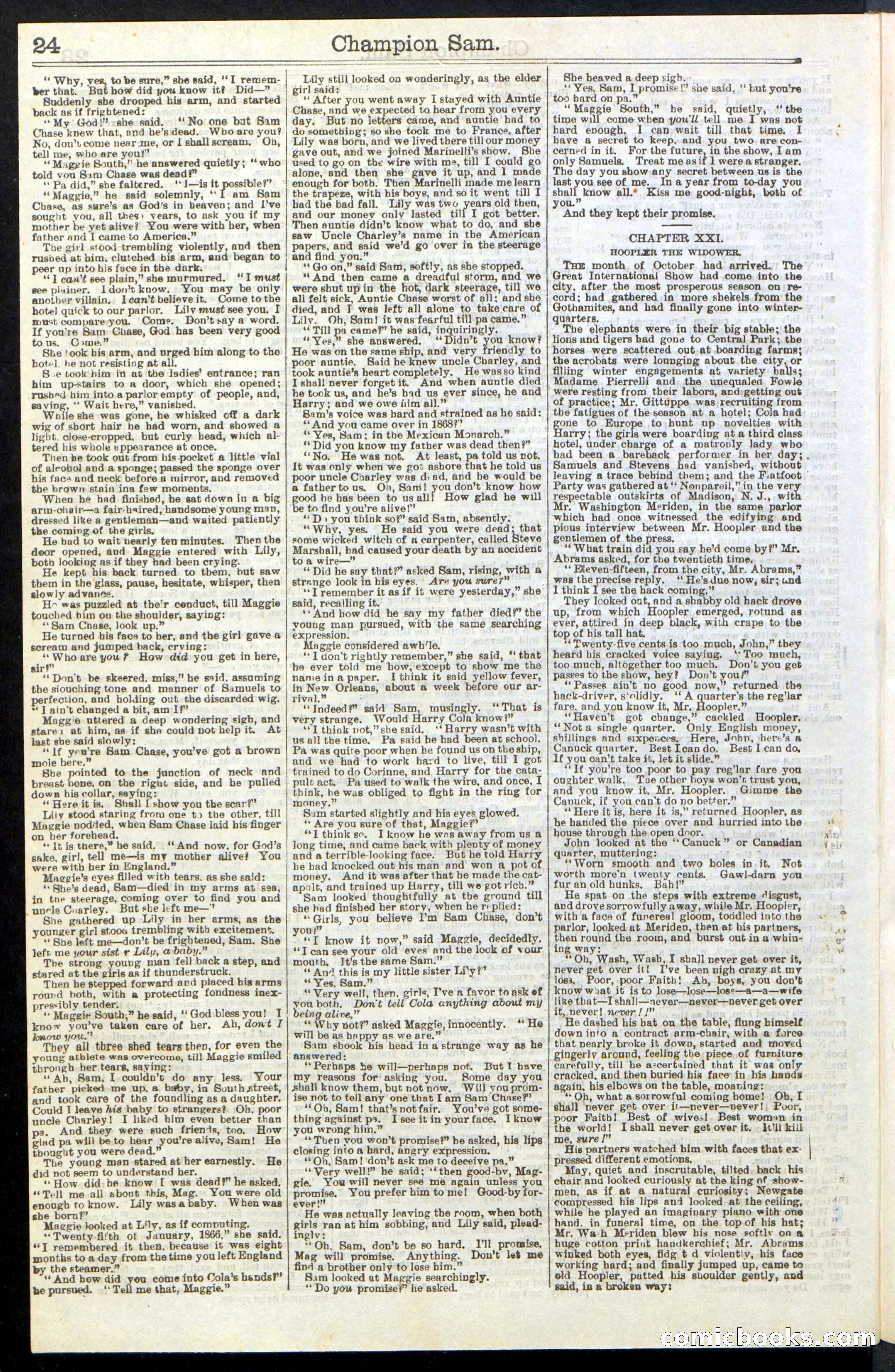
A restored page from Pulp Fiction, 1883. Page through the whole issue in the reader above.
📄 Transcribed text from this page (OCR, searchable)
Machine-transcribed from the original scan — historical spelling and the odd misread are preserved.
24. “Why, i to be sure,” she said, “I remem- ber that. But how did you know it? Did—” Suddenly she drovped his arm, and started back as if frightened: ‘*My God!” «she said. (hase knew that, and he’s dead. Whbo are you? No, don’: come near-me, or I shallscream. Oh, tell me, who are your’ } “ Magvie South,” he answered quietly; “‘ who told vou Sam Chase was dead?” ‘Pa did,” she faltered. ‘* J—is it possible?” “Maggie,” he said solemnly, ‘‘' 1 am Sam Chase, as sure’s as God’s in beaven; and I’ve sought you, all thes) years, to ask you if my mother be yet alive? You were with her, when father and I came to America.” The girl stood trembling violently, and then rusbed at him, clutched bis arm, and began to peer up into his face in the dark, ‘*} can’t see plain,” she murmured. ‘I must gee pluiner. Idon’t know. You may be only another villain. lean’t believe it. Come tothe hotel quick to our parlor. Lily must see you. I must compareyou. Come. Don’tsay a word. If you're Sam Chase, God has been very good tous. Come.” She !ook bis arm, and urged him along to tho hotel. he not resisting at all. S.e took him in at the Isdies’ entrance; ran him up-stairs to a door, which she opened; rushed him into aparlorempty of people, and, saving, *‘ Wait here,” vanished, While she was gone, he whisked off a dark wig of sbort hair he bad worn, and showed a light. close-eropped, but curly bead, which al- tered bis whole sppearance at once, Then be took out from bis pocket a little vial of aleobol and a sponge; passed the sponge over bis face and neck before a mirror, and removed the brown stain ina few moments. When he had finished, he sat down in a big arm-chair—a fair-haired, handsome young man, dressed like a gentleman—and waited paticntly the coming of the girls. He had to wait nearly ten minutes. Then the door opened, and Maggie entered with Lily, both looking as if they had been crying. He kept his back turned to them, but saw them in the glass, pause, hesitate, whisper, then slowly advances. H- was puzzled at the'r conduct, till Maggie touched bim on the shoulder, saying: ‘‘Sam Chase, look up.” He turned bis facs to her, and the girl gave a scream and jumped back, crving: * Who are you? How did you get in here, sir?” ‘Don't be skeered. miss,” he ssid. assuming the siouching tone and manner of Samuels to perfection, and holding out the discarded wig. ** 7] ain't changed a bit, am I?” Maggie uttered a deep wondering sigh, and stare: at him, as if she could not helpit. At last she said slowly: “If yeu’re Sam Chase, you’ve got a brown mole here.” She pointed to the junction of neck and breastbone, on the right side, and be pulled down his collar, saying: ‘‘ Here it is. Shall I show you the scar?” Lily stood staring from one t» the other, till Maggie nodded, when Sam Chase laid his finger on ber forehead, , ‘It is there,” he said. _‘*And now, for God’s sake, girl, tell me—is my mother alive? You were witb her in England.” Maggie’s eyes filled with tears, as she said: ‘* She’s dead, Sam—died in my arms at sea, in tne steerage, coming over to fied you and unrle Cuarley. But she left me—” She gathered up Lily in her arms, as the ounger girl stoos trembling with excitement. ‘ She left me—don’t be frightened, Sam. She lefs me your sist r Lily, a baby.” Tbe strong young man fell back a step, and stared at the girls as if thunderstruck. _ Then he stepped forward and placed bis arms round both, with a protecting fondness inex- pressibly tender, ‘* Maggie South,” he said, ‘‘God bless you! I know you've taken care of her. know you.” They all three shed tears then, for even the young athlete was overcome, till Maggie smiled through her tears, saying: ‘“Ab, Bam, I couldn’t do any less. Your father picked me up, a baby, in South street, and took care of the foundling as a daughter. Could I leave his baby to strangers? Ob, poor uncle Charley! I hked bim even better than . And they were such frienis, too. How giad pa wil) be to hear you're alive, Sam! He thought you were dead. The young man stared at her earnestly. He did not seem to understand her. ‘How did: be know [ was dead?” he asked, “T.]l me all about this, Mag. You were old enough to know. Lily wasababy. When was she born?’ Maggie looked at L‘ly, as if computing. “Twenty-fitth ot January, 1866,” she said. “TJ remembered it then, because it was eight months toa day from thetime you left England the steamer.” ** And bow did ou come into Cola’s hands?” he pursued. “ Tell me that, Maggie.” Ah, don't I Champion Sam. —s —~—— - —- rr eC Lily still looked on wonderingly, as the elder girl said: ‘‘ After you went away I stayed with Auntie Chase, and we expected to hear from you every ‘‘No one but Sam | day. But no letters came, and auntie had to do something; so she took me to France, after Lily was born, and we lived there till our money gave out, and we joined Marinelli’s show. She used to go on the wire with mse, till I could go alone, and then she eave it up, and 1 made enough for both. Then rinelli made me learn the trapeze, with bis boys, and so it went till I had the bad fall. Lily was two yeas old then, and our money only lasted till I got better. Then auntie didn’t know what to do, and she saw Uncle Charley’s name in the American papers, and said we’d go over in the steerage and find you.” **Go on,” said Sam, softly, as she stopped. ‘‘And then came a dreadful storm, and we were shut up in the hot, dark steerage, till we all felt sick, Auntie Chase worst of all; and she died, and I was left all alone to take care of Lily. Oh, Sam! it was fearful till pa came.” ‘* Till pa came?” he said, inquiringly. ‘‘'Yes,” she answered, ‘‘Didn’t you know? He was on the same ship, and very friendly to poor auntie, Said be knew uncle Charley, and took auntie’s heart completely. He wasso kind I shall never forget it. And when auntie died he took us, and he’s bad us ever since, he and Harry; and we owe fim all.” Sam’s voice was hard and strained as he said: “And you came over in 1868?” ** Yes, Sam; in the Mexican Monarch.” ‘Did you know my father was dead then?” ‘“‘No. He was not. At Jeast, pa told us not. It was only when we gos ashore that he told us poor uncle Charley was d: ad, and he would be a fathertous. Oh, Sani! you don’t know how good he bas been to us all! How glad he will be to find you're alive!” ‘*D> you think sof” said Sam, absently. “Why, yes. He said you were dead; that some wicked witch of a carpenter, called Bteve Marshall, bad caused your death by an accident to a wire—” “ Did he say that?” asked Sam, rising, with a strange look in his eyes. Are you sure?” ‘‘T remember it as if it were yesterday,” she said, recalling it. ‘* And how did he say my father died?” the young man pursued, with the same searching expression. aggie considered awh'le. ‘I don’t rightly remember,” she said, ‘‘ that he ever told me how, except to show me the nameinapaper. I think it said yellow fever, in New Orleans, about a week before our ar- rival.” ‘‘Indeed® said Sam, musingly. ‘That is very strange. Would Harry Cola know?” ‘*T thiok not,”she said. ‘‘ Harry wasn’t with us all the time. Pa said he had been at school. Pa was quite poor when he found us on the ship, and we had to work hard to live, till I got trained to do Corinne, and Harry for the cata- pult act. Pa used to walk the wire, and once, I think, he was obliged to fight in the ring for money.” Sam started slightly and his eyes glowed. ‘** Are you sure of that, Maggie?” “T think so. I know he wes away from us a long time, and came back with plenty of money and a terrible-looking face. But he told Harry he bad knocked out his man and won a pot of money. And it was after that he made the cat- apilt, and trained up Harry, till we got rich.” Sam looked thoughtfully at tbe ground till she had finished her story, when he replied: “Girls, you believe I’m Sam Chase, don’t ou?” he I know it now,” said Maggie, decidedly. “‘T can sea your old eves and the look of vour mouth, Jt’s the same Sam.” ‘And this is my little sister Li‘y?” “Yes, Sam.” “ Very well, then. girls, I’ve a favor to ask of you both. Don't tell Cola anything about my eing alive,” ‘* Why not?” asked Maggie, innocently. ‘“‘ He will be as happy as we are.” Sam sbook his head ina strange way as he answered: **Perhaps he will—perhaps not. But I have my reasons for’ asking you. Some day you Shall know them, but not now. ‘Will you prom- ise not to tellany one that Iam Sam Chase?” ‘“Ob, Sam! that’s notfair. You've got some- thing against ps. Isee it in yourface, I know you wrong him. ‘‘Then vou won't promise?” he asked, his lips closing into a hard, angry expression. ‘*Oh, Sam! ‘don’t ask me to deeeive pa.” ‘‘ Very well!” he said; ‘‘then good-bv, Mag- gie. You will never see me again unless you promise. You prefer him to me! Good-by for- ever! He was actually Jeaving the room, when both aa ran at him sobbing, and Lily said, plead- negelv: ‘*Oh, Sam, don’t be so hard. I'll promise, Mag will promise. Anything. Don’t let me find a brother only to lose him.” Sam looked at Maggie searchingly. **Do you promise?” he asked. ee ee ne > ee REE ENE NR SES She beaved a deep sigh. ‘* Yes, Sam, I promise!” she said, ‘‘ but you're too bard on pa.” “Maggie South,” he said, quietly, ‘‘ the time will come when you'll tell me I was not hard enough. I can wait till that time, I have a secret to keep, and you two are con- cerned in it. For the future, in the show, Iam only Samuels. Treat me asif 1 werea stranger, The day you show any secret between us is the last you see of me. Ina year from to-day you shall know all.* Kiss me good-night, both of ” And they kept their promise. CHAPTER XXI. HOOPLER THE WIDOWER, THe month of October had arrived. The Great International Show had come into the city, after the most prosperous season on re- cord; had gathered in more shekels from’ the Gotbamites, and had finally gone into winter- quarters, The elephants were in their big stable; the lions and tigers had gone to Central Park; the horses were scattered out at boarding farms; the acrobats were lounging about the city, or filling winter engagements at variety halls; Madame Pierrelli and the unequaled Fowle were resting from their labors, and:getting out of practice; Mr. Gittuppe. was recruiting from the fatigues of the season at a hotel; Cola had one to age to hunt up novelties with arry; the girls were boarding at a third class hotel, under charge of a matronly lady who had been a bareback performer in her day; . Samuels and Stevens Pod vanished, without leaving a trace bebind them; and the Fiatfoot © Party was gathered at ‘‘ Nonpareil,” in the ver respectable outskirts of Madison, N. J., wit Mr. Washington Meriden, in the same parlor which had once witnessed the edifying and pious interview between Mr. Hoopler and the gentlemen of the press, ‘*'W bat train did you say he’d come by?” Mr. Abrams asked, for the twentieth time, ‘** Kkeven-fifteen, from the city, Mr. Abrams,” was the precise reply. ‘‘ He’s due now, sir; und I think I see the back coming,” They looked ont, and a shabby old hack drove up, from which Hoopler emerged, rotund as ever, attired in deep black, with crape to the top of his tall hat. ‘Twenty-five cents is too much, John,” they heard his cracked voice saying. ‘Too much, too much, altogether too much. Don’t you get pasres to the show, hey? Don’t you/” ‘‘Passes ain’t no good now,” returned the hack-driver, s‘olidly. ‘‘ A quarter’s the reg’lar fare. and you know it, Mr.. Hoopler.” ‘‘Haven’t got change,” cackled Hoopler. “Nota single quarter. Only English money, shillings and sixpences, Here, John, shere’s a Canuck quarter. Best Ieando, Best I can do, If you can’t take it, let it slide.” *‘If you’re too poor to pay reg’lar fare you oughter walk. Toe other boys won’s trust you, and you know it, Mr. Hoopler. Gimme the Canuck, if you can't do no better.” ‘‘ Here it is, here it is,” returned Hoopler, as he handed the piece over and burried into tbe house through the open door. John looked at the ‘‘Canuck” or Canadian quarter, muttering: “Worn smooth and two holes in it, Not worth more’n twenty cents. Gawl-darn you fur an old hunks, Bah!” He spat on the steps with extreme disgust, and drove sorrowfully away, while Mr. Hoopler, with a faces of funereal gloom, toddled into the parlor, looked at Meriden, then at his partners, then round the room, and burst out in a whin- ing way: ‘Ob, Wash, Wash, I shall never get over it, never get over it! I’ve been nigh crazy at my loss3,. Poor, poor Faitb! Ab, boys, you don’t know what it is to lose—lose—loss—a—a—wife like that—I shall—never—never—never get over it, never! never / /” He dashed his bat on the table, flung bimself down into a contract arm-chair, with a force that nearly broke it down, started and moved gingerly around, tealing the piece of furniture carefully, till he azcertained that it was only cracked, and then buried his face in his hands again, his elbows on the table, moaning: «Oh, what a sorrowful coming home! Ob, I shall never get over it—never—never!, Poor, poor Faitb! Best of wives! Best women in the world! I shall never get over it, - I7ll kill me, sure !” | His partners watched bim with faces that ex- ressed different emotions, May, quiet and inscrutable, tilted. back his ebair and looked curiously at the king of show- men, as if at a natural curiosity; Newgate compressed his lips and looked at the ceiling, while he played an imaginary piano with one hand. in funeral time, on the topof his hat; Mr. Wa:h Meriden blew his nose softly ona huge cotton priut handkerchief; Mr. Abrams winked both eyes, fidg t d violentiy, his face working bard; and finally jumped up, came to i Hoopler, patted his shoulder gently, and said, in a broken way: Gomicboo (0) ‘S Cc (0)