
Pulp Fiction, 1877 · page 15 of 28
Beadle's New York Dime Library, No. 23 — page 15: what you’re looking at
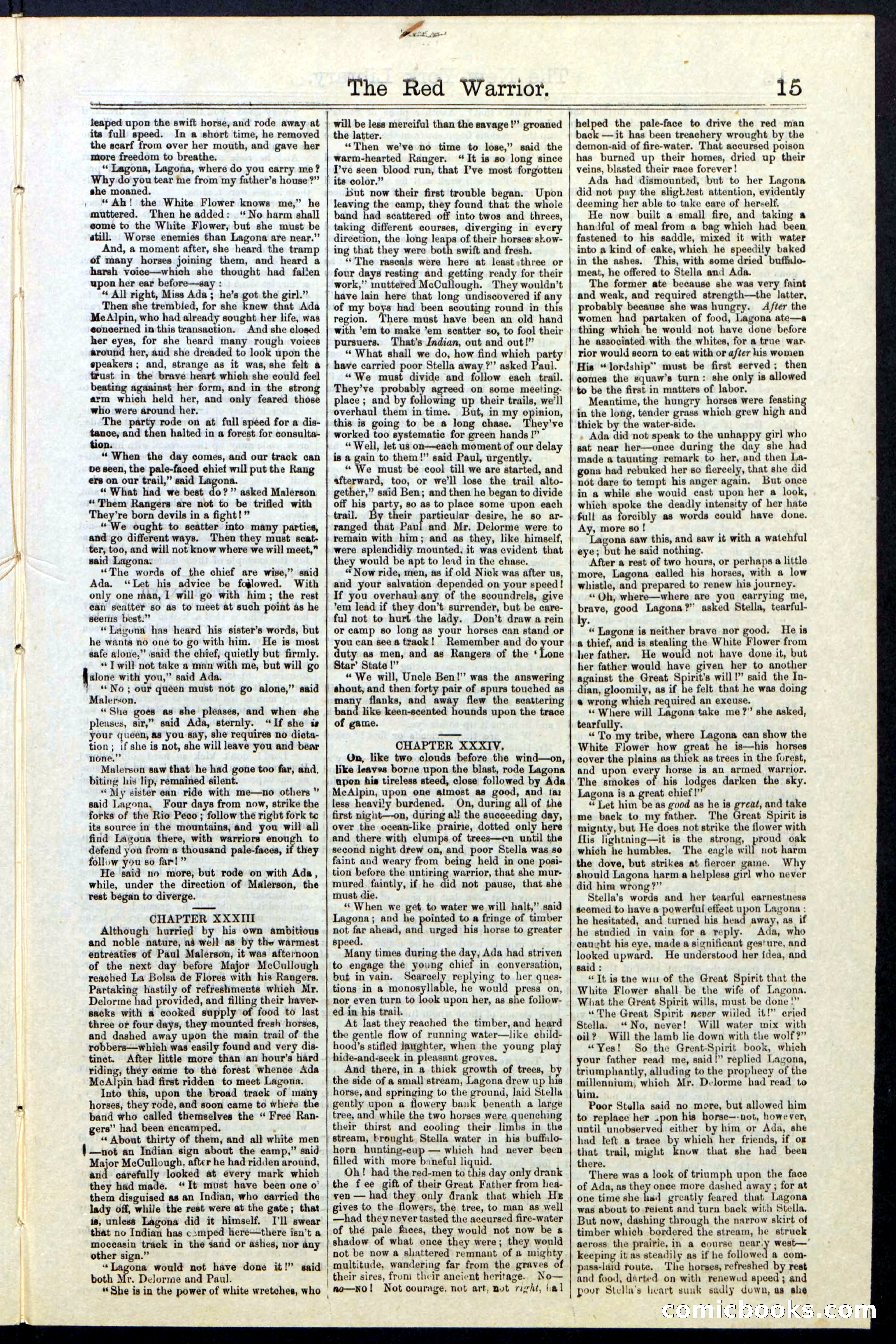
A restored page from Pulp Fiction, 1877. Page through the whole issue in the reader above.
📄 Transcribed text from this page (OCR, searchable)
Machine-transcribed from the original scan — historical spelling and the odd misread are preserved.
Oe ae ln in ~ leaped upon the swift horse, and rode away at its full speed. In a short time, he removed the scarf from over her mouth, and gave her more freedom to breathe. ‘“‘Lagona, Lagona, where do you carry me? Why do you tear me from my father’s house?” she moaned. ‘“ Ah! the White Flower knows me,” he muttered. Then he added: ‘No harm shall some to the White Flower, but she must be atill. Worse enemies than Lagona are near.” And, a moment after, she heard the tramp of many horses joining them, and heard a harsh voice—which she thought had fallen upon her ear before—say : “‘ All right, Miss Ada; he’s got the girl.” Then she trembied, for she ede that Ada Me Alpin, who had already sought her life, was eoncerned in this transaction. And she closed her eyes, for she heard many rough voices around her, and she dreaded to look upon the speakers ; and, strange as it was, she felt a trust in the brave heart which she could feel beating agaainat her form, and in the strong arm which held her, and only feared those who were around her. The party rode on at full speed for a dis- tance, and then halted in a forest for consulta- tion. “When the day comes, and our track can be seen, the pale-faced chief will put the Rang ers on our trail,” said Lagona. “ What had we best do?” asked Malerson “Them Rangers are not to be trifled with They’re born devils in a fight!” “We ought to scatter into many parties, and go different ways. Then they must scat- ter, too, and will not know where we will meet,” said Lagona: “The words of the chief are wise,’ said Ada. “Let his advice be foglowed. With only one man, 1 will go with him; the rest ean scatter so as to meet at such point as he seems best.” “Lavona has heard his sister’s words, but he wants no one to go with him. He is most safe alone,” said the chief, quietly but firmly. “T will not take a man with me, but will go alone with you,” said Ada. ‘No; our queen must not go alone,” said Malerson. “She goes as she pleases, and when she pleases, sir,” said Ada, sternly. “If she is your queen, as you say, she requires no dicta- tion; if she is not, she will leave you and béar none.” Malerson saw that he had gone too far, and, biting his lip, remained silent. “My sister ean ride with me—no others " said Lagona, Four days from now, strike the forks of the Rio Peco ; follow the right fork te its source in the mountains, and you will all find Lagona there, with warriors enough to defend you from a thousand pale-faces, if they follow you so far!” He said no more, but rode on with Ada, while, under the direction of Malerson, the rest began to diverge. CHAPTER XXXIII Although hurried by his own ambitious and noble nature, a4 well as by the warmest entreaties of Paul Malerson, it was afternoon of the next day before Major McCullough reached La Bolsa de Flores with his Rangers. Partaking hastily of refreshments whieh Mr. Delorme had provided, and filling their haver- sacks with a cooked supply of food to last three or four days, they mounted fresh horses, and dashed away upon the main trail of the robbers—which was easily found and very dis- tinct. After little more than an hour’s hard riding, they edme to thé forest whence Ada McAlpin had first ridden to meet Lagona. Into this, upon the broad track of many horses, they rode, and soon came to where the band who called themselves the “ Free Ran- gers” had been encamped. , “ About thirty of them, and all white men —not an Indian sign about the camp,” said Major McCullough, after he had ridden around, anid carefully looked at every mark which they had made. “It must have been one o’ them disguised as an Indian, who carried the lady off, while the rest were at the gate; that is, unless Lagona did it himself. I'll swear that no Indian has c»mped here—there isn’t a moccasin track in the sand or ashes, nor any other sign.” “Lagona would not have done it!” said both Mr. Delorme and Paul. “She is in the power of white wretches, who The Red Warrior. will be less merciful than the savage!” groaned the latter. “Then we’ve no time to lose,” said the warm-hearted Ranger. “It is so long since I’ve seen blood run, that I’ve most forgotten its color.” but now their first trouble began. Upon leaving the camp, they found that the whole band had scattered off into twos and threes, taking different courses, diverging in every direction, the long leaps of their horses’ skow- ing that they were both swift and fresh. ‘The rascals were here at least »three or four days resting and getting ready for their work,” muttered McCullough. They wouldn’t have lain here that long undiscovered if an of my ore had been scouting round in this region. ‘There must have been an old hand with ’em to make ’em scatter so, to fool their pursuers. That's Indian, out and out!” “What shall we do, how find which party have carried poor Stella away ?”’ asked Paul. “We must divide and follow each trail. They’ve probably agreed on some meeting- place ; and by following up their trails, we’ll overhaul them in time. But, in my opinion, this is going to be a long chase. They’ve worked too systematic for green hands !” “Well, let us on—each moment of our delay is a gain to them!” said Paul, urgently. “ We must be cool till we are started, and afterward, too, or we'll lose the trail alto- gether,” said Ben; and then he began to divide off his party, so as to place some upon each trail. their pomene desire, he so ar- ranged that Paul and Mr. Delorme were to remain with him; and as they, like himeelf, were splendidly mounted, it was evident that they would be apt to lead in the chase. “‘ Now ride, men, as if old Nick was after us, and your salvation depended on your speed! If you overhaul any of the scoundrels, give ‘em lead if they don’t surrender, but be care- ful not to hurt the lady. Don’t draw a rein or camp so long as your horses can stand or you can see a track! Remember and do your uty as men, and as Rangers of the ‘ Lone Star’ State !” “We will, Uncle Ben!” was the answering shout, and then forty pair of spurs touched as many flanks, and away flew the scattering bana like keen-scented hounds upon the trace of game. CHAPTER XXXIV, On, like two clouds before the wind—on, like leaves borne upon the blast, rode Lagona upon his tireless steed, close followed by Ada McAlpin, upon one almost as good, and fa less heavily burdened. On, during all of the first night—-on, during al} the succeeding day, over the ocean-like prairie, dotted only here and there with clumps of trees—cen until the second night drew on, and poor Stella was so faint and weary from being held in one posi- tion before the untiring warrior, that she mur- mured. faintly, if he did not pause, that she must die. ‘‘When we get to water we will halt,” said Lagona; and he pointed to a fringe of timber not far ahead, aot urged his horse to greater speed. Many times during the day, Ada had striven to engage the young chief in conversation, but in vain. Searcely replying to her ques- tions in a monosyllable, he would press on, nor even turn to look upon her, as she follow- ed in his trail. At last they reached the timber, and heard the gentle flow of running water—like child- hood’s stifled Jaughter, when the young play hide-and-seek in pleasant groves. And there, in a thick growth of trees, by the side of a small stream, Lagona drew up his horse, and springing to the ground, laid Stella gently upon a flowery bank beneath a large tree, and while the two horses were quenching their thirst and cooling their limbs in the stream, brought Stella water in his buffulo- hora hunting-ewp — which had never been filled with more baneful liquid. Oh! had the red-men to this day only drank the fee gift of their Great Father from hea- ven — had they only drank that which Hr gives to the flowers, the tree, to man as well —had they never tasted the aceursed fire-water of thé pale faces, they would not now be s shadow of what once they were; they would not be now a shattered remnant of a mighty multitude, wandering far from the graves of their sires, from their ancient heritage. No— no—no! Not courage, not art, pot right, hal 1 et cee helped the pale-face to drive the red man back —it has been treachery wrought by the demon-aid of fire-water. That accursed poison has burned up their homes, dried up their veins, blasted their race forever! Ada had dismounted, but to her Lagona did not pay the slightest attention, evidently deeming her able to take care of herself, He now built a small fire, and taking a handful of meal from a bag which had been fastened to his saddle, mixed it with water into a kind of cake, which he speedily baked in the ashes. This, with some dried buffalo- meat, he offered to Stella and Ada. The former ate because she was very faint and weak, and required strength-—the latter, iy because she was hungry. A/ter the women had partaken of food, Lagona ate—a thing which he would not have done before he associated with the whites, for a true war. rior would scorn to eat with or after his women His “lordship” must be first served; then comes the squaw’s turn: she only is allowed to be the first in matters of labor. Meantime, the hungry horses were feastin in the long, tender grass which grew high an thick by the water-side. . Ada did not speak to the unhappy girl who sat near her—once during the day she had made a taunting remark to her, and then La- gona had rebuked her so fiercely, that she did not dare to tempt his anger again. But once in a while she would cast upon her a look, which spoke the deadly intensity of her hate full as forcibly as words could have done. Ay, more so ! Lagona saw this, and saw it with a watchful eye; but he said nothing. After a rest of two hours, or perhaps a little ‘more, Lagona called his horses, with a low whistle, and prepared to renew his journey. “Oh, where—where are you carrying me, brave, good Lagona?” asked Stella, tearful- ly. “ Lagone is neither brave nor good. He is a thief, and is stealing the White Flower from her father. He wont not have done it, but her father would have given her to another against the Great Spirit’s will!” said the In- dian, gloomily, as if he felt that he was doing @ wrong which required an excuse. “Where will Lagona take me?” she asked, tearfully. “To my tribe, where Lagona can show the White Flower how great he is—his horses cover the plains as thick as trees in the forest, and upon every horse is an armed warrior. The smokes of his lodges darken the sky. Lagona is a great chief!” “ Let him be as gvod as he is great, and take me back to my father. The Great Spirit is mighty, but He does not strike the flower with flis lightning—it is the strong, proud oak which he humbles. The eagle will not harm the dove, but strikes at fiercer game. Why should Lagona harm a helpless girl who never did him wrong?” Stella’s words and her tearful earnestness seemed to have a powerful effect upon Layona : he hesitated, and turned his head away, as if he studied in vain for a reply. Ada, who cauvht his eye, made a significant gesture, and looked upward. He understood her idea, and said : “Tt is the wiu of the Great Spirit that the White Flower shall be the wife of Lagona. What the Great Spirit wills, must be done!” “The Great Spirit never wiiled it!” cried Stella. “No, never! Will water mix with oil? Will the lamb lie down with the wolf?” “Yes! So the Great-Spirit book, which your father read me, said!” replied Lagona, triumphantly, alluding to the prophecy of the asp which Mr. Delorme had read to im. Poor Stella said no more, but allowed him to replace her .pon his horse—-not, however, until unobserved either by him or Ada, she had lett a trace by which her friends, if oz that trail, might oon that she had been there. There was a look of triumph upon the face of Ada, as they onee more dashed away ; for at one time she had greatly feared that Lagona was about to reient and turn back with Stella, But now, dashing through the narrow skirt of timber which bordered the stream, he struck across the prairie, in a course near.y west—’ keeping it as steadily as if he followed a com- pass-laid route. The horses, refreshed by rest and food, darted on with renewed speed; and pour Stella's heart sunk sadly down, as she JOOKS (ECO A MINCE iC (0)