
Pulp Fiction, 1882 · page 28 of 32
Beadle's Dime Library No. 211 — page 28: what you’re looking at
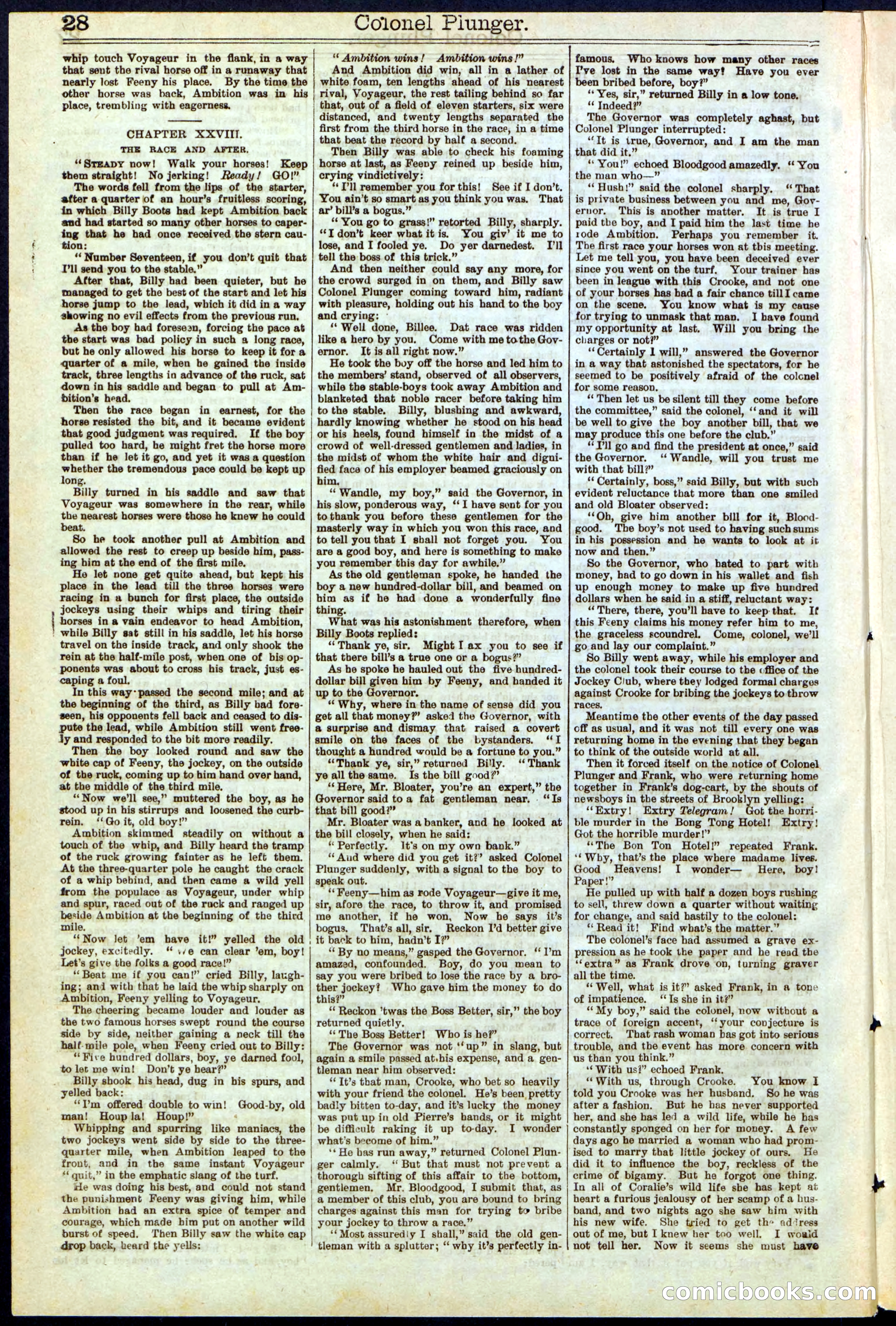
A restored page from Pulp Fiction, 1882. Page through the whole issue in the reader above.
📄 Transcribed text from this page (OCR, searchable)
Machine-transcribed from the original scan — historical spelling and the odd misread are preserved.
28 whip touch Voyageur in the flank, in a way that sent the rival horse off in a runaway that nearly lost Feeny his place. By the time the other horse was back, Ambition was in his place, trembling with eagerness. CHAPTER XXVIII. THE RACE AND AFTER, ““Srgapy now! Walk your horses! Keep them straight! No jerking! Ready! GO!” The words fell from the lips of the starter, after a quarter of an hour’s fruitless scoring, in which Billy Boots had kept Ambition back and had started so many other horses to caper- ing that he had once received the stern cau- tion: ‘‘ Number Seventeen, if you don’t quit that Dll send you to the stable.” After that, Billy had been quieter, but he managed to get the best of the start and let his horse jump to the lead, which it did ina way skowing no evil effects from the previous run, as the boy had foresean, forcing the pace at the start was bad policy in such a long race, but he only allowed his horse to keep it fora quarter of a mile, when he gained the inside track, three lengths in advance of the ruck, sat down in his saddle and began to pull at Am- dition’s head. Then the race began in earnest, for the horse resisted the bit, and it became evident that good judgment was required. If the boy pulled too hard, be might fret the horse more than if he let it go, and yet it was a question whether the tremendous pace could be kept up long. Billy turned in his saddle and saw that Voyageur was somewhere in the rear, while the nearest horses were those he knew he could beat. So he took another pull at Ambition and allowed the rest to creep up beside him, pass- ing him at the end of the first mile. He let none get quite ahead, but kept his place in the lead till the three horses were racing in a bunch for first place, the outside jockeys using their whips and tiring their horses in a vain endeavor to head Ambition, ' while Billy sat still in his saddle, let his horse travel on the inside track, and only shook the rein at the half-mile post, when one of bis op- ponents was about to cross his track, just es- caping a foul. In this way- the second mile; and at the beginning of the third, as Billy bad fore- seen, his opponents fell back and ceased to dis- pute the lead, while Ambition still went free- dy and repens to the bit more readily. Then the boy looked round and saw the white cap of Feeny, the jockey, on the outside of tbe ruck, coming up to him hand over hand, at the middle of the third mile. “Now we'll see,” muttered the boy, as he stood up in his stirrups and lovsened the curb- rein. ‘Go it, old boy!” Ambition skimmed steadily on without a touch of the whip, and Billy heard the tramp of the ruck growing fainter as he left them. At the three-quarter pole he caught the crack of a whip bebind, and then came a wild yell from the populace as Voyageur, under whip and spur, raced out of the ruck and ranged up beside Ambition at the beginning of the third mile. ‘‘Now Jet ’em have it!” yelled the old jockey, excitedly. “./e can clear ’em, boy! Let’s give the folks a good race!” ‘Beat me if you can!” cried Billy, laugh- ing; and with that he laid the whip sharply on Ambition, Feeny yelling to Voyageur. The cheering became louder and louder as the two famous horses swept round the course side by side, neither gaining a neck till the half-mile pole, when Feeny cried out to Billy: ‘Five hundred dollars, boy, ye darned fool, to let me win! Don’t ye hear?” Billy shook his head, dug in his spurs, and yelled back: “Tm offered double to win! Good-by, old man! Houpla! Houp!” ‘ Whipping and spurring like maniacs, the two jockeys went side by side to the three- quarter mile, when Ambition leaped to the front, and in the same instant Voyageur ** quit,” in the emphatic slang of the turf. ile was doing his best, and could not stand | Colonel Piunger. “ Ambition wins! Ambition wins!” And Ambition did win, all in a lather of white foam, ten lengths ahead of his nearest rival, Voyageur, the rest tailing behind so far that, out of a field of eleven starters, six were distanced, and twenty lengths separated the first from the third horse in the race, in a time that beat the record by half a second. Then Billy was able to check his foaming horse at last, as Feepy reined up beside him, crying vindictively: **[’ll remember you for this! See if I don’t. You ain’t so smart as you think you was. That ar’ bill’s a bogus.” ** You go to grass!’ retorted Billy, sharply. ‘IT don’t keer whatitis. You giv’ it me to lose, and I fooled ye. Do yer darnedest. I'll tell the boss of this trick.” And then neither could say any more, for the crowd surged in on them, and Billy saw Colonel Plunger coming toward him, radiant with pleasure, holding out his hand to the boy and crying: © ‘* Well done, Billee. Dat race was ridden like a hero by you. Come with me tothe Gov- ernor. It is all right now.” He took the buy off the horse and led him to the members’ stand, observed of all observers, while the stable-boys took away Ambition and blanketed that noble racer before taking him to the stable. Billy, blushing and awkward, hardly knowing whether he stood on his head or his heels, found himself in the midst of a crowd of well-dressed gentlemen and ladies, in the midst of whom the white hair and digni- fied face of his employer beamed graciously on him, “ Wandle, my boy,” said the Governor, in his slow, ponderous way, ‘‘ I have sent for you tothank you before these gentlemen for the masterly way in which you won this race, and to tell you that I sball not forget you. You are a good boy, and here is something to make you remember this day for awhile.” As the old gentleman spoke, he handed the boy a new bundred-dollar bill, and beamed on bim as if he had done a wonderfully fine thing. What was his astonishment therefore, when Billy Boots replied: “‘Thank ye, sir. Might I ax you to see if that there bill’s a true one or a bogus?” As he spoke he hauled out the five hundred- dollar bill given him by Feeny, and handed it up to the Governor. “Why, where in the name of sense did you get all that money?” asked the Governor, with a surprise and dismay that raised a covert smile on the faces of the bystanders. ‘I thought a hundred would be a fortune to you.” “Thank ye, sir,” returned Billy. ‘ Thank ye all the same. Is the bill good?’ ‘* Here, Mr, Bloater, you’re an expert,” the Governor said toa fat gentleman near. . “‘Is that bill good?” Mr. Bloater was a banker, and he looked at the bill closely, when he said: “Perfectly. It's on my own bank.” ** Aiud where did you get it?’ asked Colonel Plunger suddenly, with a signal to the boy to 3 out, ‘*Feeny—him as rode Voyageur—give it me, sir, afore the race, to throw it, and promised me another, if he won, Now he says it’s bogus, That’s all, sir. Reckon I’d better give it back to him, hadn’t I?” ** By no means,” gasped the Governor. “ I’m amazed, confounded. Boy, do you mean to say you were bribed to lose the race by a bro- ther jockey? Who gave him the money to do this?” * Reckon ’twas the Boss Better, sir,” the boy returned quietly. ‘‘The Boss Better! Who is he?” The Governor was not ‘‘up” in slang, but again a smile passed at-his expense, and a gen- tleman near him observed: ** It’s that man, Crooke, who bet so heavily with your friend the colonel. He’s been pretty badly bitten to-day, and it’s lucky the money was put up in old Pierre’s bands, or it might be difficult raking it up to-day. I wonder what's become of him.” ‘* He bas run away,” returned Colonel Plun- ger calmly. ‘ But that must not prevent a thorough sifting of this affair to the bottom, gentlemen, Mr. Bloodgood, I submit that, as the punishment Feeny was giving him, while | a member of this club, you are bound to bring Ambition bad an extra spice of temper and | charges against this man for trying to bribe courage, which made him put on another wild | your jockey to throw a race,” burst of speed. Then Billy saw the white cap drop back, beard the yells: ** Most assuredly I shall,” said the old gen- tleman with a splutter; “ why it’s perfectly in- — —_— famous. Who knows how many other races I’ve lost in the same way! Have you ever been bribed before, boy?” “Yes, sir,” returned Billy in a low tone. ** Indeed?” The Governor was completely aghast, but Colonel Plunger interrupted: “Tt is true, Governor, and I am the man that did it,” “You!” echoed Bloodgood amazedly. ‘‘ You the man who—” “Hush!” said the colonel sharply. ‘ That is private business between you and me, Goy- ernor. This is another matter. It is true I paid the boy, and I paid him the last time he 10de Ambition. Perhaps you remember it. The first race your horses won at this meeting. Let me tell you, you have been deceived ever since you went on the turf. Your trainer has been in league with this Crooke, and not one of your borses has had a fair chance tillI came on the scene. You know what is my cause for trying to unmask that map. I have found my opportunity at last. Will you bring the charges or not?” ‘*Certainly 1 will,” answered the Governor in a way that astonished the spectators, for he seemed to be positively afraid of the colcnel for some reason, ‘Then let us be silent till they come before the committee,” said the colonel, ‘‘and it will be well to give the boy another bill, that we may produce this one before the club,” “‘T’'ll go and find the president at once,” said the Governor. ‘“ Wandle, will you trust me with that bill?’ ** Certainly, boss,” said Billy, but with such evident reluctance that more than one smiled and old Bloater observed: “‘Oh, give him another bill for it, Blood- good. The boy’s not used to having such sums in his possession and he wants to look at it now and then.” So the Governor, who hated to part with money, had to go down in his wallet and fish up enough money to make up five bundred dollars when he said in a stiff, reluctant way: “There, there, you'll have to keep-that. If this Feeny claims his money refer him to me, the graceless scoundrel. Come, colonel, we'll go. and lay our complaint.” So Billy went away, while his employer and the colonel took their course to the office of the Jockey Club, where they lodged formal charges against Crooke for bribing the jockeys to throw races, Meantime the other events of the day passed off as usual, and it was not till every one was returning home in the evening that they began to think of the outside world at all. Then it forced itself on the notice of Colonel Plunger and Frank, who were returning home together in Frank’s dog-cart, by the shouts of newsboys in the streets of Brooklyn yelling: “Extry! Extry Telegram! Gor the borri- ble murder in the Bong Tong Hotel! Extry! Got the horrible murder!” “The Bon Ton Hotel!” repeated Frank. ‘* Why, that’s the place where madame lives. Good Heavens! I wonder— _ Here, boy! Paper!” He pulled up with half a dozen boys rushing to sell, threw down a quarter without waiting for change, and said hastily to the colonel: ** Read it! Find what’s the matter.” The colonel’s face had assumed a grave ex- pression as he took the paper and he read the ‘‘extra” as Frank drove on, turning graver all the time. ‘Well, what is it?’ asked Frank, in a tone of impatience. ‘Is she in it?’ ‘My boy,” said the colonel, now without a trace of foreign accent, ‘‘your conjecture is correct. That rash woman bas got into serious trouble, and the event has more concern with us than you think.” ‘With us?” echoed Frank, “With us, through Crooke. You know I told you Crooke was her husband. So he was after a fashion. But he bas never supported her, and she has led a wild life, while he has constantly sponged on her for money. A few days ago he married a woman who had prom- ised to marry that little jockey of ours. He did it to influence the boy, reckless of the crime of bigamy. But he forgot one thing. In all of Coralie’s wild life she has kept at heart a furious jealousy of her scamp of a hus- band, and two nights ago she saw him with his new wife. She tried to get the address out of me, but I knew her too well. I woaid not tell her. Now it seems she must have GEomichbooks (E (0) z ——_ = (€