
Pulp Fiction, 1882 · page 25 of 32
Beadle's New York Dime Library No. 210 — page 25: what you’re looking at
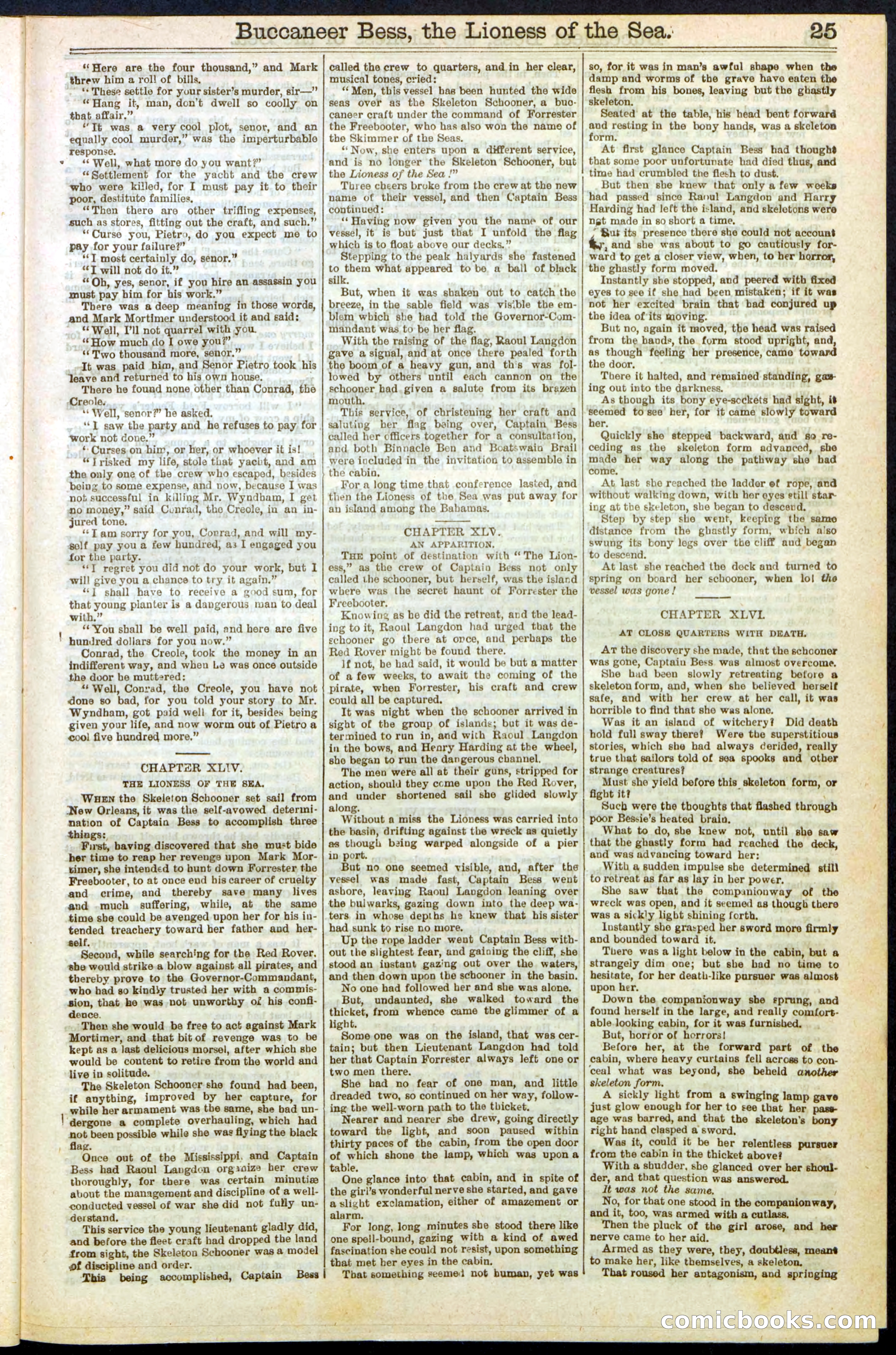
A restored page from Pulp Fiction, 1882. Page through the whole issue in the reader above.
📄 Transcribed text from this page (OCR, searchable)
Machine-transcribed from the original scan — historical spelling and the odd misread are preserved.
— Buccaneer Bess, the Lioness of the Sea. 25 ——- ‘‘Here are the four thousand,” and Mark threw him a rol! of bills, ‘«'These settle for your sister’s murder, sir—” “Hang it, man, don’t dwell so coolly on that affair,” “Té was a very cool plot, senor, and an equally cool murder,” was the imperturbable response. ‘‘ Well, what more do you want?” “Settlement for the yacht and the crew who were killed, for I must pay it to their poor, destitute families, “Then there are other trifling expenses, such as stores, fitting out the craft, and such.” **Curse you, Pietro, do you expect me to pay for your failure?” ‘‘T most certainly do, senor.” “*T will not do it.” “Oh, yes, senor, if you hire an assassin you must pay him for his work.” There was adeep meaning in those words, and Mark Mortimer understood it and said: “ Well, I'll not quarrel with you. ‘How much do I owe you?” ‘‘'Two thousand more, senor.” It was paid him, and Senor Pietro took his leave and returned to his own house. There he found none other than Conrad, the Creole. ‘‘ Well, senor?’ he asked. “] saw the party and he refuses to pay for ‘work not done.” ‘-Curses.on him, or her, or whoever it is! “Jrisked my life, stole that yacht, and am the only one of the crew who escaped, besides being to some expense, and now, because I was not successful in killing Mr. Wyndbam, I get mo money,” said Cunrad, the Creole, in an in- jured tone, | ‘¢T am sorry for you, Conrad, and will my- self pay you a few hundred, a3 I engaged you for the party. ‘‘T regret you did not do your work, but I wil! give you a chance to try it again.” ‘“‘] shall have to receive a good sum, for that young planter is a dangerous man to deal with,” ‘You shall be well paid, and here are five hundred dollars for you now.” Conrad, the Creole, took the money in an indifferent way, and when Le was once outside the door be muttered: ‘Well, Conrad, the Creole, you have not done so bad, for you told your story to Mr. Wyndham, got paid well for it, besides being given your life, and now worm out of Pietro a cool five hundred more,” CHAPTER XLV. THE LIONESS OF THE SEA, WuHeEn the Skeleton Schooner set sai] from ‘New Orleans, it was the self-avowed determi- nation of Captain Bess to accomplish three things: First, baving discovered that she must bide her time to reap her revenge upon Mark Mor- timer, she intended to bunt down Forrester the Freebooter, to at once end his career of cruelty and crime, and thereby save many lives and .much suffering, while, at the same time sbe could be avenged upon her for his in- tended treachery toward her father and her- self. Second, while searching for the Red Rover. she would strike a blow against all pirates, and thereby prove to the Governor-Commandant, who had so kind}y trusted her with a commis- sion, that he was not unworthy of his confi- dence. Then she would be free to act against Mark Mortimer, and that bit of revenge was to be kept as a last delicious morsel, after which sbe would be content to retire from the world and live in solitude. The Skeleton Schooner she found had been, if anything, improved by her capture, for while her armament was tbe same, she bad un- dergone a complete overhauling, which had not been possible while she was flying the black . flag. Once out of the Mississippi, and Captain Bess had Raoul Langdon orgscize ber crew thoroughly, for there was certain minutise about the management and discipline of a well- conducted vessel of war she did not fully un- derstand. This service the young lieutenant gladly did, and before the fleet craft had dropped the land from sight, the Skeleton Schooner was a model of discipline and order. This being accomplished, Captain Bess | totem ee eee called the crew to quarters, and in her clear, musical tones, cried: ‘Men, this vessel bas been hunted the wide seas over as the Skeleton Schooner, a buc- caneer craft under the command of Forrester the Freebooter, who has also won the name of the Skimmer of the Seas. “Now, she enters upon a different service, and is no longer the Skeleton Schooner, but the Lioness of the Sea !” Tbree cheers broke from the crew at the new name of their vessel, and then Captain Bess continued: ‘‘Having now given you the name of our vessel, if is but just that I unfold the flag which is to float above our decks,” Stepping to the peak halyards she fastened to them what appeared to be a ball of black sill. But, when it was shaken out to catch the breeze, in the sable field was visible the em- blem which she had told the Governor-Com- mandant was to be her flag. With the raising of the flag, Raoul Langdon gave a signal, and at once there pealed forth the boom of a heavy gun, and th's was fol- lowed by others until each cannon on the schooner had.given a salute from its brazen mouth. This service, of christening her craft and saluting her flag baing over, Captain Bess called her officers together for a consultation, and both Binnacle Ben and Boatswain Brail were included in the invitation to assemble in . the cabin, For a long time that conference lasted, and then the Lioness of the Sea was put away for an island among the Bahamas. CHAPTER XLV. AN APPARITION, THE point of destination with “ The Lion- ess,” as the crew of Captain Bess not only called the schooner, but herself, was the island where was the secret haunt of Forrester the Freebooter. Knowing as be did the retreat, and the lead- ing to it, Raoul Langdon had urged that the echooner go there at once, and perbaps the Red Rover might be found there. If not, be had said, it would be but a matter of a few weeks, to await the coming of the pirate, when Forrester, his craft and crew could all be captured, It was night when the schooner arrived in sight of the group of islands; but it was de- termined to run in, and with Raoul Langdon in the bows, and Henry Harding at the wheel, she began to run the dangerous channel, The men were all at their guns, stripped for action, should they come upon the Red Rover, and under shortened sail she glided slowly along. Without a miss the Lioness was carried into the basin, drifting against the wreck as quietly as though being warped alongside of a pier in port. But no one seemed visible, and, after the vessel was made fast, Captain Bess went asbore, leaving Raou)] Langdon leaning over the bulwarks, gazing down into the deep wa- ters in whose depths he knew that his sister had sunk to rise no more. Up the rope ladder went Captain Bess with- out the slightest fear, and gaining the cliff, she stood an instant gazing out over the waters, and then down upon the schooner in the basin. No one had followed ber and she was alone. But, undaunted, she walked toward the thicket, from whence came the glimmer of a light. Some one was on the island, that was cer- tain; but then Lieutenant Langdon had told her that Captain Forrester always left one or two men there. ’ She had no fear of one man, and little dreaded two, so continued on her way, follow- ing the well-worn path to the thicket. Nearer and nearer she drew, going directly toward the light, and soon paused within thirty paces of the cabin, from the open door of which shone the lamp, which was upona table. One glance into that cabin, and in spite of the gir'l’s wonderful nerve she started, and gave a slight exclamation, either of amazement or alarm. For long, long minutes she stood there like one spell-bound, gazing with a kind of awed fascination she could not resist, upon something that met ber eyes in the cabin. That something seemed not human, yet was so, for it was in man’s awful shape when the damp and worms of the grave have eaten the flesh from his bones, leaving but the ghastly skeleton. Seated at the table, his head bent forward ra resting in the bony hands, was a skeleton orm. At first glance Captain Bess had thoughé that some poor unfortunate had died thus, and time had crumbled the flesh to dust. But then she knew that only a few weeks had passed since Raoul Langdon and Harr Harding had left the island, and skeletons we ngt made in so short a time, Bui its presence there she could not account t,, and she was about to go cautiously for- ward to get a closer view, when, to her horror, the ghastly form moved. Instantly she stopped, and peered with fixed eyes to see if she had been mistaken; if it was not her excited brain that bad conjured up the idea of its moving. | But no, again it moved, the head was raised from the bands, the form stood upright, and as though feeling her presence, came tow the door, There it halted, and remained standing, gas ing out into the darkness. As though its bony eye-sockets had sight, it gm to see her, for it came slowly toward er. Quickly she stepped backward, and 80 re- ceding as the skeleton form advanced, she made her way along the pathway she had come, At last she reached the ladder ef rape, and without walking down, with her eyes etill star ing at the skeleton, she began to descend, Step by step she went, keeping the samo distance from the ghastly form, which also swung its bony legs over the cliff aud began to deseend. At last she reached the deck and turned to spring on board her schooner, when lol the vessel was gone ! CHAPTER XLVL AT CLOSE QUARTERS WITH DEATH. AT the discovery she made, that the schooner was gone, Captain Bess was almost overcome. She bud been slowly retreating before a skeleton form, and, when she believed herself safe, and with her crew at her call, it was horrible to find that she was alone. Was it an island of witchery? Did death hold full sway there? Were the superstitious stories, which she had always cerided, really true that sailors told of sea spooks and other strange creatures? ' Must she yield before this skeleton form, or fight it? : Such were the thoughts that flashed through poor Bessie’s heated brain, What to do, sbe knew not, until she saw that the ghastly form had reached the deck, and was advancing toward her: With a sudden impulse she determined still to retreat as far as lay in her power. | She saw that the companionway of the wreck was open, and it seemed as though there was a sickly ligbt shining forth, Instantly she grasped her sword more firmly and bounded toward if, Tuere was a light below in the cabin, but a strangely dim one; but she bad no time to hesitate, for her death-like pursuer was almost upon her. Down the companionway she sprung, and found herself in the large, and really comfort- able looking cabin, for it was furnished, _ . But, horror of horrors! Before her, at the forward part of the cabin, where heavy curtains fell across to con- ceal what was beyond, she beheld another skeleton form, A sickly light from a swinging lamp gave just glow enough for her to see that her age was barred, and that the skeleton’s bony right hand clasped a sword, Was it, could it be her relentless pursuer from the cabin in the thicket above? With a shudder, she glanced over her shoul- der, and that question was answered. jt was not the same, / No, for that one stood in the companionway, and it, too, was armed with a cutlass. Then the pluck of the girl arose, and her nerve came to her aid. Armed as they were, they, doubtless, meant to make her, like themselves, a skeleton, — That roused her antagonism, and springing “Ss fd (E(0) aaliicel eyeyo) eee