
Pulp Fiction, 1882 · page 21 of 32
Beadle's New York Dime Library No. 210 — page 21: what you’re looking at
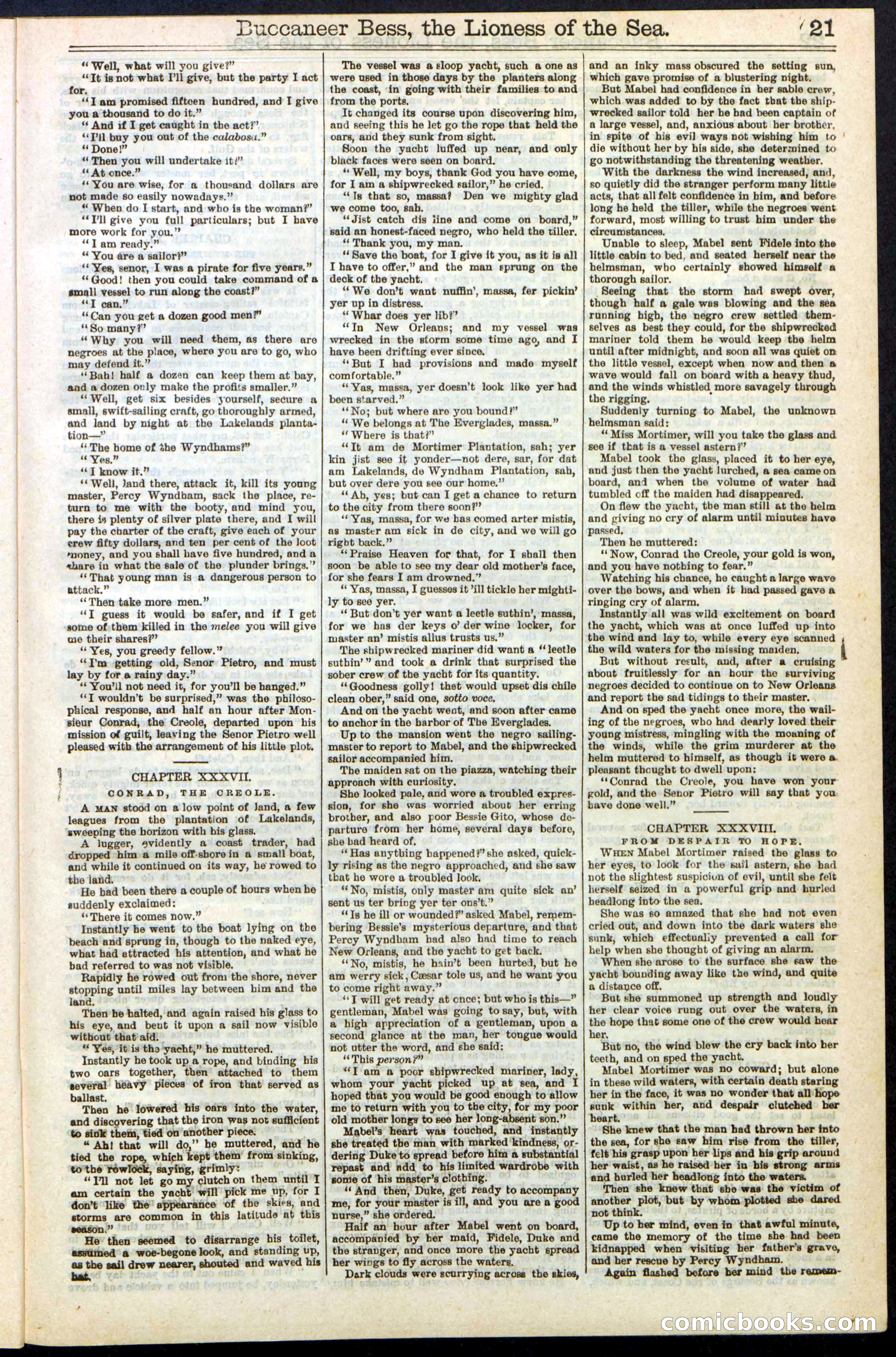
A restored page from Pulp Fiction, 1882. Page through the whole issue in the reader above.
📄 Transcribed text from this page (OCR, searchable)
Machine-transcribed from the original scan — historical spelling and the odd misread are preserved.
“It is not what Ill give, but the party I act for. ‘““T am promised fifteen hundred, and I give you a thousand to do it.” ‘ And if I get caught in the act?’ “Pil buy you out of the calabosu.” * Done!” “ Then you will undertake it?’ ‘« At once.” ‘* You are wise, for a thousand dollars are not made so easily nowadays.” “ When do I start, and who is the woman?” “‘T'll give you full particulars; but I bave more work for you,” ““T am ready.” “You are a sailor?” ‘* Yes, senor, I was a pirate for five years.” ‘‘Good! then you could take command of a small vessel to run along the coast?” “ I can.” “Can you get a dozen good men?” So many?” “Why you will need them, as there are negroes at the place, where you are to go, who may defend it.” ‘‘Bah! half a dozen can keep them at bay, and a dozen only make the profits smaller.” ‘Well, get six besides yourself, secure a small, swift-sailing craft, go thoroughly armed, and land by night at the Lakelands planta- tion—” ‘‘The home of the Wyndhams?” “ce Yes.” ‘‘T know it.” ‘* Well, Jand there, attack it, kill its young master, Percy Wyndham, sack the place, re- turn to me with the booty, and mind you, there is plenty of silver plate there, and I will pay the charter of the craft, give each of your erew fifty dollars, and ten per cent of the loot money, and you shall bave five hundred, anda «hare in what the sale of the plunder brings.” ‘‘That young man is a dangerous person to attack.” ‘‘Then take more men.” “T guess it would be safer, and if I get some of them killed in the melee you will give me their shares?” ‘Yes, you greedy fellow.” “I'm getting old, Senor Pietro, and must lay by for a rainy day.” ‘* You'll not need it, for you'll be hanged.” **T wouldn't be surprised,” was the philoso- phical response, and half an hour after Mon- sieur Conrad, the Creole, departed upon his mission of guilt, leaving the Senor Pietro well pleased with the arrangement of his little plot, CHAPTER XXXVII. CONRAD, THE CREOLE. A MAN stood on a low point of Jand, a few leagues from the plantation of Lakelands, sweeping the horizon with his glass. A lugger, 9vidently a coast trader, had dropped him a mile off-shore in a small boat, and while it continued on its way, he rowed to the land. He bad been there a couple of hours when he suddenly exclaimed: ‘There it comes now.” Instantly he went to the boat lying on the beach and sprung in, though to the naked eye, what had attracted his attention, and what he bad referred to was not visible. Rapidly he rowed out from the shore, never stopping until miles lay between him and the land. Then be halted, and again raised his glass to his eye, and bent it upon a sail now visible without that aid. “ Yes, it is the yacht,” he muttered. Instantly he took up a rope, and binding his two oars together, then attached to them several héavy pieces of iron that served as ballast. Then he lowered his oars into the water, and discovering that the iron was not sufficient to sink them, tied on another piece. “ Ah! that will do,” he muttered, and he tied the which kept them’ from sinking, to'thé rowlock, saying, grimly: “TN not let go my clutch on them until T am certain the yacht will pick me up, for I don’t like the’ appearé of the skies, and storms are common in this latitude at this He then seemed to disarrange his toilet, asstiined a woe-begone look, and standing up, as the sail drew nearer, shouted and waved his bat. Duccaneer Bess, the Lioness of the Sea. The vessel was a sloop yacht, such a one as were used in those days by the planters along the coast, in going with their families to and from the ports. It changed its course upon discovering him, and seeing this he let go the rope that held the oars, and they sunk from sight. Soon the yacht luffed up near, and only black faces were seen on board. ‘* Well, my boys, thank God you have come, for I am a shipwrecked sailor,” he cried, “Is that so, massa? Den we mighty glad we come too, sab. ““Jist catch dis iine and come on board,” said an honest-faced negro, who held the tiller. ‘Thank you, my man. ** Save the boat, for I give it you, as it is all I have to offer,” and the man sprung on the deck of the yacht, “We don’t want nuffin’, massa, fer pickin’ yer up in distress. “Whar does yer lib?’ “In New Orleans; and my vessel was wrecked in the storm some time ago, and I have been drifting ever since, ‘‘But I had provisions and made myself comfortable.” ‘‘ Yas, massa, yer doesn’t look like yer had been starved.” ‘*No; but where are you bound?” ‘‘ We belongs at The Everglades, massa.” ‘Where is that?” “Tt am de Mortimer Plantation, sah; yer kin jist see it yonder—not dere, sar, for dat am Lakelands, de Wyndham Plantation, sah, but over dere you see our home.” ‘‘ Ah, yes; but can I get a chance to return to the city from there soon?’ ‘Yas, massa, for we has comed arter mistis, as master am sick in de city, and we will go rigbt back.” “‘Praise Heaven for that, for I shall then soon be able to see my dear old mother’s face, for she fears I am drowned.” “Yas, massa, I guesses it ’ill tickle her mighti- ly to see yer. ‘‘ But don’t yer want a leetle suthin’, massa, for we has der keys o’ der wine locker, for master an’ mistis allus trusts us.” The shipwrecked mariner did want a ‘‘leetle suthbin’” and took a drink that surprised the sober crew of the yacht for its quantity. **Goodness golly! thet would upset dis chile clean ober,” said one, sotto voce, And on the yacht went, and soon after came to anchor in the barbor of The Everglades. Up to the mansion went the negro sailing- master to report to Mabel, and the shipwrecked sailor accompanied him. The maiden sat on the piazza, watching their approach with curiosity. She looked pale, and wore a troubled expres- sion, for she was worried about her erring brother, and also poor Bessie Gito, whose de- parture from her home, several days before, she bad heard of, ‘Has anything bappened?”’ she asked, quick- ly rising as the negro approached, and she saw that he wore a troubled Jook. ‘No, mistis, only master am quite sick an’ sent us ter bring yer ter ons’t.” ‘(Ts he ill or wounded?” asked Mabel, remem- bering Bessie’s mysterious departure, and that Percy Wyndham had also had time to reach New Orleans, and the yacht to get back. ‘‘No, mistis, he hain’t been hurted, but he am werry sick, Ceesar tole us, and he want you to come right away.” “J will get ready at once; but who is this—” gentleman, Mabel was going to say, but, with a high appreciation of a gentleman, upon a second glance at the man, her tongue would not utter the word, and she said: “This person?” “T am a poor shipwrecked mariner, lady, whom your yacht picked up at sea, and I hoped that you would be good enough to allow me to return with you to the city, for my poor old mother longy to see her long-absent son.” Mabel’s heart was touched, and instuntly she treated the man with marked kindness, or- dering Duke to spread before him a substantial repast and add to his limited wardrobe with sonie of his master’s clothing. nt? ‘‘And then, Duke, get ready to accompany me, for your master is ill, and you are a good nurse,” she ordered. Half an hour after Mabel went on board, accompanied by her maid, Fidele, Duke and the stranger, and once more the yacht spread her wings to fly across the waters. Dark clouds were scurrying across the skies, (21 and an inky mass obscured the setting sun, which gave promise of a blustering night. But Mabel had confidence in her sable crew, which was added to by the fact that the ship- wrecked sailor told her be had been captain of a large vessel, and, anxious about her brother, in spite of his evi] ways not wishing him to ' die without her by his side, she determined to go notwithstanding the threatening weather. With the darkness the wind increased, and, so quietly did the stranger perform many little acts, that all felt confidence in him, and before long he held the tiller, while the negroes went forward, most willing to trust him under the circumstances. Unable to sleep, Mabel sent Fidele into the little cabin to bed, and seated herself near the helmsman, who certainly showed himeelf a thorough sailor. Beeing that the storm had swept over, though half a gale was blowing and the sea running high, the negro crew settled them- selves as best they could, for the shipwrecked mariner told them he would keep the helm until after midnight, and soon all was quiet on the little vessel, except when now and then a wave would fall on board with a heavy thud, and the winds whistled more savagely through the rigging. Suddenly turning to Mabel, the unknown helmsman said: “Miss Mortimer, will you take the glass and see if that is a vessel astern?” Mabel took the glass, placed it to her eye, and just then the yacht lurched, a sea came on board, and when the volume of water had tumbled off the maiden had disappeared. On flew the yacht, the man still at the helm and giving no cry of alarm until minutes have passed, Then he muttered: ‘* Now, Conrad the Creole, your gold is won, and you have nothing to fear.” Watching his chance, he caught a large wave over the bows, and when it had passed gave a ringing cry of alarm, Instantly all was wild excitement on board the yacht, which was at once luffed up into the wind and lay to, while every eye scanned the wild waters for the missing maiden, But without recult, and, after a cruising about fruitlessly for an hour the surviving negroes decided to continue on to New Orleans and report the sad tidings to their master. And on sped the yacht once more, the wail- ing of the negroes, who had dearly loved their young mistress, mingling with the moaning of the winds, while the grim murderer at the helm muttered to himself, as though it were a. pleasant thought to dwell upon: ‘*Conrad the Creole, you have won your gold, and the Senor Pietro will say that you: bave done well.” CHAPTER XXXVIIL FROM DESPAIR TO HOPE, WHEN Mabel Mortimer raised the glass to her eyes, to look for the sail astern, she bad not the slightest suspicion of evil, until she felt herself seized in a powerful grip and hurled headlong into the sea. She was 80 amazed that she had not even cried out, and down into the dark waters she sunk, which effectualiy prevented a call for help when she thought of giving an alarm, When she arose to the surface she saw the yacht bounding away like the wind, and quite a distance off. But she summoned up strength and loudly her clear voice rung out over the waters, in the hope that some one of the crew would hear her, But no, the wind blew the cry back into ber teeth, and on sped the yacht. Mabel Mortimer was no coward; but alone in these wild waters, with certain death staring her in the face, it was no wonder that all: hope sunk within her, and despair clutched her heart. She knew that the man had thrown her into the sea, for she saw him rise from the tiller, felt his grasp upon her lips and his grip around her waist, as he raised her in bis strong arms and hurled her headlong into the watera =~ Then she knew that sho was the victim of another plot, but by whom plotted she dared not think. | G4 Up to her mind, even in that awful minute, came the memory of the time she had been kidnapped when visiting her father’s grave, and her rescue by Percy Wyndham. » a Again flashed before ber mind the remem- i nichbook (E(0) c Si