
Pulp Fiction, 1882 · page 19 of 32
Beadle's New York Dime Library No. 210 — page 19: what you’re looking at
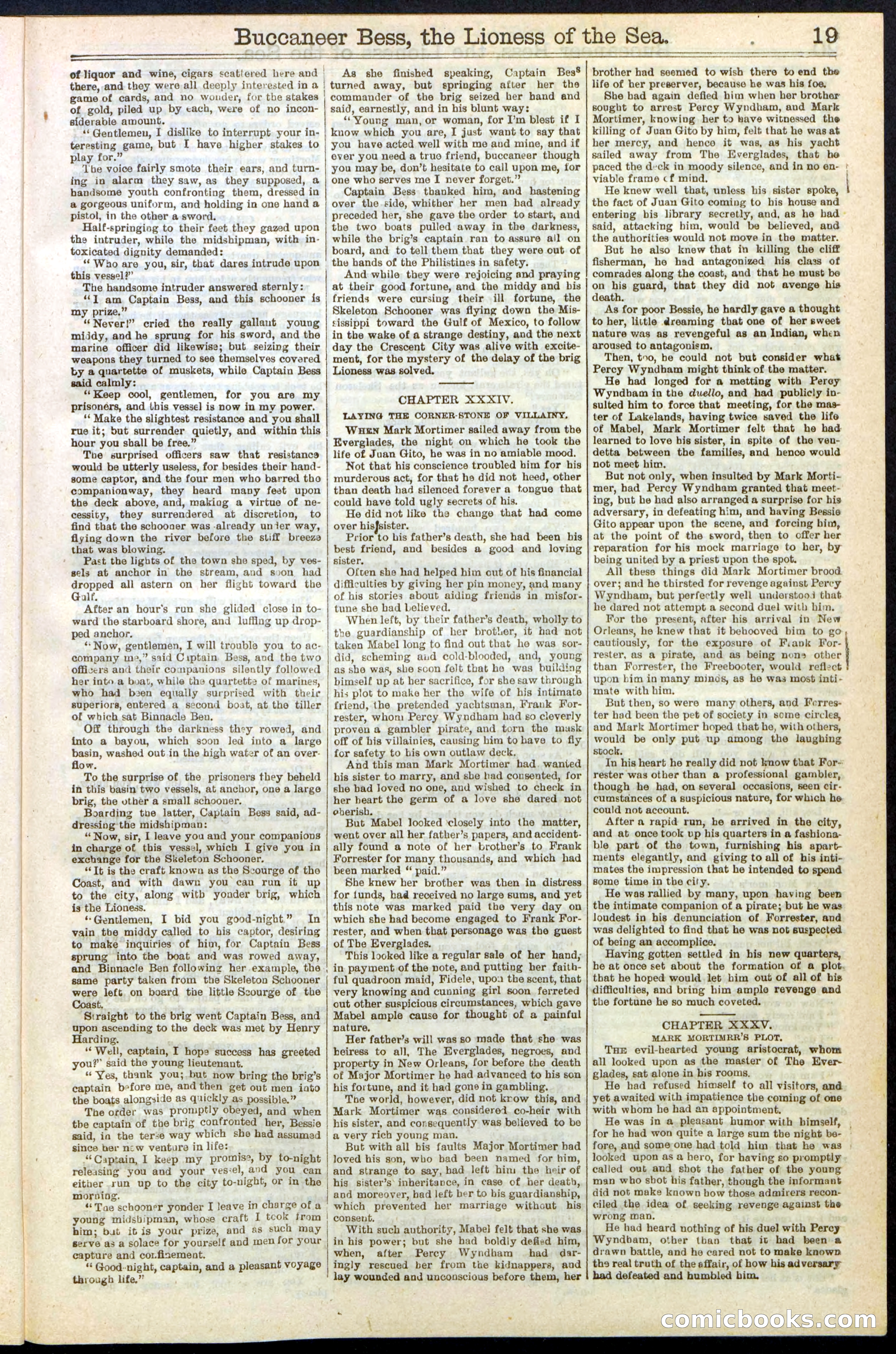
A restored page from Pulp Fiction, 1882. Page through the whole issue in the reader above.
📄 Transcribed text from this page (OCR, searchable)
Machine-transcribed from the original scan — historical spelling and the odd misread are preserved.
of liquor and wine, cigars scatiered here and | there, and they were all deeply interested in a game of cards, and no wonder, for the stakes of gold, piled up by cach, were of no incon- siderable amount. ‘‘ Gentlemen, I dislike to interrupt your in- teresting game, but I have higher stakes to play for.” ‘Lbe voice fairly smote their ears, and turn- ing in alarm they saw, as they supposed, a handsome youth confronting them, dressed in a gorgeous uniform, and holding in one hand a pistol, in the other a sword. Half-springisg to their feet they gazed upon the intruder, while the midshipman, with in- toxicated dignity demanded: ‘* Who are you, sir, that dares intrude upon this vessel?” The handsome intruder answered sternly: “] am Captain Bess, and this schooner is my prize,” “Never!” cried the really gallant young midjdy, and he sprung for his sword, and the marine officer did likewise; but seizing their weapons they turned to see themselves covered by a quartette of muskets, while Captain Bess said calmly: ‘Keep cool, gentlemen, for you are my prisoners, and tbis vesse] is now in my power. ‘* Make the slightest resistance and you shall rue it; but surrender quietly, and within this hour you shall be free.” Tbe surprised officers saw that resistancs would be utterly useless, for besides their hand- some captor, and the four men who barred tho companionway, they heard many feet upon the deck above, and, makiog a virtue of ne- cessity, they surrendered at discretion, to find that the schooner was already unier way, flying down the river before the stiff breeze that was blowing. Past the lights of the town she sped, by ves- sels at anchor in the stream, and svon had dropped all astern on her flight toward the Galf, After an hour's run she glided close in to- ward the starboard shore, and luffing up drop- ped anchor. ‘*Now, gentlemen, I will trouble you to ac- company me,” said Ciptain Bess, and the two Officers and their companions silently followed her into a boat, while the quartette of marines, who had been equally surprised with their superiors, entered a second boat, at the tiller of which sat Binnacle Ben. Of through the darkness they rowed, and into a bayou, which soon led into a large basin, washed out in the high water of an over- flow. To the surprise of the prisoners they beheld in this basin two vessels, at anchor, one a large brig, the other a small schooner. Boarding tbe latter, Captain Bess said, ad- dressing the midshipman: “ Now, sir, I leave you and your companions in charge of this vessel, which I give you in exchange for the Skeleton Schooner. ‘Tt is the craft known as the Scourge of the Coast, and with dawn you can run it up to the city, along witb yonder brig, which is the Lioness. ‘Gentlemen, I bid you good-night.” In vain tbe middy called to his captor, desiring to make inquiries of him, for Captain Bess sprung into the boat and was rowed away, and Binnacle Ben following her example, the same party taken from the Skeleton Schooner were left on board the little Scourge of the Coast, Straight to the brig went Captain Bess, and upon ascending to the deck was met by Henry Harding. ‘‘ Well, captain, I hope success has greeted you?” said the young lieutenant. “Yes, thank you; but now bring the brig’s captain before me, and then get out men iato the boats alongside as quickly as possible.” The order was promptly obeyed, and when tbe captain of the brig confronted her, Bessie said, ia the terse way which she had assumed since ber new venture in life: _ “Captain, 1 keep my promise, by to-night releasing you and your ves:el, and you can either run up to the city to-night, or in the morning. ‘Tae schoonsr yonder I leave in charge of a young midsbipman, whose craft I tcok from him; but itis your prize, and 4s such may serve as a solace for yourself and menfor your capture and confinement. “ Good-night, captain, and a pleasant voyage through life,” ed Buccaneer Bess, the Lioness of the Sea. As she finished speaking, Captain Bes® turned away, but springing after her the commander of the brig seized her hand and said, earnestly, and in his blunt way: ‘‘ Young man, or woman, for I’m blest if I know which you are, I just want to say that you have acted well with me aud mine, and if ever you need a truo friend, buccaneer though you may be, don’t hesitate to call upon me, tor one who serves me I never forget.” Captain Bess thanked him, and hastening over the side, whither her men bad already preceded her, she gave the order to start, and the two boats pulled away in the darkness, while the brig’s captain ran to assure all on board, and to tell them that they were out of the bands of the Philistines in safety. And while they were rejoicing and praying at their good fortune, and the middy and bis friends were cursing their ill fortune, the Skeleton Schooner was flying down the Mis- sissippi toward the Gulf of Mexico, to follow in the wake of a strange destiny, and the next day the Crescent City was alive with excite- ment, for the mystery of the delay of the brig Lioness was solved, CHAPTER XXXIV. LAYING THE CORNER-STONE OF VILLAINY, Wun Mark Mortimer sailed away from the Everglades, the night on which he took the life of Juan Gito, he was in no amiable mood. Not that his conscience troubled him for his murderous act, for that he did not heed, other than death had silenced forever a tongue that could have told ugly secrets of his. He did not like the change that had come over hisJsister. Prior to his father’s death, she had been bis best friend, and besides a good and loving sister. Often she had helped him out of his financial difficulties by giving her pin money, and many of his stories about aiding friends in misfor- tune she had believed. When left, by their father’s death, wholly to the guardianship of her brother, it had not taken Mabel long to find out that he was sor- did, scheming aud cold-blooded, and, young as she was, she soon felt that ho was building bimself up at her sacrifice, for she saw through his plot to make her the wife of his intimate friend, the pretended yachtsman, Frank For- rester, whom Percy Wyndham had so cleverly proven a gambler pirate, and torn the musk off of his villainies, causing him to have to fly for safety to his own outlaw deck, And this man Mark Mortimer had. wanied bis sister to marry, and sbe had consented, for she bad Joved no one, and wished to check in her beart the germ of a love she dared not eherish, But Mabel looked ‘closely into the matter, went over all her father’s papers, and accident- ally found a note of her brother’s to Frank Forrester for many thousands, and which had been marked “ paid.” She knew her brother was then in distress for tunds, had received no large sums, and yet this note was marked paid the very day on which she had become engaged to Frank For- rester, and when that personage was the guest of The Everglades. This looked like a regular sale of her hand; in payment of the note, and putting her faith- ful quadroon maid, Fidele, upo. the scent, that very knowing and cunning girl soon ferreted out other suspicious circumstances, which gave Mabel ample cause for thought of a painful nature, Her father’s will was so made that she was heiress to all, The Everglades, negroes, and property in New Orleans, for before the death of Major Mortimer he had advanced to his son his fortune, and it had gone in gambling. The world, however, did not know this, and Mark Mortimer was considered co-heir with his sister, and consequently was believed to be a very rich young man. But with all bis faults Major Mortimer had loved his son, who bad been named for him, and strange to say, bad left him the heir of his sister’s: inberitance, in case of ber death, and moreover, bad left ber to bis guardianship, which prevented her marriage without his consent. With such authority, Mabel felt that she was in his power; but she bad boldly defied him, when, after Percy Wyndham had dar- ingly rescued ber from tie kidnappers, and lay wounded and unconscious before them, her ~_ 19 brother had seemed to wish there to end the life of her preserver, because he was his foe, She bad again defied him when her brother sought to arrest Percy Wyndham, and Mark Mortimer, knowing her to have witnessed the killing of Juan Gito by him, felt that he was at her mercy, and henco it was, as his yacht sailed away from The Everglades, that he paced the dvck in moody silence, and in no en- viable frame cf mind, He knew well that, unless his sistar spoke, the fact of Juan Gito coming to his house and es - ee entering bis library secretly, and, as he had - said, attacking him, would be believed, and the authorities would not move in the matter. But he also knew that in killing the cliff fisherman, he had antagonized his class of comrades along the coast, and that he must be on his guard, that they did not avenge his death. As for poor Bessie, he hardly gave a thought to her, little dreaming that one of her sweet nature was as revengeful as an Indian, when aroused to antagonism. Then, too, he could not but consider what Percy Wyndham might think of the matter. He had longed for a metting with Perey Wyndbam in the duello, and had publicly in- sulted him to force that meeting, for the mas- ter of Lakelands, having twice saved the life of Mabel, Mark Mortimer felt that he had learned to love bis sister, in spite of the ven- detta between the families, and hence would not meet him. But not only, when insulted by Mark Morti- mer, had Percy Wyndham granted that meet- ing, but be had also arranged a surprise for his adversary, in defeating him, and having Bessie Gito appear upon the scene, and forcing bin), at the point of the sword, then to offer her reparation for his mock marriage to her, by being united by a priest upon the spot. All these things did Mark Mortimer brood over; and he thirsted for revenge against Percy Wyndham, but perfectly well understood that he dared not attempt a second duel with bim. For the present, after his arrival in New Orleans, he knew that it behooved bim to go cautiously, for the exposure of Fiapvk For- rester, as a pirate, and as being non» other than Forrester, the Freebooter, would reflect upon him in many minds, as he was most inti- mate with him. But then, so were many others, and Ferres- ter had been the pet of society in some circles, and Mark Mortimer hoped that he, with others, would be only put up among the laughing stock. In his heart he really did not know tbat For- rester was other than a professional gambler, though he had, on several occasions, seen cir- cumstances of a suspicious nature, for which he could not account. After a rapid run, he arrived in the city, and at once took up his quarters in a fashiona- ble part of the town, furnishing his apart- ments elegantly, and giving to all of his inti- mates the impression that he intended to spend some time in the city. He was rallied by many, upon having been the intimate companion of a pirate; but he was loudest in his denunciation of Forrester, and was delighted to find that he was not suspected of being an accomplice. Having gotten settled in his new quarters, he at once set about the formation of a plot, that he hoped would let him out of all of bis difficulties, and bring him ample revenge and the fortune he so much coveted. CHAPTER XXXV. MARK MORTIMRR’S PLOT. Tue evil-hearted young aristocrat, whom all looked upon as the master of The Ever- glades, sat alone in his rooms, He had refused himself to all visitors, and. yet awaited with impatience the coming of one with whom he had an appointment. -_— He was in a pleasant humor with bimself, , for he had won quite a large sum the night be- | fore, and some one had told him that he was looked upon as a hero, for having so promptly called out and shot the father of the young man who shot his father, though the informant did not make known how those adairers recon- ciled the idea of seeking revenge against the wrong man. He had heard nothing of his duel with Percy Wyndbam, other than that it had been a drawn battle, and he cared not to make known ths real truth of the affair, of how his adversary had defeated and humbled bim, Eomicboo c <SriGO) 4 - . - *