
Pulp Fiction, 1882 · page 17 of 32
Beadle's New York Dime Library No. 210 — page 17: what you’re looking at
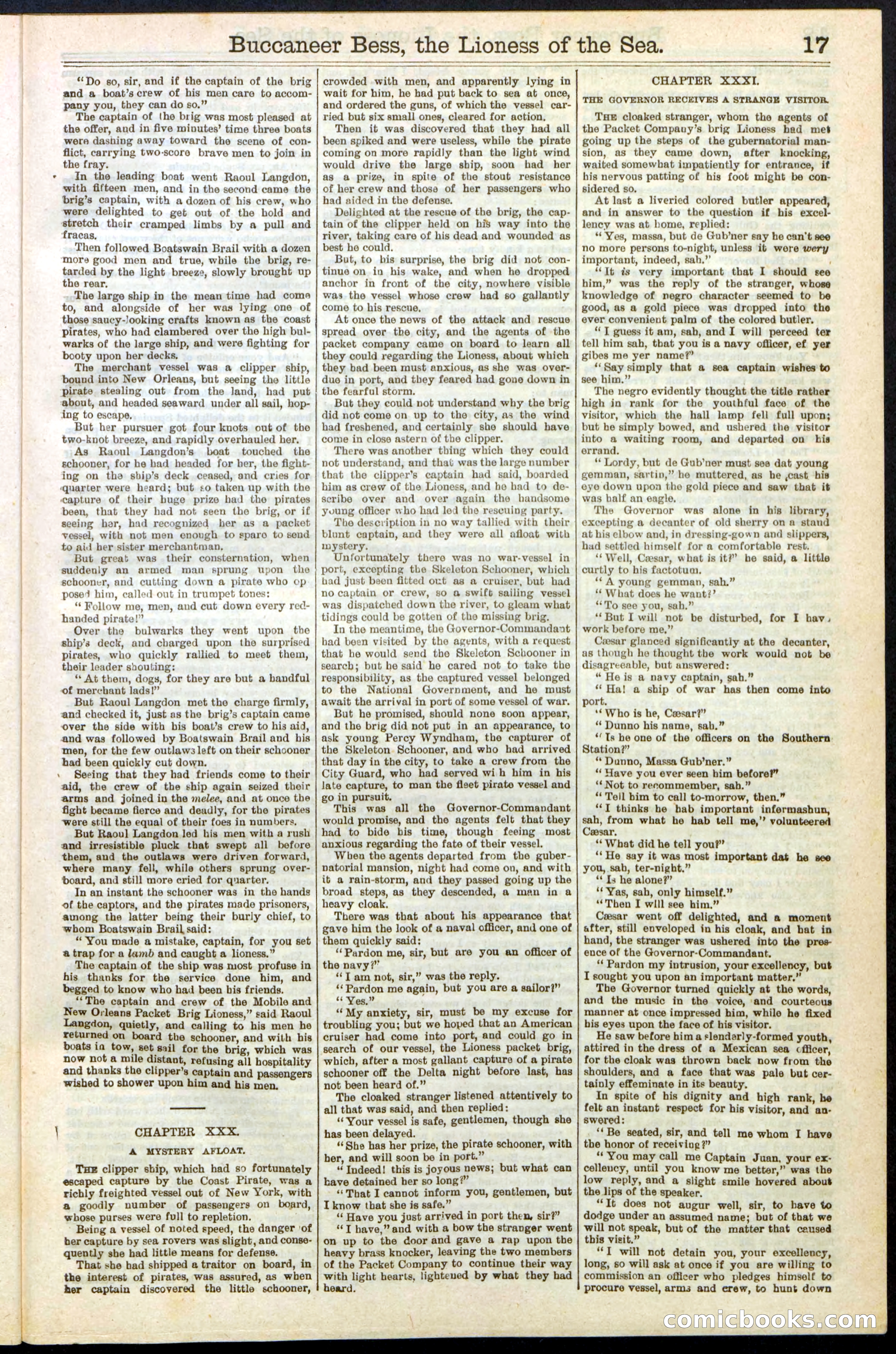
A restored page from Pulp Fiction, 1882. Page through the whole issue in the reader above.
📄 Transcribed text from this page (OCR, searchable)
Machine-transcribed from the original scan — historical spelling and the odd misread are preserved.
“Do so, sir, and if the captain of the brig and a boat’screw of his men care to accom- pany you, they can do so,” The captain of the brig was most pleased at the offer, and in five minutes’ time three boats were dashing away toward the scene of con- flict, carrying two-score brave men to join in the fray. In the leading boat went Raoul Langdon, with fifteen men, and in the second came the brig’s captain, with a dozen of his crew, who were delighted to get out of the hold and stretch their cramped limbs by a pull and fracas, Then followed Boatswain Brail with a dozen More good men and true, while the brig, re- tarded by the light breeze, slowly brought up the rear, The large ship in the mean time had come to, and alongside of her was lying one of those saucy-looking crafts known as the coast pirates, who had clambered over the high bul- warks of the large ship, and were fighting for booty upon ber decks, The merchant vessel was a clipper ship, bound into New Orleans, but seeing the little pirate stealing out from the land, had put about, and headed seaward under all sail, hop- ing to escape, But her pursuer got four knots out of the two-knot breeze, and rapidly overhauled her. As Raoul Langdon’s boat touched the schooner, for he bad headed for her, the fight- ing on the sbip’s deck ceased, and cries for quarter were heard; but so taken up with the capture of their buge prize had the pirates been, that they had not seen the brig, or if seeing har, had recognized ber as a packet vessel, with not men enough to sparo to send to aid her sister merchantman, But great was their consternation, when suddenly an armed man sprung upon the schooner, and cutting down a pirate who op posed him, called out in trumpet tones: ‘* Follow me, men, and cut down every red- handed pirate!” Over the bulwarks they went upon the ship’s deck, and charged upon the surprised pirates, who quickly rallied to meet them, their leader shouting: ** At them, dogs, for they are but a bandful of merchant lads!’ But Raoul Langdon met the charge firmly, and checked it, just as the brig’s captain came over the side with bis boat’s crew to his aid, and was followed by Boatswain Brail and his men, for the few outlaws left on their schooner had been quickly cut down. . Seeing that they had friends come to their aid, the crew of the ship again seized their arms and joined in the melee, and at once the fight became fierce and deadly, for the pirates were still the equal of their foes in numbers, But Raoul] Langdon led his men with a rush and irresistible pluck that swept all before them, and the outlaws were driven forward, where many fell, while others sprung over- board, and still more cried for quarter. In an instant the schooner was in the hands of the captors, and the pirates made prisoners, among the latter being their burly chief, to whom Boatswain Brail said: “You made a mistake, captain, for you set a trap for a lamb and caught a lioness.” The captain of the ship was most profuse in his thanks for the service done him, and begged to know who had been bis friends. ‘*The captain and crew of the Mobile and New Orleans Packet Brig Lioness,” said Raoul Langdon, quietly, and calling to his men he returned on board the schooner, and with his boats ia tow, set sail for the brig, which was now not a mile distant, refusing all hospitality wished to shower upon him and his men. CHAPTER XXX, A MYSTERY AFLOAT. Tue clipper ship, which had so fortunately escaped capture by the Coast Pirate, was a richly freighted vessel out of New York, with a goodly number of passengers on board, whose purses were full to repletion. | Being a vessel of noted speed, the danger ‘of ber capture by sea rovers was slight, and conse- quently she had little means for defense. That she had shipped a traitor on board, in the interest of pirates, was assured, as when her captain discovered the little schooner, Buccaneer Bess, the Lioness of a ae ee ee crowded with men, and apparently lying in wait for him, he bad put back to sea at once, and ordered the guns, of which the vessel car- ried but six small ones, cleared for action, Then it was discovered that they had all been spiked and were useless, while the pirate coming On more rapidly than the light wind would drive the large ship, soon had her as a prize, in spite of the stout resistance of her crew and those of her passengers who had aided in the defense. Delighted at the rescue of the brig, the cap- tain of the clipper held on his way into the river, taking care of his dead and wounded as best he could. But, to bis surprise, the brig did not con- tinue on in his wake, and when he dropped anchor in front of the city, nowhere visible was the vessel whose crew had 60 gallantly come to his rescue, At once the news of the attack and rescue spread over the city, and the agents of the packet company came on board to learn all they could regarding the Lioness, about which they bad been must anxious, as she was over- due in port, and they feared had gone down in the fearful storm. But they could not understand why the brig did not come on up to the city, as the wind had freshened, and certainly she should have come in close astern of the clipper. There was another thing which they could not understand, and that was the large number that the clipper’s captain had said, boarded him as crew of the Lioness, and he had to de- scribe over and over again the handsome yvung officer who had led the rescuing party. The description in no way tallied with their blunt captain, and they were all afloat with mystery. Unfortunately there was no war-vessel in port, excepting the Skeleton Schooner, which ad just been fitted oct as a cruiser, but had no captain or crew, so a swift sailing vessel was dispatched down the river, to gleam what tidings could be gotten of the missing brig. In the meantime, the Governor-Commandant had been visited by the agents, with a request that he would send the Skeleton Schooner in search; but he said he cared not to take the responsibility, as the captured vessel belonged to the National Government, and he must await the arrival in port of some vessel of war. But he promised, should none soon appear, and the brig did not put in an appearance, to ask young Percy Wyndham, the capturer of the Skeleton Schooner, and who had arrived that day in the city, to take a crew from the City Guard, who had served wih him in his late capture, to man the fleet pirate vessel and go in pursuit, This was all the Governor-Commandant would promise, and the agents felt that they had to bide bis time, though feeing most anxious regarding the fate of their vessel. When the agents departed from the guber- patorial mansion, night had come on, and with if a rain-storm, and they passed going up the broad steps, as they descended, a man in a heavy cloak, There was that about his appearance that gave him the look of a naval officer, and one of them quickly said; “Pardon me, sir, but are you an officer of the navy?” ‘‘T am not, sir,” was the reply. ‘Pardon me again, but you are a sailor?” es Yes,” “My anxiety, sir, must be my excuse for troubling you; but we hoped that an American cruiser had come into port, and could go in search of our vessel, the Lioness packet brig, which, after a most gallant capture of a pirate schooner off the Delta night before last, has not been heard of.” The cloaked stranger listened attentively to all that was said, and then replied: “Your vessel is safe, gentlemen, though she has been delayed. ‘‘ She has her prize, the pirate schooner, with her, and will soon be in port.” “ Indeed! this is joyous news; but what can have detained her so long?” ‘‘That I cannot inform you, gentlemen, but I know that she is safe.” ‘‘ Have you just arrived in port then, sir?” ‘““T have,” and with a bow the stranger went on up to the door and gave a rap upon the heavy brass knocker, leaving the two members of the Packet Company to continue their way with light hearts, lighteued by what they had heard. the Sea. 17 ee eee CHAPTER XXXI. THE GOVERNOR RECEIVES A STRANGE VISITOR THE cloaked stranger, whom the agents of the Packet Compauy’s brig Lioness had met going up the steps of the gubernatorial man- sion, as they came down, after knocking, waited somewhat impatiently for entrance, if his nervous patting of his foot might be con- sidered so, At last a liveried colored butler appeared, and in answer to the question if his excel- lency was at home, replied: ‘Yes, massa, but de Gub’ner say he can’t see no more persons to-night, unless it were wery important, indeed, sah,’’ ; ‘It is very important that I should see him,” was the reply of the stranger, whose knowledge of negro character seemed to be good, as a gold piece was dropped into the ever convenient palm of the colored butler. “T guess it am, sab, and I will perceed ter tell him sah, that you is a navy officer, ef yer gibes me yer name?” ‘‘Say simply that a sea captain wishes to see him.” | The negro evidently thought the title rather high in rank for the youthful face of the visitor, which the hall lamp fell full upon; but be simply bowed, and ushered the visitor into a waiting room, and departed on his errand. ‘* Lordy, but de Gub’ner must sea dat young gemman, sartin,” he muttered, as he ,cast his eye down upon the gold piece and saw that it was balf an eagle, The Governor was alone in his library, excepting a decanter of old sherry on a stand at his elbow and, in dressing-gown and slippers, had settled himself for a comfortable rest, ‘‘ Well, Caesar, what is it?” be said, a little curtly to his factotum, ‘*A young gemman, sah.” ** What does he want?’ “To see you, sah,” ‘*But I will not be disturbed, for I hav, work before me,” Ceesar glanced significantly at the decanter, as though he thought the work would not be disagreeable, but answered: “ He is a navy captain, sah.” ‘Ha! a ship of war has then come into port. ‘*Who is he, Cassar?” ** Dunno his name, sab.” ‘(Ts he one of the officers on the Southern Station?” * Dunno, Massa Gub’ner.” “Have you ever seen him before?” ‘** Not to reeommember, sah.” “‘ Tell bim to call to-morrow, then.” “I thinks be hab important infermashun, sah, from what he hab tell me,’’ volunteered Ceasar, ‘* What did he tell you?” ‘“‘He say it was most important dat he see you, sab, ter-night.” ‘** Ts he alone?” ‘*' Yas, sah, only himself.” “Then I will see him,” Cesar went off delighted, and a moment after, still enveloped in his cloak, and bat in hand, the stranger was ushered into the pres- ence of the Governor-Commandant, “Pardon my intrusion, your excellency, but I sought you upon an important matter,” The Governor turned quickly at the words, and the music in the voice, and courteous manner at once impressed him, while he fixed his eyes upon the face of his visitor. He saw before hima slenderly-formed youth, attired in the dress of a Mexican sea cflicer, for the cloak was thrown back now from the shoulders, and a face that was pale but cer- tainly effeminate in its beauty. In spite of his dignity and high rank, he felt an instant respect for his visitor, and an- swered: _ ‘Be seated, sir, and tell me whom I have the honor of receiving?” “You may call me Captain Juan, your ex- celleucy, until you know me better,” was the low reply, and a slight smile hovered about the lips of the speaker. “It does not augur well, sir, to bave to dodge under an assumed name; but of that we will not speak, but of the matter that caused this visit.” “I will not detain you, your excellency, long, so will ask at once if you are willing to commission an officer who pledges himself to procure vessel, arm3 and crew, to hunt down Eomichbooks (Eo)