
Pulp Fiction, 1882 · page 2 of 24
Beadle's New York Dime Library No. 209 — page 2: what you’re looking at
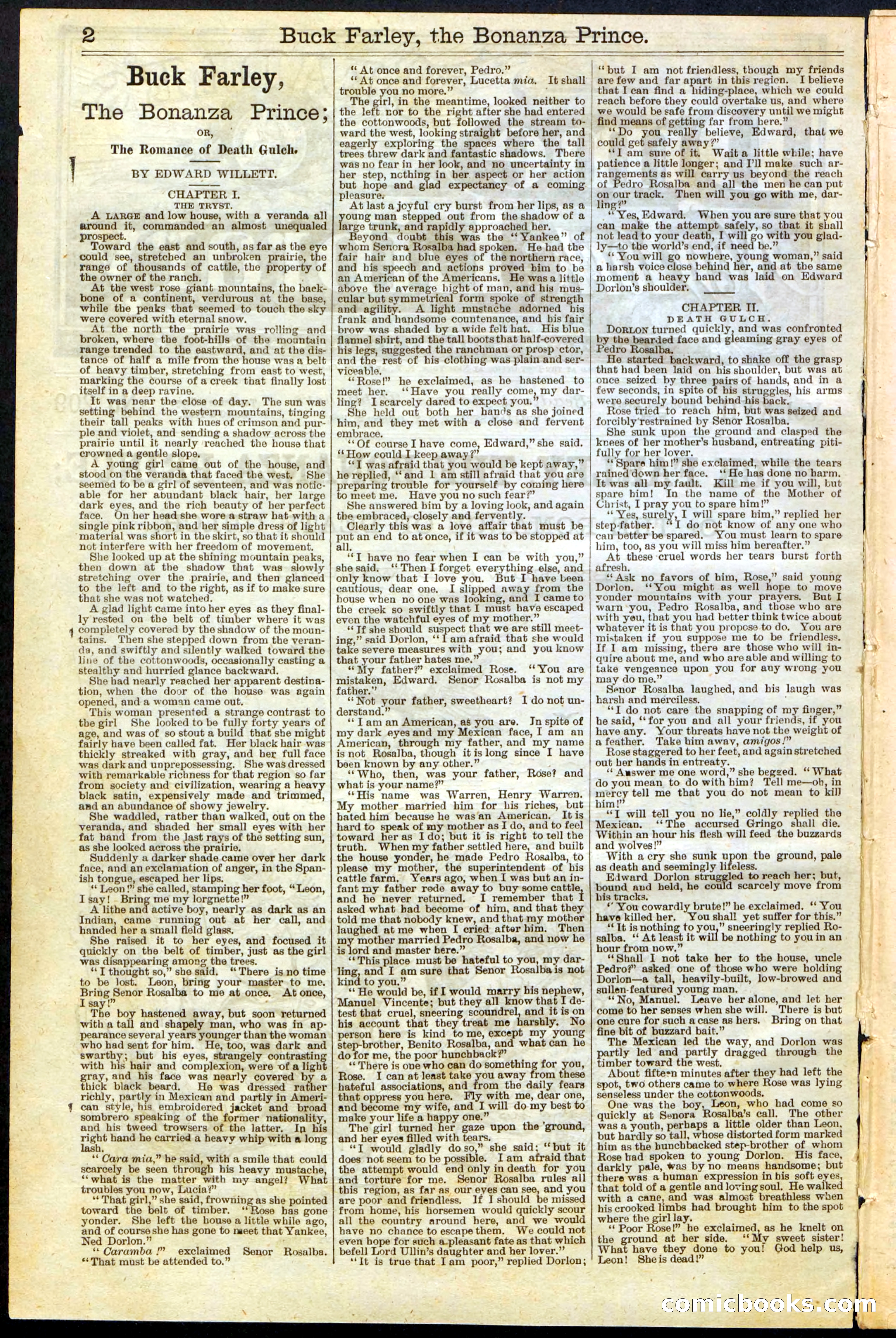
A restored page from Pulp Fiction, 1882. Page through the whole issue in the reader above.
📄 Transcribed text from this page (OCR, searchable)
Machine-transcribed from the original scan — historical spelling and the odd misread are preserved.
—- _ fat ban PD) Buck Farley, The Bonanza Prince; OR, The Romance of Death Gulch BY EDWARD WILLETT. CHAPTER I. THE TRYST. _A LARGE and low house, with a veranda all around ts commanded an almost unequaled prospect. Toward the east and south, as far as the eye could see, stretched an unbroken prairie, the range of thousands of cattle, the property of the owner of the ranch. At the west rose giant mountains, the back- bone of a continent, verdurous at the base, while the peaks that seemed to touch the sky were covered with eternal snow. Aft the north the prairie was rolling and broken, where the foot-hills of the mountain range trended to the eastward, and at the dis- tance of half a mile from the house was a belt of heavy timber, stretching from east to west, marking the course of a creek that finally lost itself in a deep ravine. It was near the close of day. The sun was setting behind the western mountains, tinging their tall peaks with hues of crimson and pur- ple and violet, and sending a shadow across the prairie until it nearly reached the house that crowned a gentle slope, A young girl came out of the house, and stood on the veranda that faced the west. She seemed to be a girl of seventeen, and was notic- able for her abundant black hair, her large dark eyes, and the rich beauty of her perfect face. On her head she wore a straw hat with a single pink ribbon, and her simple dress of light material was short in the skirt, so that it should not interfere with her freedom of movement. She looked up at the shining mountain peaks, then down at the shadow that was slowly stretching over the prairie, and then glanced to the left and to the right, as if to make sure that she was not watched. A glad light came into her eyes as they final- ly rested on the belt of timber where it was completely covered by the shadow of the moun- tains. Then she stepped down from the veran- da, and swiftly and silently walked toward the line of the cottonwoods, occasionally casting a stealthy and hurried glance backward. She had nearly reached her apparent destina- tion, when the door of the house was again opened, and a woman came out. This woman presented a strange contrast to the girl She looked to be fully torty years of age, and was of so stout a build that she might fairly have been called fat. Her black hair was thickly streaked with gray, and ber full face was dark and unprepossessing. She was dressed with remarkable richness for that region so far from society and civilization, wearing a heavy black satin, expensively made and trimmed, and an abundance of showy jewelry. She waddled, ratber than walked, out on the veranda, and shaded her small eyes with her from the last rays of the setting sun, as she looked across the prairie. Suddenly a darker shade came over her dark face, and an exclamation of anger, in the Span- ish tongue, escaped her lips. ** eon!” she called, stamping her foot, “Leon, I say! - ae me my lorgnette!” A lithe and active boy, nearly as dark as an Indian, came running out at her call, and handed her a small field glass. She raised it to her eyes, and focused it quickly on the belt of timber, just as the girl was disappearing among the trees. ‘*T thought so,” she said. “There is no time to be lost. Leon, bring your master to me. Bring Senor Rosalba to me at once. At once, Isay! The a hastened away, but soon returned with a and shapely man, who was in ap- pearance several years younger than the woman who had sent for him. He, too, was dark and swarthy; but his eyes, strangely contrastin with his hair and complexion, were of a ligh ray, and his face was nearly covered by a hick black beard. He was dressed Sather richly, partly in Mexican and partly in Ameri- can style, his embroidered jacket and b sombrero speaking of the former nationality, and his tweed trowsers of the latter. In his nee hand he carried a heavy whip with a long ‘* Cara mia,” he said, with a smile that could be seen through his heavy mustache “what is the matter with my angel? Wha troubles you now, Lucia?” “That girl,” she said, frowning as she pointed toward the belt of timber. ‘ bas gone yonder. She left the house a little while ago, and of course she has gone to naeet that Yankee, Ned Dorlon.” : ‘* Oaramba !” exclaimed Senor Rosalba. *‘That must be attended to.” ** At once and forever, Pedro.” ** At once and forever, Lucetta mia, It shall trouble you no more.” The girl, in the meantime, looked neither to the left nor to the right after she had entered the cottonwoods, but followed the stream to- ward the west, looking straight before her, and eagerly exploring the ces where the tall trees threw dark and fantastic shadows. There was no fear in her look, and no uncertainty in her step, ncthing in ber aspect or her action but hope and glad expectancy of a coming pleasure. At last a joyful cry burst from her lips, as a oung man stepped out from the shadow of a arge trunk, and rapidly approached her. eyond doubt this was the ‘‘ Yankee” of whom Senora Rosalba had spoken. He had the fair hair and blue eyes of the northern race, and his speech and actions proyed bim to be an American of the Americans. He was a little above the average hight of man, and his mus- cular but symmetrical form spoke of strength and agility. A light mustache adorned his frank and handsome countenance, and bis fair brow was shaded by a wide felt hat. His blue flannel shirt, and the tall boots that half-covered his legs, suggested the ranchman or prosp ctor, and the rest of his clothing was plain and ser- viceable. “Rose!” he exclaimed, as he hastened to meet her. ‘‘Have you really come, my dar- ling? Iscarcely dared to expect you.” She held out both her hands as she joined him, and they met with a close and fervent embrace. ‘Of course I have come, Edward,” she said. ** How could I keep away?” “T was afraid that you would be kept away,” he replied, ‘‘and 1 am still afraid that you are Buck Farley, the Bonanza Prince. | a | ‘but I am not friendless, though my friends are few and far apart in this region. I believe that I can find a hiding-place, which we could reach before they could overtake us, and where we would be safe from discovery until we might find means of getting far from here.” ‘**Do you really believe, Edward, that we could get safely away?” **] am sure of it. Waita little while; have patience a little longer; and I'll make such ar- rangements as will carry us beyond the reach of Pedro Rosalba and all the men he can put co our track. Then will you go with me, dar- ng? ‘Yes, Edward. When you are sure that you can make the attempt safely, so that it shall not lead to your death, I Me TS with you glad- ly—to the world’s end, if need be.” ** You will go nowhere, young woman,” said harsh voice close behind her, and at the same moment a heayy band was laid on Edward Dorlon’s shoulder, CHAPTER II. DEATH GULCH. Dorion turned quickly, and was confronted by the bearded face and gleaming gray eyes of Pedro Rosalba. He started backward, to shake off the grasp that had been laid on his shoulder, but was at once seized by three pairs of hands, and in a few seconds, in spite of his struggles, his arms were securely bound behind-his Sok. Rose tried to reach him, but was seized and forcibly'restrained by Senor Rosalba. She sunk upon the ground and clasped the knees of her mother’s husband, entreating piti- fully for her lover, ‘* Spare him!” she exclaimed, while the tears rained down her face. ‘‘ He has done no harm. preparing trouble for yourself by coming here | It was all my fault. Kill me if you will, but to meet me. Have you no such fear?” She answered bim by a loving look, and again the embraced, closely and fervently. Clearly this was a love affair that must be ae an end to at once, if if was to be stopped at all, ‘“T have no fear when I can be with you,” she said. ‘‘ Then I forget everything else, and only know that I love you. But I have been cautious, dear one. I slipped away from the house when no one was looking, and I came to the creek so swiftly that I must have escaped even the watchful eyes of my mother.” ‘Tf she should suspect that we are still meet- ing,” said Dorlon, ‘ { am afraid that she would take severe measures with you; and you know that your father hates me.” “My father?’ exclaimed Rose. ‘You are mistaken, Edward. Senor Rosalba is not my father.” P ‘‘Not your father, sweetheart? I do not un- derstand.” ‘‘Tam an American, as you are. Jn spite of my dark eyes and my Mexican face, [ am an American, through my father, and my name is not Rosalba, though itis long since I have been known by any other.” ‘‘Who, then, was your father, Rose? and what is your name?” ‘‘His name was Warren, Henry Warren. My mother married him for his riches, but bated him because he wasn American, It is hard to ak of my mother as I do, and to feel toward her as I do; but it is right to tell the truth. When my father settled here, and built the house yonder, he made Pedro Rosalba, to please my mother, the superintendent of bis cattle farm, Years ago, when I was but an in- fant my father rede away to buy some er and he never returned. I remember that asked what bad become of him, and that they told me that nobody knew, and that my mother laughed at me when I cried afterhim. Then my mother married Pedro Rosalba, and now he is lord and master here.” ; ‘‘This place must be hateful to you, my dar- ling, and I am sure that Senor Rosalbais not kind to you.” ‘He would be, if I would marry his nephew, Manuel Vincente; but they all know that I de- test that cruel, sneering scoundrel, and it is on his account that they treat me harshly. No person here is kind_to me, per my young step-brother, Benito Rosalba, and what can he do for me, the poor hunchback?” ‘‘ There is one who can do something for you, Rose. I can at least take you away from these hateful associations, and from the daily fears that oppress you here. Fly with me, dear one, and become my wife, and I will do my best to make your life a happy one.” The girl turned her gaze upon the ‘ground, and her eyes filled with tears. , “T would gladly doso,” she said; ‘but it does not seem to be possible. Iam afraid that the attempt would end only in death for you and torture for me. Senor Rosalba rules all this region, as far as our eyes can see, and you are poor and friendless. If I should be missed from home, his horsemen would quickly scour all the country around here, and we would have no chance to escapethem. We could not even hope for such a-pleasant fate as that which befell Lord Ullin’s daughter and her lover.” ‘‘It is true that Iam poor,” replied Dorlon; spare him! In the name of the Mother of Christ, I pray you to spare him!” ‘* Yes, surely, I will spare him,” replied her step-father. “T do not know of any one who can better be spared. You must learn to spare him, too, as you will miss him hereafter.” At these cruel words her tears burst forth afresh. ‘Ask no favors of him, Rose,” said young Dorlon. ‘*You might as well hope to move vonder mountains with your prayers. But I warn you, Pedro Rosalba, and those who are with you, that you had better think twice about whatever it is that you propose to do. You are mistaken if you suppose me to be friendless. If I am missing, there are those who will in- quire about me, and who are able and willing to take vengeance upon you for auy wrong you may do me.” Senor Rosalba laughed, and his laugh was harsh and merciless. ‘*T do not care the snapping of my finger,” he said, ‘*for you and all your friends, if you have any. Your threats have not the weight of a feather. Take him away, amigos!” Rose staggered to her feet, and again stretched out ber hands in entreaty. ‘* Awswer me one word,” she begged. ‘* What do you mean to do with bim? Tell me—oh, in mercy tell me that you do not mean to kil} him!’ “T will tell you no lie,” coldly replied the Mexican. ‘‘The accursed Gringo shall die. Within an hour his flesh will feed the buzzards and wolves!” With acry she sunk upon the ground, pale as death and seemingly lifeless. Edward Dorlon atraagpe to reach her; but, bound and held, he could scarcely move from his tracks. ‘You cowardly brute!” he exclaimed. ‘‘ You have killed her. You shal! yet suffer for this.” ‘‘ It is nothing to you,” sneeringly replied Ro- salba. ‘‘ At least it will be nothing to youin an hour from now,” ‘Shall I not take her to the house, uncle Pedro?” asked one of those who were holding Dorlon—a tall, heavily-built, low-browed and sullen-featured young man. ‘‘ No, Manuel. Leave ber alone, and let her come to her senses when she will. There is but one cure for such a case as hers. Bring on that fine bit of buzzard bait.” The Mexican led the way, and Dorlon was partly led and partly dragged through the timber toward the west. About fiftesn minutes after they had left the spot, two others came to where Rose was lying senseless under the cottonwoods, One was the boy, Leon, who had come so quickly at Senora Rosalba’s call, The other was a youth, perbaps a little older than Leon, but hardly so tall, whose distorted form marked him as the bunchbacked step-brother of whom Rose bad spoken to young Dorlon. His face, darkly pale, was by no means handsome; but there was a human expression in his soft eyes, that told of a gentle and loving soul. He walked with a cane, and was almost breathless when his crooked limbs had brought him to the spot where the girl lay. ‘¢ Poor Rose!” he exclaimed, as he knelt on the ground at her side. “My sweet sister! What have they Leon! Sheis dead! Se (EO) (E 100 nS Ba done to you! God help us, + | : ' : 1 i 4