
Pulp Fiction, 1882 · page 13 of 24
Beadle's New York Dime Library No. 209 — page 13: what you’re looking at
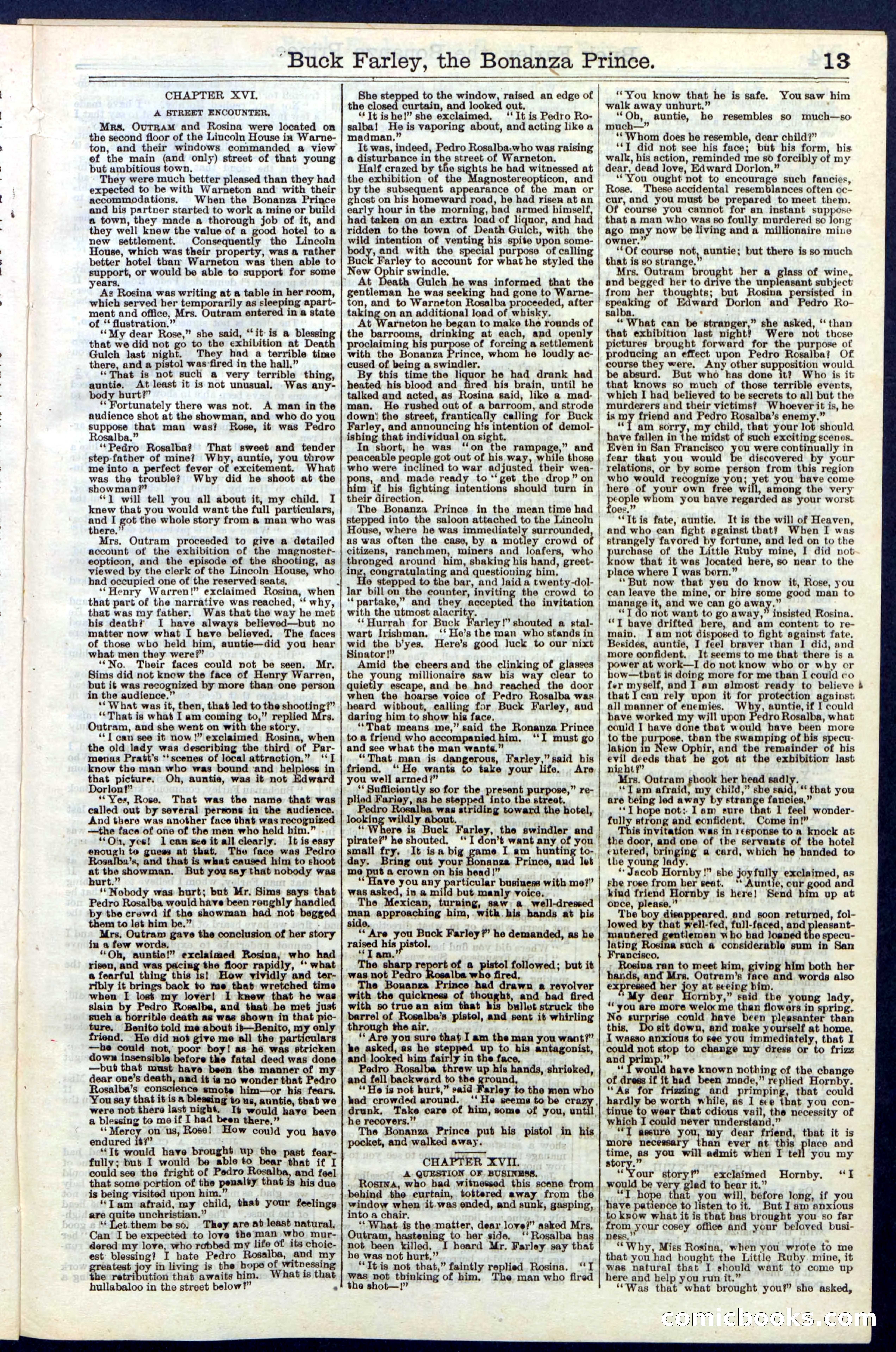
A restored page from Pulp Fiction, 1882. Page through the whole issue in the reader above.
📄 Transcribed text from this page (OCR, searchable)
Machine-transcribed from the original scan — historical spelling and the odd misread are preserved.
2 oe ee “Buck Farley, the Bonanza Prince. is CHAPTER XVI. A STREET ENCOUNTER, Mrs. OvurrRamM and Rosina were located on the second floor of the Lincoln House in Warne- ton, and their windows commanded a view ef the main (and only) street of that young but ambitious town, They were much better pleased than they had expected to be with Warneton and with their accommodations. When the Bonanza Prince and his partner started to work a mine or build a town, they made a thorough job of it, and they well knew the value of a good hotel to a new settlement. Consequently the Lincoln House, which was their property, was a rather better hotel than Warnetou was then able to support, or would be able to support for some ears, 4 As Rosina was writing at a table in her room, which served her temporarily as sleogane apart- ment and office, Mrs. Outram entered in a state of “ flustration.” ‘““My dear Rose,” she said, “it is a ene that we did not go to the exhibition at Deat Gulch last night. They had a terrible time there, and a pistol was-fired in the hall,” “That is not such a very terrible thing, auntie. At least it is not unusual. Was any- body hurt?” ‘Fortunately there was not. A man in the audience shot at the showman, and who do you suppose that man was? Rese, it was Pedro Rosalba,” ‘Pedro Rosalba? That sweet and tender step-father of mine? Why, auntie, you throw me into a perfect fever of excitement. What was the trouble? Why did he shoot at the showman?” **] will tell you all about it, my child. I knew that yon would want the full particulars, and I got the whole story from a man who was there.’ Mrs. Outram proceeded to give a detailed account of the exhibition of the magnoster- eopticon, and the episode of the shooting, as viewed by the clerk of the Lincoln House, who had occupied one of the reserved seats, Z ‘“Henry Warren!” exclaimed Rosina, when that part of the narrative was reached, “ why, that was my father. Was that the way he met his death? I have eodving believed—but no matter now what I heve believed. The faces of those who held him, auntie—did you hear what men they were?” ‘‘No. Their faces could not be seen. Mr. Sims did not know the face of Henry Warren, but it was recognized by more than one person in the audience.” ‘* What was it, then, that led to the shooting?” ‘“‘That is what I am coming to,” replied Mrs. Outram, and she went on with the story. ‘*T can see it now!” exclaimed Rosina, when the old lady waa describing the third of Par- menas Pratt's *‘scenes of local attraction,” ‘I know the man who was bound ‘and helpless in that picture. Oh, auntie, was it not Edward Dorlon?f” | ‘*'Yes, Rose. That was the name that was called out by several persons in the audience. And there was another face that was recognized —the face of one of the men who held bim.” . ' “Ob, yes! Lean seo it all clearly. It is easy qoeughs 5 guess at that. The face was Pedro ’s, and that is what ca him to shoot - the showman. But you say that nobody was urt. ‘‘ Nobody was hurt; but Mr. Sims says that Pedro Rosalba would have been roughly handled by the crewd if the showman had not begged them to let him be.” ' Mrs. Outram gave the conclusion of her story in a few words. “Oh, auntioc!” exclaimed Rosina, who had risen, and was oacing the floor ra idly, * what a fearful thing this is! How vividl and ter- ribly it brings back to me that wretched time when I lost my lover! I knew that he was slain by Pedro be, and that he met just such a borrible death as was shown in that pic- Benito told me about it—Benito, my only friend. He did not give me all the a bas a wed —he could not, poor boy! as he was stricken down insensible before the fatal deed was done —but that must have been the manner of my dear one’s death, and it is no wonder that Pedro Rosalba’s conscience smote him—or his fears. You say that it is a blessing to us, auntie, that we were not there last night. It would have been a blessing to mo if I had been there,” ‘‘Mercy on us, Rose! How could you have Sra e tromkd Hewel btengiot tupes th “Tt wou ave broug P the past fear- fully; but I would be able to bear that if I could see the fright of Pedro Rosalba, and feel that some portion of the penalty that is his due is being visited upon him.” “Tam afraid, my child, that your feelings are quite unchristian.” ‘‘Let.them beso. They are at least natural, Can I be expected to love the man who mur- dered my love, who robbed my life of its choic- est’ blessing? 1 Bare ages Roses el ad test joy in living is the bo Seeurteet totion that awaite him. What is that hullabaloo in the street below?” . Bhe ste to the window, raised an edge of the clo curtain, and looked out. ‘It ishe!” she exclaimed. ‘‘It is Pedro Ro- salba! He is vaporing about, and acting like a madman.” It was, indeed, Pedro Rosalba,who was raising a disturbance in the street of Warneton. Half crazed by the sights he had witnessed at the exhibition of the Magnostereopticon, and P 4 the subsequent appearance of the man or ghost on his homeward road, he had risen at an early hour in the morning, had armed himself, had taken on an extra load of liquor, and had ridden tothe town of Death Gulck, with the wild intention of venting his spite upon some- soe ty and with the special purpose of calling Buck Farley to account for what he styled the New Ophir swindle. At th Gulch he was informed that the gentleman he was seeking had gone to Warne- ton, and to Warneton Rosalba proceeded, after taking on an additional load of whisky. At Warneton he began to make the rounds of the barrooms, drinking at each, and openly proclaiming his pornos of forcing a settlement with the Bonanza Prince, whom he loudly ac- cused of being a swindler. By this time the liquor he had drank had heated his blood and fired his brain, until he talked and acted, as Rosina said, like a mad- man. He rushed out of a barroom, and strode down’! the street, frantically calling for Buck Farley, and announcing his intention of demol- isbing that individual on sight. In short, he was ‘‘on the rampage,” and peaceable people got out of his way, while those who were inclined to war adjusted their wea- pont, and made ready to ‘get the drop” on im if his fighting intentions should turn in their direction. The Bonanza Prince in the mean time had stepped into the saloon attached to the Lincoln House, where he was immediately surrounded as was often the case, by a motley crowd of citizens, ranchmen, miners and loafers, who thronged around him, shaking his hand, greet- ing, congratulating and questioning him, 8 stepped to the bar, and Jaid a twenty-dol- lar bill on the counter, inviting the crowd to ‘* partake,” and they accep the invitation with the utmost tgs ‘*Hurrah for Buck Farley!” shouted a stal- wart Irishman, ‘‘ He’s the man who stands in wid the b’yes. Here’s good Juck to our nixt Sinator!” Amid the cheers and the clinking of glasses the young millionaire saw his way clear to quietly escape, and be had reached the door when the hoarse voice of Pedro Rosalba was heard without, calling for Buck Farley, aud daring him to show his face. ‘That means me,” said the Ronanza Prince to a friend who accompanied him. ‘I must go and see what the man wants.” “That man is dangerous, Farley,” said his friend. ‘“ He wants to take your life. Are you well armed?” ‘* Sufficiontly so for the present p ” re- plied Fariey, as he stepped into the streot. Pedro Rosalba was striding toward the hotel, ei) wildly about. 7 ‘Where is Buck Farley, the swindler and pirate?” he shouted. ‘I don’t want any of you small fry. day. Bring out your Bonanza Prince, and let me put a crown on bis head!” “Have you any particular business with mo?” was asked, in a mild but manly voice. The Mexican, turning, saw a_ well-dressed man approaching him, with his hands at bis “Are you Buck Farley?’ he demanded, as be raised his pistol. - “T am,’ : Rosalba whe fired.) The was not P Bonanga had drawn a revolver with the quickness of t , and bad fired with sotruean aim that bullet struck the barrel of Rosalba’s pistol, and sent it whirling through the air. sa eee ee or erent oa et a e as he s up to antagonist, so locked bias ty in the face, shrioked rew and fell backward to ns a Bi as ‘* He is not hurt,” said ley to the men who wad crowded around. ‘‘ He seems to be c drunk, Take care of him, some of you, un he recovers.” The Bonanza Prince put his pistol in his pocket, and walked away. CHAPTER XVII. A QUESTION OF BUSINESS, . Rosrva, who bad witnessed this scene from behind the eurtain, tottered away from the window when it-was ended, and sunk, gasping, into a chair. ‘What. is the matter, dear love?’ asked Mrs, Outram, hastening to her side. ‘' Rosalba bas not been killed, I heard Mr. Farley say that he was not hurt,” “It is not that,” faintly replied Rosina. “I was not thinking of him, e@ man who fired the shot—!” It is a big fame Iam hunting to-. o 1, ‘You know that he is safe. walk away unhurt.” “Ob, auntie, be resembles so much—so much—” ‘Whom does he resemble, dear child?” ‘*T did not see his face; but his form, bis walk, his action, reminded me 80 forcibly of my dear, dead love, Edward Dorlon.” ‘You ought not to encourage such fancies, Rose. These accidental resemblances often oc- cur, and you must be prepared to meet them. Of course you cannot for an instant suppose that a man who was so foully murdered so Jong ago may now be living anda millionaire mine owner.” “Of course not, auntie; but there is so much that is so strange.” Mrs. Outram brought her a pines of wine, and begged her to drive the unpleasant subject from her thoughts; but Rosiva persisted in = (sd of ward Dorlon and Pedro Ro- sa oo “What can be stranger,” she asked, “than that exhibition last night? Were not those pictures brought forward for the purpose of producing an effect upon Pedro Rosalba! Of course they were, Any other supposition would be absurd. But who has done it? Who is it that knows so much of those terrible events, which I had believed to be secrets to all but the murderers and their victims? Whoever it is, he is my friend and Pedro Rosalba’s enemy.” ““T am sorry, my child, that your lot should have fallen in the midst of such exciting scenes. Even in San Francisco hee were continually in fear that you would discovered by your relations, or by some person from this region who would recognize you; yet you bave come here of your own free will, among the very -ople whom you bave regarded as your worst “It is fate, auntie. It is the will of Heaven, and who ean fight sgainst that? When I was strangely favored by fortune, and led on to the poschass of the Little Ruby mine, I did not now that it was located here, so near to the place where I was born.” “But now that yeu do know it, Rose, you can leave the mine, or hire some good man to manage it, and we can go away.” “IT do not want to go away,” insisted Rosina. “TI bave drifted here, and am content to re- main. I am not disposed to fight against fate. Besides, auntie, I feel braver than I did, and more confident. It seems to me that there is a pow, at work—I do not know who or why or ow—tbat is doing more for me than I could co fer myself, and I am almost ready to believe } that lcan rely upon it for protection against all manner of enemies. Why, auntie, if I could have worked my will upon Pedro Rosalba, what pr I have hie ag would have bse more o the pu . than the swamping of bis specu- lation fo New Ophir, and the remainder of bis a4 deeds that he got at the exbibition last nig ht? Mrs. Outram ghook her head wer ‘Tam afraid, my child,” she said, “ that you are being led away by strange fancies,” ‘*T hope not: lam sure that 1 feel wonder- fully strong and confident. Come in!” invitation was in 1«sponse to a knock at the door, and one of the servants of the hotel eutered, bringing a card, which he handed to the young lady. . ** Jacob Hornby!” she jo fally exclaimed, as che rose from ber seat. ** Auntie, our good and kind friend Hornby is here! Send him up at once, please.” The boy disappeared. and soon returned, fol- lowed by that well-fed, full-faced, and serenens: Tyce jal omaha «bo bad loaned the specu- lating such a considerable sum in San Francisco, - Rosiva ran to meet him, giving him both her You saw him hands, and Mra. Outrem’s face and words also expressed her joy at seeing bim. My dear Hornby,” said the young lady, *‘ you are more wela me than flowers in spring. No could have been pleasanter than this, sit down, and make yourself at home. I waeso anxious to see you immediately, that I could not stop to change my dress or to frizz and S poo . .‘T would have known nothing of the change of dress if it had been made,” replied Hornby. “As for fr and primping, that could hardly be worth while, as I se that you con- | tinue to wear that odious vail, the necessity of which I could never understand,” “TI assure you, my dear friend, that it is more necessary than ever at this place and pr as you will admit when I tell you my svory. “Your story!” exclaimed Hornby. “I would be a glad to hear it.” “T hope tha you will, before long, if you Sighs patience to listen to it. But I am anxious know what it is that bas brought you so far from your cosey office and your beloved busi- ness,’ + “Why, Mies Rosina, when you wrote to me that you had bought the Little Ruby. mine, it was natural that I should want to come up here and help you run it.” ‘““Was that what brought you?” she asked, CORNICE MOOKS. EO)