
Pulp Fiction, 1882 · page 26 of 28
Beadle's New York Dime Library, No. 196 — page 26: what you’re looking at
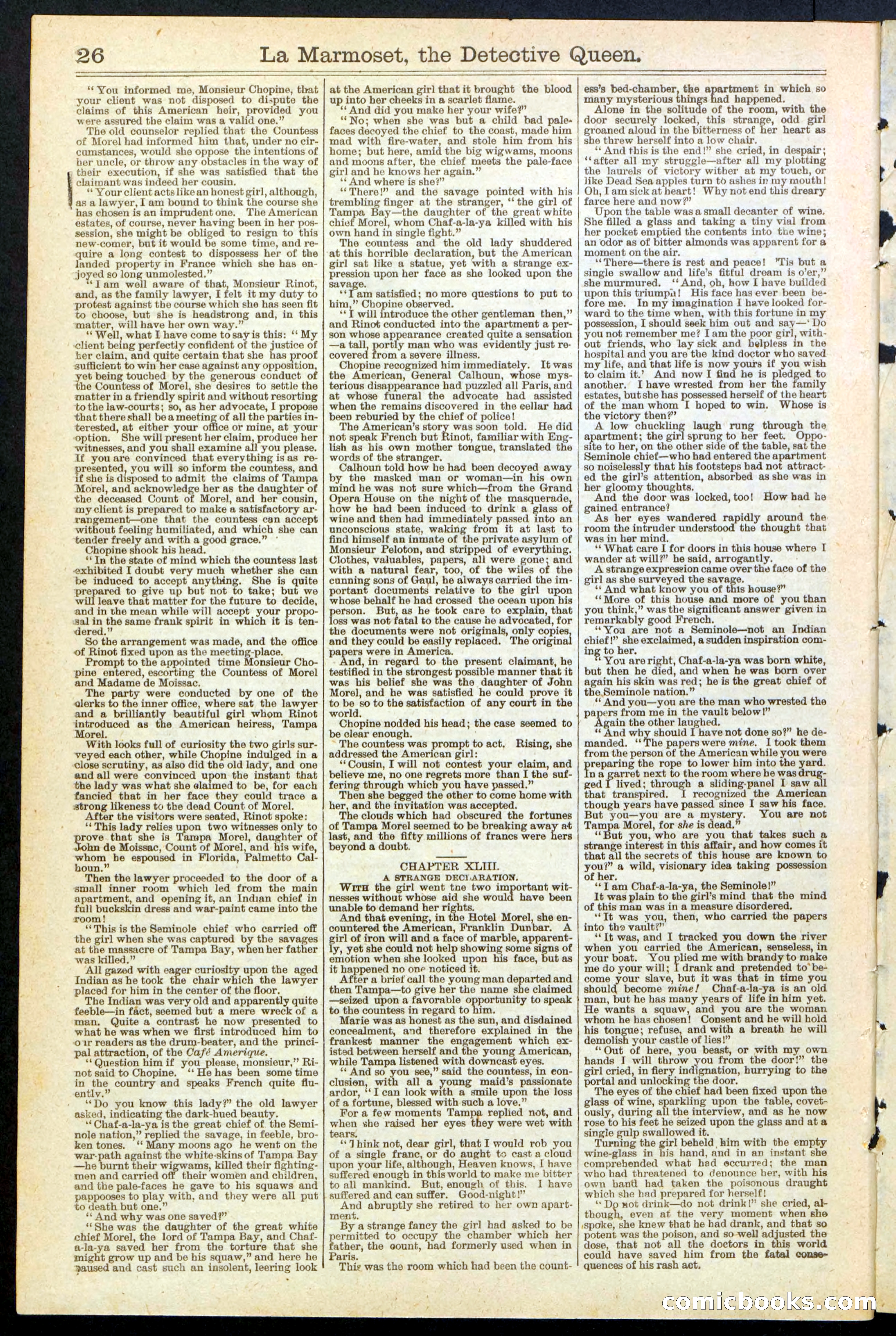
A restored page from Pulp Fiction, 1882. Page through the whole issue in the reader above.
📄 Transcribed text from this page (OCR, searchable)
Machine-transcribed from the original scan — historical spelling and the odd misread are preserved.
o— | 26 La Marmoset, the Detective Queen, ‘You informed me, Monsieur Chopine, that your client was not disposed to dispute the claims of this American heir, provided you were assured the claim was a valid one.” The old counselor replied that the Countess of Morel had informed him that, under no cir- cumstances, would she oppose the intentions of ber uncle, or throw any obstacles in the way of their execution, if she was satisfied that the claimant was indeed her cousin. ** Your client acts like an honest girl, although, as a lawyer, 1 am bound to think the course she has chosen is an imprudentone. The American estates, of course, never having been in her pos- session, she might be obliged to resign to this new-comer, but it would be some time, and re- quire a long contest to dispossess her of the landed property in France which she has en- joyed so long unmolested.” ‘Tam well aware of that, Monsieur Rinot, and, as the family lawyer, I felt it my duty to protest against the course which she has seen fit to choose, but she is headstrong and, in this matter, will have her own way.” ‘Well, what I have come tosayis this: ‘‘ My «<lient being perfectly confident of the justice of ber claim, and quite certain that she has proof sufficient to win her case against any opposition, et being touched by the generous conduct of he Countess of Morel, she desires to setitle the matter iv a friendly spirit and without resorting to the law-courts; so, as her advocate, I propose that there shall bea meeting of all the parties in- terested, at either your office or mine, at your option. She will present her claim, produce her ‘witnesses, and you shall examine all you please. If youare convinced that everything is as re- resented, you will so inform the countess, and if she is disposed to admit the claims of Tampa Morel, and acknowledge ber as the daughter of the deceased Count of Morel, and her cousin, my client is prepared to make a satisfactory ar- rangement—one that the countess can accept without feeling humiliated, and which she can tender freely and with a good grace.” ° Chopine shook his head. **In the state of mind which the countess last exhibited I doubt very much whether she can be induced to accept anything. She is quite sits! rat to give up but not to take; but we will leave that matter for the future to decide, and in the mean while will accept your propo- Sal in the same frank spirit in which it is ten- dered.” So the arrangement was made, and the office of Rinot fixed upon as the meeting-place. Prompt to the appointed time Monsieur Cho- pine entered, escorting the Countess of Morel and Madame de Moissac. The party were conducted by one of the alerks to the inner office, where sat the lawyer and a brilliantly beautiful girl whom Rinot introduced as the American heiress, Tampa Morel. With looks full of curiosity the two girls sur- veyed each other, while Chopine indulged in a close scrutiny, as also did the old lady, and one and all were convinced upon the instant that the lady was what shoe elaimed to be, for each fancied that in her face they could trace a strong likeness to the dead Count of Morel. After the visitors were seated, Rinot spoke: ** This lady relies — two witnesses only to ove that she is Tampa Morel, daughter of John de Moissac, Count of Morel, and his wife, shina he espoused in Florida, Palmetto Cal- oun. Then the lawyer proceeded to the door of a small inner room which led from the main apartment, and opening it, an Indian chief in full buckskin dress and war-paint came into the room! ‘*This is the Seminole chief who carried off the girl when she was captured by the savages at the massacre of Tampa Bay, when her father was killed.” All gazed with eager curiosity upon the aged Indian as he took the chair which the lawyer placed for him in the center of the floor. The Indian was very old and apparently quite feeble—in fact, seemed but a mere wreck of a man. Quite a contrast he now presented to what he was when we first introduced him to o1r readers as the drum-beater, and the princi- pal attraction, of the Café Amerique. ‘Question him if you please, monsieur,’’ Ri- not said to Chopine. ‘‘ He has been some time in the country and speaks French quite fiu- ently.” **Do you know this lady?’ the old lawyer asked, indicating the dark-hued beauty. ‘‘Chaf-a-la-ya is the great chief of the Semi- nole nation,” replied the savage, in feeble, bro- ken tones. ‘‘ Many moons ago he went on the war-path ae the white-skins of Tampa Bay —he burnt their wigwams, killed their fighting- men and carried off their women and children, and the pale-faces he gave to his squaws and pappooses to play with, and they were all put to death but one.” ** And why was one saved?” ‘‘She was the daughter of the great white chief Morel, the lord of Tampa Bay, and Chaf- a-la-ya saved her from the torture that she might grow up and be his squaw,” and here he paused and cast such an insolent, leering look at the American girl that it brought the blood up into her cheeks in a scarlet flame. ** And did you make her your wife?” ** No; when she was but a child had pale- faces decoyed the chief to the coast, made him mad with fire-water, and stole him from his home; but here, amid the big wigwams, moons and moons after, the chief meets the pale-face girl and he knows her again.” ** And where is she?” “There!” and the savage pointed with his trembling finger at the stranger, ‘‘ the girl of Tampa Bay—the daughter of the great white chief Morel, whom Chaf-a-la-ya killed with his own hand in single fight.” The countess and the old lady shuddered at this horrible declaration, but the American girl sat like a statue, yet with a strange ex- pression upon her face as she looked upon the savage. ‘*T am satisfied; no more questions to put to him,’”’ Chopine observed. ‘*T will introduce the other gentleman then,” and Rinot conducted into the apartment a per- son whose appearance created quite a sensation —a tall, portly man who was evidently just re- covered froma severe illness. Chopine recognized him immediately. It was the American, General Calhoun, whose mys- terious disappearance had puzzled all Paris, and at whose funeral the advocate had assisted when the remains discovered in the cellar had been reburied by the chief of police! The American’s story was soon told. He did not speak French but Rinot, familiar with Eng- lish as his own mother tongue, translated the words of the stranger. Calhoun told how he had been decoyed away by the masked man or woman—in his own mind he was not sure which—from the Grand Opera House on the night of the masquerade, how he had been induced to drink a glass of wine and then had immediately passed into an unconscious state, waking from it at last to find himself an inmate of the private asylum of Monsieur Peloton, and stripped of everything. Clothes, valuables, papers, all were gone; and with a natural fear, too, of the wiles of the eunning sons of Gaul, he always carried the im- portant documents relative to the girl upon whose behalf he had crossed the ocean upon his rson. But, as he took care to explain, that oss was not fatal to the cause he advocated, for the documents were not originals, only copies and they could be easily replaced. The original papers were in America. nd, in regard to the present claimant, he testified in the strongest possible manner that it was his belief she was the daughter of John More], and he was satisfied he could prove it to be so to the satisfaction of any court in the world. Chopine nodded his head; the case seemed to be clear enough. | ~ The countess was prompt to act, Rising, she addressed the American girl: **Cousin, I will not contest your claim, and believe me, no one regrets more than I the suf- fering through which you have passed.” Then she begged the other to come home with her, and the invitation was accepted. The clouds which had obscured the fortunes of Tampa Morel seemed to be breaking away at last, and the fifty millions of francs were hers beyond a doubt. ; CHAPTER XLIII. A STRANGE DEC!\ARATION. Wrrs the girl went tne two important wit- nesses without whose aid she would have been unable to demand her rights. And that evening, in the Hotel Morel, she en- countered the American, Franklin Dunbar. A girl of iron will and a face of marble, apparent- ly, yet she could not help showing some signs of emotion when she looked upon his face, but as it happened no one noticed it. After a brief call the young man departed and then Tampa—to give her the name she claimed —seized upon a favorable opportunity to speak to the countess in regard to him. Marie was as honest as the sun, and disdained concealment, and therefore explained in the frankest manner the engagement which ex- isted between herself and the young American, while Tampa listened with downcast eyes. ** And so you see,” said the countess, in eon- clusion, with all a young maid’s passionate ardor, ‘‘I can look with a smile upon the loss of a fortune, blessed with such a love.” For a few moments mca» replied not, and when she raised her eyes they were wet with tears, “Think not, dear girl, that I would rob you of a single franc, or do aught to cast a cloud upon your life, although, Heaven knows, I have suffered enough in this world to make me bitter to all mankind. But, enough of this. I have suffered and can suffer. Good-night!” And abruptly she retired to her own apart- ment. By a strange fancy the girl had asked to be permitted to occupy the chamber which her eens the gount, had formerly used when in aris. Thie was the room which had been the count- eee ee ——— ee ess’s bed-chamber, the apartment in which so many mysterious things had happened. Alone in the solitude of the room, with the door securely locked, this strange, odd girl groaned aloud in the bitterness of her heart as she threw herself into a low chair. ‘* And this is the end!” she cried, in despair; ‘‘after all my struggle—after all my plotting the laurels of victory wither at my touch, or like Dead Sea applies turn to ashes in my mouth! Oh, [am sick at heart! Why not end this dreary farce here and now?” Upon the table was a small decanter of wine. She filled a glass and taking a tiny vial from her pocket emptied the contents into the wine; an odor as of bitter almonds was apparent for a moment on the air. ‘‘There—there is rest and peace! "Tis but a single swallow and life’s fitful dream is o’er,” she murmured. ‘‘ And, oh, how I have builded upon this triumpa! His face has ever been be- fore me. In my imagination I have looked for- ward to the time when, with this fortune in my possession, I should seek him out and say—* Do you not remember me? I am the poor girl, with- out friends, who lay sick and helpless in the hospital and you are the kind doctor who saved my life, and that life is now yours if you wish to claim it.’ And now I find he is pledged to another. I have wrested from her the family estates, but she has possessed herself of the heart of the man whom I hoped to win. Whose is the victory then?’ A low chuckling laugh rung through the apartment; the girl sprung to her feet. Oppo- site to her, on the other side of the table, sat the Seminole chief—who had entered the apartment so noiselessly that his footsteps had not attract- ed the girl’s attention, absorbed as she was in her gloomy thoughts. And the door was locked, too! How had he gained entrance? As her eyes wandered rapidly around the room the intruder understood the thought that was in her mind, ‘¢ What care I for doors in this house where I wander at will?” he said, arrogantly. A strange expresvion came over the face of the girl as she surveyed the pies ‘* And what know you of this house?” ‘*More of this house and more of you than you think,” was the significant answer given in remarkably good French. “You are not a Seminole—not an Indian chief!” she exclaimed, a sudden inspiration com- ing to her. ‘You are right, Chaf-a-la-ya was born white, but then he died, and when he was born over again his skin was red; he is the great chief of the Seminole nation.” ‘‘ And you—you are the man who wrested the papers from me in the vault below!” gain the other laughed, ‘‘ And why should I have not done so?” he de- manded. ‘The papers were mine. I took them from the person of the American while you were a gesininn the rope to lower him into the yard. na garret next to the room where be was drug- ged I lived; through a sliding-panel I saw all that transpired. I recognized the American though years have passed since I saw his face. But you—you are a mystery. You are not Tampa Morel, for she is dead.” “But you, who are you that takes such a strange interest in this affair, and how comes it that all the secrets of this house are known to ea a wild, visionary idea taking possession of her. ‘‘T am Chaf-a-la-ya, the Seminole!” It was plain to the girl’s mind that the mind of this man was in a measure disordered. ‘‘Tt was you, then, who carried the papers into the vault?” ‘It was, and I tracked you down the river when you carried the American, senseless, in your boat. You i me with brandy to make me do your will; I drank and pretended to’ be- come your slave, but it was that in time you should become mine! Chaf-a-la-ya is an old man, but he has many years of life in him yet. He wants a squaw, and you are the woman whom he has chosen! Consent and he will hold his tongue; refuse, and with a breath he will demolish your castle of lies!” “Out of here, you beast, or with my own hands I will throw you from the door!” the girl cried, in fiery indignation, hurrying to the portal and unlocking the door, The eyes of the chief had been fixed upon the glass of wine, sparkling upon the table, covet- ously, during all the interview, and as he now rose to his feet he seized upon the glass and at a single gulp swallowed it. Turning the girl beheld him with the empty wine-glass in his hand, and in an instant she comprehended what had eccurred; the man who had threatened to denounce her, with his own bani had taken the poisonous draught which she bad prepared for herself! ‘* Do not drink—do not drink!” she cried, al- though, even at the very moment when she spoke, she knew that he had drank, and that so potent was the poison, and so-well adjusted the dose, that not all the doctors in this world could have saved him from the fatal conse- quences of his rash act, ) a poo (E(0) AMC S.GOn