
Pulp Fiction, 1882 · page 21 of 28
Beadle's New York Dime Library, No. 196 — page 21: what you’re looking at
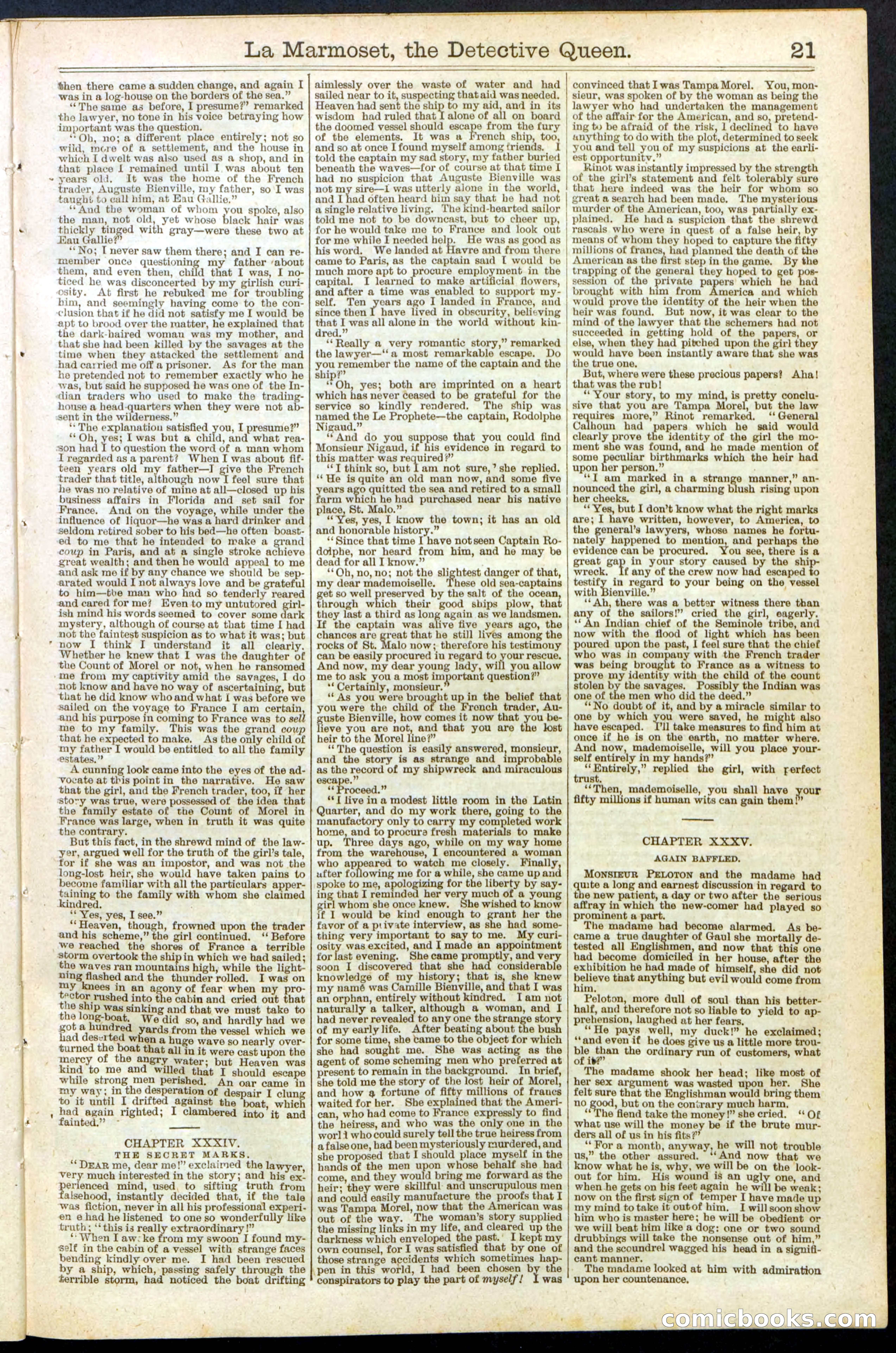
A restored page from Pulp Fiction, 1882. Page through the whole issue in the reader above.
📄 Transcribed text from this page (OCR, searchable)
Machine-transcribed from the original scan — historical spelling and the odd misread are preserved.
s ee é . a ~ a i — then there came a sudden change, and again I was in a log-house on the borders of the sea.” ‘The same as before, I presume?’ remarked the lawyer, no tone in his voice betraying how important was the question. ; ‘Oh, no; a different place entirely; not so wild, more of a settlement, and the house in which I dwelt was also used as a shop, and in that place I remained until I was about ten years old, It was the home of the French trader, Auguste Bienville, my father, so I was taught to call him, at Eau Gallie,” ‘*And the woman of whom you spoke, also the man, not old, yet whose black hair was thickly tinged with gray—were these two at Fau Gallie?”’ ‘‘'No; [ never saw them there; and I can re- member once questioning my father ‘about them, and even then, child that I was, I no- ticed he was disconcerted by my girlish curi- osity. At first he rebuked me for troubling bim, and seemingly having come to the con- clusion that if he did not satisfy me I would be apt to brood over the matter, he explained that the dark-haired woman was my mother, and that she had been killed by the savages at the time when they attacked the settlement and had carried me off a prisoner. As for the man he pretended not to remember exactly who he was, but said he supposed he was one of the In- (ian traders who used to make the trading- house a head-quarters when they were not ab- sent in the wilderness.” ‘**The explanation satisfied you, I presume?” **Oh, yes; I was but a child, and what rea- son had TI to question the word of a man whom I regarded as a parent? When I was about fif- teen years old my father—I give the French trader that title, although now I feel sure that he was no relative of mine at all—closed up his business affairs in Florida and set sail for France. And on the voyage, while under the influence of liquor—he was a hard drinker and seldom retired sober to his bed—he often boast- ed to me that he intended to make a grand coup in Paris, and at a single stroke achieve great wealth; and then he would appeal to me and ask me if by any chance we should be sep- arated would I not always love and be grateful to him—tbe man who had so tenderly reared and cared forme? Even to my untutored girl- ish mind his words seemed to cover some Sark mystery, although of course at that time I had not the faintest suspicion as to what it was; but now I think I understand it all clearly. Whether he knew that I was the daughter of the Count of Morel or not, when he ransomed me from my captivity amid the savages, I do not know and have no way of ascertaining, but that he did know whoand what I was before we sailed on the voyage to France I am certain, and his purpose in coming to France was to sell me to my family. This was the grand coup that he expected to make. As the only child of my father I would be entitled to all the family estates.” A cunning look came into the eyes of the ad- vovcate at this pointin the narrative. He saw that the girl, and the French trader, too, if her story was true, were possessed of the idea that the family estate of the Count of Morel in France was large, when in truth it was quite the contrary. But this fact, in the shrewd mind of the law- yer, argued well for the truth of the girl’s tale, for if she was an impostor, and was not the long-lost heir, she would have taken pains to become familiar with all the particulars apper- taining to the family with whom she claimed kindred, ** Yes, yes, I see.” “Heaven, though, frowned upon the trader and his scheme,” the girl continued. ‘ Before we reached the shores of France a _ terrible storm overtook the shipin which we had sailed; the waves ran mountains high, while the light- ning flashed and the thunder rolled. I was on rf knees in an agony of fear when my pro- rates rushed into the cabin and cried out that the ship was sinking and that we must take to the ong: boat. We did so, and hardly had we got a hundred yards from the vessel which we had deserted when a huge wave so nearly over- turned the boat that all in it were cast upon the mercy of the angry water; but Heaven was kind to me and willed that I should escape while strong men perished. An oar came in my way; in the desperation of despair I clun to it until I drifted against the boat, whic had again righted; I clambered into it and fainted.” ~- CHAPTER XXXIV. THE SECRET MARKS. “DEAR me, dear me!” exclaimed the lawyer, very much interested in the story; and his ex- erienced mind, used, to sifting truth from alsehood, instantly decided that, if the tale was fiction, never in all his professional experi- en e had he listened to one so wonderfully like truth; ‘this is really extraordinary!” ** When I aw: ke from my swoon I found my- self in the cabin of a vessel with strange faces bending kindly over me. I had been rescued by a ship, which, passing safely through the terrible storm, had noticed the boat drifting La Marmoset, the Detective Queen. aimlessly over the waste of water and had sailed near to it, suspecting that aid was needed. Heaven had sent the ship to my aid, and in its wisdom had ruled that [ alone of all on board the doomed vessel should escape from the fury of the elements. It was a French ship, too, and so at once I found myself among friends. I | told the captain my sad story, my father buried beneath the waves—for of course at that time I had no suspicion that Auguste Bienville was not my sire—I was utterly alone in the world, and I had often heard him say that he had not a single relative living. The kind-hearted sailor told me not to be downcast, but to cheer up, for he would take me to France and look out for me while I needed Delp. He was as good as his word. We landed at Havre and from there came to Paris, as the captain said [ would be much more apt to procure employment in the capital. I learned to make artificial flowers, and after a time was enabled to support my- self. Ten years ago I landed in France, and since then "dl have lived in obscurity, believing that I was all alone in the world without kin- dred.” ‘*Really a very romantic story,” remarked the lawyer—‘‘a most remarkable escape. Do you remember the name of the captain and the ship?” + Oh, yes; both are imprinted on a heart which has never ceased to grateful for the service so kindly rendered. The ship was named the Le Prophete—the captain, Rodolphe Nigaud,” ‘* And do you suppose that you could find Monsieur Nigaud, if his evidence in regard to this matter was required?’ ‘*T think so, but [am not sure,’ she replied. ‘He is quite an old man now, and some five years ago quitted the sea and retired to a small farm which he had purchased near bis native place, St. Malo.” “Yes, yes, I know the town; it has an old and honorable history.” ‘* Since that time I have notseen Captain Ro- doiphe, nor heard from him, and he may be dead for all I know.” ‘*Oh, no, no; not the slightest danger of that, my dear mademoiselle. These old sea-captains get so well pecan: by the salt of the ocean through which their good ships plow, that they last a third as long again as we landsmen. If the captain was alive five years ago, the chances are great that he still lives among the rocks of St. Malo now; therefore his testimony can be easily procured iu regard to your rescue, And now, my dear young lady, will you allow me to ask you a most important question?” ‘* Certainly, monsieur. ‘As you were brought up in the belief that you were the child of the French trader, Au- uste Bienville, how comes it now that you be- lieve you are not, and that you are the lost heir to the Morel line?” ; ‘The question is easily answered, monsieur, and the story is as strange and improbable as the record of my shipwreck and miraculous re roceed.” **{f live in a modest little room in the Latin Quarter, and do my work there, going to the manufactory only to carry my completed work home, and to procura fresh materials to make up. Three days ago, while on my way home from the warehouse, I encountered a woman who appeared to watch me closely. Finally, ufter following es fora be er os uP and spoke to me, apologizing for the liberty by say- hs that I recited her very much of a young girl whom she once knew. She wished to know if 1 would be kind enough to grant her the favor of a ptivate interview, as she had some- thing very important to say to me. My curi- osity was excited, and I made an appointment for last evening. She came promptly, and ve soon I discovered that she had considerable knowledge of my history; that is, she knew my namé was Camille Bienville, and that I was an orphan, entirely without kindred. I am not naturally a talker, although a woman, and I had never revealed to any one the sales. oa of my early life. After beating about the b for some time, she tame to the object for which she had sought me. She was acting as the agent of some scheming men who preferred at resent to remain in the background. In brief, she told me the story of the lost heir of Morel, and how @ fortune of fifty millions of fraues waited for her. She explained that the Ameri- can, who had come to France expressly to find the heiress, and who was the only one in the worl 1 who could surely tell the true heiress from a false one, had been mysteriously murdered, and she proposed that I should place myself in the hands of the men upon whose behalf she had come, and they would bring me forward as the heir; they were skillful: and unscrupulous men and could easily manufacture the proofs that I was Tampa Morel, now that the American was out of the way. The woman’s story supplied the missing links in my life, and cleared up the darkness which enveloped the past.’ I kept my own counsel, for I was satisfied that by one of those strange accidents which sometimes hap- pen in this world, I had been chosen bY the conspirators to play the part of myself! I was 21 convinced that Iwas Tampa Morel. You, mon- sieur, was spoken of by the woman as being the lawyer who had undertaken the management of the affair for the American, and so, pretend- ing to be afraid of the risk, 1 declined to have anything to do with the plot, determined to seek you and tell you of my suspicions at the earli- oe _ est opportunity.” Kinot was instantly impressed by the strength of the girl’s statement and felt tolerably sure ‘ that here indeed was the heir for whom so great a search had been made, The mysterious murder of the American, too, was partially ex- plained. He hada suspicion that the shrewd rascals who were in quest of a false heir, by means Of whom they hoped to capture the fifty millions of frances, had planned the death of the American as the first step in the game, By the trapping of the general they hoped to get pos- session of the private papers which he had brought with him from America and which would prove the identity of the heir when the heir was found. But now, it was clear to the mind of the lawyer that the schemers had not succeeded in getting hold of the papers, or else, when they had pitched upon the girl they would have been instantly aware that she was the true one, , : But, where were these precious papers? Aha! that was the rub! “Your story, to my mind, is sive that you are Tampa More requires more,” Rinot remarked. ‘ General Calhoun had panes which he said would clearly prove the identity of the girl the mo- ment she was found, and he made mention of some peculiar birthmarks which the heir had upon her person.” , ‘*] am marked in a strange manner,” an- nounced the girl, a charming blush rising upon her cheeks, ** Yes, but I don’t know what the right marks are; | have written, however, to America, to the goneres lawyers, whose names he fortu- nately happened to mention, and perhaps the evidence can be procured. You see, there is a great gap in your story caused by the shi wreck, If any of the crew now had escaped a in regard to your being on the vessel with Bienville.” ‘‘Ah, there was a better witness there than any of the sailors!” cried the girl, eagerly. ‘‘An Indian chief of the Seminole tribe, and now with the flood of light which has been poured upon the past, I feel sure that the chief who was in ne gs with the French trader was being brought to France as a witness to prove my identity with the child of the count stolen by the savages. Possibly the Indian was one of the men who did the deed.” ; **No doubt of it, and by a miracle similar to one by which you were saved, he might also have escaped. I'll take measures to find him at once if he is on the earth, no matter where. And now, mademoiselle, will you place your- self entirely in my hands?” ; serail replied the girl, with perfect rust. ‘“‘Then, mademoiselle, you shall have fifty millions if human wits can gain them!” pened conclu- , but the law our ——— CHAPTER XXXV. AGAIN BAFFLED. MONSIEUR PELOTON and the madame had Na a long and earnest discussion in regard to the new patient, a day or two after the serious affray in which the new-comer had played so prominent a part. The madame had become alarmed. As be- came a true daughter of Gaul she mortally de- tested all En men, and now that this one had become domiciled in her house, after the exhibition he had made of himself, she did not panes that anything but evil would come from im. : Peloton, more dull of soul than his better- half, and therefore not so liable to yield to ap- prehension, laughed at her fears, “He pays well, my duck!” he exclaimed; ‘and even if he does give us a little more trou- oe — the ordinary run of customers, what Oo | The madame shook her head; like most of her sex argument was wasted upon her. She felt sure that the Englishman would bring them no good, but on the contrary much harm, ** The fiend take the money!” she cried. “Of what use will the money be if the brute mur- ders all of us in his fits? ‘“‘ For a month, anyway, he will not trouble us,” the other assured. ‘‘And now that we know what he is, why, we will be on the look- out for him. His wound is an ugly one, and when he gets on his feet again he will be weak; now on the first sign of temper I have made up my mind to take it outof him. I will soon show him who is master here; he will be obedient or we will beat him like a dog: one or two sound drubbings will take the nonsense out of him,” and the scoundrel wagged his head in a signifi- cant manner. The madame looked at him with admiration upon her countenance, m WOOKS