
Pulp Fiction, 1882 · page 18 of 28
Beadle's New York Dime Library, No. 196 — page 18: what you’re looking at
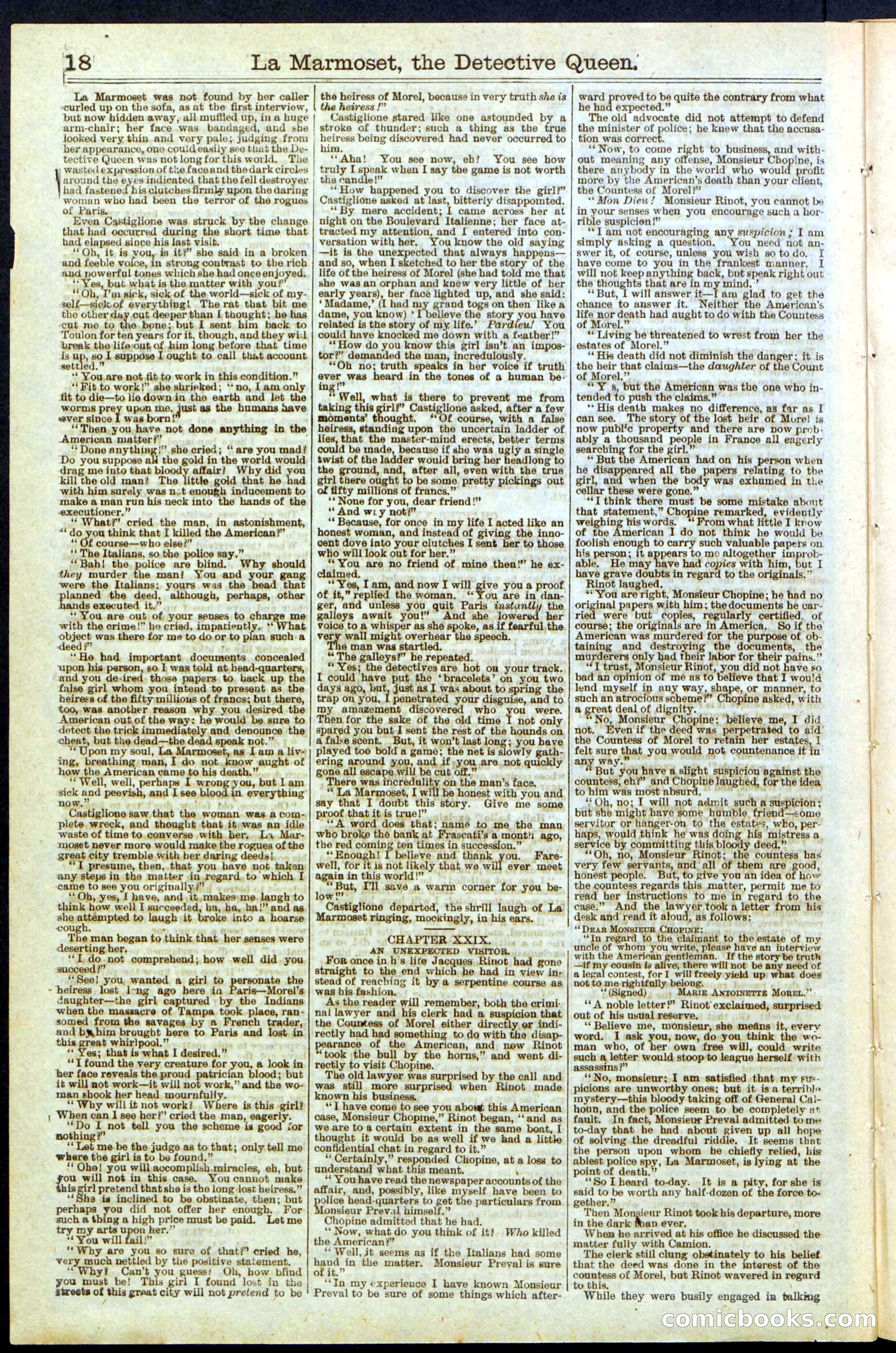
A restored page from Pulp Fiction, 1882. Page through the whole issue in the reader above.
📄 Transcribed text from this page (OCR, searchable)
Machine-transcribed from the original scan — historical spelling and the odd misread are preserved.
18) | La Marmoset was not found by her caller curled up on the sofa, as at the first interview, but now hidden away, all muffled up, ina huge arm-chair; her face was bandaged, and she looked very thin and very pale; judging from her appearance, one couldeasily see that the De- tective Queen was notlong for this world. The wastel expression of the face and thedark circles around the eyes indicated that the fell destroyer had fastened his clutches firmly upon the daring woman who had been the terror of the rogues of Paris. Even Castiglione was struck by the change that had occurred during the short time that had elapsed since his last visib. “Qh, it, is vou, is it?” she said in a broken and feeble voice, in strong contrast to the rich and powerful tones which she had once enjoyed. ‘Yes, but. what is the matter with you?” “Oh, I’m sick, siekof the world—sick of my- self—siel.of everything! The rat that bit me the other day cut deeper than L thought; be has cut me to the bene; but I sent him back to oulon for ten years for it, though, and they wil break the lifeout of him long before that time isu ug suppose I ought to call that account settled. You, are not fit. to work in this condition.” ‘Pit to work!” she shrieked; ‘‘ no, I am only fit to die—to lie down in the earth and let the worms prey upon me, just as the humans ave ever since [ was born! ‘Then you. have not done anything in the American matter?” ‘* Done anything!’ she cried; ‘‘ are you mad? Do you suppose all the gold in the world would drag me into that moedy affair? Why did ~— kill the old man? The little gold that he with him surely was n-t enough inducement to make a man run his neck into the hands of the executioner.” ; ‘* What?’ cried the man, in astonishment, “‘do you think that I killed the American?” ‘* Of course—who else?” ‘* The Italians, so the police say.” “Bah! the police are blind. Why should they murder the man! You and your gang were the Italians; yours was the head that lanned the deed, although, perhaps, other Fat executed bed pod ‘‘ You are out of, your senses to c e me with the crime!” he cried, impatient! What ae was there for me to do or to p +: se, bes ieportant qopauacas concealed upon his person, so 1 was uarters, and you de-ired. those papers to. back up the false girl whom you intend to present as the heiress of the fifty millious of francs; but there, too, was another reason why you 5 the American out.of the way: he would be sure to detect the trick immediately. and denounce the cheat, but the dead—the ead not.” : Upon my soul, La Marmoset, as Lam a liv- ing, breathing man, I do not know aught of how the American came to his death.” ‘Well, well, perhaps I wrong you, but lam sick and peevish, and L see blood everything now.’ ye | such a aosalioge tan that : 6 that it idle vaste of time ea retain with her, La Mar- moset never more would make the rogues of the i city tremble with her daring deeds! presume, then, that you have not taken any steps in the matter in regard to which I came to see you originally?” |... **Ohb, yes, I have, and it, makes: me. laugh to think how well I feccoedony bts ha, ba!” and as she auiampted to laugh it broke into a hoarse cough. 4 Abeiy | The man began to think that her senses were ‘defo nes comprehend; how well did. you Su ‘See! you, wanted a girl to personate the ~ heiress lost long ago here ia Parie—-Morel’s cdaughter—the girl tured by the Indians when the re of T spate vet gy abe! pn som om the savages by a French trader, ani iohen brought bere to Paris and lost in this t whir) Wf cth ” S oes that is what I desired.” “‘T found the very creature for you, a look in her face reveals the proud patrician blood; but it will not work—it will not work,” and the wo- man shook her head mournfully. “Why will it not work?) Where is this girl? , When can I see her?” cried the man, eagerly. ‘‘Do I not tell you the scheme is good for mas et + me be the judge as to that; only tell me where the girl is to be found,” ‘* Oho! you will accomplish miracles, eh, but ou will not in this case. You cannot make is girl pretend that she is the long-lost heiress.” ‘She ia inclined to be obstinate, then; but perhaps you did not offer her enough. For such a thing a high price must be paid, Let me try my arts upon ker.” ** You will fail!” “‘Why are you so sure of that?” cried he, very much nettled by the positive statement. "3 Can’t you guess: Oh, how blind you must be! This girl I found lost in the streets of this great city will not pretend to be / woman was acom- the heiress of Morel, because in very truth she is the heiress !” Castiglione stared like one astounded by a | voice of thunder; such a thing as the true ' heiress being discovered had never occurred to ‘**‘Aha! You see now, eh? You see how truly [speak when I say the game is not worth the candle!” ‘“How happened you to discover the girl?” Castiglione asked at last, bitterly disappoimted. “By mere accident; [ came across her at night on the Boulevard Italienne; her face at- tracted my attention, and I entered into con- versation with her. You know the old saying —it is the unexpected that always happens— and so, when I sketched to her the story of the life of the heiress of Morel (she had told me that she was an orphan and knew very little of her early years), ber face lighted up, and she said: ‘ Madame,’ (I had my grand togs on then likea dame, you know) ‘I believe the story you have related is the story of my, life.’ Pardieu/ You could have knocked me down with a feather!” ** How do you know this girl isn’t an impos- tor?’ demanded the man, incredulously. *‘Ob no; truth speaks in her voice if truth ever was heard in the tones of a human be- in ” a Well, what is there to prevent me from taking this girl?” Castiglione asked, after a few moments’ thought, ‘Of course, with a false heiress, standing upon the uncertain ladder of lies, that the master-mind erects, better terms could be made, because if she was ugly a single twist of the ladder would bring her headlong to a 9 d, a a all, over ap vines Ai ; ere oug some pretty pic ou of fifty millions of francs.” * ‘* None for you, dear friend!” * And wiy not?” ** Because, for once in my life I acted like an honest woman, and instead of giving the inno- cent dove into your clutches I sent her to those who will look out for her.” “You are no friend of mine then!” he ex- claimed. "a I am, and now I will give you a proof of it,” replied the woman, ‘ You are in dan- ger, and unless you quit Paris instantly the galleys await you!” And she lowered: r voice to a whisper as she spoke, as if fearful ary wall might overhear the speech. eTheguiant he thata e ys?” he re ‘ . “Yes; the detectives are hot on your track. I could have put the ‘bracelets’ on you two days but, just was about to spring the trap Oyen. t danse your disguis Ho, to my amazement discovered who you were. Then for the sake of the old time I not only spared you but I sent the rest of the hounds on a false scent. But, it wea last long; you have played too bold a game; the net is slowly gath- ering around you and if you are not quickly gone all escape, w il be cut off.” There was incredulity on the man’s face, “ La Marmoset, I will be honest with you and say that I doubt this story. Give me some proof that this re)”, cigtows i, " ‘‘A word does that; namé to me the man who broke the bank at Frascafi’s a mont! ago, the red coming ten times in succession.” “En ! I believe and thank you. Fare- well, for it is not likely that we will ever meet again in this world!” — . ' “B Ill save a warm corner for you be- ow! , Castiglione departed, the shrill laugh of La Marmoset 1g, Mockingly, in his ears, CHAPTER XXIX, _ AN UNEXPECTED VISITOR, : For once in hs life degen Rinot had gone selete to the end which he had in view in- stead of reaching it by a serpentine course as was bis fashion, As the reader will remember, both the crimi- nal lawyer and his clerk had a icion the Coumtess of Morel either directly er indi- rectly had had something to do with the disap- pearance of the American, and now Rinot took the bull by the horns,” and went di- rectly to visit Chopine. The old lawyer was rised by the call and was more surpri when Rinot made known his business, “‘T have come to see you abowt this American case, Monsieur Chopine,” Rinot began, ‘‘and as we are to a certain extent in the same boat, I thought it would be as well if we had a little confidential chat in regard to it.” “ Certainly,” ceepomded Chopine, at a loss to understand what this meant. \ ‘* You have read the newspaper accounts of the affair, and, possibly, like myself have been to olice head-quarters to get the particulars from lonsieur Preval himself.” Chopine admitted that he had. ‘** Now, what do you think of it?) Who killed the American?” ** Well, it seems as if the Italians had some re in the matter. Monsieur Preval is sure of it.” ‘*In my experience I have known Monsieur Preval to be sure of some things which after- La Marmoset, the Detective Queen. ward Mee to be quite the contrary from what he had expected.” The old advocate did not attempt to defend the minister of police; he knew that the accusa- tion was correct. ‘* Now, to come right to business, and with- out meaning any offense, Monsieur Chopine, is there anybody in the world who would profit more by the American’s death than your client, the Countess of Morel?” **Mon Dieu! Monsieur Rinot, you cannot be in your senses when you encourage such a hor- rible suspicien!” **T am not encouraging any suspicion ; I am simply asking a question. You need not an- swer it, of course, unless you wish sotodo, [ have come to you in the frankest manner, I will not keep anything back, but speak right out the thoughts that are in my mind.’ “But, [ will answer it—I am glad to get the chance to answer it. Neither the American's life nor death had aught to do with the Countess of Morel.” ** Living he threatened to wrest from her the estates of Morel.” ‘* His death did not diminish the danger: it is the heir that claims—the daughter of the Count of Morel.” “'Y s, but the American was the one who in- tended to push the claims.” ‘** His death makes no difference, as far as I can see. The story of the lost heir of Mure! is now publ’c property and there are pow prob- ably a thousand people in France all eagerly searching for the girl.” * But the American had on his person when he disappeared all the papers relating to the girl, and when the body was exhumed in the cellar these were gone.” “I think there must be some mistake about that statement,” Chopine remarked, evidently weighing his words. “ From what little I know of the American I do not think he would be foolish enough to carry such valuable papers on his person; it eppeers to me altogether improb- able. He may have had copies with him, but I have grave doubts in regard to the originals.” Rinot laughed. ‘You are right, Monsieur Chopine; he had no original papers with him; the documents he var- ried were but Sopiee, regularly certified, of course; the originals are in America. So if the American was murdered for the p of ob- taining and destroying the documents, the murderers only had their labor for their pains.” ‘“*T trust, Monsieur Rinot, you did not have so bad an opinion of me as to believe that I wou!d lend myself in any way, shape, or manner, to such an atrocious scheme?” Chopine asked, with a great deal of dignity. ~~ ‘No, Monsieur Chopine; believe me, I did not. en if the deed was perpetrated to aid the Countess of Morel to retain her estates, I felt sure that you would not countenance it in any way.” : But you have a slight suspicion against the countess, eh?” and CeOpiyP laughed, for the idea to him was most absurd, ~~ he” “Oh, no; I will not admit such a suspicion; but she might have some humble friend—<ome servitor or hanger-on to the estates, who, per- haps, would think he was doing his mistress a service by committing this bloody deed,” “Oh, no, Monsieur Lg the countess has very few servants, and all of them are good, honest people. But, to give you an idea of how the countess regards this matter, permit me to read her instructions to me in regard to the case.” And the lawyer took a letter from his desk and read it aloud, as follows; “DEAR MONereDe CRORINE:, " ' “In regard to the claimant to the estate of my uncle of whom you write, p have an interview with the American gentleman. If the story be truth —if my cousin és alive, there will not be any need of a legal contest, for I will freely yield up w does not to me rightfully belong. ' (Signed) . , Marte Antrornetre Moret.” ‘*A noble letter?’ Rinot’ exclaimed, surprised out of his usualreserve, , 0 ‘* Believe me, monsieur, she means it, everv word. I ask you, now, do you think the wo- man who, of her own free will, could write such a letter would stoop to league herself with assassins?” ‘*No, monsieur; I am satisfied that my sus- picions are unworthy ones; but it isa terrible mystery—this bloody taking off of Genera] Cal- houn, and the police seem to be completely at fault. In fact, Monsieur Preval admitted tome to-day that he had about given up all hope of solving the dreadful riddle. It seems that the person upon whom he chiefly relied, his ablest police spy, La Marmoset, islying at the point of death,” “So IT heard to-day. It is a pity, for she is said to be worth any half-dozen of the force to» gether.” Then Monsieur Rinot took bis departure, more in the dark fan ever, When he arrived at his office he discussed the matter fully with Camion. The clerk still clung obstinately to his belief that the deed was done in the interest of the conaeers of Morel, but Rinot wavered in regard to this, While they were busily engaged in talking (E(@) Eomicbooks a