
Pulp Fiction, 1882 · page 16 of 28
Beadle's New York Dime Library, No. 196 — page 16: what you’re looking at
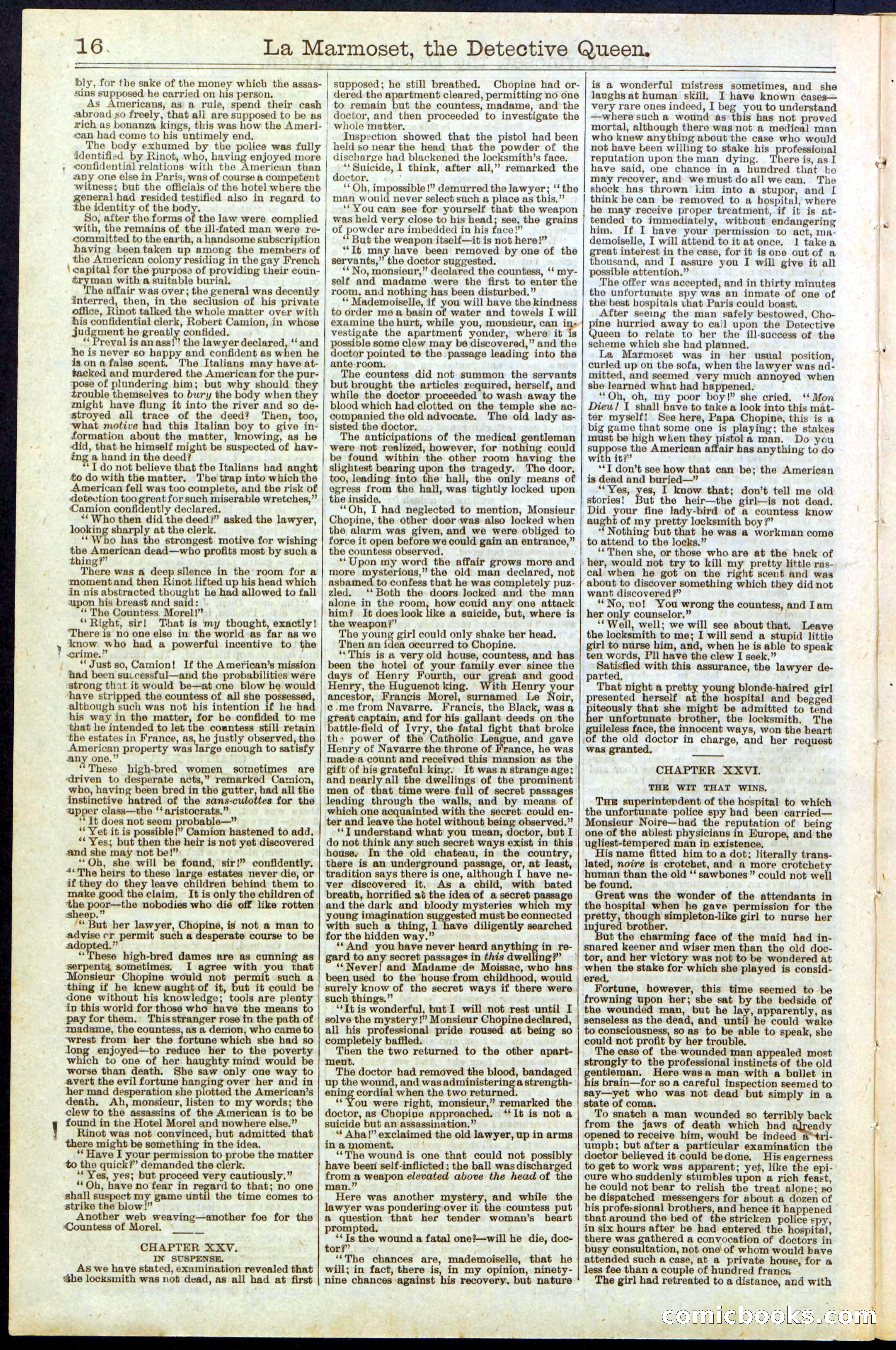
A restored page from Pulp Fiction, 1882. Page through the whole issue in the reader above.
📄 Transcribed text from this page (OCR, searchable)
Machine-transcribed from the original scan — historical spelling and the odd misread are preserved.
-- af ~ we. bly, for the sake of the money which the assas- | Sins supposed he carried on his person, As Americans, as a rule, spend their cash abroad so freely, that all are supposed to be as rich as bonanza kings, this was how the Ameri- ean had come to his untimely end, The body exhumed by tbe police was fully | identified by Rinot, who, having enjoyed more confidential relations with the American than any one else in Paris, was of course a competent witness; but the officials of the hotel where the general had resided testified also in regard to the identity of the body. So, after the forms of the law were eomplied with, the remains of the ill-fated man were re- committed to the earth, a handsome subscription having beentaken up among the members of the American colony residing in the gay French ‘ capital for the purpose of providing their coun- ¢ryman with a suitable burial. he affair was over; the general was decently interred, then, in the seclusion of his private office, Rinot talked the whole matter over with his confidential clerk, Robert Camion, in whose judgment he greatly confided, ** Preval is anass!” the lawyer declared, ‘‘and he is never so happy and confident as when he is on a false scent, The Italians may have at- tacked and murdered the American for the pur- ‘pose of plundering him; but why should they rouble themselves to bury the body when they might have flung it into the river and so de- stroyed all trace of the deed? Then, too, ‘what motive had this Italian boy to give in- formation about the matter, knowing, as he did, that he himself might be suspected of hav- ing a hand in the deed? **T do not believe that tbe Italians had aught £o do with the matter, The trap into which the American fell was too complete, and the risk of detection too great for such miserable wretches,” Camion confidently declared. “Who then did the deed?” asked the lawyer, bere sharply at the clerk. ** Who has the strongest motive for wishing 3 American dead—who profits most by such a thing? There was a deep silence in the room for a ‘moment and then Rinot lifted up his head which in nis abstracted thought he had allowed to fall upon his breast and said: ‘The Countess. Morel!” “Right, sir! That is my thought, exactly! ‘There is no one else in the world as far as we know who had a powerful incentive to the crime.” ** Just so, Camion! If the American’s mission had been successful—and the probabilities were ‘strong that it would be—at one blow he would have stripped the countess of all she possessed although such was not his intention if he had his way in the matter, for he confided to me that he intended to let the countess still retain ‘the estates in France, as, he justly observed, the American property was large enough to satisfy any one.” ‘*‘These high-bred women sometimes are driven to desperate acts,” remarked Camion, who, having been bred in the gutter, had all the instinctive hatred of the sans-culottes for the upper class—the “aristocrats.” ‘* It does not seem probable—” ‘Yet it is possible!” Camion hastened to add. ** Yes; but then the heir is not yet discovered and she may not be!” ‘**Oh, she will be found, sir!” confidently. “*The heirs to these large estates never die, or if they do they leave children behind them to make good the claim. It is only the children of oe poor—the nobodies who die off like rotten eep. ‘“ But her lawyer, Chopine, is not a man to advise cr permit such a desperate course to be mar, “These high-bred dames are as cunning as I agree with you that a such a ut it could be serpents sometimes, Monsieur Chopine would not ‘thing if he knew aught of it, done without his knowledge; tools are plenty in this world for those who have the means to pay for them. Thisstranger rose in the path of madame, the countess, as a demon, who came to ‘wrest from her the fortune which she had so pain enjoyed—to reduce her to the poverty which to one of her haughty mind would be worse than death. She saw only one way to avert the evil fortune hanging over her and in her mad desperation she plotted the American’s death. Ah, monsieur, listen to my words; the clew to the assassins of the American is to be found in the Hotel Morel and nowhere else.” Rinot was not convinced, but admitted that there might be something in the idea. ** Have I your permission to probe the matter to the quick?” demanded the clerk. ** Yes, yes; but proceed very cautiously.” “Oh, have no fear in regard to that; no one shall suspect my game until the time comes to strike the blow!” Another web weaving—another foe for the Countess of Morel. _ CHAPTER XXV. IN SUSPENSE. As we have stated, examination revealed that he locksmith was not dead, as all had at first ‘ ee La Marmoset, the Detective Queen. supposed; he still breathed. Chopine had or- dered the apartment cleared, permitting no one to remain but the countess, madame, and the doctor, and then proceeded to investigate the whole matter. Inspection showed that the pistol had been held so near the head that the powder of the discharge had blackened the locksmith’s face. ‘** Suicide, 1 think, after all,’’ remarked the doctor. ** Oh, impossible!” demurred the lawyer; ‘‘ the man would never select such a place as this,” ‘* You can see for yourself that the weapon was held very close to his head; see, the grains of powder are imbedded in his face!” ‘** But the weapon itself—it is not here!” ‘‘It may have been removed by one of the servants,” the doctor suggested. ** No, monsieur,” declared the countess, ‘‘ my- self and madame were the first to enter the room, and nothing has been disturbed.” ** Mademoiselle, if you will have the kindness to order me a basin of water and towels I will examine the hurt, while you, monsieur, can in» vestigate the apartment yonder, where it is possible some clew may be discovered,” and the doctor pointed to the passage leading into the ante-room. The countess did not summon the servants but brought the articles required, herself, and while the doctor proceeded to wash away the blood which had clotted on the —- she ac- companied the old advocate. The old lady as- sisted the doctor. The anticipations of the medical gentleman were not realized, however, for nothing could be found within the other room having the slightest bearing upon the tragedy. The door, too, leading into the hall, the only means of egress from the hall, was tightly locked upon the inside. “‘Oh, I had neglected to mention, Monsieur Chopine, the other door was also locked when the alarm was given, and we were obliged to force it open before we could gain an entrance,” the countess observed. ‘*Upon my word the affair grows more and more mysterious,” the old man declared, not asbamed to confess that he was completely puz- zled. ‘* Both the doors locked and the man alone in the room, how couid an, one attack him? It does look like a suicide, but, where is the weapon?” The young girl could only shake her head. Then an idea occurred to Chopine. ‘*This is a very old house, countess, and has been the hotel of your family ever since the days of Henry Fourth, our a and good Henry, the Huguenot king. ith Henry * Lar ancestor, Francis Morel, surnamed Le Noir, c.me from Navarre. Francis, the Black, was a gma captain, and for his gallant deeds on the attle-field of Ivry, the fatal fight that broke ths power of the Catholic League, and gave Henry of Navarre the throne of France, he was madea count and received this mansion as the gift of his grateful king. It was a strange age; and nearly all the dwellings of the prominent men of that time were full of secret passages leading through the walls, and by means of which one acquainted with the secret could en- ter and leave the hotel without being observed.” ‘*T understand what you mean, doctor, but I do not think any such secret ways exist in this house. In the old chateau, in the country, there is an underground passage, or, at least, tradition says there is one, although I have ne- ver discovered it, As a child, with bated breath, horrified a% the idea of a secret passage and the dark and bloody ee which my young imagination suggested must be connected with such a thing, 1 have diligently searched for the hidden way.” ‘*And you have never heard an in re- gard to any secret passages in this dwelling?” ‘¢ Never! and Madame de Moissac, who has been used to the house from childhood, would surely know of the secret ways if there were such things.” ‘ ‘“‘It is wonderful, but I will not rest until I solve the mystery!” Monsieur Chopine declared, all his professional pride roused at being so completely baffled. Then the two returned to the other apart- ment. The doctor had removed the blood, bandaged up the wound, and was ee strength- ening cordial when the two returned. ‘*'You were right, monsieur,” remarked the doctor, as Chopinve approached. “It is not a suicide but an assassination.” “ Aha!” exclaimed the old lawyer, up in arms in a moment. ' ‘The wound is one that could not possibly have bee self-inflicted ; the ball was discharged from 2 weapon elevated above the head of the man. Here was another mystery, and while the lawyer was pondering over it the countess put a question that her tender woman’s heart prompted. : : “ Is the wound a fatal one?—will he die, doc- or? ‘“*The chances are, mademoiselle, that he will; in fact, there is, in my opinion, ninety- nine chances against his recovery. but nature is a wonderful mistress sometimes, and she laughs at human skill. I have known cases— very rare ones indeed, I beg you to understand —where such a wound as this has not proved mortal, although there was not a medical man who knew anything about the case who would not have been willing to stake his professional reputation upon the man dying. There is, as I have said, one chance in a hundred that be may recover, and we must doall wecan. The shock has thrown lim into a stupor, and [ think he can be removed to a hospital, where he may receive proper treatment, if it is at- tended to immediately, without endangering him. If I have your permission to act, ma- demoiselle, I will attend to it at once. 1 takea great interest in the case, for it isone out of a thousand, and I assure you I will give it all possible attention.” The offer was accepted, and in thirty minutes the unfortunate spy was an inmate of one of the best hospitals that Paris could boast. After seeing the man safely bestowed, Cho- pine hurried away to ca!l upon the Detective Queen to relate to her the ill-success of the scheme which she had planned. La Marmoset was in her usual position, curled up on the sofa, when the lawyer was ad- mitted, and seemed very much annoyed when she learned what had happened. ‘*Oh, oh, my poor boy!” she cried. ‘‘ Mon Dieu! I shall have to take a look into this mat- ter myself! See here, Papa Chopine, this is a big game that some one is playing; the stakes must be high when they pistola man. Do you suppose the American affair has anything to do with it?’ ‘“*T don’t see how that can be; the American is dead and buried—” ** Yes, har I know that; don’t tell me old stories! But the heir—the girl—is not dead. Did your fine lady-bird of a countess know aught of my pretty locksmith boy?” * Nothing but that he was a workman come to attend to the locks.” ** Then she, or those who are at the back of her, would not try to kill my pretty little ras- cal when he got on the right scent and was about to discover something which they did not want discovered?” “No, no! You wrong the countess, and Iam her only counselor.” ‘* Well, well; we will see about that. Leave the locksmith to me; I will send a stupid little girl to nurse him, and, when he is able to speak ten words, I'll have the clew I seek.” Satisfied with this assurance, the lawyer de- parte That night a ves | young blonde-haired girl presented herself at the hospital and begged chy te that she might be admitted to tend er unfortunate brother, the locksmith. The guileless face, the innocent ways, won the heart of the old doctor in charge, and her request was granted, CHAPTER XXXVI. THE WIT THAT WINS. THE superintendent of the hospital to which the unfortunate police spy had been carried— Monsieur Noire—had the reputation of being one of the ablest physicians in Europe, and the i tasty Hr man in existence. is name fitted him to a dot; literally trans- lated, noire is crotchet, and a more crotchety human than the old “‘ sawbones” could not weil be found. Great was the wonder of the attendants in the hospital when he gave permission for the pretty, though simpleton-like girl to nurse her in ured brother. ut the charming face of the maid had in- snared keener and wiser men than the old doc- | tor, and her victory was not to be wondered at when the stake for which she played is consid- ed, Fortune, however, this time seemed to be frowning upon her; she sat by the bedside of the wounded man, but he lay, apparently, as senseless as the dead, and until he could wake to consciousness, so as to be able to speak, she could not profit by her trouble. The case of the wounded man appealed most strongly to the professional instincts of the old entleman, Here wasa man with a bullet in is brain—for so a careful inspection seemed to say—yet who was not dead but simply in a state of coma. To snatch a man wounded so terribly back from the jaws of death which had already opened to receive him, would be indeed a™tri- umph; but after a particular examination the doctor believed it could bedone. His eagerness to get to work was apparent; yet, like the epi- cure who suddenly stumbles upon a rich feast, he could not bear to relish the treat alone; so he dispatched messengers for about a dozen of his professional brothers, and hence it happened that around the bed of the stricken police spy, in six hours after he had entered the hospital, there was gathered a convocation of doctors in busy consultation, not one’ of whom would bave attended such a case, at a private house, for a less fee than a couple of hundred francs The girl had retreated to a distance, and with “4 ~ ,OO SS (0) ‘ COMIC é | :