
Pulp Fiction, 1882 · page 6 of 28
Beadle's New York Dime Library, No. 195 — page 6: what you’re looking at
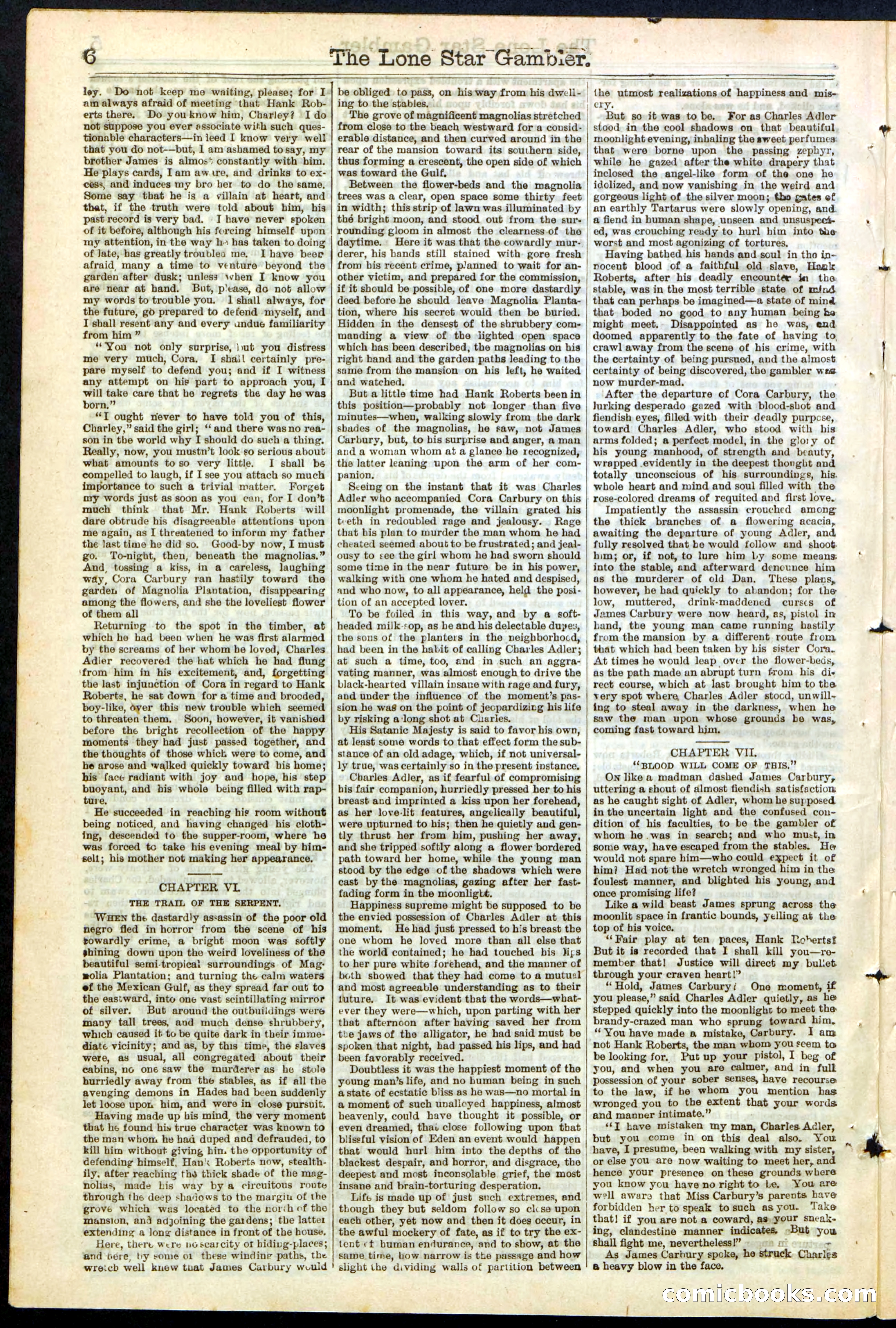
A restored page from Pulp Fiction, 1882. Page through the whole issue in the reader above.
📄 Transcribed text from this page (OCR, searchable)
Machine-transcribed from the original scan — historical spelling and the odd misread are preserved.
S ley. Do’ not keep me waiting, please; for I am always afraid of meeting that Hank Rob- erts there. Do youknow him, Charley? I do not stippose you ever sssociate with such ques- tionable characters—in leed I know very well that you do not-—but, 1 am ashamed tosay, my brother James is almos‘ constantly with bim. He plays cards, Iam aw.re, and drinks to ex- cess, and induces my bro her to do the same, Some say that he is a villain at heart, and that, if the truth were told about him, his past record is very bad. I have never spoken of it before, although his forcing himself upon my attention, in the way h» has taken to doing of Jate, has greatly troubles me. Ihave beer afraid many a time to venture beyond the garden after dusk; unless when I know you are near at band. But, p'ease, do not allow my words to trouble you. 1 shall always, for the future, go prepared to defend myself, and I shall resent any and every undue familiarity from him ” “You not only surprise, }ut you distress me very much, Cora. I shail certainly pre- pare myself to defend you; and if I witness any attempt on his part to approach you, I will take care that be regrets the day he was born,” “T ought never to have told you of this, Charley,” said the girl; “‘ and there was no rea- son in tbe world why I should do such a thing. Really, now, you mustn’t look so serious about what amounts to so very little. I shall bse compelled to laugh, if I see you attach so much importance to such a trivial matter. Forget ory words just as soon as you can, for I don’t much think that Mr. Hank Roberts will dare obtrude his disagreeable attentions upon me again, as I threatened to inform my father the last time he did so. Good-by now, I must go. To-night, then, beneath the magnolias.” And, tossing a kiss, in a careless, laughing way, Cora Carbury ran hastily toward the garden of Magnolia Plantation, disappearing among the flowers, and she the loveliest flower of them all Returning to the spot in the timber, at which he had been when he was first alarmed by the screams of her whom he loved, Charles Adier recovered the bat which he had flung ‘from him in his excitement, and, forgetting the last injunction of Cora in regard to Hank Roberts, he sat down for a time and brooded, boy-like, 6yer this new trouble which seemed to threaten them. Soon, however, it vanished before the bright recollection of the happy moments they had just passed together, and the thoughts of those whick were to come, and he arose and walked quickly toward his home; his face radiant with joy and hope, his step buoyant, and bis whole being filled with rap- ture, He succeeded in reaching hie room without being noticed, and having changed his cloth- ing, descended to the supper-room, where he was forced to take his evening meal by him- seli; his mother not making her appearance. — CHAPTER VL THE TRAIL OF THE SERPENT. WHEN the dastardly assassin of the poor old negro fled in horror from the scene of his towardly crime, a bright moon was softly shining down upon the weird loveliness of the beautiful semi-tropicai surroundings of Mag: molia Plantation; and turning the calm waters ef the Mexican Gulf, as they spread far out to the eastward, into one vast scintillating mirror of silver. But around the outbuildings were mapy tall trees, and much dense shrubbery, which caused it to be quite dark in their imme- diate vicinity; and as, by this time, the slaves were, as usual, all congregated about their cabins, no one saw the murderer as he stvle hurriedly away from the stables, as if all the avenging demons in Hades had been suddenly let loose upon him, and were in close pursuit. Having made up bis mind, the very moment that he found his true character was known to the man whom he had duped and defrauded, to kill him without giving hin. the opportunity of defending himself, Han Roberts now, stealth- ily, after reaching the thick shade of the mag- nolius, made his way bya circuitous route through the deep shadows to the margin of the grove which was located to the north ef the mansion, and adjoining the gardens; the latter extending a long distance in front of the house, Here, there were poscarcity or bidivg-places; and bére, ty some o1 these windine paths, the wreicb well knew tuat James Carbury wuld The Lone Star Gambier. i Et M_tHRPEELEE EE ,,,,,,.—,.—,,,, be obliged to pass, on his way from his dwell- ing to the stables, The grove of magnificent magnolias stretched from close to the beach westward for a consid- | erable distance, and then curved around in the rear of the mansion toward its southern side, thus forming a crescent, the open side of which was toward the Gulf, Between the flower-beds and the magnolia trees was a clear, open space some thirty feet in width; this strip of lawn was illuminated by thé bright moon, and stood out from the sur- rounding gloom in almost the clearness.of the daytime. Here it was that the cowardly mur- derer, his hands still stained with gore fresh from bis recent crime, p/anned to wait for an- other victim, and prepared for the commission, if it should be possible, of one more dastardly deed before he should leave Magnolia Planta- tion, where his secret would then be buried. Hidden in the densest of the shrubbery com- manding a view of the lighted open space which has been described, the magnolias on his right hand and the garden paths leading to the same from the mansion on his left, he waited and watched. But a little time had Hank Roberts been in this position—probably not longer than five minutes—when, walking slowly from the dark shades of the magnolias, he saw, not James Carbury, but, to bis surprise and anger, a man and a woman whom at a glance he recognized, the latter leaning upon the arm of her com- panion. Seeing on the instant that it was Charles Adler who accompanied Cora Carbury on this moonlight promenade, the villain grated his t-eth in redoubled rage and jealousy. Rage that his plan to murder the man whom he had cheated seemed about to be frustrated; and jeal- ousy to see the girl whom he had sworn should some time in the near future be in his power, walking with one whom he hated and despised, | the utmost realizations of happiness and sis~ | ery. But so it was to be, For as Charles Adler stood in the cool shadows on that beautiful moonlight evening, inhaling the sweet perfumes that were borne upon the passing zephyr, while he gazed after the white drapery that inclosed the angel-like form of the one he idolized, and now vanishing in the weird and gorgeous light of the silver moon; tho gates ef an earthly Tartarus were slowly opening, and. a fiend in human shape, unseen and unsuspecé- ed, was crouching ready to hurl him into the worst and most agonizing of tortures, Having bathed his bands and soul in tho in- nocent blood of a faithful old slave, Haak Roberts, after his deadly encountér ian the stable, was in the most terrible state of mind that can perhaps be imagined—a state of mind that boded no good to any human being ke might meet. Disappointed as he was, end doomed apparently to the fate of having to, crawl away from the scene of his crime, with the certainty of being pursued, and the almost certainty of being discovered, the gambler wes now murder-mad. After the departure of Cora Carbury, the Jurking desperado gezed with blood-shot and fiendish eyes, filled with their deadly purpcse, toward Charles Adler, who stood with his arms folded; a perfect model, in the glory of his young manhood, of strength and beauty, wrapped evidently in the deepest thongbt and totally unconscious of his surroundings, his. whole heart and mind and soul filled with the rose-colored dreams of requited and first love. Impatiently the assassin crouched among the thick branches of a flowering acacia, awaiting the departure of young Adler, and fully resolved that be would follow and shoot. him; or, if not, to lure him Ly some means into the stable, and afterward deneunce him as the murderer of old Dan. These plans, and who now, to all appearance, held the posi- however, he had quickly to abandon; for the tion of an accepted lover. To be foiled in this way, and by a soft- low, muttered, drink-maddened curscs of James Carbury were now heard, as, pistol in headed milk-sop, as be and his delectable dupes, | hand, the young man came running hastily the sons of the planters in the neighborhocd, _ from the mansion by a different route from had been in the habit of calling Charles Adler; | that which had been taken by his sister Cora. at such a time, too, and in such an aggra- vating manner, was almost enough to drive the black-hearted villain insane with rage and fury, and under the influence of the moment’s pas- sion he wag on the point of jeopardizing his life by risking along shot at Clarles. His Satanic Majesty is said to favor his own, at least some words to that effect form the sub- stance of an old adage, which, if not universal- ly true, was certainly so in the present instance, Charles Adler, as if fearful of compromising bis fair companion, hurriedly pressed her to his breast and imprinted a kiss upon her forehead, as her love-lit features, angelically beautiful, were upturned to his; then he quietly aud gen- tly thrust her from him, pushing her away, and she tripped softly along a flower bordered path toward ber home, while the young man stood by the edge of the shadows which were cast by the magnolias, gazing after her fast- fadiog form in the moonligt#. Happiness supreme might be supposed to be the envied possession of Charles Adler at this moment. He had just pressed to his breast the one whom he loved more than all else that the world contained; he had touched bis ligs to her pure white forehead, and the manner of both showed that they had come to a mutual and most agreeable understanding as to their future, It was evident that the words—what- ever they were—which, upon parting with her that afternoon after having saved her from the jaws of the alligator, he had said must be spoken that night, bad passed his lips, and had been favorably received. Doubtless it was the happiest moment of the young man’s life, and no buman being in such astate of ecstatic bliss as ho was—no mortal in a moment of such unalicyed happiness, almost heavenly, could have thought it possible, or even dreamed, thai close following upon that At times he would leap over the flower-beds, as the path made an abrupt turn from his di- rect course, which at last brought him to the very spot where Charles Adler stocd, unwill- ing to steal away in the darkness, when he saw the man upon whose grounds be was, coming fast toward hjm. CHAPTER VII. “BLOOD WILL COME OF THIS,” On like a madman dashed James Carbury, uttering a shout of almost fiendish satisfaction as he caught sight of Adler, whom he supposed in the uncertain light and the confused con- dition of his faculties, to be the gambler of whom he .was in search; and who must, in some way, have escaped from the stables. He would not spare him—who could expect it of him? Had not the wretch wronged him in the foulest manner, and blighted his young, and once promising life? Like a wild beast James sprung across the moonlit space in frantic bounds, yelling at the top of bis voice. ‘Pair play at ten paces, Hank IRohertst But it is recorded that I shall kill you—ro- member that! Justice will direct my buliet through your craven heart!” “Hold, James Carbury{ One moment, if you please,” said Charles Adler quietly, as he stepped quickly into the moonlight to meet the brandy-crazed man who sprung toward him, ‘You have made a mistake, Carbury. I am not Hank Roberts, the man whom you scem to be looking for, Put up your pistol, I beg of you, and when you are calmer, and in full possession of your sober senses, have recourse to the law, if he whom you mention has wronged you to the extent that your words and manner intimate.” ‘‘T have mistaken my man, Charles Adler, blissful vision of Eden an event would happen ; but you come in on this deal also. You that would hurl him into the depths of the | blackest despair, and horror, and disgrace, the deepest and most inconsolable grief, the most insane and brain-torturing desperation. Life is made up of just such extremes, and though they but seldom follow so cl.se upon each other, yet now and then it does occur, in the awful mockery of fate, as if to try the ex- tent «f buman endurance, and to show, at the same time, bow narrow is the passage and how slight the dividing walls of partition between have, I presume, been walking with my sister, or else you are now waiting to meet her, and hence your presence on these grounds where you know you have no right to Le. You are well awarsa that Miss Carbury’s parents have forbidden her to speak tosuch as you. Take that! if you are not a coward, asyour sneak. ing, clandestine manner indicates. -But you shall fight me, nevertheless!” iri - As James Carbury spoke, he struck Charles e heavy blow in the face. | EORNIELICO KS (C (E(0) ~.