
Pulp Fiction, 1882 · page 14 of 32
Beadle's New York Dime Library, No. 181 — page 14: what you’re looking at
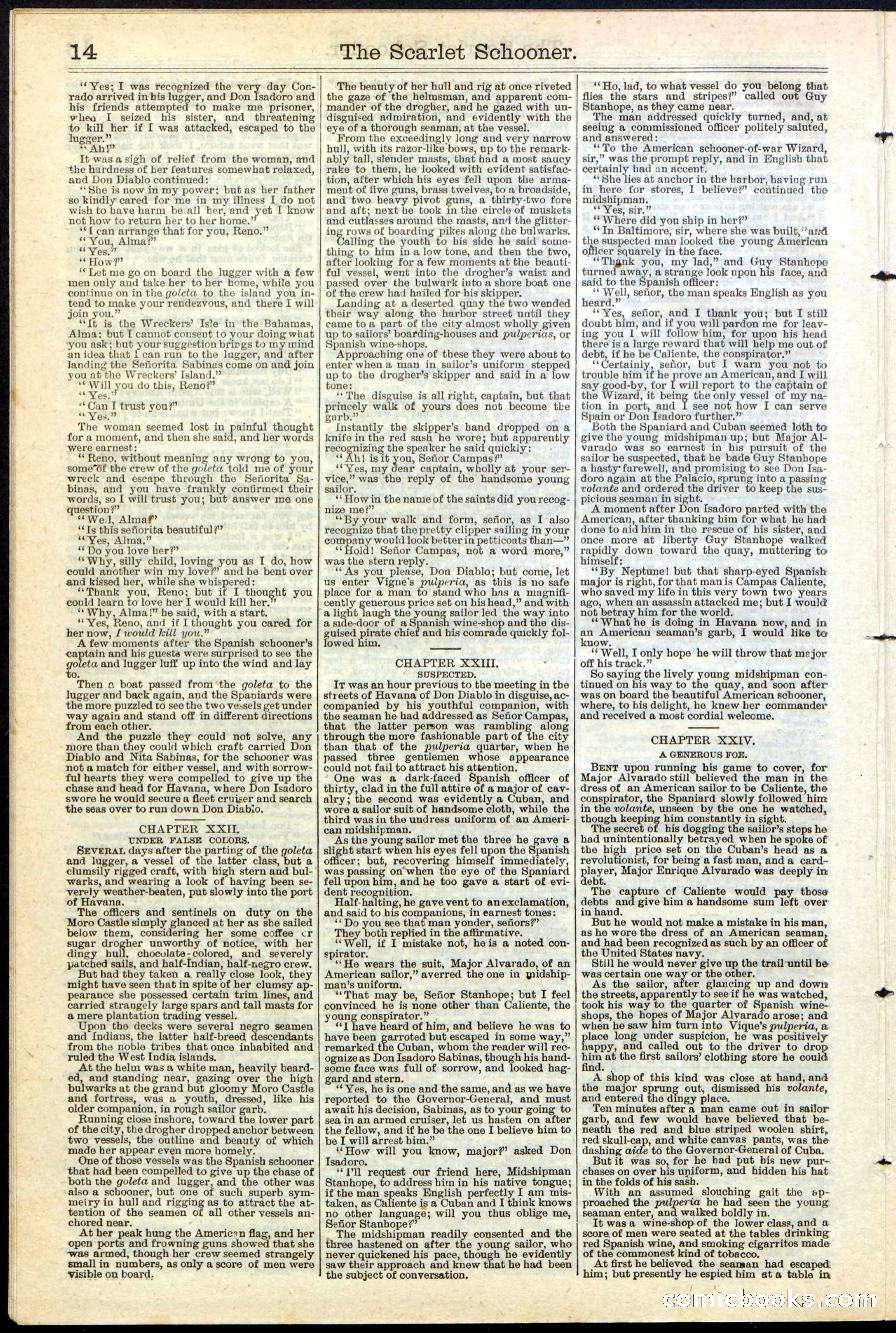
A restored page from Pulp Fiction, 1882. Page through the whole issue in the reader above.
📄 Transcribed text from this page (OCR, searchable)
Machine-transcribed from the original scan — historical spelling and the odd misread are preserved.
~——— > Bis ad — ee 14 —_—- + ‘Yes; I was recognized the very day Con- rado arrived in bis lugger, and Don Isadoro and his friends attempted to make me prisoner, wheo I seized his sister, and threatening to kill her if [ was attacked, escaped to the lugger.” ‘Ah!’ It wasasigh of relief from the woman, and ‘the hardness of her features somewhat relaxed, and Don Diablo continued: ‘*She is now in my power: but as her father so kindly cared for me in my illness I do not wish to bave harm be all her, and yet I know not how to return her to her home.’ ‘*[ can arrange that for you, Reno.” “You, Alma?” ~ vou" “cc How iad “Let me go on board the lugger with a few men only and take her to her home, while you continue on in the goleta to the island you in- tend to make your rendezvous, and there I will join you.” “Tt is the Wreckers’ Isle in the Bahamas, Alma; but [ cannot consent to your doing what ‘you ask; but your suggestion brings to my mind an idea that | can run tothe lugger, and after landing the Sefiorita Sabinas come on and join you at the Wreckers’ Island.” ‘Will you do this, Reno?” pin TB ‘*Can I trust you?” a Yes, ” The woman seemed lost in for a moment, and then she sai were earnest; “ Reno, without meaning any wrong to you, some6f the crew of the goleta told me of your wreck and escape through the Sefiorita Sa- binas, and you have frankly confirmed their words, so [ will trust you; but answer me one question?” “Weil, Alma?’ ‘“*Ts this sefiorita beautiful?” ‘Yes, Alma,” f ** Do you love ber?” “Why, silly child, loving you as I do, how eould another win my love?” and he bent over and kissed her, while she whispered: “Thank you, Reno; but if I thought you could learn to love her I would kill her.” “Why, Alma!” he said, with a start. ‘Yes, Reno, and if lI thought you cared for her now, / would kill you,” A few moments after the Spanish schooner’s a fo and his guests were rised to see the oleta and lugger luff up into the wind and lay Pentel thought , and her words Then o boat passed fromthe goleta to the lugger and back again, and the Spaniards were the more puzzled to see the two vessels get under way again and stand off in different directions from each other. And the puzzle they could not solve, any more than they could which craft carried Don Diablo and Nita Sabinas, for the schooner was not a match for either vessel, and with sorrow- ful hearts they were compelled to ade up the chase and head for Havana, where Don Isadoro swore he would secure a fleet cruiser and search the seas over to run down Don Diabio. CHAPTER XXII UNDER FALSE COLORS. SEVERAL days after the parting of the goleta and lugger, a vessel of the latter class, but a clumsily rigged craft, with high stern and bul- warks, and wearing a look of having been se- verely weather-beaten, put slowly into the port of Havana. The officers and sentinels on duty on the Moro Castle simply glanced at her as she sailed below them, considering her some coffee cr sugar err unworthy of notice, with her Gey bull, chocvlate-colored, and severely patched sails, and half-Indian, half-negro crew. But bad they taken a really close look, they might have seen that in spite of her clumsy ap- pearance she possessed certain trim lines, and carried strangely large spars and tall masts for a mere plantation trading vessel. Upon the decks were several negro seamen and Indians, the latter half-breed descendants from the noble tribes that once inhabited and ruled the West India islands. At the helm was a white man, neeyoy beard- me and standing near, gazing over the high bulwarks at the grand but gloomy Moro Castle and fortress, was a youth, dressed, like his older companion, in rough sailor garb. Running close inshore, toward the lower part of the city, the drogher dropped anchor between two vessels, the outline and beauty of which made ber appear even more homely. One of those vessels was the Spanish schooner that had been compelled to give up the chase of -both the goleta and lugger, and the other was also a schooner, but one of such superb sym- metry in bull and rigging as to attract the at- tention of the seamen of all other vessels an- chored near. . At her peak hung the Americ?n flag, and her open ports and frowning guns showed that she ‘was armed, though her crew seemed strangely small in numbers, as only a score of men were visible on board. eee eee alight laugh the The Scarlet Schooner. The beauty of her hull and rig at once riveted the gaze of the helmsman, and apparent com- mander of the drogher, and he gazed with un- disguised admiration, and evidently with the eye of a thorough seaman, at the vessel. From the exceedingly long and very narrow hull, with its razor-like bows, up to the remark- ably tall, slender masts, that had a most saucy rake to them, he looked with evident satisfac- tion, after which his eyes fell upon the arma- ment of five guns, brass twelves, to a broadside, and two heavy pivot guns, a thirty-two fore and aft; next he took in the circle of muskets and cutlasses around the masts, and the glitter- ing rows of boarding pikes along the bulwarks, Jalling the youth to bis side he said some- thing to him in a low tone, and then the two, after looking for a few moments at the beauti- ful vessel, went into the drogher’s waist and passed over the bulwark into a shore boat one of the crew had hailed for his skipper. Landing at a deserted quay the two wended their way along the harbor street until they came toa part of the city almost wholly given up to sailors’ boarding-houses and pulperias, or Spanish wine-shops. Approaching one of these they were about to enter when a man in sailor’s uniform stepped up to the drogher’s skipper and said in a low tone: ‘*The disguise is all right, captain, but that princely walk of yours does not become the arb. instantly the skipper’s band dropped on a knife in the red sash he wore; but apparently recognizing the speaker he said quickly: “* Ah} is it you, Sefior Campas?” ‘*' Yes, my dear captain, wholly at your ser- vice,” was the reply of the handsome young sailor. ‘* How in the name of the saints did you recog- nize me?” “By your walk and form, sefior, as I also recognize that the pretty clipper sailing in your company would look better in petticoats than—” ‘*Hold! Sefior Campas, not a word more,” was the stern reply. ‘*As you please, Don Diablo; but come, let us enter Vigne'’s pulperia, as this is no safe place for a man to stand who has a magnifi- cently generous price set on his head,” and with oung sailor led the way into a side-door of a Spanish wine-shop and the dis- guised pirate chief and his comrade quickly fol- lowed him. CHAPTER XXIII, SUSPECTED. Ir was an hour previous to the meeting in the streets of Havana of Don Diablo in disguise, ac- companied by his youthful companion, with the seaman he had addressed as Sefior Campas, that the latter person was tar along through the more fashionable part of the city than that of the pulperia quarter, when he passed three gentlemen whose appearance could not fail to attract his attention. One was a dark-faced Spanish officer of thirty, clad in the full attire of a major of cav- alry; the second was evidently a Cuban, and wore a sailor suit of handsome cloth, while the third was in the undress uniform of an Ameri- can midshipman. As the young sailor met the three he gave a slight start when his eyes fell upon the Spanish officer; but, recovering himself immediately, was passing on when the eye of the Spaniard fell upon him, and he too gave a start of evi- dent recognition. Half-halting, he gave vent to anexclamation, and said to bis companions, in earnest tones: ‘*Do you see that man yonder, sefiors?” The both replied in the affirmative. “Well, if I mistake not, heis a noted con- spirator. ‘‘He wears the suit, Major Alvarado, of an American sailor,” ayerred the one in ynidship- man’s uniform, “That may be, Sefior Stanhope; but I feel convinced he is none other than Caliente, the young conspirator.” | ‘“‘T have heard of him, and believe he was to have been garroted but escaped in some way,”’ remarked the Cuban, whom the reader will rec- ognize as Don Isadoro Sabinas, though his hand- some face was full of sorrow, and looked hag- gard and stern. ‘¢-Yes, he is one and the same, and as we have reported to the Governor-General, and must await his decision, Sabinas, as to your going to sea in an armed cruiser, let us hasten on after the fellow, and if he be the one I believe him to be I will arrest him.” ‘How will you know, major?’ asked Don Isadoro, =e ‘ri ro our friend here, Midshipman Stanhope, to address him in his native tongue; if the pan Spears English perfectly I am mis- taken, as ente is a Cuban and I think knows no other language; will you thus oblige me, Sefior Stanhope?’ The midshipman readil ree hastened on after the youn never quickened his pace, though saw their approach and knew t the subject of conversation. consented and the sailor, who 6 evidently t he had been —_—-—-<-- —s ‘* Ho, lad, to what vessel do you belong that flies the stars and stripes?’ called ovt Guy Stanhope, as they came near. The man addressed quickly turned, and, at seeing a commissioned officer politely saluted, and answered: “To the American schooner-of-war Wizard sir,” was the prompt reply, and in English that certainly had an accent. “She lies at anchor in the harbor, having run in here for stores, 1 believe?” continued the midshipman, ** Yes, sir.” *“Where did you ship in her?” “In Baltimore, sir, where she was built,’ ard the suspected man looked the young American officer squarely in the face, “Thank you, my lad,” and Guy Stanhope turne oe a strange look upon his face, and said to the Spanish officer: ‘* Well, sefor, the man speaks English as you heard.” ‘Yes, sefior, and I thank you; but I stil doubt him, and if you will pardon me for leay- ing you | will follow him, for upon his head there is a large reward that will help me out of debt, if he be Caliente, the conspirator.” ‘*Certainly, sefior, but I warn you not to trouble him if he prove an American, and I will say good-by, for | will report to the captain of the Wizard, it being the only vessel of my na- tion in port, and | see not how I can serve Spain or Don Isadoro further.” Both the Spaniard and Cuban seemed loth to give the young midshipman up; but Major Al- varado was so earnest in his pursuit of the sailor he suspected, that he bade Guy Stanhope a hasty’ farewell, and promising to see Don Isa- doro again at the Palacio, sprung into a passing volante and ordered the driver to keep the sus- picious seaman in sight. A moment after Don Isadoro parted with the American, after thanking bim for what he had done to aid him in the rescue of his sister, and once more at liberty Guy Stanhope walked pepialy down toward the quay, muttering to himself: ‘“*By Neptune! but that sharp-eyed Spanish major is right, for that manis Campas Caliente, who saved my life in this very town two years ago, when an assassin attacked me; but I would not betray him for the world. ‘What he is doing in Havana now, and in an American seaman’s garb, I would like te know. ** Well, I only hope he will throw that major off his track.” ' So saying the lively young midshipman con- tinued on his way to the quay, and soon after was on board the beautiful American schooner, where, to his delight, he knew her commander and received a most cordial welcome. CHAPTER XXIV. A GENEROUS FOE. BENT upon running his game to cover, for Major Alvarado still believed the man in the dress of an American sailor to be Caliente, tho conspirator, the Spaniard slowly followed him in the volante, unseen by the one he watched, though Be him constantly in sight. The secret of his dogging the sailor’s steps he had unintentionally betrayed when he spoke of the high price set on the Cuban’s head as a revolutionist, for being a fast man, anda card- pores Major Enrique Alvarado was deeply in t ebt. The capture cf Caliente would pay those debts and give him a handsome sum left over in hand. But he would not make a mistake in his man, as he wore the dress of an American seaman and had been recognized as such by an officer of the United States navy. Still he would never give up the trail until he was certain one way or the other, ‘ As the sailor, after glancing up and down the streets, oe ph eed to see if he was watched, took his way to the quarter of Spanish wine- shops, the ie gm of Major Alvarado arose; and when he saw him turn into Vique’s id, & lace long under suspicion, he was positively appy, and called out to the driver to drop him at the first sailors’ clothing store he could find. A shop of this kind was close at hand, and the major ger Pea dismissed his volante, and entered the dingy place. ? Ten minutes after a man came out in sailor garb, and few would have believed that be- neath the red and blue striped woolen shirt, red skull-cap, and white canvas pants, was the dashing aide to the Governor-General of Cuba. But it was so, for be bad put bis new pur- chases on over his uniform, and hidden his hat in the folds of his sash. ' With an assumed slouching gait the sp- proached the pulperia he had seen the young seaman enter, and walked boldly in. It wasa wine-shop of the lower class, and a score of men were seated at the tables drinking red Spanish wine, and smoking cigarritos made of the commonest kind of tobacco. At first he believed the seaman had escaped him; but presently he espied him ata table in / ; (El NOCH KS (0) = | €om