
Pulp Fiction, 1877 · page 6 of 28
Beadle's Dime Library No. 18 — page 6: what you’re looking at
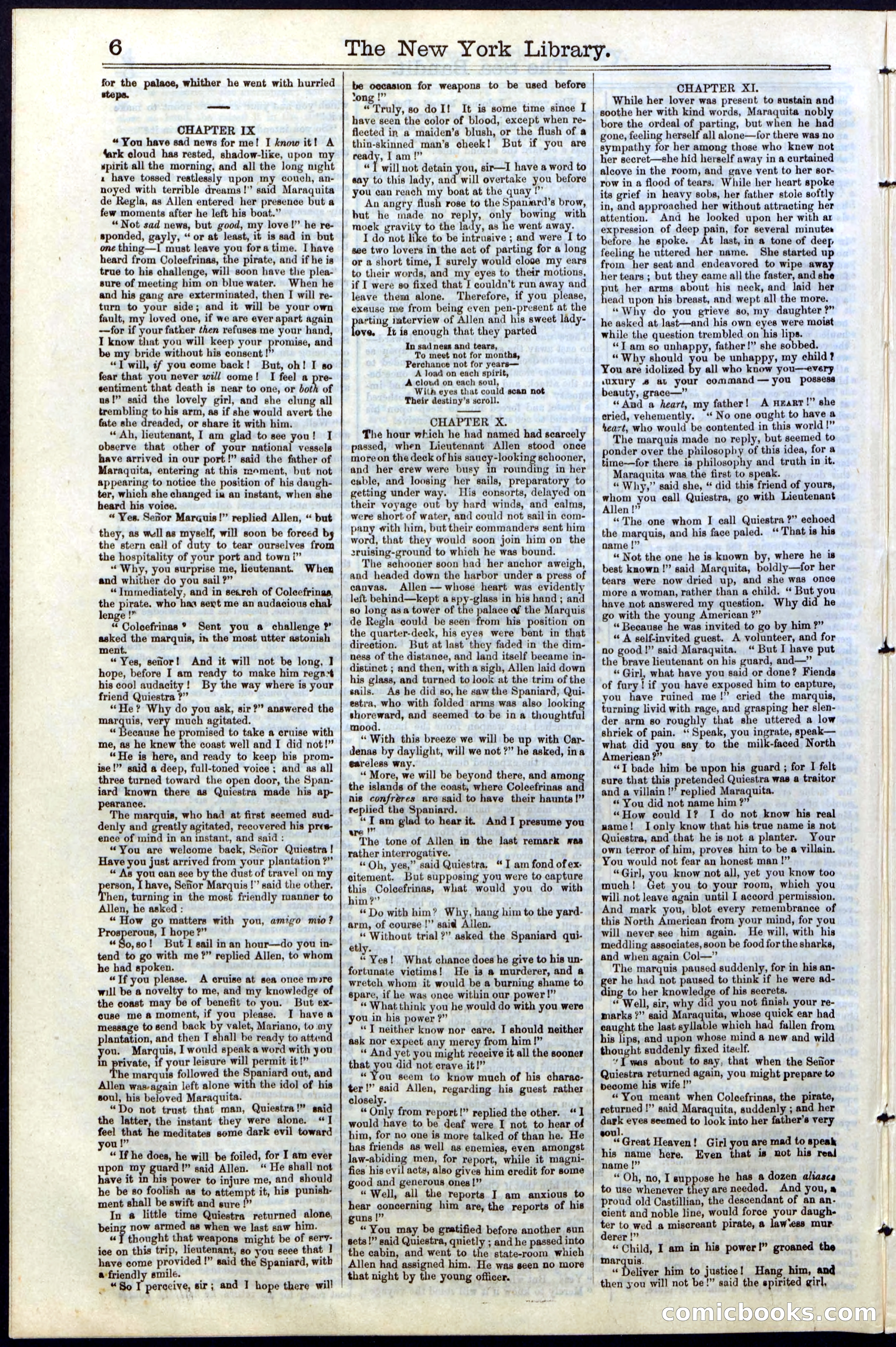
A restored page from Pulp Fiction, 1877. Page through the whole issue in the reader above.
📄 Transcribed text from this page (OCR, searchable)
Machine-transcribed from the original scan — historical spelling and the odd misread are preserved.
6 The New York Library. | / a-nweeo wae : Sarees wd ~ the palace, whither he went with hurried | be oecasion for weapons to be used before CHAPTER XI. | ~ on; se : au ¥ While her lover was present to sustain and | Truly, so do I! It is some time since soothe her with kind words, Maraquita nobly have seen the color of blood, except when re- | tore the ordeal of parting, but when he had CHAPTER IX ‘ flected in a maiden’s blush, or the flush of a gone, feeling herself all alone—for there was no “ You have sad news for me! T know it! A | thin-skinned man’s cheek! But if you are sympathy for her among those who knew not fark cloud has rested, shadow-like, upon my | ready, I am!” her secret—she hid herself away in a curtained spirit all the morning, and all the long mght “T will not detain you, sir—I have a word to | gjooye in the room, and gave vent to her sor- « have tossed restlessly upon my couch, an- | gay to this lady, and will overtake you before | pow in a flood of tears. While her heart spoke nie noyed with terrible dreams!” said Maraquita de Regla, as Allen entered her presence but a few moments after he left his boat.” “ Not sad news, but good, my love!” he re- sponded, gayly, “ or at least, it is sad in but one thing—I must leave you fora time. I have heard from Coleefrinas, the pirate, and if he is true to his challenge, will soon have the plea- sure of meeting him on blue water. When he and his gang are exterminated, then I will re- turn to your side; and it will be your own fault, my loved one, if we are ever apart again —for if your father then refuses me your hand, I know that you will keep your promise, and be my bride without his consent !” “T will, if you come back! But, oh! I so fear that you never will come! I feel a pre- sentiment that death is near to one, or both of us!” said the lovely girl, and she clung all trembling to his arm, as if she would avert the fate she dreaded, or share it with him. “ Ah, lieutenant, I am glad to see you! I observe that other of your national vessels have arrived in our port!” said the father of Maraquita, entering at this moment, but not appearing to notice the position of his daugh- ter, which she changed ix an instant, when she heard his voice. “ Yes. Seior Marquis!” replied Allen, “ but they, as wll as myself, will soon be foreed by the stern call of duty to tear ourselves from the hospitality of your port and town i” “ Why, you surprise me, lieutenant. When and whither do you sail ?” “Immediately, and in search of Colcefrinas, the pirate. who haa sext me an audacious chal lenge !” “ Colcefrinas ® Sent you a challenge ? asked the marquis, in the most utter astonish ment. “Yes, senor! And it will not be long, ] hope, before I am ready to make him regn-t his coo] audacity! By the way where is your friend Quiestra ?” “He? Why do you ask, sir?” answered the marquis, very much agitated. “ Because he promised to take a cruise with me, as he knew the coast well and I did not!” “He is here, and ready to keep his prom- ise!” gaid a deep, full-toned voice ; and as all three turned toward the open door, the Span- iard known there as Quiestra made his ap- pearance. The marquis, who had at first seemed sud- denly and greatly agitated, recovered his pree- ence of mind in an instant, and said : “You are welcome back, Senor Quiestra! Have you just arrived from your plantation ?” “As ve can see by the dust of travel on my erson, I have, Sefior Marquis !” said the other. hen, turning in the most friendly manner to Allen, he asked : “How go matters with you, amigo mio? Prosperous, I hope?” “$So,so! But I sail inan hour—do you in- tend to go with me” replied Allen, to whom he had spoken. “Tf you please. A cruise at sea once more will be a novelty to me, and my knowledge of the coast may be of benefit to you. But ex- cuse me a moment, if you please. I havea message to send back by valet, Mariano, to my plantation, and then I shall be ready to attend ou. Marquis, I would speak a word with you rivate, if your leisure will permit it!” The marquis followed the Spaniard out, and Allen was-again left alone with the idol of his soul, his beloved Maraquita. “Do not trust that man, Quiestra!” said the latter, the instant they were alone. “] feel that he meditates seme dark evil toward ou!” “Tf he does, he will be foiled, for I am ever upon my — !” said Allen. ‘ He shall not have it 1n his power to injure me, and should he be so foolish as to attempt it, his punish- ment shall be swift and sure fr In a little time Quiestra returned alone, being now armed as when we last saw him. “ F thonght that weapons might be of serv- ice on this trip, lieutenant, so you seee that | have come provided !” said the Spaniard, with a‘friendly smile. . “Bo T perceive, sir; and I hope there will you can reach my boat at the quay !”’ An angry flush rose to the Spanmrd’s brow, but he made no reply» only bowing with mock gravity to the lady, as he went away. I do not like to be intrusive ; and were I to see two lovers in the act of parting for a long or a short time, I surely would close my ears to their words, and my eyes to their motions, if I were so fixed that I couldn’t run away and leave them alone. Therefore, if you please, exeuse me from being even pen-present at the arting imterview of Allen and his sweet lady- tive. It is enough that they parted In sad ness and tears, To meet not for months, Perchance not for years— A load on each spirit, A clowd on each soul, With eyes that could scan not Their destiny’s scroll. CHAPTER X. The hour which he had named had scarcely passed, when Lieutenant Allen stood once more on the deck of his saucy-lookin schooner, and her erew were busy in rounding in her eable, and loosing her sails, preparatory to getting under way. Tis consorts, delayed on their voyage out by hard winds, and calms, were short of water, and could not sail in com- pany with him, but their commanders sent him word, that they would soon join him on the 2ruising-ground to which he was bound. The schooner soon bad her anchor aweigh, and headed down the harbor under a press of canvas. Allen — whose heart was evidently left behind—kept a spy-glass in his hand ; and so long asa tower of the palace of the Marquis de Regla could be seen from his position on the quarter-deck, his eyes were bent in that direction. But at last they faded in the dim- ness of the distanee, and land itself became in- distinet ; and then, with a sigh, Allen laid down his glass, and turned to look at the trim of the sails. As he did so, he saw the Spaniard, Qui- estra, who with folded arms was also looking shoreward, and seemed to be in a thoughtful mood. “With this breeze we will be up with Car- denas by daylight, will we not ?” he asked, ina eareless way. ‘“‘ More, we will be beyond there, and amon the islands of the coast, where Colecefrinas ad nis confréres are said to have their haunts!” replied the Spaniard. 3 I am glad to hear it. AndI presume you are The tone of Allen in the last remark was rather interrogative. “Oh, yes,” said Quiestra, “I am fond ofex- citement. But supposing you were to capture this Coleefrinas, what would you do with him?” “Do with him? Why, hang him to the yard- arm, of course !’’ said Allen. “ Without trial?” asked the Spaniard qui- etly. “Yes! What chance does he give to his un- fortunate victims! He ia a murderer, and a wretch whom it would be a burning shame to spare, if he was onee within our power!” “What think you he would do with you were you in his power ?” “T neither know nor care. I should neither ask nor expect any merey from him!” “ And yet you might receive it all the sooner that you did not crave it!” “You seem to know much of his charac- ter!” said Allen, regarding his guest rather closely. “ Only from report!” replied the other. “1 would have to be deaf were I not to hear of him, for no one is more talked of than he. He has friends as well as enemies, even amongst law-abiding men, for report, while it magni- fies his evil acts, also gives him eredit for some good and generous ones |” “Well, all the reports I am anxious to hear concerning him are, the reports of his guns |” “You may be gratified before another sun sets!” said Quiestra, quietly ; and he passed into the cabin, and went to the state-room which — Allen had assigned him. He was seen no more that night by the young officer. its grief in heavy sobs, her father stole softly in, and approached her without attracting her attention. And he looked upon her with ar expression of deep pain, for several minuter before he spoke. At last, in a tone of deep feeling he uttered her name. She started up from her seat and endeavored to wipe away her tears ; but they came all the faster, and she ut her arms about his neck, and laid her 1ead upon his breast, and wept all the more. “Why do you grieve so, my daughter ?” he asked at last—and his own eyes were moist while the question trembled on his lips. “Tam so unhappy, father!” she sobbed. “Why should you be unhappy, my child? You are idolized by all who know you—every uxury # at your command— you possess beauty, grace—” “And a heart, my father! A Heart!” she eried, vehemently. “ No one ought to have a heart, who would be contented in this world!” The marquis made no reply, but seemed to ponder over the philosophy of this idea, for a time—for there is philosophy and truth in it. Maraquita was the first to speak. _ “Why,” said she, “ did this friend of yours, whom you call Quiestra, go with Lieutenant Allen !”’ “The one whom I eall Quiestra ?” echoed the marquis, and his face paled. ‘That is his name |” “ Not the one he is known by, where he is best known !”’ said Marquita, boldly—for her tears were now dried up, and she was once more a woman, rather than a child. “ But you have not answered my question. Why did he go with the young American ?” “ Because he was invited to go by him ?” “ A self-invited guest. A volunteer, and for no good!” said Maraguita. “ But I have put the brave lieutenant on his guard, and—” “ Girl, what have you said or done? Fiends of fury! if you have exposed him to capture, you have ruined me!” cried the marquis, turning livid with rage, and grasping her slen- der arm so roughly that she uttered a low shriek of pain. ‘Speak, you ingrate, speak— what did you say to the milk-faced North American ?” “T bade him be upon his guard ; for I felt sure that this preten ed Quiestra was a traitor and a villain!” replied Maraquita. “ You did not name him ?” “How could I? I do not know his real name! I only know that his true name is not Quiestra, and that he is not a planter. Your own terror of him, proves him to be a villain. You would not fear an honest man !” “Girl, you know not all, yet you know too much! Get you to your room, which you will not leave again until I accord permission. And mark you, blot every remembrance of this North American from your mind, for you will never see him again. He will, with his meddling associates, soon be food for the sharks, and when again Col—” The marquis paused suddenly, for in his an- er he had not paused to think if he were ad- dling to her knowledge of his secrets. “ Well, sir, why did you not finish your re- marks ?”” said Maraquita, whose quick ear had caught the last syllable which had fallen from his a and upon whose mind a new and wild thought suddenly fixed itself. “IT was about to say, that when the Senor Quiestra returned again, you might prepare to become his wife |” “You meant when Colecefrinas, the pirate, returned !” said Maraquita, suddenly ; and her dark eyes seemed to look into her father’s very soul. “Great Heaven! Girl you are mad to speak his name here. Even that is not his real name |” “Oh, no, I suppose he has a dozen aliasca to use whenever they are needed. And you, a proud old Castillian, the descendant of an an. cient and noble line, would force your daugh- ter to wed a miscreant pirate, a law‘ess mur. derer !” ; “Child, I am in his power!” groaned the | Marquis. tiny : wes eliver him to justice! Hang him, and then you will not be!” said the spirited girl, Gomicbooksiue (0)