
Pulp Fiction, 1877 · page 22 of 28
Beadle's Dime Library No. 18 — page 22: what you’re looking at
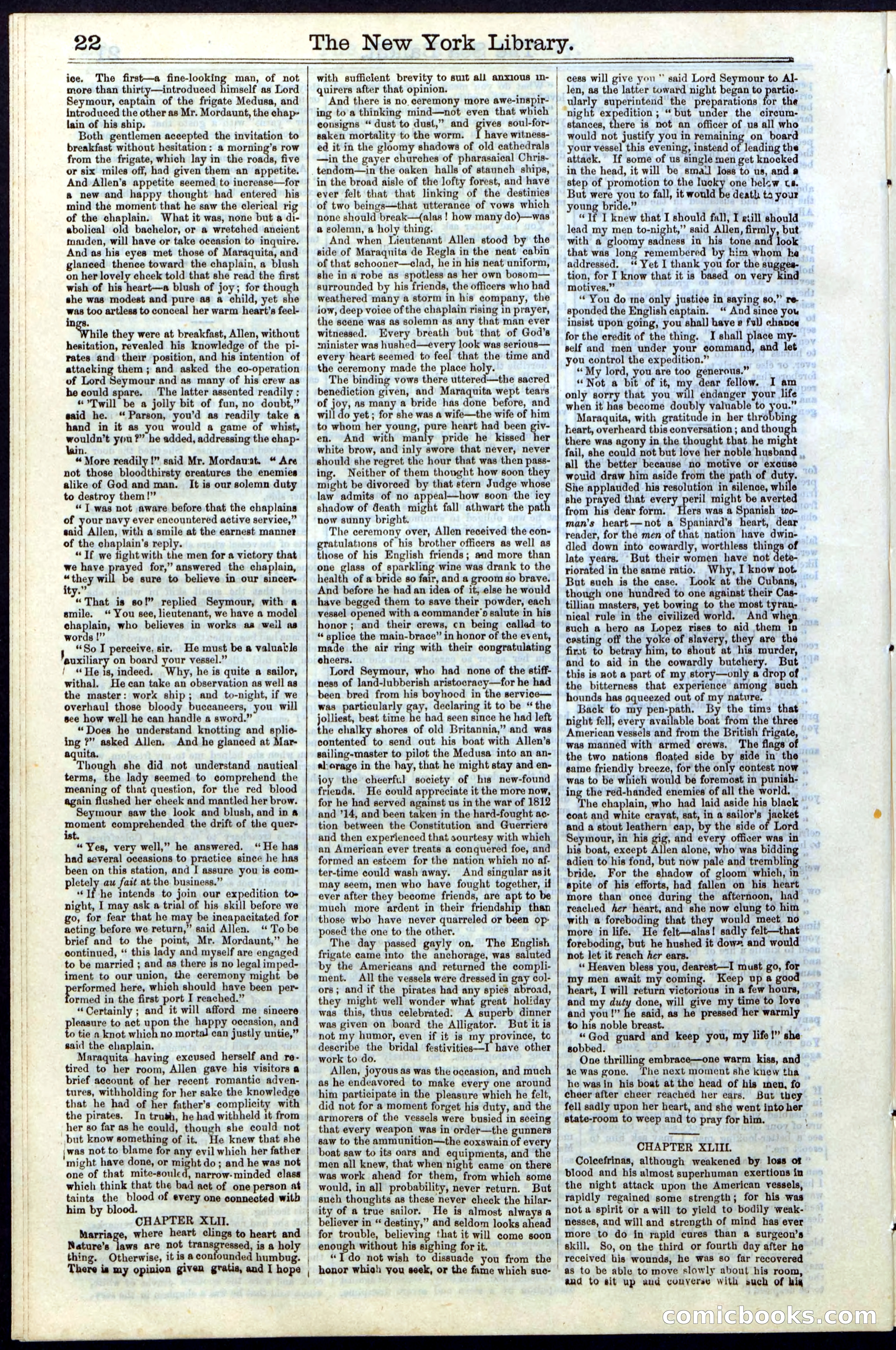
A restored page from Pulp Fiction, 1877. Page through the whole issue in the reader above.
📄 Transcribed text from this page (OCR, searchable)
Machine-transcribed from the original scan — historical spelling and the odd misread are preserved.
ice. The first—a fine-looking man, of not more than thirty—introduced himself as Lord Seymour, captain of the frigate Medusa, and introduced the other as Mr. Mordaunt, the chap» lain of his ship. Both gentlemen aceepted the invitation to breakfast without hesitation: a morning’s row from the frigate, which lay in the roads, five or six miles off, had given them an appetite. And Allen’s appetite seemed to increase—for a new and happy thought had entered his mind the moment that he saw the clerical ri of the chaplain. What it was, none but a di- abolical old bachelor, or a wretched ancient maiden, will have or take oceasion to inquire. And as his eyes met those of Maraquita, and glanced thence toward the chaplain, a blush on her lovely cheek told that she read the first wish of his heart—a blush of joy; for though she was modest and pure as a child, yet she was too artless to conceal her warm heart's feel- ings. While they were at breakfast, Allen, without hesitation, revealed his knowledge of the pi- rates and their position, and his intention of attacking them; and asked the co-operation of Lord Seymour and as many of his crew as he could spare. The latter assented readily : “Twill be a jolly bit of fun, no doubt,” said he. “Parson, you'd as readily take a hand in it as you would a game of whist, wouldn’t you?” he added, addressing the chap- n. “More readily !” said Mr. Mordauat. “ Are not those bloodthirsty creatures the enemies alike of God and man. It is our solemn duty to destroy them!” “T was not aware before that the chaplains of your navy ever encountered active service,” said Allen, with a smile at the earnest manne? of the chaplain's reply. “Tf we fight with the men for a victory that we have prayed for,” answered the chaplain, “they will be sure to believe in our sincer- “That is so!” replied Seymour, with a smile. ‘ You see, lieutenant, we have a model chaplain, who believes in works aa weil as words |” “So I perceive, sir. He must be a valuable auxiliary on board your vessel.” { “He is, indeed. Why, he is quite a sailor, withal. Hecan take an observation as well as the master: work ship; and to-night, if we overhaul those bloody buccaneers, you will see how well he can handle a sword.” “Does he understand knotting and splic- ing ?’”’ asked Allen, And he glanced at lice aquita. Though she did not understand nautical terms, the lady seemed to comprehend the meaning of that question, for the red blood again flushed her cheek and mantled her brow. Seymour saw the look and blush, and in 4 mouar comprehended the drift of the quer- t. “Yes, very well,” he answered. “He has had eeveral oceasions to practice since he has been on this station, and I assure you is com- pletely au fait at the business.” “If he intends to join our expedition to- night, I may ask a trial of his skill before we go, for fear that he may be incapacitated for acting before we return,” said Allen. “ To be brief and to the point, Mr. Mordaunt,’”’ he continued, “ this lady and myself are engaged to be married ; and as there is no legal imped- iment to our union, the ceremony might be rformed here, which should have been per- ormed in the first port I reached.” “Certainly ; and it will afford me sincere leasure to act upon the happy occasion, and tie a knot which no mortal can justly untie,” said the chaplain. Maraguita having excused herself and re- tired to her room, Allen gave his visitors a brief account of her recent romantic adven- tures, withholding for her sake the knowledge that he had of her father’s complicity with the pirates. In trush, he had withheld 1t from her so far as he could, though she could not but know something of it. He knew that she was not to blame for any evil which her father might have done, or might do; and he was not one of that mitovedullet: narrow-minded class which think that the bad act of one person at taints the blood of every one connected with him by blood. CHAPTER XLII. Marriage, where heart clings to heart and Nature’s es are not transgressed, is a holy thing. Otherwise, it is a confounded humbug. There is my opinion given gratia, and I hope | | with sufficient brevity to suit all anxious in- quirers after that opinion. And there is no ceremony more awe-inspir- ing to a thinking mind—not even that which eonsigns “ dust to dust,” and gives soul-for- saken mortality to the worm. I have witness- ed it in the gloomy shadows of old cathedrals —in the gayer churches of pharasaical Chris- tendom—in the oaken halls of staunch ships, | in the broad aisle of the lofty forest, and have ever felt that that linking of the destinies of two beings—that utterance of vows which none should break—(alas ! how many do)—was a eolemn, a holy thing. And when Lieutenant Allen stood by the side of Maraqnita de Regla in the neat cabin of that schooner—elad, he in his neat uniform, she in a robe as spotless as her own bosom— surrounded by his friends, the officers who had weathered many a storm in his company, the iow, deep voice of the chaplain rising 1n prayer, the scene was as solemn as any that man ever witnessed. Every breath but that of God’s minister was hushed—every look was serious— every heart seemed to feel that the time and the ceremony made the place holy. The binding vows there uttered—the sacred benediction given, and Maraquita wept tears of joy, ns many a bride has done before, and will rh yet; for she was a wife—the wife of him to whom her young, pure heart had been giv- en. And with manly pride he kissed her white brow, and inly swore that never, never should she regret the hour that was then pass- ing. Neither of them thought how soon they might be divoreed by that stern Judge whose law admits of no eee titty soon the ie shadow of death might fall athwart the path now sunny bright. The ceremony over, Allen received the con- gratulations of his brother officers as well as those of his English friends; and more than one glass of sparkling wine was drank to the health of a bride so fair, and a groom so brave. And before he had an idea of it, else he would have begged them to save their powder, each vessel opened with a commander's salute in his honor; and their crews, cn being called to “splice the main-brace” in honor of the event, made the air ring with their congratulating eheers. Lord Seymour, who had none of the stiff- ness of land-lubberish aristocracy—for he had been bred from his boyhood in the service— was particularly gay, declaring it to be “the jolliest, best time he had seen since he had left the chalky shores of old Britannia,” and was contented to send out his boat with Allen’s sailing-master to pilot the Medusa into an an- al:orage in the hay, that he might stay and en- joy the cheerful society of Ins new-found friends. He could appreciate it the more now, for he had served against us in the war of 1812 and ’14, and been taken in the hard-fought ac- tion between the Constitution and Guerriere and then experienced that sourtesy with which an American ever treats a conquered foe, and formed an esteem for the nation which no af- ter-time could wash away. And singular asit may seem, men who have fought together, if ever after they become friends, are apt to be much more ardent in their friendship than those who have never quarreled or been op- posed the one to the other. The day passed gayly on, The English frigate came into the anchorage, was saluted by the Americans and returned the compli- ment. All the vessels were dressed in gay col- ors; and if the pirates had any spies abroad, they might well wonder what great holiday was this, thus celebrated: A superb dinner was given on board the Alligator. But it is not my humor, even if it is my province, to describe the bridal festivities—I have other work to do. Allen, joyous as was the occasion, and much as he endeavored to make every one around him participate in the pleasure which he felt, did not for a moment forget his duty, and the armorers of the vessels were busied in seeing that every weapon was in order—the gunners saw to the ammunition—the coxswain of every boat saw to its oars and equipments, and the men all knew, that when night came on there was work ahead for them, from which some would, in all probability, never return. But such thoughts as these never check the hilar- ity of a true sailor. He is almost always a believer in “ destiny,” and seldom looks ahead for trouble, believing that it will come soon TE without his sighing for it. “Ido not wish to dissuade you from the ! ee honor whieh you seek, or the fame which suc- | The New York Library. TE ee ee ee cess will give you * said Lord Seymour to Al- len, as the latter toward night began to partic- ularly superintend the preparations for the night expedition; “but under the circum- stances, there is not an officer of us all who would not justify you in remaining on board your vessel this evening, instead of leading the attack. If some of us single men get knocked in the head, it will be small loss to us, and a step of promotion to the lucky one belaw ta. But were you to fall, it would be death ta your young bride.” “Tf I knew that I should fall, I etill should lead my men to-night,” said Allen, firmly, but with a gloomy sadness in his tone and look that was long remembered by kim whom he addressed. ‘ Yet I thank you for thes tion, for I know that it is based on very kind motives.” ‘You do me only justice in saying so,” re sponded the English captain. ‘“ And since you insist upon going, you shall have e ful) chance for the eredit of the thing. I shall pea my- self and men under your command, and let you control the expedition.” “My lord, you are too generous.” ‘Not a bit of it, my dear fellow. I am only sorry that you will endanger your life when it has become doubly valuable to you.” Maraguita, with gratitude in her thro ni heart, overheard this conversation ; and thou there was agony in the thought that he might fail, she could not but love her noble husband . all the better because no motive or excuse would draw him aside from the path of duty. She applauded his resolution in silence, while she prayed that every ag might be averted from his dear form. Hers was a Spanish wo- man’s heart—not a Spaniard’s heart, dear reader, for the men of that nation have dwin- dled down into cowardly, worthless mip of late years. But their women have not dete- riorated in the same ratio. Why, I know not But such is the case. Look at the Cubans, though one hundred to one against their Cas- tillian masters, yet bowing to the most tyran- nical rule in the civilized world. And when such a hero as Lopez rises to aid them in casting off the yoke of slavery, they are the first to betray him, to shout at his murder, and to aid in the cowardly butchery. But | this is not a part of my story—only a drop of the bitterness that experience among such hounds has oqueezed out of my nature. Back to my pen-path. By the tims that night fell, every available boat from the three American vessels and from the British frigate, was manned with armed crews. The flags of the two nations floated side by side in the same friend] was to be which would be foremost in punish- ing the red-handed enemies of all the world. The chaplain, who had laid aside his black coat and white cravat, sat, in a sailor’s jacket and a stout leathern cap, by the side of Lord Seymour, in his gig, and every officer was in his boat, except Allen alone, who was bidding adieu to his fond, but now pale and trembling _ bride. For the shadow of gloom which, in spite of his efforts, had fallen on his heart more than once during the afternoon, had reached her heart, and she now clung to him with a foreboding that they would meet no more in life. He felt—alas! sadly felt—that foreboding, but he hushed it dow» and would not let it reach Aer ears. “ Heaven bless you, dearest—I must go, for my men await my coming. Keep up a go heart, I will return victorious in a few hours, and my duty done, will give my time to love and you!” he said, as he pressed her warmly to his noble breast. “God guard and keep you, my life!” she sobbed. One thrilling embrace—one warm kiss, and ae was gone. The next moment she knew tha he was in his boat at the head of his men, fo cheer after cheer reached her ears. But they fell sadly upon her heart, and she went into her state-room to weep and to pray for him. CHAPTER XLIIL Coleefrinas, although weakened by loss of blood and his almost superhuman exertions in the night attack upon the American vessels, rapidly regained some strength; for his was not a spirit or a will to yield to bodily weak- nesses, and will and strength of mind has ever more to do in rapid cures than a surgeon’s skill. So, on the third or fourth day after he received his wounds, he was so far recovered as to be able to move slowly about his room, and to sit up and converse with such of hig breeze, for the only contest now | JOO (E(0) m (E “S (E (0)