
Pulp Fiction, 1877 · page 28 of 32
Beadle's Dime Library No. 16 — page 28: what you’re looking at
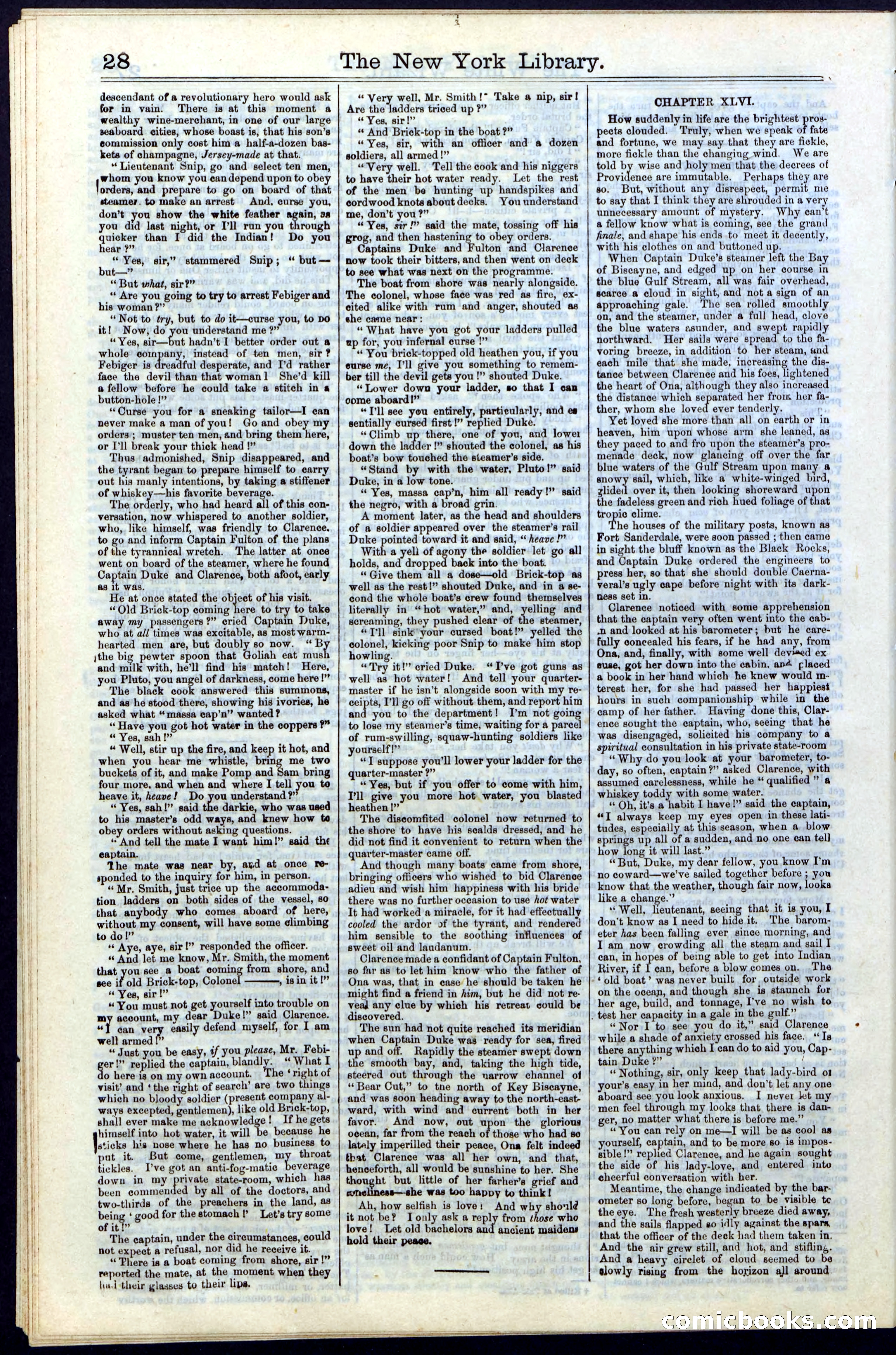
A restored page from Pulp Fiction, 1877. Page through the whole issue in the reader above.
📄 Transcribed text from this page (OCR, searchable)
Machine-transcribed from the original scan — historical spelling and the odd misread are preserved.
descendant of a revolutionary hero would ask for in vain. There is at this moment a wealthy wine-merchant, in one of our large seaboard cities, whose boast is, that his son’s commission only cost him a half-a-dozen bas- kets of champagne, Jersey-made at that. “Lieutenant Snip, go and select ten men, whom you know you can depend upon to obey lorders, and prepare to go on board of that steamey. to make an arrest And, curse you, don’t you show the white feather again, os you did last night, or T’ll ran you through quicker than I did the Indian! Do you hear ?” “ Yes, sir,” stammered Snip; “ but— but—” “ But what, sir?” “ Are you going to try to arrest Febiger and his woman ?” “Not to try, but to do it—curse you, to Do it! Now, do you understand me ?” “Yes, sir—but hadn’t I better order out a whole company, instead of ten men, sir? Febiger is dreadful desperate, and I’d rather face the devil than that woman] She’d kill a fellow before he could take a stitch in a button-hole !” “Curse you for a sneaking tailor—I can never make a man of you! Go and obey my orders’; muster ten men, and bring them here, or I'll break your thick head !” Thus admonished, Snip disappeared, and the tyrant began to prepare himself to carry out his manly intentions, by taking a stiffener of whiskey—his favorite beverage. The orderly, who had heard all of this con- versation, now whispered to another soldier, who, like himself, was friendly to Clarence. to go and inform Captain Fulton of the plans of the tyrannical wretch. The latter at once went on board of the steamer, where he found Captain Duke and Clarenee, both afoot, early as it was. He at once stated the object of his visit. “Old Brick-top coming here to try to take away my passengers?” cried Captain Duke, who at all times was excitable, as most warm- hearted men are, but doubly so now. “B jthe big pewter spoon that Goliah eat mus and milk with, he’ll find his match! Here, you Pluto, you angel of darkness, come here !” The black cook answered this summons, and as he stood there, showing his ivories, he asked what “massa cap’n” wanted ? “Have you got hot water in the coppers ?” “ Yes, sah!” “ Well, stir up the fire, and keep it hot, and when you hear me whistle, bring me two buckets of it, and make Pomp and oe bring four more, and when and where I tell you to heave it, heave! Do you understand ?’ “ Yes, sah!” said the darkie, who was used to his master’s odd ways, and knew how te obey orders without asking questions. “And tell the mate I want him!” said the eaptain. The mate was near by, ayd at once re- sponded to the inquiry for him, in person. “Mr. Smith, just trice up the accommoda- tion ladders on both sides of the vessel, so that anybody who comes aboard of here, without my consent, will have some climbing to do!” “ Aye, aye, sir!” responded the officer. «“ And let me know, Mr. Smith, the moment that you see a boat coming from shore, and see if old Brick-top, Colonel ———, is in it!” “ Yes, sir!” “ You must not get yourself into trouble on my account, my dear Duke!” said Clarence. uf can very easily defend myself, for I am well armed !” ; “ Just you be easy, if you please, Mr. Febi- er!” replied the captain, Diane “What I o here is on my own account. he ‘right of visit’ and ‘the right of search’ are two things which no bloody soldier (present company al- ways excepted, gentlemen), like old Brick-top, shall ever make me acknowledge! If he gets himself into hot water, it will be because he sticks his nose where he has no business to put it. But come, gentlemen, i throat tickles. I’ve got an anti-fog-matie beverage down in my private state-room, which has been commended by all of the doctors, and two-thirds of the preachers in the land, as bel ‘good for the stomach’ Let’s try some of it!” ; The captain, under the cireumstances, could not expect a refusal, nor did he receive it. “Phere is a boat coming from shore, sir!” reported the mate, at the moment when they ud their glasses to their lips. The New York Library. “ Very well, Mr. Smith!“ Take 4 nip, sir! Are the ladders triced up ?” “Yes, sir!” “« And Brick-to “Yes, sir, wit soldiers, all armed!” “Very well. Tell the cook and his niggers to have their hot water ready. Let the rest of the men be hunting up handspikes and cordwood knots about decks. You understand me, don’t you ?” “Yes, sir!” said the mate, tossing off his grog: and then hastening to obey orders. aptains Duke and Fulton and Clarence now took their bitters, and then went on deck to see what was next on the programme. The boat from shore was nearly alongside. The colonel, whose face was red as fire, ex- cited alike with rum and anger, shouted as she came near: “What have you got your ladders pulled up for, you infernal curse !” “ You brick-topped old heathen you, if you eurse me, I’ll give you something to remem- ber till the devil gets you !” shouted Duke. “Lower down your ladder, so that I can come aboard!” “T’ll see you entirely, particularly, and es sentially cursed first!” replied Duke. “Climb up there, one of you, and lowe1 down the ladder !” shouted the colonel, as his boat’s bow touched the steamer’s side. “Stand by with the water, Pluto!” said Duke, in a low tone. “ Yes, massa cap’n, him all ready!” said the negro, with a broad grin. A moment later, as the head and shoulders of a soldier appeared over the steamer’s rail Duke pointed toward it and said, “heave !” With a yell of agony the soldier let go all holds, and dropped back into the boat. “Give them all a dose—old Brick-top as well as the rest!” shouted Duke, and in a se- cond the whole boat’s crew found themselves literally in “hot water,” and, yelling and screaming, they pushed clear of the steamer, “T'll sink’ your cursed boat!” yelled the colonel, kicking poor Snip to make him stop howling. “Try it!’ eried Duke. “T’ve got guns as well as hot water! And tell your quarter- master if he isn’t alongside soon with my re- i I'll go off without them, and report him and you to the department! I’m not going to lose my steamer’s time, waiting for a parcel of rum-swilling, squaw-hunting soldiers like yourself!” “JT suppose you'll lower your ladder for the quarter-master ?” “Yes, but if you offer to come with him, Ill give you more hot water, you blasted heathen |” The diseomfited colonel now returned to the shore to have his sealds dressed, and he did not find it convenient to return when the quarter-master came off. And though many boats came from shore, bringing officers who wished to bid Clarence adieu and wish him happiness with his bride there was no further oceasion to use hot water It had worked a miracle, for it had effectually cooled the ardor of the tyrant, and rendered him sensible to the soothing influences of sweet oil and landanum. Clarence made a confidant of Captain Fulton, so far as to let him know who the father of Ona was, that in case he should be taken he might find a friend in him, but he did not re- veal any clue by which his retreat could be discovered. The sun had not quite reached its meridian when Captain Duke was ready for sea, fired up and off. Rapidly the steamer swept down the smooth bay, and, taking the high tide, steered out through the narrow channel of “ Bear Cut,” to the north of Key Biscayne, and was soon heading away to the north-east- ward, with wind and current both in her favor. And now, out upon the glorious ocean, far from the reach of those who had 8o lately imperilled their peace, Ona felt indeed that Clarence was all her own, and that, henceforth, all would be sunshine to her. She thought but little of her farher’s grief and cone e was too happy to think! Ah, how selfish is love: And why should it not be? Tonly ask a reply from those who love! Let old bachelors and ancient maidens hold their peace. in the boat ?” an officer and a dozen neg ie i eS ES PE PS CHAPTER XLVI. How suddenly in life are the brightest pros- pects clouded. Truly, when we speak of fate and fortune, we may say that they are fickle, more fickle than the changing wind. We are told by wise and holy men that the decrees of Brcsidcag! are immutable. Perhaps they are so. But, without any disrespect, permit me to say that I think they are shrouded in a very unnecessary amount of mystery. Why can’t a fellow know what is coming, see the grand finale, and shape his ends to meet it decently, with his clothes on and buttoned up. When Captain Duke’s steamer left the Bay of Biscayne, and edged up on her course in the blue Gulf Stream, all was fair overhead, scarce a cloud in sight, and not a sign of an approaching gale. The sea rolled smoothly on, and the steamer, under a full head, clove the blue waters asunder, and swept rapidly northward. Her sails were spread to the fa- voring breeze, in addition to her steam, snd each mile that she made, increasing the dis- tance between Clarence and his foes, lightened the heart of Ona, although they also increased the distance which separated her from her fa- ther, whom she loved ever tenderly. Yet loved she more than all on earth or in heaven, him upon whose arm she leaned, as they paced to and fro upon the steamer’s pro- maid deck, now glancing off over the far blue waters of the Gulf Stream upon many a snowy sail, which, like a white-winged bird, glided over it, then looking shoreward upon the fadeless green and rich hued foliage of that tropic clime. he houses of the military posts, known as Fort Sanderdale, were soon passed ; then came in sight the bluff known as the Black Rocks, and Captain Duke ordered the engineers to press her, so that she should double Caerna- veral’s ugly eape before night with its dark- ness set in. Clarence noticed with some apprehension that the captain very often went into the cab- .n and looked at his barometer; but he care- fully concealed his fears, if he had any, from Ona, and, finally, with some well devy*ed ex euse, got her down into the cabin, an@ placed a book in her hand which he knew would in- terest her, for she had passed her happiest hours in such companionship while in the camp of her father. Having done this, Clar- ence sought the eaptain, who, seeing that he was disengaged, solicited his company to a spiritual consultation in his private state-room “Why do you look at your barometer, to- day, so often, captain?” asked Clarence, with assumed carelessness, while he “ qualified ” a whiskey toddy with some water. “ Oh; it’s a habit I have!” said the captain, “TI always keep my eyes open in these lati- tudes, especially at this season, when a blow spuinge up all of a sudden, and no one ean tell how long it will last.” “But, Duke, my dear fellow, you know I’m no coward—we've sailed together before ; you know that the weather, though fair now, looks like a change.” ‘Well, lieutenant, seeing that it is you, I don't know as I need to hide it. The barom- eter has been falling ever since morning, and I am now crowding all the steam and sail I can, in hopes of being able to get into Indian River, if 1 ean, before a blow comes on. The -*old boat’ was never built for outside work on the ocean, and though she is staunch for her age, build, and tonnage, I’ve no wish to _ test her capacity in a gale in the gulf.” “Nor I to see you do it,” said Clarence while a shade of anxiety crossed his face. “Is there anything which I can do to aid you, Cap- tain Duke ?” “ Nothing, sir, only keep that lady-bird o1 your’s easy in her mind, and don’t let any one aboard see you look anxious. I never kt my men feel through my looks that there is dan- ger, no matter what there is before me.” “You can rely on me—I will be as cool as yourself, captain, and to be more so is impos- sible!” replied Clarence, and he again sought the side of his lady-love, and entered into cheerful conversation with her. Meantime, the change indicated by the bar- ometer so long before, began to be visible te theeye. The fresh westerly breeze died away, and the sails flapped so idly against the spars, that the officer of the deck had them taken in. And the air grew still, and hot, and stifling. And a heavy cirelet of cloud seemed to be slowly rising from the horizon ajl around. Gomichbooks: