
Pulp Fiction, 1881 · page 2 of 24
Beadle's Dime Library No. 157 — page 2: what you’re looking at
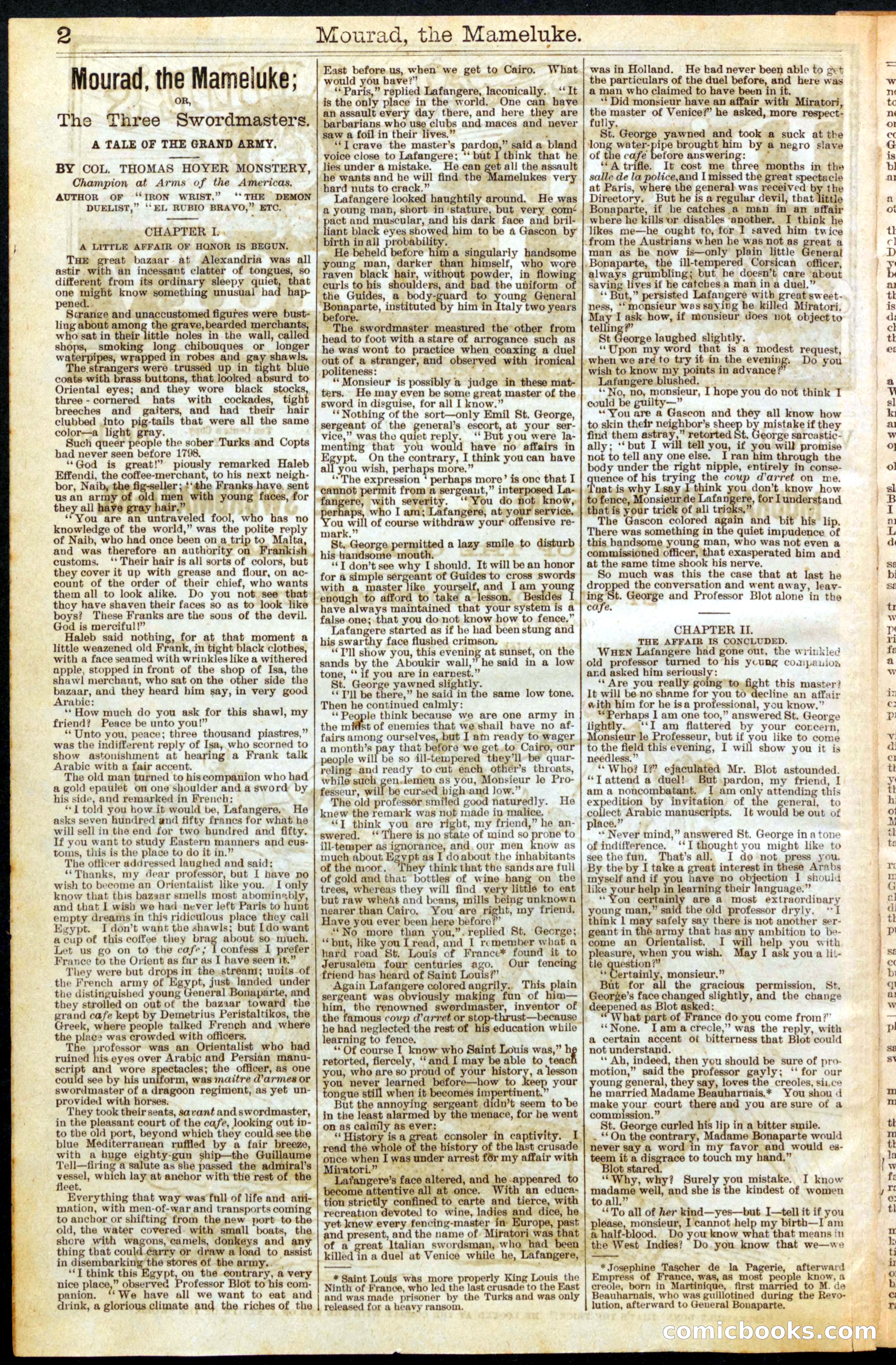
A restored page from Pulp Fiction, 1881. Page through the whole issue in the reader above.
📄 Transcribed text from this page (OCR, searchable)
Machine-transcribed from the original scan — historical spelling and the odd misread are preserved.
oa + : Pe :[ >. ° alll ae 2 ee ——— oe ee The Three Swordmasters. A TALE OF THE GRAND ARMY. —_—-_-_-- —_— BY COL. THOMAS HOYER MONSTERY, Champion at Arms of the Americas. AUTHOR OF “IRON WRIST,” ‘THE DEMON DUELIST,” ‘‘EL RUBIO BRAVO,” ETC. ~ Ses CHAPTER I, |. A LITTLE AFFAIR OF HONOR IS BEGUN. eat bazaar. at Alexandria was all th an incessant clatter of tongues, so different from its ordinary sleepy quiet, that one might know something unusual had hap- shops, smoking long chibouques or longer wate wrapped in robes and gay shawls, ‘he strangers were trussed up in” f ht blue coats with brass buttons, that looked a d to Oriental eyes; and they wore black stocks three - cornered hats with cockades, tight breeches and gaiters, and had their hair clubbed into pig-tails that were all the same color—a light gray. ; Such queer people the sober Turks and Copts had never seen before 1798, “God is great!” piously remarked Haleb Effendi, the coffee-merchant, to his next neigh- 3 they all ha r QpFe eo bas fe ‘*You are an untraveled fool, who has no knowledge of the world,” was the polite reply of Naib, who had once been on a trip y Malta, and was therefore an authority on Frankish customs. ‘* Their hair is all sorts of colors, but they cover it up with grease and flour, on ac- count of the order of their chief, who wants them all to look alike. Do you not see that thoy have shaven their faces so as to look like boys? These Franks are the sons of the devil. God is merciful!” Haleb said nothing, for at that moment a little weazened old Frank, in tight black clothes, with a face seamed with wrinkles like a withered apple, stopped in front of the shop of Isa, the shawl merchant, who sat on the other side the bazaar, and they heard bim say, in very good Arabic: ‘*How much do you ask for this shawl, my friend? Peace be unto you!” ** Unto you, peace; three thousand piastres,” was the indifferent reply of Isa, who scorned to show astonishment at hearing a Frank talk Arabic with a fair accent. The old man turned to hiscompanion who had a gold epaulet on one shoulder and a sword by. his side, and remarked in French: “I told you how it would be, Lafangere., He asks seven hundred and fifty francs for what he will sell in the end for two bundred and fifty. If you want to study Eastern manners and cus- toms, this is the place to do it in.” The officer addressed laughed and said: ‘‘Thanks, my dear professor, but I have no wish to become an Orientalist like you. I only know that this bazaar smells most abominably, and that 1 wish we had never left Paris to hunt empty dreams in this ridiculous place they call Egypt. I don’t want the shawls; but Ldo want acup of this coffee they brag about so much. Let us go on to the cafe; I confess I prefer France to the Orient as far as I have seen it.” They were but drops in the stream; units of the French army of Egypt, just. landed under the distinguished young General Bonaparte, and they strolled on out of the bazaar toward the grand cafe kept by Demetrius Peristaltikos, the Greek, where people talked French and where the place was crowded with officers. | The professor was an Orientalist who had ruined his eyes over Arabic and Persian manu- script and wore Spemnier: the officer, as one could see by his uniform, was maitre d’armes or swordmaster of a dragoon regiment, as yet un- provided with horses. They took their seats, savant and swordmaster, in the pleasant court of the cafe, looking out iv- to the old port, beyond which they could see the arr pr\rucstelrin > ruffled by a tals yreeze with a e eighty-gun ship—the illaun Tell—firing’a . Rite ache amet the admiral orga which lay at anchor with the rest o eet. , . Everything that way was full of life and ani- mation, with men-of-war and transports coming to anchor or shifting from the new port to the old, the water covered. with small boats, th shore with wagons, camels, donkeys and oid thing that cou rt pi or draw a load to assist in disembarking the stores of the army... ‘*T think this Egypt, on the contrary, a very nice place,” observed Professor Blot to his coni- panion. ‘‘We have all we want to eat and drink, a glorious climate and the riches of the Mourad, the Mameluke. Mourad, the Mameluke; e raven black ‘a > the Gui ‘ and-unagoustomed figures were bust- | wae sat in thelr little oles in ir wall, altel the ler; ‘the Franks have. sent | old, Mab at Giek ‘young faces, for |, a —- ———_—_— —_ —— -- East before.us, when we get to Cairo. What would you have?” | ‘* Paris,” replied Lafangere, laconically.. ‘‘ It is the only place in the world. One can, have an assault every day there, and here they are rbarians who use clubs and maces and never saw a foil in their lives.” a ‘‘T crave the master’s pardon,” said a, bland voice close to Lafangere; ‘‘ but I think that he lies under a mistake. He can get al! the assault he wants and he will find the Mamelukes very hard nuts to crack.” — f +, Lafangere looked haughtily around. He was a young man, short in ‘stature, but very com act and muscular, and his dark face and bril- iant black eyes showed him to be 4 Gascon by birth inall probability. oung man, darker than himself, who wore air, without powder, in flowin shoulders, and bad the uniform o 8, etree vem to young General ‘Bonaparte, instituted by him in Italy two years efore.. . “'? Wad Wi ctdinaniad. ineadiined the other from head to foot with astare of arrogance such as he was wont to practice when coaxing a duel ee on a stranger, and observed with ironical politeness: ; baie of ; . ate ‘* Monsieur is possibly a judge in these mat- ters. He may even be some great master of the. sword in disguise, for all I know.” ‘* Nothing of the sort—only Emil St. George, sergeant of the general’s escort, at your ser- vice,” was the quiet reply. ‘‘ But you were la- menting that you would have no affairs in Heypt. On the contrary, I think you can have all you wish, perhaps more.” ‘The expression ‘ perhaps more’ is one that I cannot permit from a sergeant,” interposed La- ars with severity. ‘You do not know, rhaps, who I am; Lafangere, atvyour service. ou will of course withdraw your offensive re- mark,” St. George. pommaltted a lazy smile to disturb his handsome mouth. “ = ‘‘T don’t see why I should. It will be an honor for a simple ser a of en . ser swords with a master like yourself, and 1 am youn enough ‘to afford to take a- "He beheld before he singularly handsome curls to hi ‘have always maintained that your system is a false one; that you do not know how to fence,” Lafangere started as if he had been stung and his swarthy face flushed crimson, . “Tl show you, this evening at sunset, on the sands by the Aboukir wall,” he said in a low tone, ‘‘ if you are in pete ane St. George yawned sl ghtly. ‘¢ Tl] be there,” he said in the same low tone. Then he continued calmly: ‘‘ People think because we are one army in the mfa@st of enemies that we shail bave no af- fairs among ourselves, but I am ready to wager a month’s pay that before we get.to Cairo, our people will be so ill-tempered they’ll be quar- reling and ready to cut each other’s throats, while such gen.Jemen as you, Monsieur le Pro- fesseur, will be cursed bigh and Jow.” . The old professor smiled good naturedly. He knew the remark was not made in malice, » “J think you are right, my friend,” he an- swered. ‘‘ There is no state of mind so prone to ill-temper as ignorance, and. our men know as much about Egypt as I do about the inhabitants of the moor. They think that the sandsare full of gold and that bottles of wine hang on the trees, whereas they will find very little to eat but raw wheat and beans, mills being unknown nearer than Cairo, You are eight, my friend, Have you ever been here before?” “*No more than you,”. replied St, George; ‘* but, like you Lread, and I remember what a hard road St. Louis of France* found it to erusalém four centuries ago. Our fencing . vate heard of Saint I Louis?” a See | in Lafangere colored angrily.. plain sergeant was obviously a fun of him— him, the renowned pi ag , inventor of the famous coup d’arret or om Dome. he had neglected the rest of his education while learning to fence. ‘Of course | know who Saint Louis was,” he retorted, fiercely, ‘‘and I may be able to teac ou, who are so proud of your history, a lesson font never learned before—how to keep your when it b But the annoying. sergeant didn’t seem to be in the least sae b fie tetiace, for he went on as calnily as ever; oe wr os in captivity. 1. ‘is a great consoler pti | read the whole of the history of the last crusade on I wa Snder arrest {8x my affair with my ; sred, and he appeared to ee. With ha’ ecuban ‘ ‘earte and tierce, with wine, nes and dice, he més impertinent.” . f. " “ a : 4 3 * recreation devoted t Ss yet knew every fencing-master im Kurope, past and present, and the name of Miratori was of a great Italian swordsman, who had by killed in a duel at Venice while he, Lafange * Saint Louis was more properly King Louis the Ninth of France, who led the last crusade to the East and was made prisoner by the Turks and was only 4 released for a heavy ransom. that | a half-blood. Do you know w ress Y the particulars of the duel before, and here was a man who claimed to have been init. _ ‘* Did monsieur have an with Miratori, the master of Venice?’ he asked, more respect- fully, : » 4 St. George yawned and took a suck at the lon ye ie brought him by a negro slave of the cafe before answering: ~~ “A trifle. It cost me three months in the salle de la police,and I missed the great spectacle at Paris, where the general was received by the Direetory. But he is a regulur devil, that little Bonaparte, if be catches_a man in an affair where he kills vr disables ‘another, I think he likes me—he ought to, for I saved him twice .from the Austrians when he was not as great a man as he now is—only plain little General _Bonaparte, the ill-tempered Corsican officer, always grumbling; but he doesn’t care ‘about saving lives if he catches a man in a duel.” ‘‘ But,” persisted Lafangere with greatsweet- ness, *‘monsieur wes saying be killed Miratori, May I ask how, if monsieur does not object to telling?’ St George laughed slightly. | rs my word that is a modest request, when we aré to try if in the esonttin Do you wish to know my points in advance Lafangere blushed. | “No, no, monsieur, I hope you do not think T could be guilty—” “You are a Gascon and they all know how to skin their neighbor’s sheep by mistake if they find them astray,” retorted St. George sarcastic- ally; ‘‘but I will tell you, if you will promise not to tell any one else. I ran him through the body under the right nipple, entirely in conse- uence of his trying the coup d’arret on me. ii tis why Lsay 1 think you don’t know how fe nce, Monsieur de Lafangere, for I understand thatis your trick of all tricks.” = © The Gascon colored again and bit his lip. There was something in the quiet impudence of this handsome young man, who was not even a commissioned officer, that exasperated him and at the same time shook his nerve. So much was this the case that at last he ag the conversation and went away, leay- oe t. George and Professor Blot alone in the ae. CHAPTER II. THE AFFAIR IS CONCLUDED. Wuen Lafangere had gone out, the wrinkled old professor turned to his young companion ard asked him seriously: ‘*Are you really going’ to fight this master? It will be no shame for you to decline an affair with him for he isa professional, you know.” “Perhaps 1 am one too,” answered St. George lightly. ‘‘I am flattered by your corcern, onsieur le Professeur, but if you like to come to the field this evening, I will show you it is needless. ” | ‘* Who? [?’ ejaculated Mr. Blot astounded. “T attend a duel! But pardon, my friend, I ama noncombatant. | am only attending this expedition by invitation of the general, to collect Arabic manuscripts. It would be out of place.” ** Never mind,” answered St. George in atone of indifference. ‘‘I thought you might like to see the fun, That’s all. I do not press you. By the by I take a great interest in these Arabs myself and if you have no objection 1 should like your help in learning their language.” . “You certainly are a most extraordivary young man,” said the old professor dryly. “I think | may safely say there is not another ser- geant in thé army that has any ambition to be- come an Orientalist. I x help you with pleasure, when you wish. iy I ask you a lil- tle question?” ‘* Certainly, monsieur.” But for all the gracious permission, St. George’s face changed slightly, and the change deepened as Blot ; * W hat part of nce do you come from?” ‘‘None. Lam acrecle,”’ was the reply, with a certain accent ot bitterness that Blot could not understand. | ‘* Ah, indeed, then you should be sure of pro- motion,” said the professor gayly; ‘‘for our young general, they say, loves the creoles, sii.ce e married Madame Beauharntais,* You shou d make your court there and you are sure of a commission.” te St. George curled his lip in a bitter smile. . **On the contrary, Madame Bonaparte would never say a word in my favor and would es- 1 if a disgrace to touch my hand.” Why, why? Surely ~ mistake. I know ea Kip, “he and she is the kindest of women all.” 3 _ “To all of her kind—yes—but I—tell it if you please, monsieur, I cannot pelp Hey birth—I am t that means in est Indies? Do you know that we—we “ *S osephine Tascher de la Pagerie, afterward Empress of France, was, as most people know, a creole, born in Martinique, first married to M. de Beauharnais, who was guillotined during the Revo- lution, afterward to General Bonaparte. eco anlicel oy --. —