
Pulp Fiction, 1881 · page 2 of 32
Beadle's New York Dime Library No. 154 — page 2: what you’re looking at
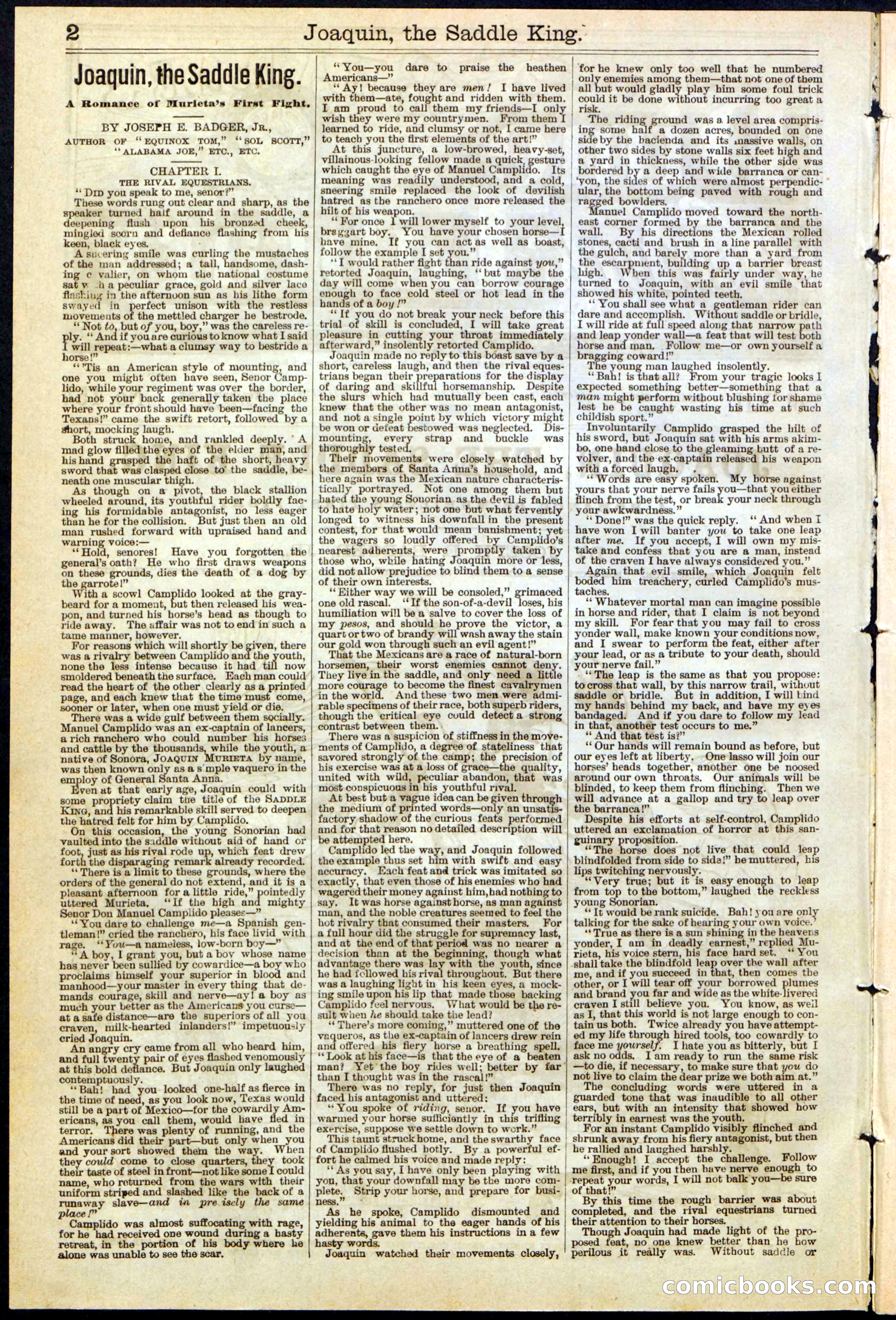
A restored page from Pulp Fiction, 1881. Page through the whole issue in the reader above.
📄 Transcribed text from this page (OCR, searchable)
Machine-transcribed from the original scan — historical spelling and the odd misread are preserved.
2 Joaquin, the Saddle King. A Romance of Murieta’s First Fight, ; BY JOSEPH E. BADGER, Jr., AUTHOR OF ‘“ EQUINOX TOM,” ‘“‘SOL SCOTT,” ‘*ALABAMA JOE,” ETC., ETC. CHAPTER L THE RIVAL EQUESTRIANS. ‘*Drp you speak to me, senor?” These words rung out clear and sharp, as the speaker turned haif around in the saddle, a deepening flush upon his bronzed cheek, mingled scorn and defiance flashing from his keen, black eyes, A sucering smile was curling the mustaches of the man addressed; a tall, handsome, dash- ing ¢ valier, on whom the national costume sat v -ha peculiar grace, gold and silver lace flashiug in the afternvon sun as his lithe form swayed in rfect unison with the restless movements of the mettled charger he bestrode. ** Not to, but of you, boy,” was the careless re- ply. “ Andif you are curious to know what I said will repeat:—what a clumsy way to bestride a horse!” ‘ “’Tis an American style of mounting, and one you might often have seen, Senor Camp- lido, while your regiment was over the border, had not your back generally taken the place where your front should have been—facing the Texans!” came the swift retort, followed by a short, mocking laugh. Both struck home, and rankled deeply. ’ A mad glow filled the eyes of the elder man, and his hand grasped the haft of the short, heavy sword that was clasped close to’ the saddle, be- neath one muscular thigh. As though on a pivot, the black stallion wheeled around, its youthful rider boldly fac- ing his formidable antagonist, no less eager than he for the collision. But just then an old man rushed forward with upraised hand and warning voice:— ‘*Hold, senores! Have you forgotten the general’s oath? He who first draws weapons on these grounds, dies the death of a dog by the garrote!” ith a scowl Camplido looked at the gray- beard for a moment, but then released his wea- pon, and turned his horse’s bead as though to ride away. The affair was not toend in such a tame manner, however. For reasons which will shortly be given, there was a rivalry between Camplido and the youth, none the less intense because it had till now smoldered beneath the surface, Each man could read the heart of the other clearly as a printed page, and each knew that the time must come, sooner or later, when one must yield or die, There was a wide gulf between them sgcially. Manuel Camplido was an ex-captain of lancers, a rich ranchero who could number his horses and cattle by the ay gt the youth, a native of Sonora, Joaquin Murrieta by name, was then known only as as mple vaquero in the employ of General Santa Anna. ~ ; ven at that early age, Joaquin could with some propriety claim the title of the SADDLE Kina, and his remarkable skill served to deepen the hatred felt for him by Camplido. | On this occasion, the young Sonorian had vaulted into the saddle without aid of hand or foot, just as his rival rode up, which feat drew forth the disparaging remark already recorded. ‘There is a limit to these grounds, where the orders of the general do not extend, and it is a pleasant afternoon for a little ride,” pomee y uttered Murieta, “If the high and mighty Senor Don Manuel Camplido pleases—” | ‘You dare to challenge me—a Spanish gen- tleman!” cried the ranchero, his face livid with ra “You—a nameless, low-born boy—” A boy, I grant you, but a boy whose name has never been sullied by cowardice—a boy who proclaims himself your superior in bl and manhood—your master in every thing that de- mands courage, skill and nerve—ay! a boy as much your better as the Americans you curse— at a safe distance—are the superiors of all you pana milk-hearted inlanders!” impetuously cried uin. : An angry ery came from all who heard him, and full twenty pair of eyes flashed venomously at this bold defiance. But Joaquin only laughed contemptuously. 2 ‘‘Bah! had you. looked one-half as fierce in the time of ant as you look now, Texas would still be a part of Mexico—for the cowardl ly Am- ericans, as you call them, would have fled in terror. ® was plenty of running, and the Americans did their part—but only when you and your sort showed them the way. When they could come to close quarters, they took their taste of steel in front—not like some I could name, who returned from the wars with their uniform striped and slashed like the back of a runaway slave—and in pre.isely the same place |” C. lido was almost suffocating with rage for ha had received ope wound during a hasty retreat, in the portion of his body where he alone was unable to see the scar. ar oaquin, the Saddle King. ~ *“You—you dare to praise the heathen | for he knew only too well that he numbered Americans—” ‘Ay! because they are men! I have lived | only enemies among them—that not one of them all but would gladly play him some foul trick with them—ate, fought and ridden with them. | could it be done without incurring too great a I am proud to call them my friends—I onl wish they were my countrymen. From them learned to ride, and clumsy or not, I came here to teach you the first elements of the art!” At this juncture, a low-browed, heavy-set, villainous-looking fellow made a quick, gesture which caught the eye of Manuel Camplido. Its meaning was readily understood, and a cold, sneering smile replaced the look of devilish hatred as the ranchero once more released the hilt of his weapon. “For once 1 will lower myself to your level breggart boy. You have your chosen horse— have mine. If you can act as well as boast, follow the example I set you.” ‘I would rather fight than ride against you,” retorted Joaquin, laughing, ‘‘ but maybe the day will come when you can borrow courage enough to face cold steel or hot lead in the hands of a boy !” oe: you do not break your neck before this trial of skill is concluded, I will take great pleasure in cutting your throat immediately afterward,” insolently retorted Camplido. Joaquin made no reply to this boast save by a short, careless laugh, and then the rival eques- trians began their gy He for the display of daring and skillful horsemanship. Despite the slurs which had mutually been cast, each knew that the other was no mean antagonist, and nota single point by which victory might ————E—— be won or defeat bestowed was neglected. Dis- | strap and buckle was re | ever thoroughly temeds Their movements were closely watched by the members of Santa Anna’s household, and here again was the Mexican nature characteris- tically portrayed. Not one among them but hated the young Sonorian as the devil is fabled to hate holy water; not one but what fervently longed to witness his downfallin the present contest, for that would mean banishment; yet the wagers so loudly offered by Cxemplido’s nearest adherents, were promptly taken by those who, while hating Joaquin more or less, did not allow prejudice to blind them to a sense of their own interests. ‘* Hither way we will be consoled,” grimaced one old rascal. ‘‘If the son-of-a-devil loses, his humiliation will be a salve to cover the loss of my pesos, and should he prove the victor, a quart or two of brandy will wash away the stain our gold won through such an evil agent!” That the Mexicans are a race of natural-born horsemen, their worst enemies cannot deny. They live in the saddle, and only need a little more courage to become the finest ca men in the worl And these two men were admi- rable specimens of their race, both superb riders, though the eritical eye cvuld detect a strong contrast between them... There was a suspicion of stiffness in the move- ments of Camplido, a degree of stateliness that savored strongly of the camp; the precision of his exercise was at a loss of grace—the quality, united with wild, peculiar abandon, that was most conspicuous in his youthful rival. At best but a vague idea can be given through the medium of printed words—only an unsa factory shadow of the curious feats performed and for that reason no detailed description will be attempted here. Camplido led the way, and Joaquin followed the example thus set him with swift and easy accuracy. Each feat and trick was imitated so exactly, that even those of his enemies who had wagered their money against him, bad nothing to say. It was horse against horse, as man against man, and the noble creatures seemed to feel the hot rivalry that consumed their masters. For a full hour did the struggle for supremacy last, and at the end of that od was no nearer a decision than at the beginning, though what advantage there was lay with the youth, since he had fcllowed his rival throughout. But there was a laughing light in his keen eyes, a mock- ing smile upon his lip that made those backing Camplido feel nervous. What would be the re- sult when he should take tbe lead? ‘‘ There’s more coming,” muttered one of the vaqueros, as the ex-captain of lancers drew rein and offered his fiery horse a breathing spell. ‘* Look at his face—is that the eye of a beaten man? Yet'the boy rides well; better by far than I thought was in the rascal!” There was no reply, for just then Joaquin faced his antagonist and uttered: “You spoke of riding, senor. If you have warmed your horse sufficiently in this trifling exercise, suppose we settle down to work.” This taunt struck home, and the swarthy face of Camplido flushed botly. By a powerful ef- fort he calmed his voice and made reply: ‘** As you say, [ have only been playing with you, that your downfall may be the more com- plete. Strip your horse, an ness.” * As he spoke, Camplido dismounted and yielding his animal to the eager hands of his adherents, gave them his instructions in a few hasty words. Joaquin watched their movements closely, ee See Be SE ae RE ee el a. ET ee re, Meme Soe: ee eee | | | risk. _ The riding ground was a level area compris- ing some half a dozen acres, bounded on one side by the bacienda and its :nassive walls, on other two sides by stone walls six feet high and a yard in thickness, while the other side was bordered by a deep and wide barranca or can- ‘yon, the sides of which were almost perpendic- © ular, the bottom being paved with rough and ragged bowlders. anuel Camplido moved toward the north- east corner formed by the barranca and the wall. By his directions the Mexican rolled stones, cacti and brush in a line parallel with the gulch, and barely more than a yard from the escarpment, building up a barrier breast high. When this was fairly under way, he turned to Joaquin, with an evil smile that showed his white, pointed teeth. ‘* You shall see what a gentleman rider can dare and accomplish. Without saddle or bridle, I will ride at full speed along that narrow path and leap yonder wall—a feat that will test both horse and man, Follow me—or own yourself a bragging coward!” The young man laughed insolently. “Bah! is that all? From your tragic looks I expected something better—sometbing that a man might perform without blushing tor shame lest he be caught wasting his time at such childish sport.” Involuntarily Camplido grasped the hilt of his sword, but Joaquin sat with his arms akim- bo, one band close to the gleaming butt of a re- volver, and the ex-captain released his weapon with aforced laugh, , ‘* Words are easy spoken. My horse against ours that your nerve fails you—that you either inch from the test, or break your neck through your awkwardness.” ‘** Done!” was the quick reply. ‘‘ And when I have won I will banter you to take one leap after me. If you accept, I will own my mis- take and confess that you are a man, instead of the craven I have always considered you.” Again that evil smile, which Joaquin felt boded him treachery, curled Camplido’s mus- taches. ‘* Whatever mortal man can imagine ible in horse and rider, that I claim is not be pond my skill. For fear that you may fail to cross yonder wall, make known your conditions now, and I swear to perform the feat, either after your lead, or as a tribute to your death, should your nerve fail.” ‘“The leap is the same as that you propose: to cross that wall, by this narrow trail, without saddle or bridle. But in addition, I will bind my hands behind my back, and bave my eyes bandaged. And if you dare to follow my lead in that, another test occurs to me.” ‘“* And that test is?” ** Our hands will remain bound as before, but our eyes left at liberty. One lasso will join our horses’ heads together, another one be noosed around our own throats. Our animals will be blinded, to keep them from flinching. Then we will advance at a gallop and try to leap over the barranca!” : Despite his efforts at self-control, Camplido uttered an peoiepralion of horror at this san- guin roposition. “The LO does not live that could lea blindfolded from side to side!” be muttered, his lips twitching nervously. “Very true; but it is easy enough to leap from top to the bottom,” laughed the reckless young Sonorian. ‘Tt would be rank suicide. Bah! you are only talking for the sake of hearing your own voice.’ ‘True as there is a sun shining in the heavens yonder, I am in deadly earnest,” replied Mu- rieta, his voice stern, his face hard set. ‘* You shall take the blindfold leap over the wall after me, and if you sueceed in that, then comes the other, or I will tear off your borrowed plumes and brand you far and wide as the white-livered craven I still believe you. You know, as weil as I, that this world is not large enough to con- tain us both. Twice already you have attempt- ed my life through hired tools, too cowardly to face me yourself. I hate you as bitterly, but I ask no odds, Iam ready to run the same risk —to die, if necessary, to make sure that you do not live to claim the dear prize we both at.” The concluding words were uttered in a guarded tone that was inaudible to all other ears, but with an intensity that showed how terribly in earnest was the yourr For an instant Camplido visibly flinched and sbrunk away from his fiery antagonist, but then he rallied and laughed harshly. “Enough! I accept the challenge. Follow me first, and if you then bave nerve enough to repeat your words, I will not balk you—be sure prepare for busi- | of that!” By this time the rough barrier was about completed, and the rival equestrians turned their attention to their horses, Though Joaquin had made light of the pro- posed feat, no one knew better than he how perilous it really was. Without saddle or S AME G 9X) (E(O) =.) (0) |