
Pulp Fiction, 1881 · page 17 of 32
Beadle's Dime Library No. 152 — page 17: what you’re looking at
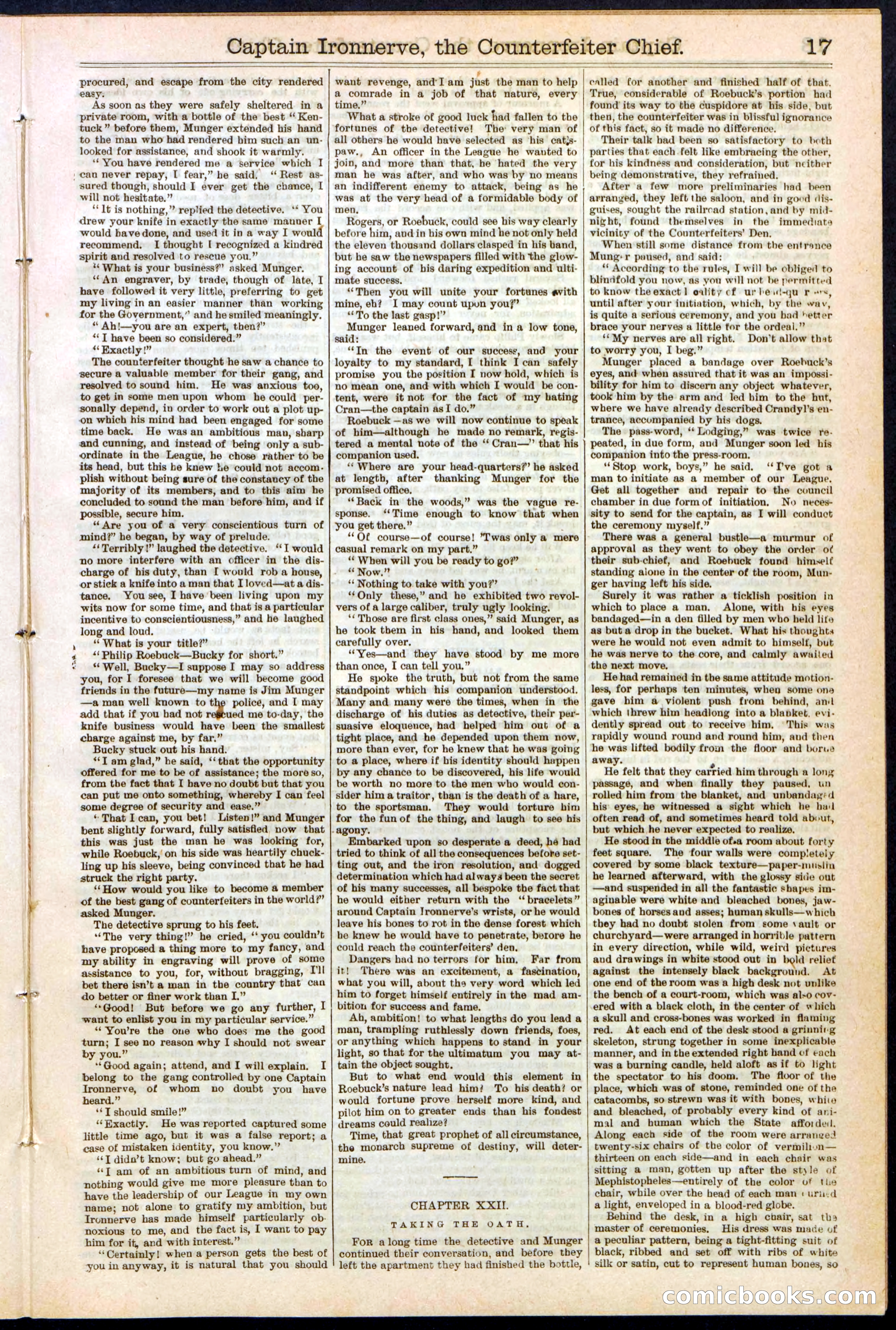
A restored page from Pulp Fiction, 1881. Page through the whole issue in the reader above.
📄 Transcribed text from this page (OCR, searchable)
Machine-transcribed from the original scan — historical spelling and the odd misread are preserved.
y } ca ‘can never repay, [ fear,” he said. procured, and escape from the city rendered easy. As soon as they were safely sheltered in a private room, with a bottle of the best “‘ Ken- tuck” before them, Munger extended his hand to the man who had rendered bim such an un- looked for assistance, and shook it warmly. ‘** You have rendered me a service which I “‘ Rest as- sured though, should I ever get the chance, I will not hesitate.” ‘lt is nothing,” replied the detective. ‘* You drew your knife in exactly the same manner [| would have done, and used it in a way I woul recommend, I thought I recognized a kindred spirit and resolved to rescue you.” “What is your business?” asked Munger. ‘‘An engraver, by trade, though of late, I have followed it very little, preferring to get my living in an easier manner than working for the Government,” and he smiled meaningly. * Ah!—you are an expert, then?” “‘T have been so considered.” ** Exactly!” The counterfeiter thought he saw a chance to secure a valuable member for their gang, and resolyed to sound him. He was anxious too, to get in some men upon whom he could per- sonally depend, in order to work out a plot up- on which his mind had been engaged for some time back. He was an ambitious man, sharp and cunning, and instead of being only a sub- ordinate in the League, he chose rather to be its head, but this he knew he could not accom. plish without being sure of the constancy of the majority of its members, and to this aim he concluded to sound the man before him, and if possible, secure him. “Are you of a very conscientious turn of mind?” he began, by way of prelude. ‘‘ Terribly |” laughed the detective. ‘I would no more interfere with an officer in the dis- charge of his duty, than [ would rob a house, or stick a knife into a man that I loved—at a dis- tance. You see, I have been living upon my wits now for some time, and that is a particular incentive to conscientiousness,” and he laughed long and loud. ‘What is your title?” “‘ Philip Roebuck—Bucky for short.” *‘ Well, Bucky—I suppose I may so address you, for I foresee that we will become good friends in the future—my name is Jim Munger —a man well known to the police, and [ may add that if you bad not regtued me to-day, the knife business would have been the smallest charge against me, by far.” Bucky stuck out his hand. **T am glad,” he said, ‘‘ that the opportunity offered for me to be of assistance; the more so, from the fact that I have no doubt but that you can put me onto something, whereby I can feel some degree of security and ease.” * That I can, you bet! Listen!” and Munger bent slightly forward, fully satisfied now that this was just the man he was looking for, while Roebuck, on his side was heartily chuck- ling up his sleeve, being convinced that he had struck the right party. ‘‘ How would you like to become 4 member of the best gang of counterfeiters in the world?” asked Munger. The detective sprung to his feet. ‘‘The very thing!” he cried, ‘‘ you couldn’t bave proposed a thing more to my fancy, and my ability in engraving will prove of some assistance to you, for, without bragging, I'll bet there isn’t a man in the country that can do better or finer work than I.” ‘“Good! But before we go any further, I want to enlist you in my particular service.” “You're the one who does me the good turn; I see no reason why I should not swear by you.” ‘Good again; attend, and I will explain. I belong to the gang controlled by one Captain Tronnerve, of whom no doubt you have heard.” ‘**T should smile!” ‘‘Exactly. He was reported captured some little time ago, but it was a false report; a case of mistaken identity, you know.” ‘‘T dido’t know; but go ahead.” “JT am of an ambitious turn of mind, and nothing would give me more pleasure than to have the leadership of our League in my own name; not alone to gratify my ambition, but Ironnerve has made himself particularly ob. noxious to me, and the fact is, I want to pay him for it, and with interest.” “Certainly! when a person gets the best of you in anyway, it is natural that you should Captain Ironnerve, the Counterfeiter Chief. * want revenge, and’I am just the man to help a comrade in a job of that nature, every time.” What a stroke of good luck had fallen to the fortunes of the detective! The very man of all others he would have selected as ‘his catjs- paw,, An officer in the League he wanted to join, and more than that, he hated the very man he was after, and who was by no means an indifferent enemy to attack, being as he was at the very head of a formidable body of men, Rogers, or Roebuck, could see his way clearly before him, and in his own mind he not only held the eleven thousand dollars clasped in his band, but he saw the newspapers filled with the glow- ing account of bis daring expedition and ulti- mate success. “Then you will unite your fortunes evith mine, eh? I may count upun you?” ‘To the last gasp!” Munger leaned forward, and in a low tone, said: ‘‘In the event of our success, and your loyalty to my standard, I think I can safely promise you the position I now hold, which is no mean one, and with which I would be con- tent, were it not for the fact of my hating Cran—the captain as I do.” Roebuck —as we will now continue to speak of him—although he made no remark, regis- tered a mental note of the ‘* Cran—’ that his companion used. ‘“‘Where are your head-quarters?’ he asked at length, after thanking Munger for the promised office. “Back in the woods,” was the vague re- sponse. ‘*Time enough to know that when you get there.” . **Of course—of course! "T'was only a mere casual remark on my part.” “When will you be ready to go?” se Now. ” ‘* Nothing to take with you?’ ‘Only these,” and he exhibited two revol- vers of a large caliber, truly ugly looking. ‘* Those are first class ones,” said Munger, as he took tbem in his hand, and looked them carefully over. ‘““Yes—and they have stood by me more than once, I can tell you.” He spoke the truth, but not from the same standpoint which his companion understood. Many and many were the times, when in the discharge of his duties as detective, their per- suasive eloquence, had helped him out of a tight place, and he depended upon them now, more than ever, for he knew that he was going to a place, where if bis identity should happen by any chance to be discovered, his life would be worth no more to the men who would con- sider him a traitor, than is the death of a hare, to the sportsman. They would torture bim for the funof the thing, and laugh to see his -agony. Embarked upon so desperate a deed, hé had tried to think of all the consequences before set- ting out, and the iron resolution, and dogged determination which had always been the secret of his many successes, all bespoke the fact that he would either return with the ‘“ bracelets” around Captain Jronnerve’s wrists, or he would leave his bones to rot in the dense forest which be knew he would have to penetrate, berore he could reach the counterfeiters’ den. Dangers bad no terrors for him, Far from it! There was an excitement, a fascination, what you will, about the very word which led him to forget himself entirely in the mad am- bition for success and fame. Ah, ambition! to what lengths do you lead a man, trampling ruthlessly down friends, foes, or anything which happens to stand in your light, so that for the ultimatum you may at- tain the object sought. But to what end would this element in Roebuck’s nature lead him? To his death? or would fortune prove herself more kind, and pilot him on to greater ends than his fondest dreams could realize? Time, that great prophet of all circumstance, the monarch supreme of destiny, will deter- mine. CHAPTER XXII. TAKING THE OATH, For along time the detective and Munger continued their conversation, and before they left the apartment they had finished the bottle, 17 called for another and finished half of that. True, considerable of Roebuck’s portion had found its way to the cuspidore at his side, but then, the counterfeiter was in blissful ignorance of this fact, so it made no difference. Their talk bad been so satisfactory to both parties that each felt like embracing the other, for his kindness and consideration, but neither being demonstrative, they refrained. After a few more preliminaries had been arranged, they left the saloon, and in govod dis- guises, sought the railroad station, and by mid- night, found themselves in the immediate vicinity of the Counterfeiters’ Den, When still some distance from the entrance Mung‘r paused, and said: ** According to the rules, I will be obliged to blindfold you now, as you will not be permitted to know theexact 1 oaity cf urbewl-qu rors, until after your initiation, which, by the wav, is quite a serious ceremony, and you bad etter brace your nerves a little tor the ordeal.” ‘* My nerves are all right. Don’t allow that to worry you, I beg.” Munger placed a bandage over Roebuck’s eyes, and when assured that it was an impossi- bility for him to discern any object whatever, took him by the arm and led bim to the hut, where we have already described Crandy!’s en- trance, accompanied by his dogs. The pass-word, “* Lodging,” was twice re- peated, in due form, and Munger soon led his companion into the press-room., ‘Stop work, boys,” he said. “Ive got a man to initiate as a member of our League, Get all together and repair to the council chamber in due formof initiation, No neces- sity to send for the captain, as I will conduct the ceremony myself.” There was a general bustle—a murmur of approval as they went to obey the order of their sub-chief, and Roebuck found himself standing alone in the center of the room, Mun- ger having left his side. Surely it was rather a ticklish position in which to place a man. Alone, with bis eyes bandaged—in a den filled by men who held lite as but a drop in the bucket. What his thoughts were he would not even admit to bimself, but he was nerve to the core, and calmly awuailed the next move, He had remained in the same attitude motion- less, for perhaps ten minutes, when some ona gave him a violent push from behind, an which threw him headlong into a blapket, evi- dently spread out to receive him, This wis rapidly wound round and round him, and then he was lifted bodily from the floor and borue away. P He felt that they carried him through a long passage, and when finally they paused, un rolled him from the blanket, and unbandagrd his eyes, he witnessed a sight which he hail often read of, and sometimes heard told abvout, but which he never expected to realize. He stood in the middle of.a room about forty feet square. The four walls were completely covered by some black texture—paper-muslin he learned afterward, with the glossy side out —and suspended in all the fantastic shapes im- aginable were white and bleached bones, jaw- bones of horses and asses; human skulls—which they had no doubt stolen from some \ault or churchyard—were arranged in horrible pattern in every direction, while wild, weird pictures aud drawings in white stood out in bold reliet against the intensely black background. At one end of the room was a high desk not unlike the bench of a court-room, which was also cov- ered with a black cloth, in the center of which a skull and cross-bones was worked in flaming red. At each end of the desk stood a grinnitg skeleton, strung together in some inexplicable manner, and in the extended right hand of each was a burning candle, held aloft as if to light the spectator to his doom. The floor of the place, which was of stone, reminded one of the catacombs, so strewn was it with bones, whiie and bleached, of probably every kind of ani- mal and human which the State affordeil. Along each side of the room were arranged twenty-six chairs of the color of vermilion— thirteen on each side—and in each chair was sitting a man, gotten up after the style of Mephistopheles—entirely of the color of the chair, while over the bead of each man ¢ uriied a light, enveloped in a blood-red globe. Behind the desk, in a high chair, sat tha master of ceremonies, His dress was mate of a peculiar pattern, being a tight-fitting suit of black, ribbed and set off with ribs of white silk or satin, cut to represent human bones, so | (EOAIE OO) “S (E(@)