
Pulp Fiction, 1881 · page 12 of 32
Beadle's Dime Library No. 152 — page 12: what you’re looking at
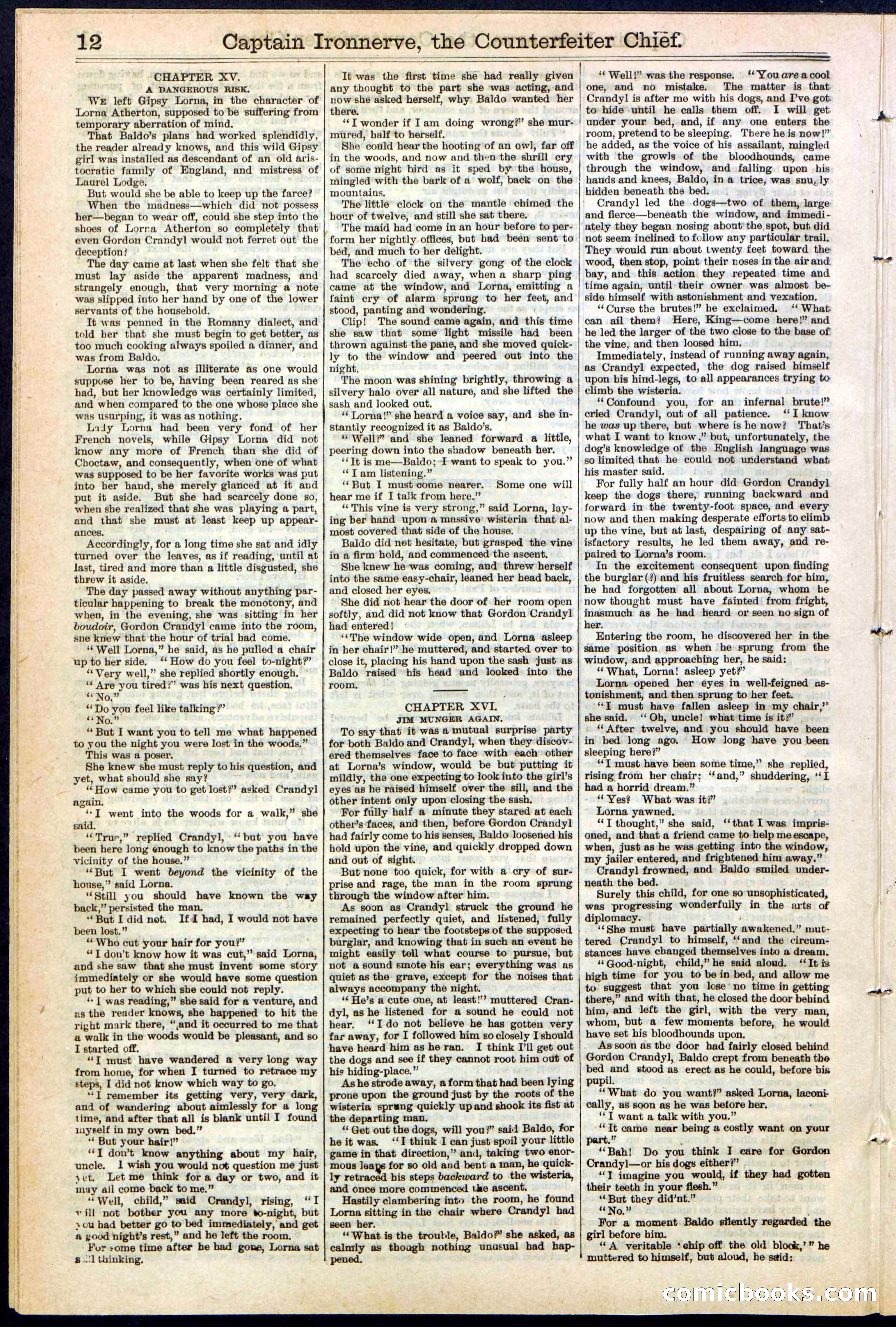
A restored page from Pulp Fiction, 1881. Page through the whole issue in the reader above.
📄 Transcribed text from this page (OCR, searchable)
Machine-transcribed from the original scan — historical spelling and the odd misread are preserved.
= ——-— a ee ee <—tti7 a Mrs —— ee | i | i ; | er ale dead ~ up to her side. eh tain me WEI 2° Sap he SS CHAPTER XV. A DANGEROUS RISK. WE left Gipsy Lorna, in the character of Lorna Atherton, supposed to be suffering from temporary aberration of mind. That Baldo’s plans had worked splendidly, the reader already knows, and this wild Gipsy girl was installed as descendant of an old aris- tocratic family of England, and mistress of Laurel Lodge, But would she be able to keep up the farce? When the madness—which did not possess her—began to wear off, could she step into the shoes of Lorna Atherton so completely that even Gordon Crandyl would not ferret out the deception? The day came at last when she felt that she must lay aside the apparent madness, and strangely enough, that very morning a note was slipped into her hand by one of the lower servants of the housebold, It was penned in the Romany dialect, and told ber that she must begin to get better, as too much cooking always spoiled a dinner, and was from Baldo, Lorna was not as illiterate as one would suppose her to be, having been reared as she had, but her knowledge was certainly limited, and when compared to the one whose place she was usurping, it was as nothing. Liidy Lorna had been very fond of her French novels, while Gipsy Lorna did not know any more of French than she did of Choctaw, and consequently, when one of what was supposed to be her favorite works was put into her hand, she merely glanced at it and put it aside. But she had scarcely done so, when she realized that she was playing a part, and that she must at least keep up appear- ances, Accordingly, for a long time she sat and idly turned over the leaves, as if reading, until at last, tired and more than a little disgusted, she threw it aside. The day passed away without anything par- ticular happening to break the monotony, and when, in the evening, she was sitting in her boudoir, Gordon Crandyl came into the room, she knew that the hour of trial had come. ‘Well Lorna,” he said, as he pulled a chair ** How do you feel to-night?” “‘Very well,” she replied shortly enough. ‘¢ Are you tired?” was his next question, “c No. 99 ‘Do you feel like talking?’ 4s No. ” *“ But I want you to tell me what happened to you the night you were lost in the woods.” This was a poser. She knew she must reply to his question, and yet, what should she say? “How came you to get lost?’ asked Crandyl again. ‘“‘T went into the woods for a walk,” she said. “True,” replied Crandyl, “but you have been here long enough to know the paths in the vicinity of the house.” “But I went beyond the vicinity of the house,” said Lorna. “Still you should have known the way back,” persisted the man, “But I did not. Ifd had, I would not have been lost,” “Who cut your hair for you?’ **T don’t know how it was cut,” said Lorna, and she saw that she must invent some story immediately or she would have some question put to her to which she could not reply. ‘| was reading,” she said for a venture, and as the reader knows, she happened to hit the right mark there, “,and it occurred to me that a walk in the woods would be pleasant, and so I started off. “TI must have wandered a very long way from home, for when I turned to retrace my steps, I did not know which way to go. “I remember its getting very, very dark, and of wandering about aimlessly for a long time, and after that all is blank until I found uiyself in my own bed.” ‘* But your hair!” “I don’t know anything about my hair, uncle. 1 wish you would not question me just yet. Let me think fora day or two, and it may all come back to me.” “Well, child,” said Crandyl, rising, “I vill not botber you any more to-night, but }ou had better go to bed immediately, and get a good night’s rest,” and he left the room. For some time after he had gone, Lorna sat 8 .:] thinking. 2 OPES SISAL OD EE ASE sors, Me es fs ee er ee ees Seg. It was the first time she had really given any thought to the part she was acting, and now she asked herself, why Baldo wanted her there. ; ‘¢T wonder if Iam doing wrong?’ she mur- mured, half to herself. She could hear the hooting of an ow], far off in the woods, and now and then the shrill cry of some night bird as it sped by the house, mingled with the bark of a wolf, back on the mountains, The little clock on the mantle chimed the honr of twelve, and still she sat there. The maid had come in an hour before to per- form her nightly offices, but had been sent to bed, and much to her delight. The echo of the silvery gong of the clock had scarcely died away, when a sharp ping came at the window, and Lorna, emitting a faint ery of alarm sprung to her feet, and stood, panting and wondering. ! Clip! The sound came again, and this time she saw that some light missile had been thrown against the pane, and she moved quick- ly to the window and peered out into the night, The moon was shining brightly, throwing a silvery halo over all nature, and she lifted the sash and looked out, ‘‘ Lorna!” she heard a voice say, and she in- stantly recognized it as Baldo’s. “Well” and she leaned forward a little, peering down into the shadow beneath her. ‘‘ Tt is me—Baldo; I want to speak to you.” ‘*T am listening.” ‘*But I must come nearer. Some one will hear me if I talk from here.” ‘This vine is very strong,” said Lorna, lay- ing ber hand upon a massive’ wisteria that al- most covered that side of the house. Baldo did not hesitate, but grasped the vine in a firm hold, and commenced the ascent. She knew he'was coming, and threw herself into the same easy-chair, leaned her head back, and closed her eyes. She did not hear the door of her room open softly, and did not know that Gordon Crandyl] had entered! ‘‘The window wide open, and Lorna asleep in her chair!” he muttered, and started over to close it, placing his hand upon the sash just as Baldo raised his head and looked into the room, CHAPTER XVI. JIM MUNGER AGAIN. To say that it was a mutual surprise party for both Baldo and Crandyl, when they discov- ered themselves face to face with each other at Lorna’s window, would be but putting it mildly, the one expecting to look into the girl’s eyes as he raised himself over the sill, and the other intent only upon closing the sash. For fully half a minute they stared at each other’s faces, and then, before Gordon Crandyl had fairly come to his senses, Baldo loosened his hold upon the vine, and quickly dropped down and out of sight. But none too quick, for with a cry of sur- prise and rage, the man in the room sprung through the window after him. As soon as Crandy] struck the ground he remained perfectly quiet, and listened, fully expecting to hear the footsteps of the supposed burglar, and knowing that in such an event he might easily tell what course to pursue, but not a sound smote his ear; everything was as quiet as the grave, except for the noises that always accompany the night. ‘¢ He’s a cute one, at least!’ muttered Cran- dyl, as he listened for a sound he could not hear. ‘Ido not believe he has gotten very far away, for I followed him so closely Ishould have heard him as he ran. I think I'll get out the dogs and see if they cannot root him out of his hiding-place.” As he strode away, a form that had been lying prone upon the ground just by the roots of the wisteria sprung quickly up and shook its fist at the departing man. “ Get out the dogs, will you?” said Baldo, for he it was. ‘‘I think I can just spoil your little game in that direction,” and, taking two enor- mous leaps for so old and bent a man, he quick- ly retraced his steps backward to the wisteria, and once more commenced wae ascent, Hastily clambering into the room, he found Lorna sitting in the chair where Crandyl had seen her. “What is the trouble, Baldo” she asked, as calmly as though nothing unusual had hap- pened. ; Captain Ironnerve, the Counterfeiter Chief ‘« Well!” was the response. ‘You areacool one, and no mistake. The matter is that Crandy] is after me with his dogs, and I’ve got to hide until he calls them off. I will get under your bed, and, if any one enters the room, pretend to be sleeping. There he is now!” he added, as the voice of his assailant, mingled with the growls of the bloodhounds, came through the window, and falling upon his hands and knees, Baldo, in a trice, was snu,ly hidden beneath the bed. Crandyl led the dogs—two of them, large and fierce—beneath the window, and immedi- ‘ately they began nosing about’ the spot, but did not seem inclined to follow any particular trail. They would run about twenty feet toward the wood, then stop, point their noses in the air and bay, and this action they repeated time and time again, until: their owner was almost be- side himself with astonishment and vexation. ‘‘Curse the brutes!” he exclaimed, ‘‘ What can ail them? Here, King—come here!” and he led the larger of the two close to the base of the vine, and then loosed him, Immediately, instead of running away again, as Crandyl expected, the dog raised himself upon his hind-legs, to all appearances trying to climb the wisteria. *‘Confound you, for an infernal brute!” cried Crandyl, out of all patience. ‘I know he was up there, but where is he now? That’s what I want to know,” but, unfortunately, the dog’s knowledge of the English language was so limited that he could not understand what his master said. For fully half an hour did Gordon Crandyl keep the dogs there, running backward and forward in the twenty-foot space, and every now and then making desperate efforts to climb up the vine, but at last, despairing of any sat- isfactory results, he led them away, and re- paired to Lorna’s room. In the excitement consequent upon finding the burglar (?) and his fruitless search for him, he had forgotten all about Lorna, whom he now thought must have fainted from fright, inasmuch as he had heard or seen no sign of her. Entering the room, he discovered her in the same position as when he sprung from the window, and approaching her, he said: “What, Lorna! asleep yet?” Lorna opened her eyes in well-feigned as- tonishment, and then sprung to her feet. ‘‘T must have fallen asleep in my chair,” she said. ‘‘Oh, uncle! what time is it?” ‘* After twelve, and you should have been in bed long ago. How long have you been sleeping here?” “I must bave been some time,” she replied, rising from her chair; “‘and,” shuddering, *‘I had a horrid dream.” ‘Yes? What was it?’ . Lorna yawned, “‘T thought,” she said, ‘‘that I was impris- oned, and that a friend came to help meescape, when, just as he was getting into the window, my jailer entered, and frightened him away.” Crandyl frowned, and Baldo smiled under- neath the bed. Surely this child, for one so unsophisticated, was progressing wonderfully in the arts of diplomacy. ' ‘‘She must have partially awakened.” mut- tered Crandyl to himself, ‘‘and the cireum- stances have changed themselves into a dream. “‘Good-night, child,” he said aloud. ‘“Itis high time for you to be in bed, and allow me to suggest that you lose no time in getting there,” and with that, he closed the door bebind him, and left the girl, with the very man, whom, but a few moments before, he would have set his bloodhounds upon. Assoon as the door had fairly closed behind Gordon Crandy], Baldo crept from beneath the bed ee stood as erect as he could, before bis pupil, “What do you want?” asked Lorna, cally, as soon as he was before her. ““T want a talk with you.” “Tt came near being a costly want on your ” “Bah! Do you think I care for Gordon Crandyl—or his dogs either?” | “TY imagine you would, if they had gotten their teeth in your flesh.” ‘But they did’nt.” «¢ No. ” . $ For a moment Baldo silently regarded the girl before him. “A veritable ‘chip off the old block,’ ” he muttered to himself, but aloud, he seid: laconi- iw (e(6) ,OO (E S) (G (0) im