
Pulp Fiction, 1881 · page 10 of 32
Beadle's Dime Library No. 152 — page 10: what you’re looking at
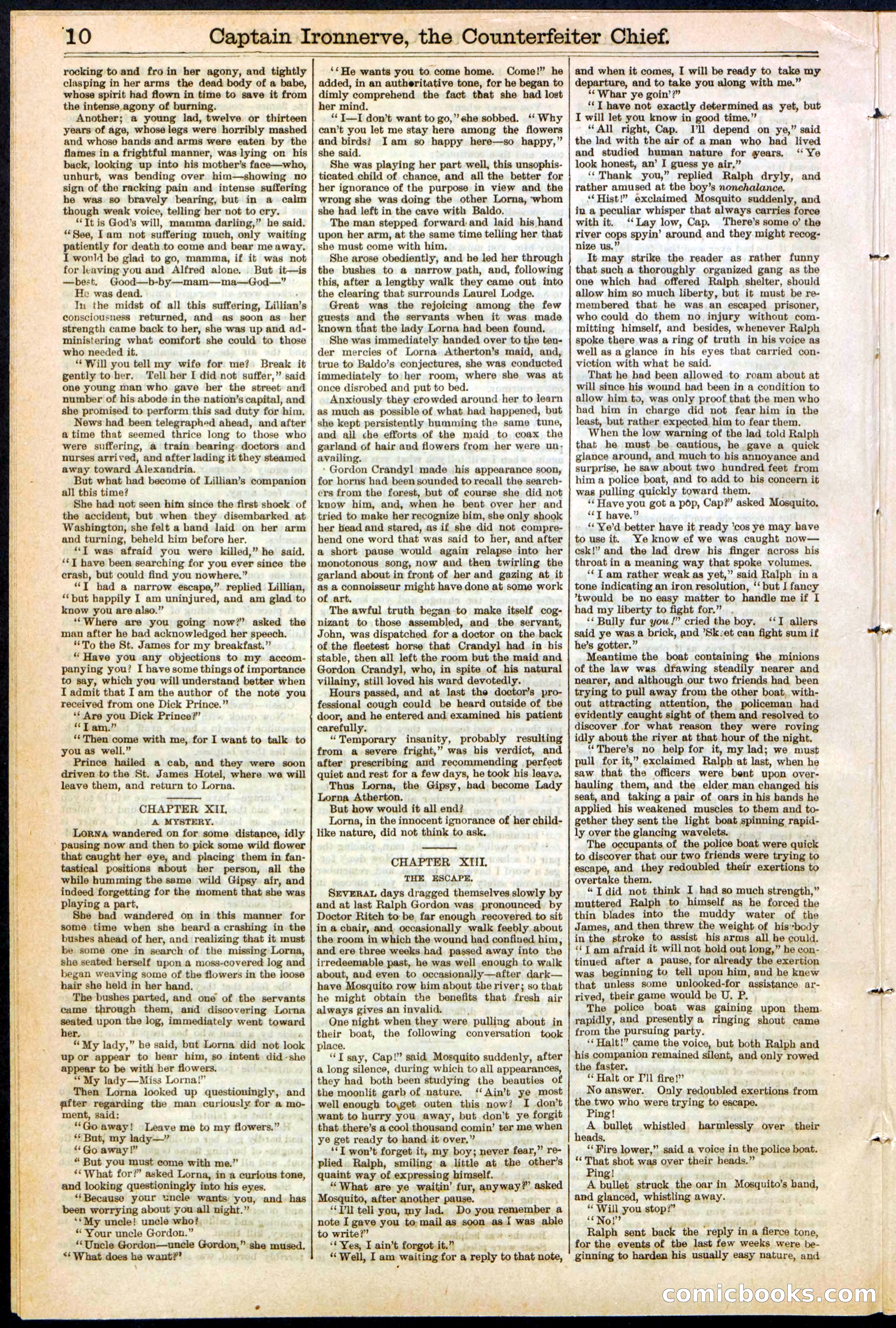
A restored page from Pulp Fiction, 1881. Page through the whole issue in the reader above.
📄 Transcribed text from this page (OCR, searchable)
Machine-transcribed from the original scan — historical spelling and the odd misread are preserved.
10 eo ee = "Captain tedemuioel” the. Covmiliieibtter Chief rm ter eo 2 ES ee rocking to and froin her agony, and tightly clasping in her arms the dead body of a babe, whose spirit had flown in time to save it from the intense,agony of burning. Another; a young lad, twelve or thirteen years of age, whose legs were horribly mashed and whose hands and arms were eaten by the flames in a frightful manner, was lying on his back, looking up into his mother’s face—who, unhurt, was bending over him—showing no sign of the racking pain and intense suffering he was so bravely bearing, but in a calm though weak voice, telling her not to ery. “It is God’s will, mamma darling,” be said. “See, [am not suffering much, only waiting patiently for death to come and bear me away. I would be glad to go, mamma, if it was not for leaving you and Alfred alone. But it—is —best. Good—b-by—mam—ma—God—” He was dead. Iu the midst of all this suffering, Lillian’ 8 consciousness returned, and as soon as her strength came back to her, she was up and ad- ministering what comfort she could to those who needed it. ** Will you tell my wife for me? Break it gently to ber. Tell her I did not suffer,” said one young man who gave her the street and number of his abode in the nation’s capital, and she promised to perform this sad duty for him. News had been telegraphed ahead, and after a time that seemed thrice long to those who were suffering, a train bearing doctors and nurses arrived, and after lading it they steamed away toward Alexandria. But what had become of Lillian’s companion aJl this time? She had not seen him since the first shock of the accident, but when they disembarked at Washington, she felt a hand laid on her arm and turning, beheld kim before her. “I was afraid you were killed,” he said. **T have been searching for you ever since the crash, but could find you nowhere.” **T had a narrow escape,” replied Lillian, ‘*but happily I am uninjured, and am glad to know you are also.” ‘“Where are you going now?” asked the man after he bad acknowledged her speech. ‘To the St. James for my breakfast.” “ Have you any objections to my accom- panying you? I have some things of importance to say, which you will understand better when I admit that I am the author of the note you received from one Dick Prince.” ‘* Are you Dick Prince?’ “ L am.” ‘‘'Then come with me, for I want to talk to you as well.” Prince hailed a cab, and they were soon driven to the St. James Hotel, where we will leave them, and return to Lorna. CHAPTER XII, A MYSTERY. LorRNA wandered on for some distance, idly ' pausing now and then to pick some wild flower that caught her eye, and placing them in fan- tastical positions about her person, all the while humming the same wild Gipsy air, and indeed forgetting for the moment that she was playing a part, She bad wandered on in this manner for some time when she heard a crashing in the bushes ahead of her, and realizing that it must be some one in search of the missing Lorna, she seated herself upon a moss-covered log and began weaving some of the flowers in the loose hair she held in her hand. The bushes parted, and one of the servants came through them, and discovering Lorna — upon the log, immediately went toward er, “My lady,” he said, but Lorna did not look up or appear to hear him, so intent did-she appear to be with ber flowers. **My lady—Miss Lorna!” Then Lorna looked up questioningly, and gfter regarding the man curiously for a mo- ment, said: “Go away! Leave me to my flowers.” ** But, my lady— ‘Go away!” “ But you must come with me.” ** What for?’ asked Lorna, ina curious tone, and looking questioningly into his eyes. ‘*Because your uncle wants you, and has been worrying about you all night.” “My une uncle! uncle who?, . m “Your uncle Gordon.” “‘Uncle Gordon—uncle Gordon,” she mtised. | ** What does he want?’ ‘<He wants you to come home. Come!” he added, in an autheritative tone, for he began to dimly comprehend the fact that she had lost her mind. ‘‘ T—I don’t want to go,’’she sobbed. ‘‘ Why can’t you let me stay here among the flowers and birds? Iam so happy here—so happy,” she said. She was playing her part well, this unsophis- ticated child of chance, and all the better for her ignorance of the purpose in view and the wrong she was doing the other Lorna, whom she had left in the cave with Baldo. The man stepped forward and laid his hand upon her arm, at the same time telling her that she must come with him, She arose obediently, and he led her through the bushes to a narrow path, and, following this, after a lengthy walk they came out into the clearing that surrounds Laurel Lodge. Great was the rejoicing among the few guests and the servants when it was made known that the lady Lorna had been found, She was immediately handed over to the ten- der mercies of Lorna Atherton’s maid, and, true to Baldo’s conjectures, she was conducted immediately to her room, where she was at once disrobed and put to bed. Anxiously they crowded around her to learn as much as possible of what had happened, but she kept persistently bumming the same tune, and all che efforts of the maid to coax the garland of hair and flowers from her were un- availing. ‘ Gordon Crandyl made his appearance soon, for horns had been sounded to recall the seareb- ers from the forest, but of course she did not know him, and, when he bent over her and tried to make her recognize him, she only shook her head and stared, as if she did not compre- hend one word that was said to her, and after a short pause would again relapse into her monotonous song, now and then twirling the garland about in front of her and gazing at it as a connoisseur might have done at some work of art. The awful truth began to make itself cog- nizant to those assembled, and the servant, John, was dispatched for a doctor on the back of the fleetest horse that Crandyl had in his stable, then all left the room but the maid and Gordon Crandyl, who, in spite of his natural villainy, still loved his ward devotedly. Hours passed, and at last the doctor’s pro- fessional cough could be heard outside of the door, and he entered and examined his patient carefully. “Temporary insanity, probably resulting from a severe fright,” was his verdict, and after prescribing aud recommending perfect quiet and rest for a few days, he took his leave, Thus Lorna, the Gipsy, bad become Lady Lorna Atherton. But how would it all end? Lorna, in the innocent ignorance of her child- like nature, did not think to ask, CHAPTER XTII. THE ESCAPE. SEVERAL days dragged themselves slowly by and at last Ralph Gordon was pronounced by Doctor Ritch to be far enough recovered to sit in a chair, and occasionally walk feebly about the room in which the wound had confined him, and ere three weeks had passed away into the irredeemable past, he was well enough to walk about, and even to occasionally—after dark— have Mosquito row bim about the river; so that he might obtain the benefits that fresh air always gives an invalid. One night when they were pulling about in their boat, the following conversation took place. “TI say, Cap!” said Mosquito suddenly, after a long silence, during which to all appearances, they had both been studying the beauties of the moonlit garb of nature. ‘‘Ain’t ye most well enough toget outen this now? I don’t want to hurry you away, but don’ t ye forgit that there’s a cool thousand comin’ ter me when ye get ready to hand it over.” ‘*T won’t forget it, my boy; never fear,” re- plied. Ralph, smiling a little at the other's quaint way of expressing himself. “What are ye waitin’ fur, anyway?’ asked Mosquito, after another pause. ‘Tl teli you, my Jad. Do you remember a note I gave you to mail as pega wl was able to write?’ ’ ‘¢ Yes, I ain’t forgot-it.” — “Well, [am waiting for a reply to that note, and when it comes, I will be ready to take my departure, and to take you along with me.” ‘Whar ye goin’?” ‘I have not exactly determined as yet, but I will let you know in good time.” “All right, Cap. Vl depend on ye,” said the lad with the air of a man who had lived and studied human nature for gears. ‘‘ Ye look honest, an’ I guess ye air,” ‘Thank you,” replied Ralph dryly, and rather amused at the boy’s nonehalance. ‘“‘ Hist!” exclaimed Mosquito suddenly, and in a peculiar whisper that always carries force with it. ‘‘Lay low, Cap. There’s some o’ the river cops spyin’ around and they might recog- nize us.” It may strike the reader as rather funny that such a thoroughly organized gang as the one which had offered Ralph shelter, should allow him so much liberty, but it must be re- membered that he was an escaped prisoner, who could do them no injury without com- mitting himself, and besides, whenever Ralph spoke there was a ring of truth in his voice as well as a glance in his eyes that carried con- viction with what he said. That he bad been allowed to roam about at will since his wound had been in a condition to allow him to, was only proof that the men who had him in charge did not fear him in the least, but rather expected him to fear them. When the low warning of the lad told Ralph that he must be cautious, he gave a quick glance around, and much to bis annoyance and surprise, he saw about two hundred feet from him a police boat, and to add to his concern it was pulling quickly toward them. ‘Have you got a pop, Cap?” asked Mosquito, “‘T have.” ‘‘ Ye’d better have it ready ’cos ye may have to use it. Ye know ef we was caught now— esk!” and the lad drew his finger across his throat in a meaning way that spoke volumes. ‘‘T am rather weak as yet,” said Ralph ina tone indicating an iron resolution, ‘‘ but I fancy ’twould be no easy matter to handle me if I had my liberty to fight for.” . ‘‘ Bully fur you!” cried the boy. ‘‘I allers said ye was a brick, and ’Sk-et can fight sum if he’s gotter.” Meantime the boat containing the minions of the law was dfawing steadily nearer and nearer, and although our two friends had been trying to pull away from the other boat, with- out attracting attention, the policeman had evidently caught sight of them and resolved to discover for what reason they were roving idly about the riyer at that hour of the night. “There’s no help for it, my lad; we must pull for it,” exclaimed Ralph at last, when he saw that the officers were bent upon over- hauling them, and the elder man changed his seat, and taking a pair of oars in his bands he applied his weakened muscles to them and to- gether they sent the light boat spinning rapid- ly over the glancing wavelets. The occupants of the police boat were quick to discover that our two friends were trying to escape, and they redoubled their exertions to overtake them. “T did not think I had so much strength,” muttered Ralph to himself as he forced the thin blades into the muddy water of the James, and then threw the weight of his“body in the stroke to assist his arms all he could. ‘¢T am afraid it will not hold out long,” he con- tinued after a pause, for already the exertion was beginning to tell upon him, and he knew that unless some unlooked-for assistance ar- rived, their game would be U, P. The police boat was gaining upon them. rapidly, and presently a ringing shout came from the pursuing party. ‘‘ Halt!” came the voice, but both Ralph and his companion remained silent, and only rowed the faster. “ Halt or I'll fire!” No answer. Only redoubled exertions from the two who were trying to escape. Ping! A bullet whistled barmlessly over their heads, ‘‘ Fire lower,” said a voice in the police boat. ‘That shot was over their heads.” Ping! A bullet struck the oar in Manat band, and glanced, whistling away. * Will you stop?” ‘* No!” Ralph sent back the ‘reply in a fierce tone, for the events of the last few weeks were be- ginning to harden his usually easy nature, and Eomicboo C S G (0) / an