
Pulp Fiction, 1877 · page 9 of 40
Beadle's New York Dime Library, Vol. II, No. 15 — page 9: what you’re looking at
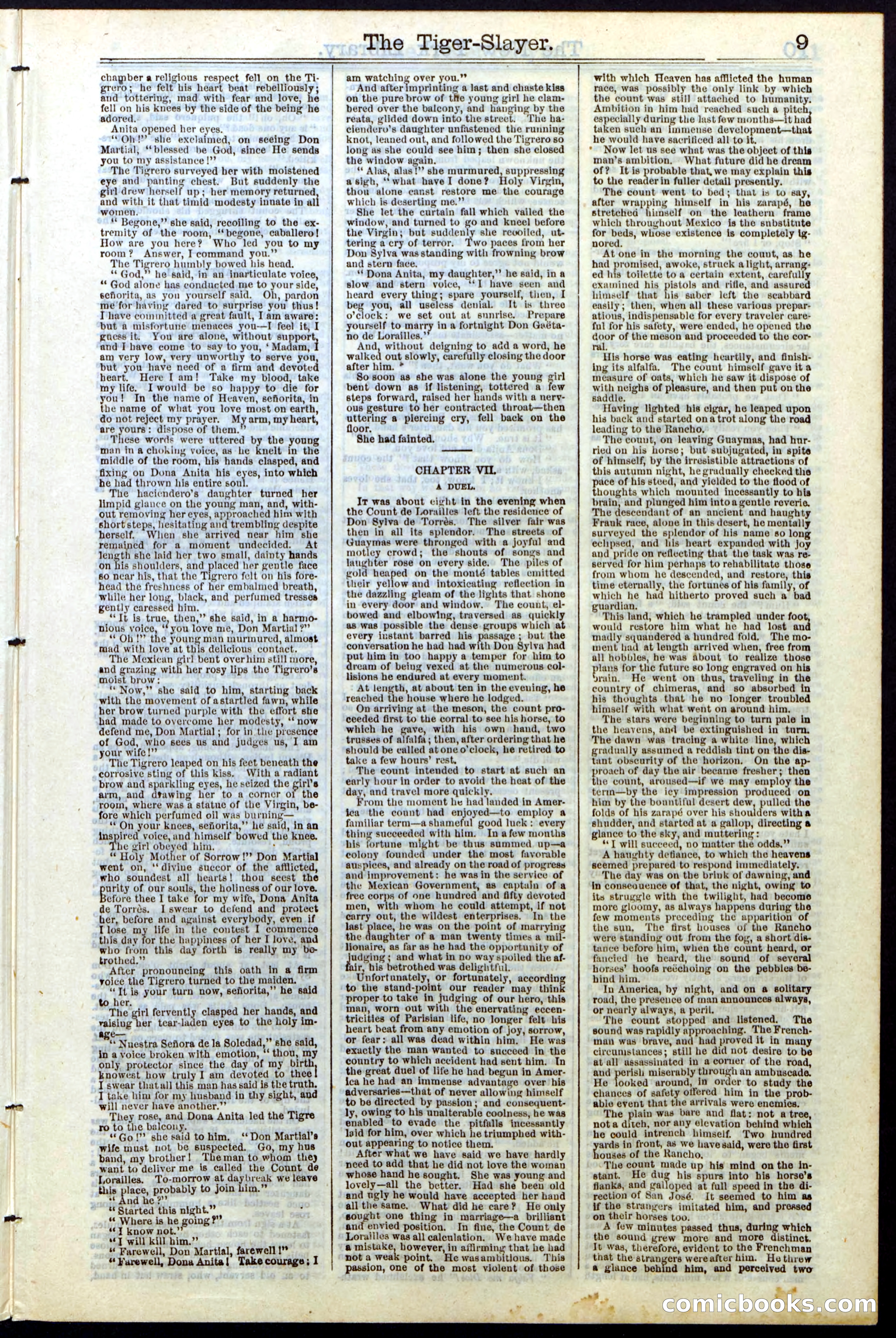
A restored page from Pulp Fiction, 1877. Page through the whole issue in the reader above.
📄 Transcribed text from this page (OCR, searchable)
Machine-transcribed from the original scan — historical spelling and the odd misread are preserved.
—_ chamber a religious respect fell on the Ti- grero; he felt bis heart beat rebelliously; and tottering, mad with fear and love, he fell on his knees by the side of the being he adored, Anita opened her eyes. “Oh!” she exclaimed, on seeing Don Martial, ‘blessed be God, since He sends you to my assistance !”’ The Tigrero surveyed her with moistened eye and panting chest. But suddenly the girl drew herself up; her memory returned and with it that timid modesty innate in all women. ** Begone,”’ she said, recoiling to the ex- tremity of the room, “‘begone, caballero! How are you here? Who led you to my room? Answer, command you.” The Tigrero humbly bowed his head. ** God,” he said, in an inarticulate voice, “God alone has conducted me to your side, sefiorita, as you yourself said, Oh, pardon me ‘for having dared to surprise you thus! T have cominitted a great fault, lam aware: but a misfortune menaces you-—I feel it, I ghess it. You are alone, without support and I have come to say to you, ‘Madam, I am very low, very unworthy to serve you but you have need of a firm and devoted heart. Here Tam! Take my blood, take my life. I would be so happy to die for you! In the name of Heaven, sefiorita, in the name of what you love most on earth, do not reject my prayer. My arm, my heart, are et nf dispose of them.” These words were uttered by the young man in a choking voice, as he knelt in the middle of the room, his hands clasped, and fixing on Dona Anita his te into which he had thrown his entire soul. The hacicendero’s daughter turned her limpid glance on the young man, and, with- out removing her eyes, approached him with short steps, hesitating and trembling despite herself. Whien she arrived near him she remained for a moment undecided. At length she laid her two small, dainty hands on his shoulders, and placed her gentle face 60 near his, that the Tigrero felt on his fore- head the freshness of her embalmed breath, while her long, black, and perfumed tresses gently caressed him. “It is true, then,’ she said, in a harmo- nious yoice, a you love me, Don Martial ?” * Ob!” the young man murtmured, almost mad with love at this delicious contact. The Mexican girl bent over him still more, and grazing with her rosy lips the Tigrero’s moist brow: ** Now,” she said to him, starting back with the movement of astartled fawn, while her brow turned purple with the effort she had made to overcome her modesty, ‘‘ now defend me, Don Martial; for in the presence of God, who sees us and judges us, I am your wife !”’ The Tigrero leaped on his feet beneath the corrosive sting of this kiss. With a radiant brow and sparkling eyes, he seized the girl's arm, and d%awing her to a corner oi the room, where was a statue of the Virgin, be- fore which perfumed oil was burning— ‘“On your knees, sefiorita,’’ he said, in an inspired voice, und himself bowed the knee, he girl obeyed him, ‘ihe “Holy Mother of Sorrow!’? Don Martial went on, ‘‘diyine succor of the affli who soundest all hearts! thou seest the dada of our souls, the holiness of our love. efore thee I take for my wife, Dona Anita de Torrés. I swear to defend and protect her, before and against everybody, even if IT lose my life in the contest I commence this day for the happiness of her I love, and who from this day forth is really my be- trothed.” After pronouncing this oath in a firm voice the Tigrero turned to the maiden. _ “Tt is your turn now, sefiorita,”’ he said to her. The girl fervently clasped her hands, and raising her tear-laden eyes to the holy im- ——_ ec Nuestra Sefiora de Ja Soledad,” she said, in a voice broken with emotion, “‘ thou, my only protector since the day of my b fey knowest how truly I am devoted to thee I swear thatull this man has said is the truth, I take him for my husband in thy sight, and will never have another.”’ _ They rose, and Dona Anita led the Tigre ro to the balcony. “Go!” she said tohim, ‘Don Martial’s wife must not be suspected. Go, my hus band, my brother! Theman to whom they want to deliver me is called the Count de Lorailles. To-morrow at daybreak we leave this place, probably to join him.” ** And he ?”’ * Started this night.” “ Where is he going ” ““Y know not.’ “J will kill him.” | “ Farewell, Don Martial, farewell!” “ Furewell, Dona Anita! Take courage; I -earry out, the wildest enterprises. The Tiger-Slayer. am watching over you.” And after imprinting a last and chaste kiss on the pure brow of tle young girl he clam- bered over the balcony, and hanging by the reata, glided down into the street. The ha- ciendero’s daughter unfastened the running knot, leaned out, and followed the Tigrero so long as she could see him; then she closed the window again. * Alas, alas !’’ she murmured, suppressing a sigh, “‘ what have I done? Holy Virgin, thou alone canst restore me the courage which is deserting me.”’ She let the curtain fall which vailed the window, and turned to go and kneel before the Virgin; but suddenly she revoiled, ut- tering a cry of terror. Two paces from her Don Sylva was standing with frowning brow and stern face. ** Dona Anita, my daughter,’’ he said, in a slow and stern voice, ‘I have seen and heard every thing; spare yourself, then, I bez you, all useless denial. It is three o’clock: we set out at snnrise. Prepare yourself to marry in a fortnight Don Gaéta- no de Lorailles.’ And, without deigning to add a word, he walked out slowly, carefully closing the door after him. * So soon as she was alone the young girl bent down as if listening, tottered a few steps forward, raised her hands with a nerv- ous gesture to her contracted throat—then eee a piercing cry, fell back on the oor, She had fainted. CHAPTER VIL A DUEL. It was about cizht in the evening when the Count de Loruilles left the residence of Don Sylva de Torrés. The silver fair was then in all its splendor. The streets of Guaymas were thronged with a joyful and motley crowd; the shouts of songs and laughter rose on every side. The piles of gold heaped on the monté tables cmitted their yellow and intoxicating reflection in the dazzling gleam of the lights that shone in every door and window. The count, el- bowed and elbowing, traversed as quickly as was possible the dense groups which at every instant barred his ment but the conversation he had had with Don Sylva had ut him in too happy a temper for him to ream of being vexed at the numerous col- lisions he endured at every moment. At length, at about ten in the evening, he reached the house where he lodged. On arriving at the meson, the count pro- ceeded first to the corral to see his horse, to which he gave, with his own hand, two trusses of alfalfa; then, after ordering that he should be valled atone o'clock, he retired to take a few hours’ rest, The count intended to start at such an early hour in order to avoid the heat of the day, and travel more quickly. ‘rom the moment he had landed in Amer- fea the count had oe greg employ a familiar term—a shameful good luck: every thing succeeded with him. In afew months his fortune might be thus summed up—a colony founded under the most favorable auspices, and already on the road of progress and improvement: he was in the service of the Mexican Government, as captain of a free corps of one hundred and fifty devoted men, with whom he could alae not n the last place, he was on the point of marryin the daughter of a man twenty times a mil- lionaire, as far as he had the opportunity of gudging 5 and what in no way spoiled the af- r, his betrothed was delightful. Unfortunately, or fortunately, accordin to the stand-point our reader may thin proper to take in judging of our hero, this man, worn out with the enervating eccen- tricities of Parisian life, no longer felt: his heart beat from any emotion of joy, sorrow, or fear: all was dead within him. He was exuctly the man wanted to succeed in the country to which accident had sent him. In the great duel of life he had begun in Amer- ica he had an immense advantage over bis adversaries—that of never allowing himself to be directed by passion; and consequent- ly, owing to his unalterable coolness, he was enabled to evade the pitfalls incessantly laid for him, over which he triumphed with- out appearing to notice them. After what we have said we have hardly need to add that he did not love the woman whose hand he sought. She was young and lovely—all the better. Had she been old and ugly he would have accepted her hand all the same. What did he care? He only sought one thing in marriage—a brilliant and envied position. In fine, the Count de Loruilles was all calculation. We have made a mistake, however, in affirming that he had nota weak point. He wasambitious. This passion, one of the most violent of those +" bea itp mt. \ @ » Pg -" , a 9 with which Heaven has afflicted the human race, was possibly the only link by which the count was still attached to humanity. Ambition in him had reached such a piteh especially during the last few months—it had tuken such an immense development—that he would have sacrificed all to it. Now let us see what was the object of this man’s ambition, What future did he dream of? Itis oo that, we may explain this to the reader in fuller detail presently. The count went to bed; that is to say, after wrapping himself in his zarapé, he stretched himself on the leathern frame which throughout Mexico is the snbstitute for beds, whose existence is completely tg- nored. At one in the morning the count, as he had Ayame ager awoke, struck alight, arrang- ed his toilette toa certain extent, carefully examined his pistols and rifle, and assured himself that his saber left the seabbard easily; then, when all these various prepar- atious, indispensable for every traveler care- ful for his safety, were ended, he opened the door of the meson and proceeded to the cor- ral. His horse was eating heartily, and finish- ing its alfalfa. The count himself gave ita measure of oats, which he saw it dispose of with neighs of pleasure, and then put on the saddle. Having lighted his cigar, he leaped upon his back and started ona trot along the road leading to the Rancho, The count, on leaving Guaymas, had hnur- ried on his horse; but subjugated, in spite of himself, by the irresistible attractions of this autumn night, he gradually checked the pace of his steed, and yielded to the flood of thoughts which mounted incessantly to his brain, and plunged him intoa gentle reverie, The descendant of an ancient and haughty Frauk race, alone in this desert, he mentally surveyed the splendor of his name so long echpsed, and his heart expanded with Joy and pride on reflecting that the task was re- served for him perhaps to rehabilitate those from whom he descended, and restore, this time eternally, the fortunes of his family, of which he had hitherto proved such a bad guardian, This land, which he trampled under foo would restore him what he had lost an madly squandered a hundred fold, The mo- ment had at length arrived when, free from all hobbles, he was about to realize those plans for the future so long engraved on his brain. He went on thus, traveling in the country of chimeras, and so absorbed in his thoughts that he no longer troubled himself with what went on around him. The stars were beginning to turn pale in the heavens, and be extinguished in turn, The dawn was tracing a white line, which gradually assumed a reddish tint on the dis- tant obscurity of the horizon. On the ap- roach of day the air became fresher; then he count, aroused—if we may employ the term—by the icy impression produced on him by the bountiful desert dew b do: the folds of his zarapé over his shoulders witha shudder, and started at a gallop, directing a glance to the sky, and muttering: “T will succeed, no matter the odds,” A haughty defiance, to which the heavens seemed prepared to respond immediately. The day was on the brivk of dawning, and in conseauence of that, the night, owing to its struggle with the twilight, had become more gloomy, as always happens during the few moments preceding the apparition of the sun, The first houses of the Rancho were standing out from the fog, a short dis- tance before him, when the count heard, or fancied he heard, the sound of several horses’ hoofs reéchoing on the pebbles be- hind him. ; In America, by night, and on a solitary road, the presence of man announces always, or nearly always, a peril. The count stopped and listened. The sound was rapidly approaching. The French- man was brave, and had proved it in many circumstances; still he did not desire to be at all assassinated in a coruer of the road, and perish miserably through an ambuscade. He looked around, in order to study the chances of safety offered him in the prob- able event that the arrivals were enemies. The plain was bare and flat: not a tree, nota ditch, nor any élevation behind which he could intrench himself. Two bundred ards in front, a8 we have said, were the first Sonkes of the Rancho, ~The count made up his mind on the in- stant. He dug his spurs into his horse's flanks, and galloped at fall speed in the di- rection Of San José. It seemed to him as if the Stranyers imitated him, and pressed on their horses too. A few minutes passed thus, during which the sound grew more and more distinct. It was, therefore, evident to the Frenchman that the strangers wereafter him. He threw @ glance d him, and perceived two wee ee we ee - ——- = ee a 5 ee _ “comic