
Pulp Fiction, 1877 · page 14 of 40
Beadle's New York Dime Library, Vol. II, No. 15 — page 14: what you’re looking at
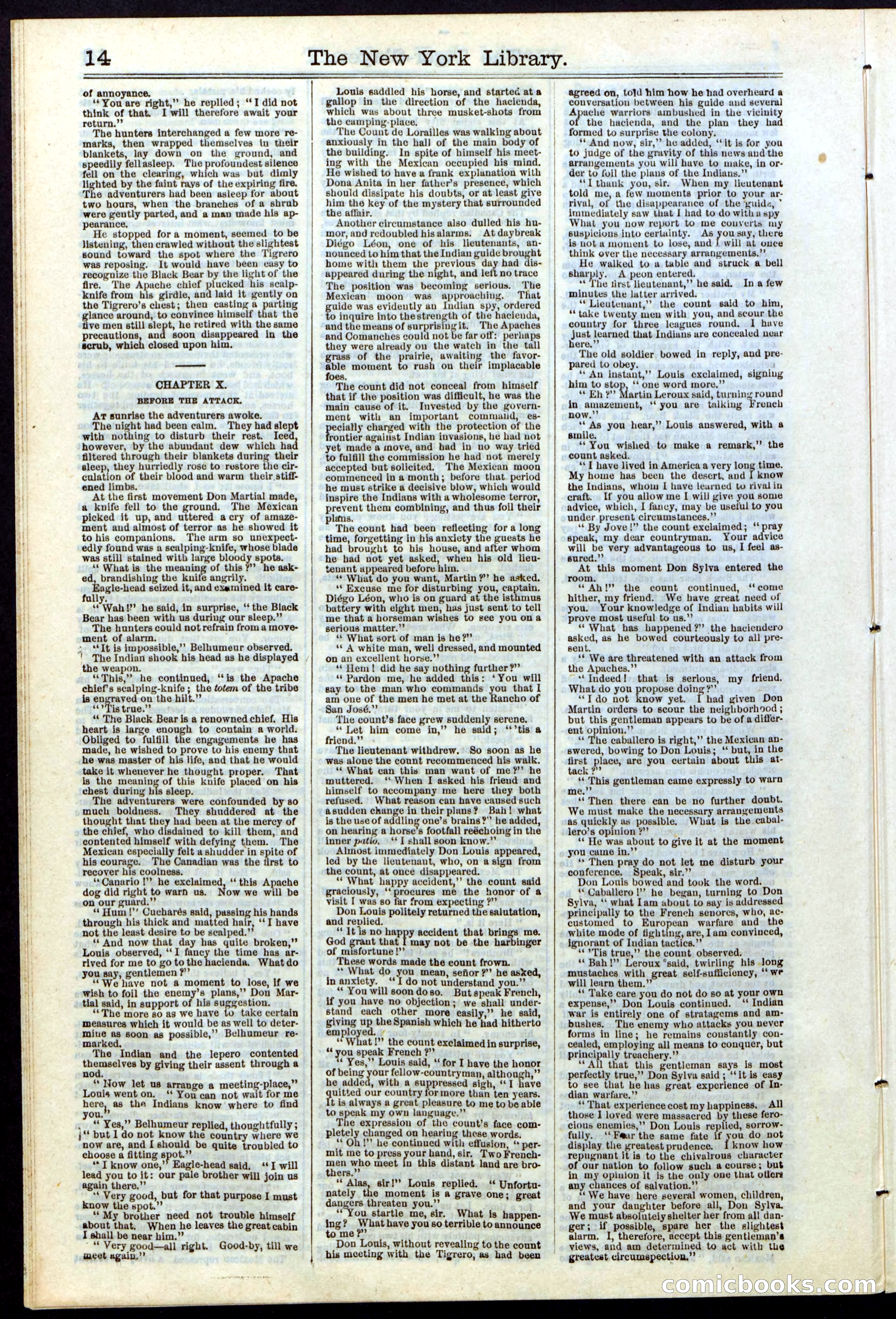
A restored page from Pulp Fiction, 1877. Page through the whole issue in the reader above.
📄 Transcribed text from this page (OCR, searchable)
Machine-transcribed from the original scan — historical spelling and the odd misread are preserved.
ee ee of annoyance, ‘You are right,” he replied; “I did not think of that. I will therefore await your return.’ The hunters interchanged a few more re- marks, then wrapped themselves in their blankets, lay down on the ground, and speedily fellasleep. The rofoundest silence fell on the clearing, which was but dimly lighted by the faint rays of the expiring fire. The adventurers had been asleep for about two hours, when the branches of a shrub were gently parted, and a man made his ap- pearance, He stopped fora moment, seemed to be listening, then crawled without the slightest sound toward the spot where the Tigrero was reposing. It would have been easy to recognize the Black Bear by the light of the fire. The Apache chief chewy his scalp- knife from his girdle, and laid it gently on the Tigrero’s chest; then casting a parting lance around, to convince himself that the ve men still sle t, he retired with the same precautions, and soon disappeared in the scrub, which closed upon him. ! ) i " | | \) B) 5! ee ol oe ert —- i? 2a S* - - -_- : - CHAPTER X. BEFORE THE ATTACK. At sunrise the adventurers awoke. The night had been calm. They had slept with nothing to disturb their rest. Iced however, by the abundant dew which ha filtered through their blankets during their sleep, they hurriedly rose to restore the cir- culation of their blood and warm their stiff- ened limbs. | At the first movement Don Martial made, i! a knife fell to the ground. The Mexican picked it up, and uttered acry of amaze- t ment and almost of terror as he showed it qt | to his companions. The arm so unexpect- edly found was a sealping-knife, whose blade was still stained with large bloody spots. ‘* What is the meaning of this ?”’ he ask- tt ed, brandishing the knife angrily, H sq hable-head seized it, and examined it care- EO - — — ae ee . a Ere SEES OSES Se Eee eee - i a Wah !”’ he said, in surprise, ‘* the Black Bear has been with us during our sleep.” The hunters could not refrain from a move- ment of alarm HY | a It is impossible,”? Belhumeur observed. Ih ' The Indian shook his head as he displayed the weapon. “This,” he continued, “is the Apache chief's scalping- knife ; the totem of the tribe is engraved on the hilt.” ay ‘”'Tis true.”’ if “‘ The Black Bear is a renowned chief. His 3 heart is large enough to contain a world. Ri Obliged to fulfill the engagements he has nae made, he wished to prove to his enemy that | he was master of his life, and that he would take it whenever he thought proper. That is the pana a this knife placed on his chest during his sleep. The adventurers were confounded by so t much boldness. They shuddered at the thought that they had been at the mercy of mt | the chief, who disdained to kill them, and contented himself with defying them. The Mexican especially felt a shudder in spite of his courage. The Canadian was the first to recover his coolness. ‘Canario !’’ he exclaimed, ‘‘ this Apache dog did right to warn us. Now we will be on our rd.”’ } | ** Hum !’’ Cucharés said, passing his hands i through his thick and matted hair, ‘TI have not the least desire to be sealped. ¥ ‘* And now that day has quite broken,” Louis observed, “I fancy the time has ar- rived for me to go to the hacienda. Whatdo you say, gentlemen ?”’ ‘““We have not a moment to lose, if we wish to foil the enemy’s plans,’’ Don Mar- al said, in support of his engaeiow “The more go as we have to take certain measures which it would be as well to deter- miue as soon as possible,” Belhumeur re- marked, The Indian and the lepero contented ee pte he by giving their assent through a ** Now let us arrange a meeting- place,”’ Louis went on. ‘ You can not wait for me here, as the Indians know where to find “‘ Yes,’’ Belhumeur replied, thoughtfully ; j but 1 do not know the country where we now are, ard [should be quite troubled to choose a fitting ot.’’ “I know one,’’ Eagle-head said, ‘I will lead you to it: our pale brother will join us ¢ again there.”’ ‘* Very good, but for that purpose I must know the spot.” “* My brother need not trouble himself about that. When he leaves the great cabin I shall be near him.” '“ Very good—all right. Good-by, till we meet ugain,’’ z riw= mo i a eee oS Sp a ea ee —_— ——-=+ —- -——— = == _——~-— ‘ ——— - i Louis saddled his horse, and started ata gallop in the direction of the hacienda, which was about three musket-shots from the camping: place. The Count de Lorailles was walking about anxiously in the hall of the main body of the building. In spite of himself his meet- ing with the Mexican occupied his mind. He wished to have a frank explanation with Dona Anita in her father’s presence, which should dissipate his doubts, or at least give him the key of the mystery that surrounded the affair. Another circumstance also dulled his hu- mor, and redoubled hisalarms. At daybreak Diégo Léon, one of his lieutenants, an- nounced to him that the Indian guide brought home with them the Meer day had dis- appeared during the night, and left no trace The position was beset serious. The Mexican moon was approaching. That ae was evidently an Indian spy, ordered o inquire into the eased a the hacienda, and the means of surpris 4 ee The Apaches and Comanches could not be far off: perhaps they were already ou the watch in the tall grass of the prairie, awaiting the favor- spa moment to rush on their implacable oes The count did not conceal from himself that if the position was difficult, he was the main cause of it. Invested by the govern- ment with an important command, es- | Heserol charged with the protection of the ntier agaist Indian invasions, he had not yet made a move, and had in no way tried to fulfill the commission he had not merely accepted but solicited, The Mexican moon commenced in a month; before that. period he must strike a decisive blow, which would inspire the Indians with a wholesome terror, prevent them combining, and thus foil their lens. r The count had been reflecting for a long time, forgetting in his anxiety the guests he had brought to his house, and after whom he had not yet asked, when his old lieu- tenant uppeared before him. ** What do you want, Martin?’ he asked. ‘* Exeuse me for disturbing you, captain. Diégo Léon, who is on guard at the isthmus battery with eight men, has just sent to tell me thata horseman wishes to see you ona serious matter.”’ ‘* What sort of man is he?” ‘* A white man, well dressed, and mounted on an excellent horse.” ‘* Hem! did be say nothing further?” ‘* Pardon me, he added this: ‘You will say to the man who commands you that I am one of the men he met at the Rancho of San José.” The count’s face grew suddenly serene. ‘“ Let him come in,” he said; ‘“’tis a friend.” The lieutenant withdrew. So soon as he was alone the count recommenced his walk, ‘* What can this man want of me?’ he muttered. ‘* When I asked his friend and himself to accompany me here they both refused. What reason can have caused such asudden change in their plans? Bah! what is the use of addling one’s brains?” he added, on hearing a horse's footfall reéchoing in the inner patio, “I shall soon know.”’ Almost immediately Don Louis appeared, led by the lieutenant, who, on asign from the count, at once disappeared. “What happy accident,’’ the count said graciously, *‘ rocures mé the honor of a visit I was so far from expecting ?”’ Don Louis politely returned the salutation, and revlied. “ It is no happy accident that pene bins God grant that [ may not be the harbinger of misfortune !”’ These words made the count frown. ** What do ee mean, sefior ?”’ he asked, in anxiety. do not understand you.”’ You will soondoso. But speak French, if you have no objection; we shall under- stand each other more easily,’’ he said, Emplo BP the Spanish which he had hitherto mplo 4 ‘** What !”’ the count exclaimed in surprise, & you speak French ?”’ m Yes,”’ Louis said, “ for I have the honor of being: oe fellow- -countryman, although,” he added, with a eupprosno’ sigh, ‘I ave uitted our country formore than ten years. “pa always a great pleasure to me to be able apes my own language.” 1e expression of the count’s face com- pert changed on hearing these words. !”” he continued with effusion, ‘ per- mit me to press your hand, sir. Two French- yeas who meet {n this distant land are bro- ers.’ ‘** Alas, sir!’’ Louis replied. ‘ Unfortu- nately the moment is a grave one; great ones threaten you.”’ ou startle me, sir. What is happen- ing? What have you so terrible to announce to me?” Don Lonis, without revealing to the count his meeting with the Tigrero, as had been The New York Library. ee agreed on, told him how he had overheurd a conversation between his guide and several ag hin warriors ambushed in the vicinity the hacienda, and the plan they had formed to surprise the colony. ** And now, sir,’’ he added, ‘it is for you to judge of the gravity of this news and the arrangements you will have to make, in or- der to fvil the plans of the Indians.” “‘] thank you, sir. When my lieutenant told me, a few moments prior to your ar- rival, of the disappearance of the ‘yuide, * immediately saw that 1 had to do witha spy What you now report to me converts my suspicions into certainty. As you say, there is nolL a moment to lose, and | will at once think over the necessary arrangements, yy He walked to a table and struck a bell sharply. A peon entered, “The tirst lieutenant,’’ he said. In a few minutes the latter arrived. ‘* Lieutenant,’ the count said to him, “‘take twenty men with you, and scour the country for three leagues round, I have just learned that Indians ure concealed neur here.”’ The old soldier bowed in reply, and pre- pared to obey. ** An instant,’’ Louis exclaimed, signing him to stop, ‘‘ one word more,’ ** Eh ?”’ Martin Leroux said, turning round in amazement, ‘* you are talking Freneh now.’ ‘* As you hear,” Louis answered, with a sinile. ‘* You wished to make a remark,’ the count asked. ‘*T have lived in America a very long time. My home has been the desert, and I know the Indians, whow I| have learned to rivalin craft. If you allow me I will give you some advice, which, I fancy, may be uselul to you under present. circumstances.’ ‘* By Jove!” the count exclaimed; ray speak, my dear countryman. “pip a vies will be very advantageous to us, I feel as- sured.” At this moment Don Sylva entered the room. * Ah!’ the count continued, ‘* come hither, my friend. We have great need of you. Your knowledge of Indian habits will prove most useful to us.’ ‘* What has happened?” the hacicndero aan as he bowed courteously to all pre- sent. ‘* We are threatened with an attack from the Apuches.”’ “Indeed! that is serious, What do you pecmaee doing?” ‘““T do not know yet. Thad given Don Martin orders to scour the neighborhood ; but this gentleman appears to be of a differ- ent 0 inion.”’ he caballero is right,’’ the Mexican an- swered, bowing to Don Louis; “ but, in the —e place, are you certain about this at- tac * This gentleman came expressly to warn me. ‘‘Then there can be no further doubt. We must make the necessary arrangements as quickly as possible. What is the cabal- lero’s opinion ?”’ ‘“‘ He was about to give it at the moment you came in.”’ ** Then pray do not let me disturb your conference, Speak, sir.’’ Don Louis bowed and took the word. ** Caballero!” he began, turning to Don Sylva, ‘‘ what Lam about to say is G faveseed principally to the French senores, who, ac- customed to European warfare and the white mode of fighting, are, Iam convinced, ignorant of Indian tactics.’’ ‘Tis true,”’ the count observed. ‘ Bah!’ Leroux “said, twirling his Jong mustaches with great self-sufficiency, ‘we will learn them.”’ ** Take care you do not do so at your own expense,’’ Don Louis continued. ‘‘ Indian war is entirely one of stratagems and am- bushes. The enemy who attacks you never forms in line; he remains constantly con- cealed, employin all means to conquer, but princi wi feeachant ‘“* All that this eeniieanaa says is most perfectly true,” Don Sylva said; ‘‘it is easy to see that he has great experience of In- dian warfare,” ‘** That experience cost my happiness. | All those 1 loved were massacred by these fero- cious enemies,’’ Don Louis replied, sorrow- fully. ‘‘Faur'the same fate if you do not display the aera prudence. know how repugnant it is to the chivalrous character of our nation to follow such a course; but in my Opinion it is the only one that otters any chances of salvation.” “We have here several women, children, and your daughter before all, Don Sylva. We must absolutely shelter her from all rian. ger; if possible, spare her the plightest alarm. I, therefore, accept this gentleman’s views, and am determined to act with the greatest circumspection,”’ my friend. ,OO Gom (¢ cS (C (0)