
Pulp Fiction, 1877 · page 11 of 40
Beadle's New York Dime Library, Vol. II, No. 15 — page 11: what you’re looking at
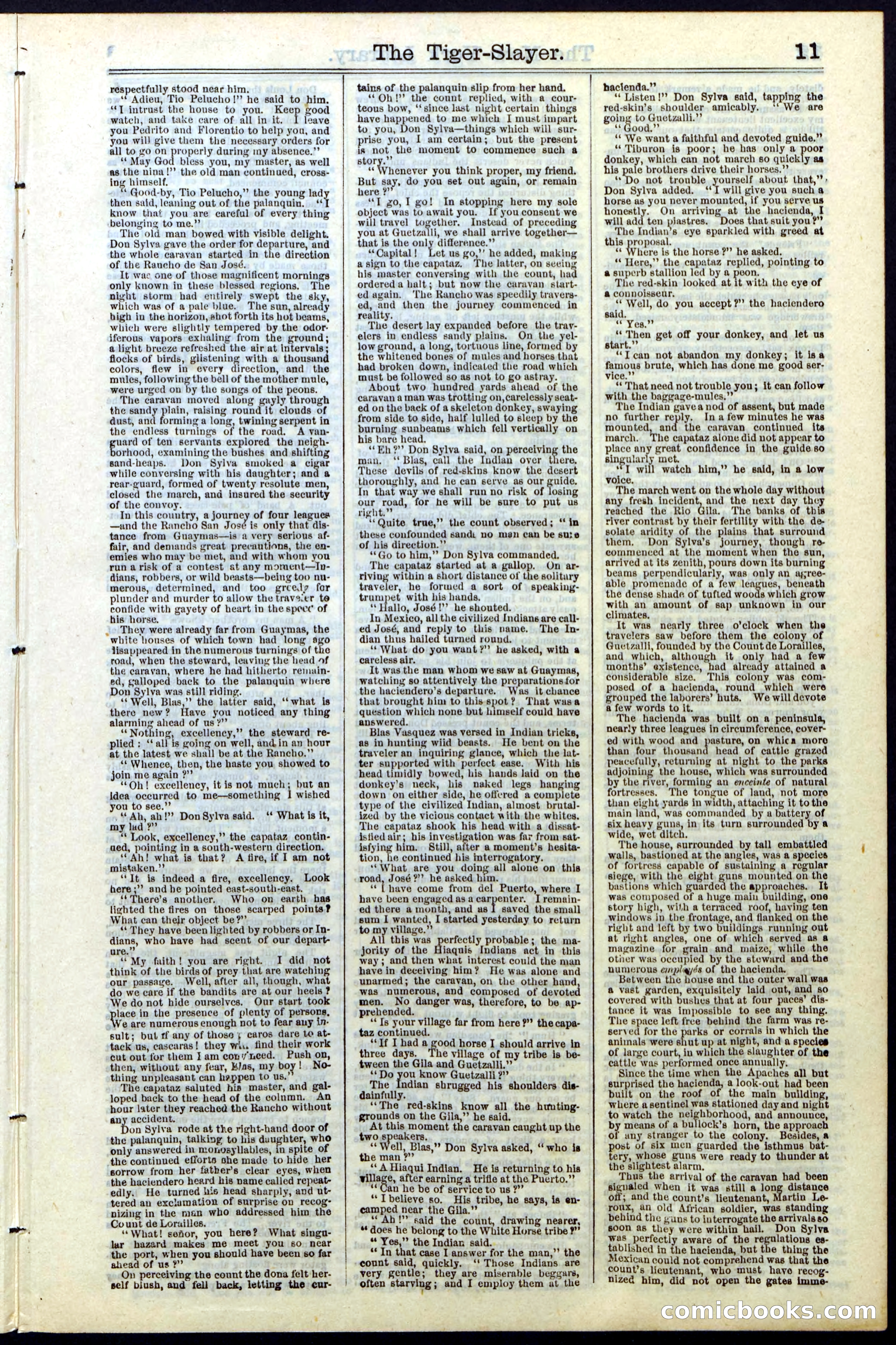
A restored page from Pulp Fiction, 1877. Page through the whole issue in the reader above.
📄 Transcribed text from this page (OCR, searchable)
Machine-transcribed from the original scan — historical spelling and the odd misread are preserved.
the continued efforts she made toh The Tiger-Slayer. 11 respectfully stood near him. ‘** Adieu, Tio Pelucho!” he said to him. “T intrust the house to you. Keep good watch, and take care of all in it. leave you Pedrito and Florentio to help you, and you will give them the necessary orders for all to go on properly during my absence.”’ ‘* May God bless you, my master, as well as the nina!’’ the old man continued, cross- ing himself. * Good-by, Tio Pelucho,” the young lad then said, leaning out of the palanquin. “ know that you are careful of every thing belonging to me.”’ The old man bowed with visible delight. Don Sylva gave the order for departure, and the whole caravan started in the direction of the Rancho de San José. It wae one of those magnificent mornings only known in these blessed regions, The night storm had entirely swept the sky, which was of a pale blue. The sun, already high in the horizon, shot forth its hot beams, which were slightly tempered by the odor- iferous vapors exhaling from the ground; a light breeze refreshed the air at intervals; flocks of birds, glistening with a thousand colors, flew in every direction, and the mules, mttaer. the bell of the mother mule, were urged on by the songs of the peons. The caravan moved along gayly through the ee ‘pore raising round it clouds of dust, and forming a long, twining serpent in the endless turnings of the road. A van- uard of ten servants explored the neigh- eels examining the bushes and shifting sand-heaps. Don Sylva smoked a cigar while conversing with his daughter; and a rear-guard, formed of twenty resolute men, closed the march, and insured the security of the convoy. In this country, a journey of four leagues —und the Rancho San José is only that dis- tance from Guaymas—is a very serious af- fair, and demands great precautions, the en- emies who may be met, and with whom you run arisk of a contest at any moment—In- dians, robbers, or wild beasts—being too nu- merous, determined, and too greely for plunder and murder to allow the travs.er to confide with gayety of heart in the specc of his horse. They were already far from Guaymas, the “white houses of which town had long ago lisappeared in the numerous turnings of the road, when the steward, leaving the head of the caravan, where he had hitherto reimuin- ed, galloped back to the palanquin where Don Sylva was still riding. ‘‘ Well, Blas,’’ the latter said, ‘“‘ what is there new? Have you noticed any thing alarming ahead of us ?’’ = Nothing, excellency,”’ the steward re- plied; ‘‘all is going on well, andin an hour at the latest we shall be at the Rancho.” ‘‘ Whence, then, the haste you showed to join me again ?” “Oh! excellency, itis not much; but an Idea oceurred to me—something 1 wished you to see.”’ _“ Ah, ah!’ Don Sylva said. ‘* What is it, my lud ?” ‘* Look, excellency,”’ the capataz contin- aed, pointing in a south-western direction. ‘‘ Ah! what is that? A fire, if I am not mistaken.’ ‘It is indeed a fire, excellency. Look here ;’’ and be pointed east-south-east. ‘*There’s another. Who on earth has lighted the fires on those scarped points? What can their object be?’ ‘‘ They have been lighted by robbers or In- dians, who have had scent of our depart- “My faith! you are right. I did not think of the birds of prey that are watchin our passage. Well, after all, though, wha do we care if the bandits are at our heels ? We do not hide ourselves. Our start took lace in the presence of plenty of persons, We are numerous enough not to fear any in- sult; but tf any of those ; caros dare to at- tack us, cascaras! they wi. find their work cut out for them 1am cony‘need. Push on, then, without any fear, Klas, my boy ! No- thing unpleasant can happen to us. The capataz saluted his master, and gal- loped back to the head of the column. An hour later they reached the Rancho without any accident, on Sylva rode at the right-hand door of the palanquin, talking to his duughter, who only answered in mongsylables, in any of de her sorrow from her father’s clear eyes, when the haciendero heard his name called repeat- edly. He turned his head sharply, and ut- tered an exclumation of surprise on recog- nizing in the man who addressed him the Co unt de Lorailles. “What! sefior, you here? What singu- lar bazard makes me meet you 60 near the port, when you should have been so far ahead of us?” On perceiving the count the dona felt her- tains of the palanquin slip from her hand. ‘Oh!’ the count replied, with a cour- teous bow, “‘since last night certain things have happened to me which I must impart to you, Don Sylva—things which will sur- prise you, I am certain; but the present is not the moment to commence such a eerte “Whenever you think proper, my friend. But say, do you set out again, or remain here ?’ “T zo, I go! In stopping here my sole object was to await you. If you consent we will travel together. Instead of preceding you at Guetzalli, we shall arrive together— that is the only difference.” “Capital! Let us go,’’ he added, making a sign to the capataz. The latter, on seeing his master conversing with the count, ha ordered a halt; but now the caravan start- ed again. ‘The Rancho was speedily travers- ed, and then the journey commenced in reality. The desert lay expanded before the tray- elers in endless sandy plains. On the yel- low ground, a long, tortuous line, formed by the whitened bones of mules and horses that had broken down, indicated the road which must be followed so as not to go astray. About two hundred yards ahead of the caravan aman was trotting on,carelessly seat- ed on the back of a skeleton donkey, swaying from side to side, half lulled to sleep by the burning sunbeams which fell vertically on his bare head. ‘Eh ?”’ Don Sylva said, on perceiving the man. ‘ Blas, call the Indian over there, These devils of red-skins know the desert thoroughly, and he can serve as our guide. In that way we shall run no risk of losing our road, for he will be sure to put us right.’ TX Quite true,’’ the count observed; “ in these confounded sand: no men can be sure of his direction.”’ **Go to him,’”’ Don Sylva commanded, The capataz started at a gallop. On ar- riving within a short distance of the solitary traveler, he formed a sort of speaking- trumpet with his hands, ‘* Hallo, José !’’ he shouted. In Mexico, all the civilized Indians are call- ed José, and reply to this name. The In- dian thus hailed turned round. ‘* What do you want?’ he asked, with a careless air. It was the man whom we saw at Guaymas, watching so attentively the preparations for the haciendero’s departure. Was it chance that brought him to this spot? That wasa question which none but himself could have answered. Blas Vasquez was versed in Indian tricks, as in hunting wiid beasts. He bent on the traveler an inquiring glance, which the lat- ter supported with perfect ease. With his head timidly bowed, his hands laid on the donkey’s neck, his naked legs hanging down on either side, he offered a complete type of the civilized Indian, almost brutal- ized by the vicious contact with the whites. The capataz shook his head with a dissat- istied air; his investigation was far from sat- aafying him. Still, after a moment’s hesita- tion, he continued his interrogatory. ‘What are you doing all alone on this road, José?’ he asked him. “Thave come from del Puerto, where I have been engaged as a pn pn I remain- ed there a month, and as I saved the small sum I wanted, I started yesterday to return to ‘it village.”’ All this was perfectly probable; the ma- jority of the Hiaquis Indians act in this way; and then what interest could the man have in deceiving him? He was alone and unarmed; the caravan, on the other hand was numerous, and composed of devoted men. No danger was, therefore, to be ap- prehended. ‘Is your village far from here ?”’ the capa- taz continued. ‘“‘If I had a good horse I should arrive in three days. The village of my tribe is be- tween the Gila and Guetzalli.” ‘*Do you know Guetzalli ?” The Indian shrugged his shoulders dis- dainfully. ‘“The red-skins know all the hrnting- grounds on the Gila,” he said. At this moment the caravan caught up the two speakers. ‘Well, Blas,” Don Sylva asked, “who is the man ?”’ ‘A Hiaqui Indian. He is returning to his village, after earning a trifle at the Puerto.” ‘**Can he be of service to us ?” “IT believe so. His tribe, he says, is en- camped near the Gila.”’ ‘Ab!’ said the count, drawing nearer, “does he belong to the White Horse tribe ?” “ Yes,’’ the Indian said. “In that case I answer for the man,”’ the -count said, quickly. ‘' Those Indians are very gentle; they are miserable beggars, ‘self biush, and fell back, letting the cur- | often starving ; and I employ them at the | | | hacienda.” ‘ Listen !’? Don Sylva said, tapping the red-skin’s shoulder amicably. ‘‘ We are going to Guetzalli.”’ ** Good.” ‘“ We want a faithful and devoted guide,” ‘Tiburon is poor; he has only a poor donkey, which can not march 80 quickly as his pale brothers drive their horses.” ‘Do not trouble yourself about that,’’, Don Sylva added. ‘I will give you sucha horse as you never mounted, if you serve us honestly. On arriving at the hacienda, I will add ten piastres. Does that suit you 4) The Indian’s eye sparkled with greed at this proposal. ‘* Where is the horse ?”” he asked. ‘‘ Here,”’ the capataz replied, pointing to a superb stallion led by a peon, The red-skin looked at it with the eye of a@ connoisseur, ‘Well, do you accept?” the haciendero said, ce Yes.”’ ‘Then get off your donkey, and let us start.”’ “Tecan not abandon my donkey; it isa yest brute, which has done me good ser- vice. ‘** That need not trouble you; it can follow with the baggage-mules,”’ The Indian gavea nod of assent, but made no further reply. Ina few minutes he was mounted, and the caravan continued ite march. The capataz alone did not appear to place ate great confidence in the guide so Bingular met. **T will watch him,” he said, in a low voice. The march went on the whole day without any fresh incident, and the next day they reached the Rio Gila. The banks of this river contrast by their fertility with the de-- solate aridity of the plains that surround them. Don Sylva’s journey, though re commenced at the moment when the sun, arrived at its zenith, pours down its burning beams perpendicularly, was only an agree- able promenade of a few leagues, beneath the dense shade of tufted woods which grow with an amount of sap unknown in our climates. It was nearly three o’clock when the travelers saw before them the colony of Guetzalli, founded by the Count de Lorailles, and which, although it only had a few months’ existence, had already attained a considerable size. This colony was com- posed of a hacienda, round which were grouped the laborers’ huts. We will devote a few words to it. The hacienda was built on a peninsula, nearly three leagues in circumference, cover- ed with wood and PORPODRS on whica more than four thousand head of cattle grazed peucefully, returning at night to the parks adjoining the house, which was surrounded by the river, forming an enceinte of natural fortresses. The tongue of land, not more than eight yards in width, attaching it tothe main land, was commanded by a battery of six heavy guns, in its turn surrounded by a wide, wet ditch. The house, surrounded by tall embattled walls, bastioned at the angles, was a species of fortress capable of sustaining a regular siege, with the eight guns mounted on the bastions which guarded the eppresches. It was composed of a huge main building, one story high, with a terraced roof, having ten windows ip the frontage, and flanked on the right and left by two buildings running out at right angles, one of which served as a magazine for grain and maize, while the otier was oceupied by the steward and the numerous empleés of the hacienda, Between the house and the outer wall was a vast garden, exquisitely laid out, and so covered with bushes that at four paces’ dis- tance it was impossible to see any thing. The space left free behind the farm was re- served for the Pans or corrals in which the aniinals were shut up at night, and a species of large court, in which the slaughter of the cattle was performed once annually, Since the time when the Apaches all but surprised the hacienda, a look-out pad been built on the roof of the main building, where asentinel was stationed day and night to watch the neighborhood, and announce, by means of a bullock’s horn, the approach of uny stranger to the colony. Besides, a post of six men guarded the isthmus bat- tery, Whose guns were ready to thunder at the slightest alarm, Thus the arrival of the caravan had been uals when it was still a long distance off; and the count’s lieutenant, Martin Le- roux, an old African soldier, was standing behind the puns to interrogate the arrivals so soon a8 they were within hail. Don Sylva was perfectly aware of the lations es- tablished in the hacienda, but the thing the Mexican could not comprehend was that the count’s lieutenant, who must havo recog- nized him, did not open the gates imme- \ comicbooks.cot ' *' “ >. rs Pa — te : dl — —_——s +s pa