
Pulp Fiction, 1877 · page 25 of 28
Beadle's Dime Library, Vol. II, No. 14 — page 25: what you’re looking at
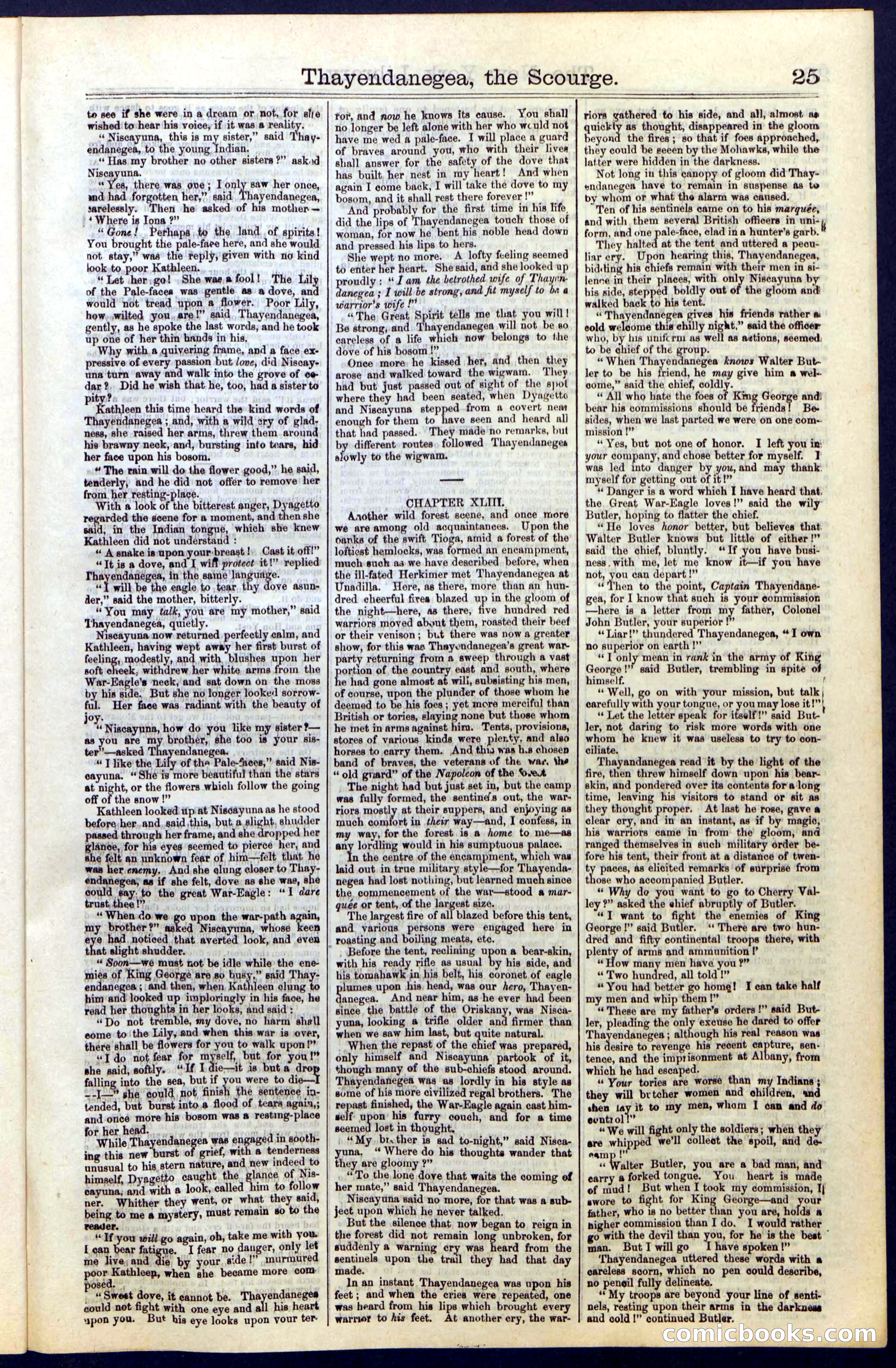
A restored page from Pulp Fiction, 1877. Page through the whole issue in the reader above.
📄 Transcribed text from this page (OCR, searchable)
Machine-transcribed from the original scan — historical spelling and the odd misread are preserved.
SS ed ee ee to see if she were in a dream or not, for sfie wished to hear his voice, if it was a reality, ‘“ Niscayuna, this is my sister,” said Thay- endanegea, to the young Indian, ‘Has my brother no other sisters?” askid Niscayuna. “Yes, there was ove; I only saw her once, md had forgotten her,” said Thayendanegea, sarelessly. Then he asked of his mother ‘ Where is Iona ?” “ Gone! Perhaps te the land of spirits! You brought thie pale-faee here, and she would not stay,” was the reply, given with no kind look.to poor Kathleen. “Let her,go! She waeafool! The Lily of the Pale-facea was gentle as a dove, and would not tread upon a flower. Poor Lily, how. wilted you, are!” said Thayendanegea, gently, as he spoke the last words, and he took up one of her thin bands in his, Why with.a quivering frame, and a face ex- pressive of every passion but dove, did Niscay- una turn away and walk into the grove of oe dar ?. Did he wish that he, too, had a sister to ity? Wathicen this time heard the kind words of Thayendanegea ; and, with a wild sry of glad- ness, she raised her arms, threw them around hie brawny neck, and, bursting into tears, hid her face upon his bosom. “ The rain will do the flower good,” he said, tenderly, and he did not offer to remove her from. her resting-place. With a look of the bitterest anger, Dyagetto rded the scene for a moment, and then she said, in the Indian tongue, which she knew Kathleen did not understand : “ A snake is upon your breast! Cast it off!” “It is a dove, and I wiff protect it!” replied Thayendanegea, in the same language. “YT will be the eagle to tear thy dove asun- der,” said the mother, bitterly. “You may talk, you are my mother,” said Thayendanegea, quietly. Wesiyusia now returned perfectly calm, and Kathleen, having wept away her first burst of feeling, modestly, nie with blushes upon her soft cheek, withdrew her white arms from the War-Eagle’s neck, and sat down on the moss by his side. But she no longer looked sorrow- ful. Her face was radiant with the beauty of oy. x Niscayuna, how do you like my sister ?— as you are my brothér, she too is your sis- ter’—asked Thayendanegea. “ T like the Lily of the Pale-‘aces,” said Nis- eayuna. “She is more beautiful than the stars at night, or the flowers which follow the going off of the snow !” Kathleen looked up at Niscayuna as he stood before her. and. said this, but. a plight shudder through her frame, and she opped her glance, for his eyes seemed to pierce her, and she pt an unknown fear of him—felt that he was her enemy. And she elung closer to Thay- endanegen; as if she felt, dove as she wae, she could say. to the great War-Eagle: “1 dare trust. thee!” 7 “When do we go upon the war-path again, my brother?” asked Niseayima, whose keen ne had. noticed that averted look, and even that slight shudder. “ Soon—we must not be idle while the ene- mies of ‘King George are so buy,” said Thay- en ea; and then, when Kathleen clung him and looked up imploringly in his face, he read her thoughts in her looks, and said : “Do not tremble, my dove, no harm shell come tothe Lily, and when this war is over, there shall be flowers for you to walk upon!” “J do not fear for myself, but for you!” she said, softly. “If Idie—it is buta dro falling into the sea, but if ou were to die— ~-J—” she could, not finish the sentence in- tended, but burst into.a flood of teara again,; and oneé more his bosom was a resting-place for her head. , eee While Thayendanegea was engaged in sooth- ing this new urst of grief, with @ tenderness unusual to his stern nature, and new indeed to himeelf, Dyagetto caught the glance of Nis- eayuna, and with a look, called him to follow ner. Whither they went, or what they said, being to me a mystery, Must remain 60 to the reader. “If you will go in, oh, take me e" a = L can bear fatigue. I fear no danger, only me live, ii be by your. side!” murmured fa peony when she became more com: oOo ad ; he en Swest dove, it cannot be. Thayendaneges could not fight with one eye and all his heart upon you. But his eye looks upon vour ter = py - Thayendanegea, the Scourge. for, and now he knows its cause. You shall no longer be left alone with her who wculd not have me wed a pale-face. I will place a guard of braves around you, who with their lives shall answer for the safety of the dove that has built, her nest in my heart! And when again I come back, I will take the dove to my bosom, and it shall rest there forever!” — And probably for the first time in his life, did the lips of Thayendanegea touch those of woman, for now he bent his noble head down and pressed his lips to hers. She wept no more. A lofty feeling seemed to enter her heart. She said, and she looked up roudly ; “Jam the betrothed wife of Thayrn- danegea ; I will be strong, and fit myself to be a warrior’s wife !" “The Great Spirit tells me that you will! Be strong, and. Thayendanegea will not be so careless of a life which now belongs to the dove of his bosom !” Onee more he kissed her, and then they arose and walked toward the wigwam. They had but just passed out of sight of the s)ot where they had been seated, when Dyagetto and Niscayuna sieved from a covert nem enough for them to have seen and heard all that had passed. They made no remarka, but by different routes. followed Thayendaneges slowly to the wigwam. CHAPTER XLII. Another wild forest scene, and once more we are among old acquaintances. Upon the oanks of the swift Tioga, amid a forest of the loftiest hemlocks, was formed an encampment, much suck as we have described before, when the ill-fated Herkimer met Thayendanegea at Unadilla. Hore, as there, more than an hun- dred cheerful firea blazed up in the gloom of the night—here, as there, five hundred red warriors moved abwut them, roasted their beef or their venison; but there was now a greater show, for this was Thayendanegea’s great war- party returning from a sweep through a vast ortion of the country east and south, where e had gone almost at will, subsisting his men, of course, upon the plunder of those whom he deemed to be his foes ; yet more merciful than British or tories, elaying none but those whom he met in arms against him. Tents, provisions, stores of various kinds were plenty, and also horses to carry them. And this was b.s chosen band of braves, the veterans of the war, ‘he “old grard” of the Napoleon of the Ser The night had but just set in, but the camp was fully formed, the sentinds out, the war- riors mostly at their suppers, and enjoying as much comfort in their way—and, I confess, in my way, for the forest is a home to me—as any lordling would in his sumptuous palace. the centre of the encampment, which was laid out in true military style—for Thayenda- negea had lost nothing, but learned much since the commencement of the war—stood a mar- quée or tent, of the Jargest size. The largest fire of all blazed before this tent, and various persons were engaged here in _ roasting and boiling meats, ete. _ Before the tent, reclining upon a bear-skin, with his ready rifle as usual by his side, and his tomahawk jin his belt, his coronet of eagle lumes upon his, head, was our hero, Thayen- Natagen. And near him, as -he ever had been since the battle of the Oriskany, was Nisca- yuna, looking @ trifle older and firmer than when we saw him last, but quite natural. _ When the repast of the chief was prepared, only himself and Niscayuna partook of it, though many of the sub-chiefs stood around. Thayendanegea was as lordly in bis style as some of his more civilized regal brothers. The repast finished, the War-Eagle again cast him- self. the his furry couch, and for a time seemed lost in thought. _ “My brvther is sad to-night,” said Nisca- yuna, “ Where do his thoughts wander that they are gloomy ?” _ “To the lone dove that waits the coming of her mate,” said Thayendanegea. Niscayuna said no more, for that was a sub- ject upon which he never talked. But the silence that, now began to reign in the forest did not remain long unbroken, for suddenly @ warning ery was eard from the aeningl upon the trail they had that day made. In an instant Thayendanegea was upon his feet ; and when the cries were repeated, one | was heard from his li which brought every warrior to his feet. t another ery, the war- ee 25 riors gathered to his side, and all, almost as quickly as thought, disappeared in the gloom beyond the fires ; so that if foes approached, they could be eeeen by the Mohawks, while the latter were hidden in the darkness. Not long iu this canopy of gloom did'Thay- endanegea have to remain in suspense as to by whom or what the alarm was caused. Ten of his sentinels came on to his marquée, and with them several British officers in uni- i form, and one pale-face, clad in a hunter's garb. They halted at the tent and uttered a pecu- liar ery. Upon hearing this, Thayendanegea, bidting his chiefs remain with their men in si- lence in their places, with only Niseayuna by his side, stepped boldly out of the gloom and walked back to his tent. “Thayendanegen gives his friends rather a cold weloome this chilly night,” said the officer who, by his unifcrm as well as ations, seemed, to be chief of the group. “When Thayendanegea knows Walter But- ler to be his friend, he may give him a web. come,” said the chief, coldly. “ All who hate the foes of Kmg George and! bear his commissions should be friends! Be sides, when we last parted we were on one com- mission !” “ Yes, but not one of honor. I left you im your company, and chose better for myself. TI was led into danger by you, and may thank. myself for getting out of it!” “ Danger is a word which I have heard that. the Great War-Eagle loves!” said the wily: Butler, hoping to flatter the chief. “He loves honor better, but believes that. Walter Butler knows but little of either!” said the chief, bluntly. “If you have busi- ness. with me, let me know it—if you have not, you can depart !” “Then to the point, Captain Thayendane- gea, for I know that such is your commission —here is a letter from my father, Colonel John Butler, your superior !” | “Liar!” thundered Thayendanegea, “I own no superior on earth !”’ uf only mean in rank in the army of King George!’ said Butler, trembling in spite of himeelf. t “Well, go on with your mission, but talk, carefully with your tongue, or you may lose it!” “ Let the letter Josal for idself !” said But- ler, not daring to risk more words with one whom he knew it was useless to try to con- ciliate. Thayandanegea read it by the light of the fire, then threw himself down upon his bear- skin, and pondered over its contents fora long time, leaving his visitors to stand or eit as they thought proper. At last he rose, gave a clear cry, and in an instant, as if by magic, his warriors came in from the gloom, and ranged themselves in such military order be- fore his tent, their front at a distance of twen- ty paces, as elicited remarks of surprise from those who accompanied Butler. “ Why do you want to go to Cherry Val- ley ?” asked the ehief abruptly of Butler. “T want to fight the enemies of King George !” said Butler. ‘ There are two hun- dred and fifty continental troops there, with Peay of arms and ammunition I’ “How many men have you ?” “Two hundred, all told !” “You had better go homg! I can take half my men and whip them !” . “These are my father’s orders!” said But- ler, pleading the aM excuse he to offer Thayendanegea ; although his real reason was his desire to revenge his recent capture, sen- tence, and the imprisonment at Albany, from which he had escaped. “ Your tories are worse than my Indians they will brtcher women and children, 4n shen lay it to my men, whom I can and do evnti ol!” ; ee “We will fight only the soldiers; when they are whipped we'll collect the spoil, and de- eamp ! “ Walter Butler, you are a bad man, and carry @ forked tongue. You heart is made of mud! But when I took my commission, Ij swore to fight for King George—and your father, odo no Hatha tt Gott are, holds a “nigher commission than I do. I would rather go with the devil than you, for he is the best © man. But I will go have spoken !” _ Thayendanegea uttered these words with a careless scorn, which no pen could describe, no pencil delineate. ‘My troops are beyond your line of senti- nels, resting upon their arms in the darka and cold!” continued Butler. | Téomicbooks