
Pulp Fiction, 1877 · page 22 of 28
Beadle's Dime Library, Vol. II, No. 14 — page 22: what you’re looking at
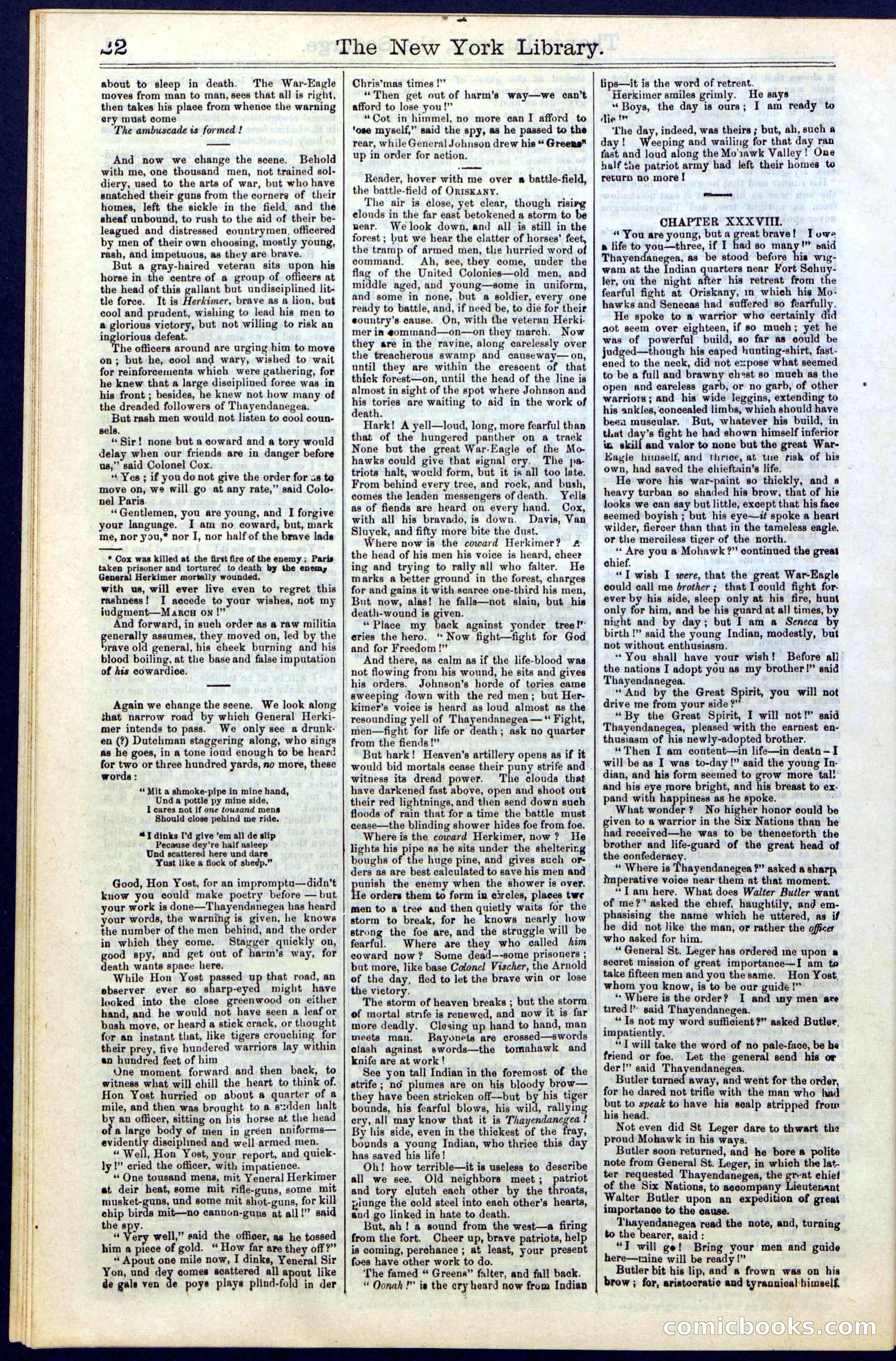
A restored page from Pulp Fiction, 1877. Page through the whole issue in the reader above.
📄 Transcribed text from this page (OCR, searchable)
Machine-transcribed from the original scan — historical spelling and the odd misread are preserved.
about to sleep in death. The War-Eagle moves from man to man, sees that all is right, then takes his place from whence the warning ery must come The ambuscade is formed ! And now we change the scene. Behold with me, one thousand men, not trained sol- diery, used to the arts of war, but who have snatched their guns from the corners of their homes, left the sickle in the field, and the sheaf unbound, to rush to the aid of their be- leagued and distressed countrymen, officered by men of their own choosing, mostly young, rash, and impetuous, as they are brave. But a gray-haired veteran sits upon his horse in the centre of a group of officers at the head of this gallant but undisciplined lit- tle force. It is Herkimer, brave as a lion, but cool and prudent, wishing to lead his men to a glorious victory, but not willing to risk an inglorious defeat. Phe officers around are urging him to move on; but he, cool and wary, wished to wait for reinforcements which were gathering, for he knew that a large disciplined foree was in his front ; besides, he knew not how many of the dreaded followers of Thayendanegea. But rash men would not listen to cool coun- sels. “Sir! none but a coward and a tory would delay when our friends are in danger before us,”’ said Colonel Cox. “ Yes ; if you do not give the order for us te move on, we will go at any rate,” said Colo- nel Paris. “Gentlemen, you are young, and I forgive your language. I am no coward, but, mark me, nor you,* nor I, nor half of the brave lads * Cox was killed at the first fire of the enemy; Paris taken prisoner and torturec to death by the enemy General Herkimer mortally wounded, with us, will ever live even to regret this rashness! I accede to your wishes, not my iudgment—M arcu on !” And forward, in such order as a raw militia finite assumes, they moved on, led by the rave old general, his cheek burning and his blood boiling, at the base and false imputation of his cowardice. Again we change the scene. We look along that narrow road by which General Herki- mer intends to pass. We only see a drunk- en (?) Dutchman staggering along, who sings as he goes, in a tone ioud enough to be heard for two or three hundred yards, no more, these words : “ Mit a shmoke-pipe in mine hand, Und a pottle py mine side, I cares not if one tousand mens Should close pehind me ride, “J dinks I'd give ’em all de slip Pecause dey’re half asleep Und scattered here und dare Yust like a flock of shedp.” Good, Hon Yost, for an impromptu—didn’t know you could make poetry before — but your work is done—Thayendanegea has heard your words, the warning is given, he knows the number of the men behind, and the order in which they come. Stagger quickly on, ood spy, and get out of harm’s way, for death wants space here. While Hon Yost passed up that road, an observer ever 80 FAD. might have looked into the close greenwood on either hand, and he would not have seen a leaf or bash move, or heard a stick crack, or thought for an instant that, like tigers crouching for their prey, five hundered warriors lay within an hundred feet of him Une moment forward and then back, to witness what will chill the heart to think of. Hon Yost hurried on about a quarter of a mile, and then was brought to a szdden halt by an officer, sitting on his horse at the head or a large body of men in gréen nniforms— evidently disciplined and well-armed men. “ Well, Hon Yost, your report, and quick- ly !” eried the officer, with impatience. ‘‘One tousand mena, mit Yeneral Herkimer at deir heat, some mit rifle-guns, some mit musket-guns, und some mit shot-guns, for kill chip birds mit—no cannon-guns at all!” said the spy. ery well,” aaid the officer, as he tossed him a piece of gold. “ How far are they off?” “ Apout one mile now, I dinks, Yeneral Sir Yon, und dey comes scattered all apout like de gale ven de poys plays plind-fold in der —< The N ew York Library. Chris’mas times !”’ “Then get out of harm’s way—we can’t afford to lose you!” “Cot in himmel, no more can I afford to ‘ose myself,” said the spy, as he passed to the rear, while General Johnson drew his “ Greens" up in order for action. Reader, hover with me over a battle-field, the battle-field of Oriskany. The air is close, yet clear, though risirg clouds in the far east betokened a storm to near. We look down, and all is still in the forest ; but we hear the clatter of horses’ feet, the tramp of armed men, the hurried word of command. Ah, see, they come, under the er of the United Colonies—old men, and middle aged, and young—some in uniform, and some in none, but a soldier, every one ready to battle, and, if need be, to die for their eountry’s cause. On, with the veteran Herki- mer in eommand—on—on they march. Now they sre in the ravine, along carelessly over the treacherous swamp and causeway— on, until they are within the crescent of that thick forest—on, until the head of the line is almost in sight of the spot where Johnson and his tories are waiting to aid in the work of death. Hark! A yell—loud, long, more fearful than that of the hungered panther on a track None but the great War-Eagle of the Mo- hawks could give that signal ery. The pa- triots halt, would form, but it is all too late. From behind every tree, and rock, and bush, comes the leaden messengers of death. Yells as of fiends are heard on every hand. Cox, with all his bravado, is down. Davis, Van Sluyck, and fifty more bite the dust. Where now is the coward Herkimer? 4 the head of his men his voice is heard, cheer ing and trying to rally all who falter. He marks a better ground in the forest, charges for and gains it with scarce one-third his men, But now, alas! he falls—not slain, but his death-wound is given. “Place my back against yonder tree!” cries the hero. “ Now fight—fight for God and for Freedom!” And there, as calm as if the life-blood was not flowing from his wound, he sits and gives his orders. Johnson’s horde of tories came sweeping down with the red men; but Her- kimer’s voice is heard as loud almost as the resounding yell of Thayendanegea — “ Fight, men—fight for life or death; ask no quarter from the fiends!” But hark! Heaven's artillery opens as if it would bid mortals cease their puny strife and witness its dread power. The clouds thet have darkened fast above, open and shoot out their red lightnings, and then send down such floods of rain that for a time the battle must cease—the blinding shower hides foe from foe. Where is the coward Herkimer, now? He lights his a e as he sits under the sheltering boughs of the huge pine, and gives such or- ders as are best calculated to save his men and unish the enemy when the shower is over. He orders them to form in circles, places twe men to a tree and then quietly waits for the storm to break, for he knows nearly how atrong the foe are, and the struggle will be fearful. Where are they who called him coward now? Sume dead—-some prisoners ; but more, like base Colonel Vischer, the Arnold of the day, fled to let the brave win or lose the victory. The storm of heaven breaks ; but the storm of mortal strife is renewed, and now it is far more deadly. Closing up hand to hand, man meets man. Bayonets are crossed—swords clash against swords—the tomahawk and knife are at work ! See yon tall Indian in the foremost of the atrife ; no plumes are on his bloody brow— they have been stricken off—but by his tiger bounds, his fearful blows, his wild, rallying ery, all may know that it is Thayendanegea! By his side, even in the thickest of the fray, bounds a young Indian, who thrice this day has saved his life! Oh! how terrible—it is useless to describe all we see. Old neighbors meet; patriot and tory clutch each other by the throats, piunge tlie cold steel into each other's hearts, and go linked in hate to death. But, ah! a sound from the west—a firing from the fort. Cheer up, brave patriots, help is coming, perchance ; at least, your present foes have other work to do. The famed “ Greena” falter, and fall back. “ Oonah !" ia the cry heard now from Indian ~ lips—it is the word of retreat. Herkimer smiles grimly. He says “ Boys, the day is ours; I am ready to ‘lie '" ‘The day, indeed, was theirs ; but, ah, such a day ! Wee ing and wailing for that day ran fast and loud along the Mo1awk Valley! One half the patriot army had left their homes to returp no more | CHAPTER XXXVIII. “You are young, but a Eo brave! Tuwe a life to you—three, if I had so many!” paid Thayendanegea, as be stood before his wig- wam at the Indian quarters near Fort Schuy- ler, on the night after his retreat from the fearful fight at Oriskany, 1n which his Mo- hawks and Senecas had suffered so fearfully. He spoke to a warrior who certainly did aot seem over eighteen, if so much; yet he was of powerful build, so far as could be judged—though his eaped hunting-shirt, fast- cea to the neck, did not expose what seemed to be a full and brawny chest so much as the open and eareless garb, or no garb, of other warriors; and his wide leggins, extending to his ankles, concealed limbs, which should have been muscular. But, whatever his build, in that day’s fight he had shown himself inferior ia skill and valor to none but the great War- Kagle himself, and thrice, at tue risk of his own, had saved the chieftain’s life. He wore his war-paint so thickly, and a heavy turban so shaded his brow, that of hie looks we can say but little, except that his face seemed boyish ; but his eye—it spoke a heart wilder, fiercer than that in the tameless eagle, or the merciless tiger of the north. ‘* Are you a Mohawk ?” continued the great chief. “T wish I were, that the great War-Eagle could call me brother; that I could fight for- ever by his side, sleep only at his fire, hunt only for him, and be his guard at all times, by night and by day; but I am a Seneca by birth !” said the young Indian, modestly, but not without enthusiasm. ‘You shall have your wish! the nations I adopt you as my brother!” said Thayendanegea. “And by the Great Spirit, you will not drive me from your side ?” “By the Great Spirit, I will not!” said Thayendanegea, pleased with the earnest en- thusiasm of his newly-adopted brother. “Then I am content—in life—in deatn-I will be as I was to-day!” said the young In- dian, and his form seemed to grow more tal! and his eye more bright, and his breast to ex- pand with happiness as he spoke. What wonder? No higher honor could be a to a warrior in the Six Nations than he iad received—he was to be thencetorth the brother and life-guard of the great head of the confederacy. “ Where is Piinyehdandyie »” asked a sharp, imperative voice near them at that moment. “Tam here. What does Walter Butler want of me?” asked the chief, haughtily, and em- as the name which he uttered, as if e did not Jike the man, or rather the officer who asked for him. “General St. Leger has ordered me upon a secret mission of great importance—I am ta take fifteen men and you thesame. Hon Yost, whom you know, is to be our guide !” ‘*: Where is the order? I and any men are tired!” said Thayendanegea. _ “Is not my word sufficient?” asked Butler, impatiently. “I will take the word of no pale-face, be he friend or foe. Let the general send his or der!” said Thayendanegea. Butler turned away, and went for the order, for he dared not trifle with the man who had but to speak to have his sealp stripped from his head. Not even did St Leger dare to thwart the proud Mohawk in his ways. Butler soon returned, and he bore a polite note from General St. Leger, in which the lat- ter requested Thayendanegea, the ha chief of the Six Nations, to accompany Lieutenant Walter Butler upon an expedition of great importance to the cause. Thayendanegea read the note, and, turning to the bearer, said : “T will ge! Bring your men and guide here—mine will be ready!” Butler bit his lip, and a frown was on his brow ; for, ariatocratio and tyrannical himself. Before al) Gomicboo CS Eo) =}