
Pulp Fiction, 1881 · page 14 of 24
Beadle's Dime Library, No. 139 — page 14: what you’re looking at
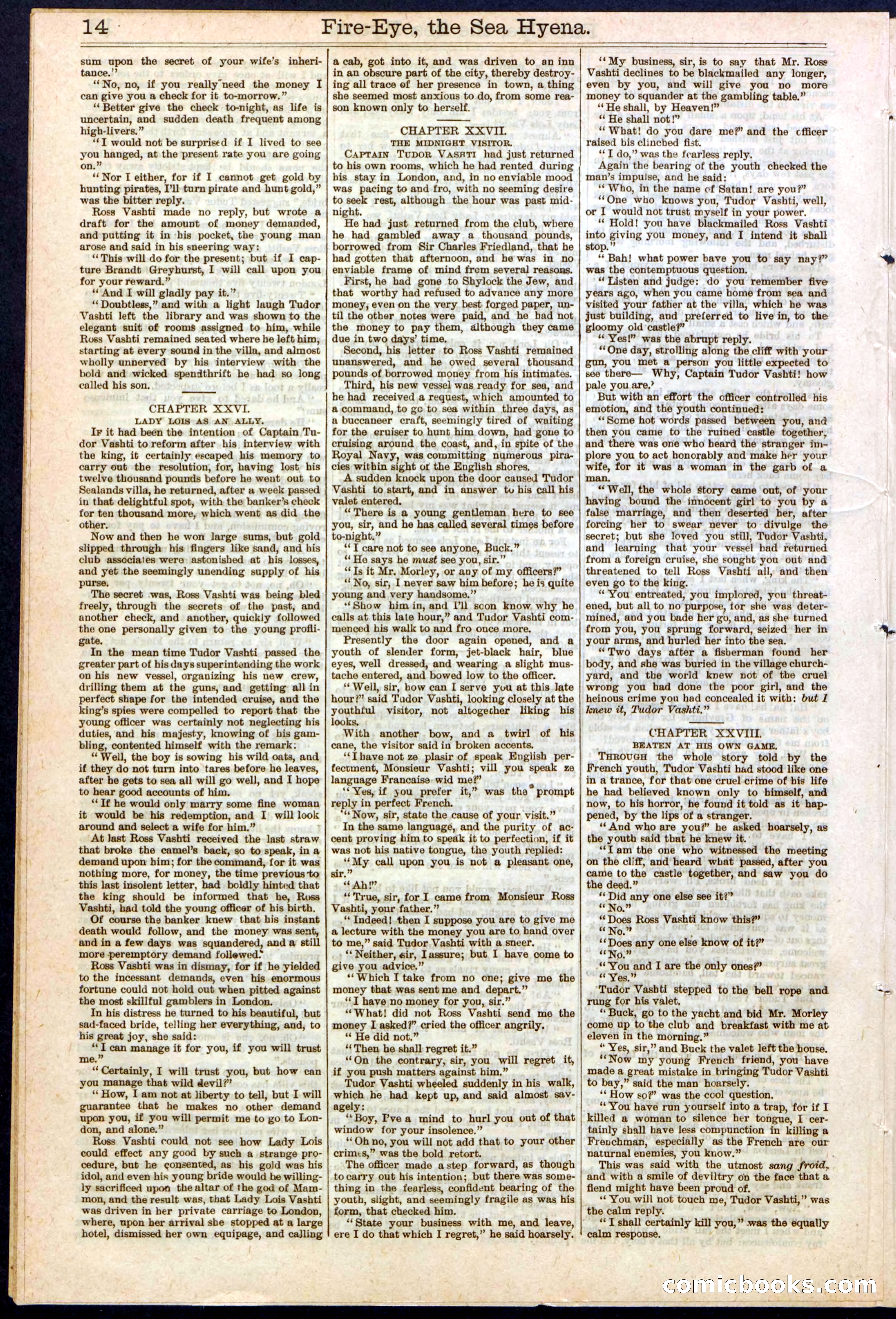
A restored page from Pulp Fiction, 1881. Page through the whole issue in the reader above.
📄 Transcribed text from this page (OCR, searchable)
Machine-transcribed from the original scan — historical spelling and the odd misread are preserved.
PD ns eee 14. — = ee a sum upon the secret of your wife’s inheri- tance.’’ ‘‘No, no, if you really need the money I can give you a check for it to-morrow.” “Better give the check to-night, as life is uncertain, and sudden death frequent among high-livers.” ‘*T would not be surprised if I lived to see you hanged, at the present rate you are going on.” ‘Nor I either, for if I cannot get gold by hunting pirates, I’ll turn pirate and hunt gold,” was the bitter reply. Ross Vashti made no reply, but wrote a draft for the amount of money demanded, and putting it in his pocket, the young man arose and said in his sneering way: “This will do for the present; but if I cap- ture Brandt Greyhurst, I will call upon you for your reward.” ** And I will gladly pay it.” “Doubtless,” and with a light laugh Tudor Vashti left the library and was shown to the elegant suit of rooms assigned to him, while Ross Vashti remained seated where he left him, starting at every sound in the villa, and almost wholly unnerved by his interview with the bold and wicked spendthrift be had so long called his son. CHAPTER XXVI. LADY LOIS AS AN ALLY. Ir it had beén the intention of Captain Tu- dor Vashti to reform after his interview with the king, it certainly escaped his memory to carry out the resolution, for, having lost his twelve thousand pounds before he went out to Sealands villa, he returned, after a week passed in that delightful spot, with the banker’s check for ten thousand more, which went as did the other. Now and then he won large sums, but gold slipped through his fingers like sand, and his club associates were astonished at his losses, and yet the seemingly unending supply of his purse, The secret was, Ross Vashti was being bled freely, through the secrets of the past, and another check, and another, quickly followed the one personally given to the young profli- gate. In the mean time Tudor Vashti passed the greater part of his days superintending the work on his new vessel, organizing his new crew, drilling them at the guns, and getting all in perfect shape for the intended cruise, and the king’s spies were compelled to report that the young officer was certainly not neglecting his duties, and his majesty, knowing of his gam- bling, contented himself with the remark: “ Well, the boy is sowing his wild oats, and if they do not turn into tares before he leaves, after he gets to sea all will go well, and I hope to hear good accounts of him. “Tf he would only marry some fine woman it would be his redemption, and I will look around and select a wife for him.” At last Ross Vashti received the last straw that broke the camel’s back, so to speak, in a demand upon him; for the command, for it was nothing more, for money, the time previous ‘to this last insolent letter, had boldly hinted that the king should be informed that he, Ross Vashti, bad told the young officer of his birth. Of course the banker knew that his instant death would follow, and the money was sent, and in a few days was squandered, and a still more peremptory demand follewed> Ross Vashti was in dismay, for if he yielded to the incessant demands, even his enormous fortune could not hold out when pitted against the most skillful gamblers in London. In his distress he turned to his beautiful, but sad-faced bride, telling her everything, and, to his great joy, she said: “I can manage it for you, if you will trust me. “Certainly, I will trust you, but how can you manage that wild devil?’ ‘‘ How, I am not at liberty to tell, but I will guarantee that he makes no other demand upon you, if you will permit me to go to Lon- don, and alone.” Ross Vashti could not see how Lady Lois could effect any good by such a strange pro- cedure, but he consented, as his gold was his idol, and even his young bride would he willing- ly sacrificed upon the altar of the god of Mam- mon, and the result was, that Lady Lois Vashti was driven in her private carriage to London, where, upon ber arrival she stopped at a large hotel, dismissed her own equipage, and cajling Fire-Eye, the Sea Hyena. a cab, got into it, and was driven to an inn in an obscure part of the city, thereby destroy- ing all trace ef her presence in town, a thing she seemed most anxious to do, from some rea- son known only to herself. CHAPTER XXVIL. THE MIDNIGHT VISITOR. Captain Tupor Vasarti had just returned to his own rooms, which he had rented during his stay in London, and, in no enviable mood was pacing to and fro, with no seeming desire to seek rest, although the hour was past mid- night. He had just returned from the club, where he had gambled away a thousand pounds, borrowed from Sir Charles Friedland, that he had gotten that afternoon, and he was in no enviable frame of mind from several reasons. First, he had gone to Shylock the Jew, and that worthy had refused to advance any more money, even on the very best forged paper, un- til the other notes were paid, and he bad not the money to pay them, although they came due in two days’ time. Second, his letter to Ross Vashti remained unanswered, and he owed several thousand pounds of borrowed money from his intimates. Third, his pew vessel was ready for sea, and he had received a request, which amounted to a command, to ge to sea within three days, as a buccaneer craft, seemingly tired of waiting for the eruiser to hunt him down, had gone to cruising around the coast, and, in spite of the Royal Navy, was committing numerous pira- cies within sight or the English shores. A sudden knock upon the door caused Tudor Vashti to start, and in answer tw his call his valet entered. “There is a young gentleman here to see you, sir, and he has called several times before to-night.” **T care not to see anyone, Buck.” “He says he must see you, sir.” “Ts it Mr. Morley, or any of my officers?” ‘“‘ No, sir, I never saw bim before; he is quite young and very handsome,”’ ‘Show himin, and Vl) scon know. why he calls at this late hour,” and Tudor Vashti com- menced his walk to and fro once more, Presently the door again opened, and a youth of slender form, jet-black hair, blue eyes, well dressed, and wearing a slight mus- tache entered, and bowed low to the officer. “Well, sir, how can I serve you at this late hour?” said Tudor Vashti, looking closely at the youthful visitor, not altogecher liking his looks, With another bow, and a twirl of his cane, the visitor said in broken accents, ‘‘Thave not ze plasir of speak English per- fectment, Monsieur Vashti; vill you speak ze language Francaise. wid me?” ‘* Yes, if you prefer it,” was the” prompt reply in perfect French. “Now, sir, state the cause of your visit.” In the same languagé, and the purity of ac- cent proving him to speak it to perfection, if it was not his native tongue, the youth replied: ‘*My call upon you is not a pleasant one, ” as ‘True, sir, for I came from Monsieur Ross Vashti, your father.” ‘* Indeed! then I suppose you are to give me a lecture with the money you are to band over to me,” said Tudor Vashti with a sneer. ‘* Neither, sir, assure; but 1 have come to give you advice.” ‘Which I take from no one; give me the money that was sent me and depart.” ‘] have no money for you, sir.” ‘““What! did not Ross Vashti send me the money I asked?” cried the officer angrily. “* He did not.” ‘Then he shall regret it.” ‘On the contrary, sir, you. will regret it, if you push matters against him,” Tudor Vashti wheeled suddenly in his walk, which he had kept up, and said almost sav- agely: ‘Boy, ’vea mind to hurl you out of that window for your insolence.” ‘Oh no, you will not add that to your other crimes,” was the bold retort. The officer made astep forward, as though tocarry out his intention; but there was some- thing in the fearless, confident bearing of the youth, slight, and seemingly fragile as was his form, that checked him. “State your business with me, and leave, ere I do that which I regret,” he said hoarsely. ** My business, sir, is to say that Mr. Ross Vashti declines to be blackmailed any longer, even by you, and will give you no more money to squander at the gambling table.” “*'He shall, by Heaven!” “He shall not!” “What! do you dare me?” and the cfficer raised bis clinched fist. ‘“*T do,” was the fearless reply. Again the bearing of the youth checked the man’s impulse, and he said: ‘* Who, in the name of Satan! are you?” ‘One who knows you, Tudor Vashti, well, or I would not trust myself in your power. ** Hold! you have blackmailed Ross Vashti into giving you money, and I intend it shall sto ’ “Bah! what power bave you to say nay?” was the contemptuous question. “Listen and judge: do you remember five years ago, when you came home from sea and visited your father at the villa, which he was just building, and preferred to live in, to the gloomy old castle?” “Yes!” was the abrupt reply. “One day, strolling along the cliff with your gun, you met a person you little expected to see there— Why, Captain Tudor Vashti! how pale you are,’ But with an effort the officer controlled his emotion, and the youth continued: *‘Some hot words passed between you, and then you came to the ruined castle together, and there was one who heard the stranger im- plore you to act honorably and make her your wife, for it was a woman in the garb of a man. “Well, the whole story came out, of your having bound the innocent girl to you by a false marriage, and then deserted her, after forcing her to swear never to divulge the secret; but she loved you still, Tudor Vashti, and learning that your vessel bad returned from a foreign cruise, she sougbt you out and threatened to tell Ross Vashti all, and then even go to the king. “You entreated, you implored, you threat- ened, but all to no purpose, tor she was deter- mined, and you bade her go, and, as she turned from you, you sprung forward, seized her in your arms, and hurled her into the sea. “Two days after a fisherman found her body, and she was buried in the village church- yard, and the world knew not of the cruel wropg you had done the poor girl, and the heinous crime you had concealed it with: but J knew it, Tudor Vashti,” CHAPTER XXVIII. BEATEN AT HIS OWN GAME, THROUGH the whole story told. by the French youth, Tudor Vashti had stood like one in a trance, for that one cruel crime of his life he had believed known only to bimself, and now, to his horror, he found it told as it hap- pened, by the lips of a stranger. ‘And who are you?” he asked hoarsely, as the youth said that he knew it.: “‘Tam the one who witnessed the meeting on the cliff, and heard what passed, after you came to the castle together, and saw you do the deed.” ** Did any one else see it?” cc No. ” “Does Ross Vashti know this?’ “No.” ‘ ‘*Does any one else know of it?” ** No. »” “You and I are the only ones?” “ Yes. » Tudor Vashti stepped to the bell rope and rung for his valet, “Buck, go to the yacht and bid Mr. Morley come up to the club and breakfast with me at eleven in the morning.” “ Yes, sir,” and Buck the valet left the house. “Now my young French friend, you have made a great mistake in bringing Tudor Vashti to bay,” said the man hoarsely. ‘* How so?’ was the cool question. “You have run yourself into a trap, for if I killed a woman to silence her tongue, I cer- tainly shall bave less compunction in killing a Frenchman, especially as the French are our naturnal enemies, you know.” This was said with the utmost sang froid, | and with a smile of deviltry on the face that a fiend might have been proud of. ‘You will not touch me, Tudor Vesna. was the calm reply. **T shall certainly kill You: was the equally calm response. Eomichbooks (fe) — 2p . —— ee