
Pulp Fiction, 1881 · page 11 of 24
Beadle's Dime Library, No. 139 — page 11: what you’re looking at
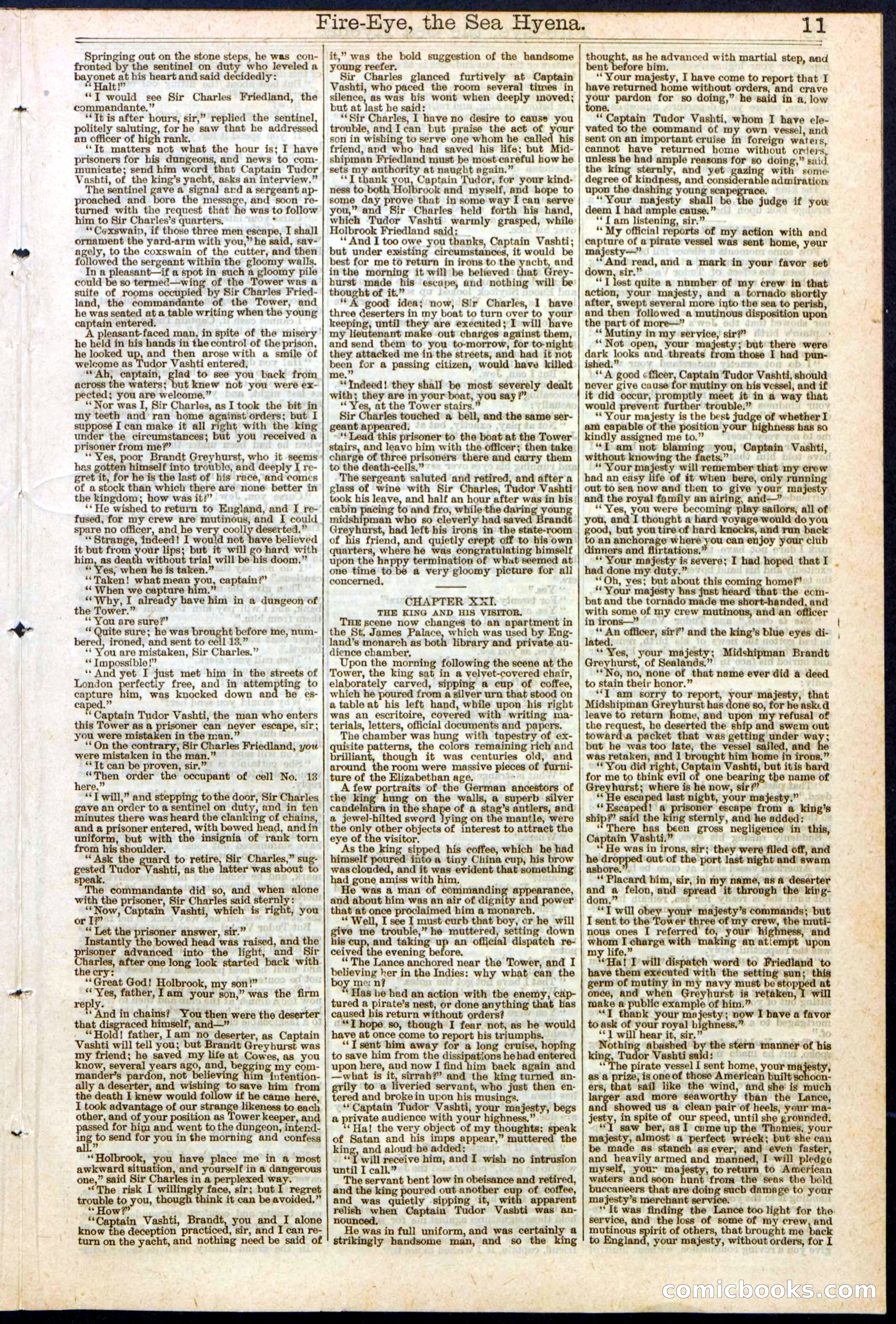
A restored page from Pulp Fiction, 1881. Page through the whole issue in the reader above.
📄 Transcribed text from this page (OCR, searchable)
Machine-transcribed from the original scan — historical spelling and the odd misread are preserved.
ae _— Springing out on the stone steps, he was con- fronted by the sentinel on duty who leveled a bayonet at his heart and said decidedly: ‘ Halt!” ‘“*T would see Sir Charles Friedland, the commandante.” ‘“*Tt is after hours, sir,” replied the sentinel politely saluting, for he saw that he address an Officer of high rank. “Tt matters not what the hour is; I have prisoners for his dungeons, and news to com- municate; send him word that Captain Tudor Vashti, of the king’s yacht, asks an interview.” The sentinel yooh a signal ard a sergeant ap- roached and bore the message, and soon re- urned with the request that he was to follow him to Sir Charles’s quarters. ‘ “*Cexswain, if those three men escape, I shall ornament the yard-arm with you,” he said, sav- agely, to the coxswain of the cutter, and then followed the sergeant within the gloomy walls. In a pleasant—if a spot in such a gloomy pile could be so termed—wing of the Tower was a suite of rooms occupied by Sir Charles Fried- land, the commandante of the Tower, and he was seated at a table writing when the young captain entered. A pleasant-faced man, in spite of the misery he held in his hands in the control of the prison, he looked up, and then arose with a smile of welcome as Tudor Vashti entered, **Ah, captain, glad to see you back from across the waters; but knew not you were ex- pected; you are welcome.” ** Nor was I, Sir Charles, as I took the bit in my teeth and ran home against orders; but I sup Ican make it all right with the king under the circumstances; but you received a prisoner from me?” ‘Yes, poor Brandt Greyhurst, who it seems has gotten himself into troublo, and deeply I re- gret it, for he is the last of his rece, and comes of a stock than which there are none better in the kingdom; how was it?” ‘* He wished to return to England, and I re- fused, for my crew are mutinous, and [ could spare no officer, and he very coolly deserted.” ‘** Strange, indeed! I would not have believed it but from your lips; but it will go hard with him, as death without trial will be his doom.” “ Yes, when he is taken.” “Taken! what mean you, captain?” ** When we capture him.” ‘“Why, I already bave him in a dungeon of the Tower.” ‘**'You are sure?’ ** Quite sure; he was brought before me, num- berec L ironed, and sent to cell 13.” ‘* You are mistaken, Sir Charles.” ** Impossible!” ‘* And yet I just met him in the streets of London perfectiy free, and in attempting to capture im, was knocked down and he es- ca ‘Captain Tudor Vashti, the man who enters this Tower as a prisoner can never escape, sir; rn the contrary sir Charles Friedlan ' con ar were mistaken in the man.” ny see **Tt can be proven, sir.” ‘ “Then order the occupant of cell No. 138 ere, ‘*]T will,” and stepping tothe door, Sir Charles gave an order to a sentinel on duty, and in ten minutes there was heard the clanking of chains, and a prisoner entered, with bewed head, andin uniform, but with the insignia of rank torn from his shoulder. “Ask the to retire, Sir Charles,” sug- gested Tudor Vashti, as the latter was about The commandante did so, and when alone with the prisoner, Sir Charles said sternly: apne Captain Vashti, which is right, you or “* Let the prisoner answer, sir.” Instantly the bowed head was raised, and the er advanced into the light, and Sir harles, after one long look started back with the ery: ‘Great God! Holbrook, my son!” “Yes, father, Iam your son,” was the firm reply. . ‘And in chains? You then were the deserter that Se ara himself, and—” “Hold! father, lam no deserter, as Captain Vashti will tell you; but t Greyburst was my Spel, saved my life % Cowes, as you OW, sev ears ago, an ng my com- mander’s pardon, not Polteving in intuition. ally a deserter, and wishing tosave him from the death I knew would follow if he came here, I took advantage of our swrenge likeness to each other, and of your position as Tower keeper, and for him and went to the dungeon, intend- in to send for you in the morning and confess ‘Holbrook, you have place me in a most awkward situa woes yourself in a dangerous one,” said Sir Charles in a perplexed a ' “he risk I willingly face, sir; but I regret trouble to you, thoug think it can be avoided.” How?” we ptain Vashti, Erenes, you and [I alone know the deception practiced, sir, and I can re- turn on the yacht, and nothing need be said of _ Fire-Hye, the 5 O_o! it,” was the bold suggestion of the handsome young reefer. Sir Charles glanced furtively at Captain Vashti, who paced the room several times in silence, as was bis wont when deeply moved; but at last he said: “Sir Charles, 1 have no desire to cause you trouble, and I can but praise the act of your son in wishing to serve one whom he called his friend, and who had saved his life; but Mid- shipman Friedland must be most careful how he sets my authority at naught again.” ‘*I thank you, Captain Tudor, for your kind- ness to both Holbrook and myself, and hope to some day prove that in some way I can serve you,” and Sir Charles held forth his hand, which Tudor Vashti warmly grasped, while Holbrook Friedland said: ‘* And I too owe you thanks, Captain Vashti; but under existing circumstances, it would be best for me to return in irons to the yacht, and inthe morning it will be believed that Grey- hurst made his escape, and nothing will thought of it.” “A good idea; now, Sir Charles, I have three deserters in my boat to turn over to your keeping, until they are executed; I will have my lieutenant make out charges against them and send them to you to-morrow, for to-night they attacked me in the streets, and had it not been for a passing citizen, would have killed me,’ “‘Indeed! they shall be most severely dealt with; they are in your boat, you say?” ** Yes, at the Tower stairs. Sir Charles touched a bell, and the same ser- geant appeared. ‘** Lead this prisoner to the boat at the Tower stairs, and leavo him with the officer; then take charge of three prisoners there and carry them to the death-cells.” The sergeant saluted and retired, and after a glass of wine with Sir Charles, Tudor Vashti took his leave, and half an hour after was in bis cabin ——- to and fro, while-the daring young midshipman who so cleverly had saved Brandt Greyhurst, had left his irons in the state-room of his friend, and quietly crept off to his own quarters, where he was congratulating himself upon the happy termination of whut seemed at one time to be a very gloomy picture for all concerned, CHAPTER XI. THE KING AND HIS VISITOR. THE scene now changes to an apartment in the St, James Palace, which was used by Eng- land’s monarch as both library and private au- dience chamber, Upon the morning following the scene at the Tower, the king sat in a velvet-covered chair, elaborately carved, sipping a cup of coffee, whieh he poured from a silver urn that stood on a table at his left hand, while upon his right was an escritoire, covered with writing ma- terials, letters, official documents and papers. The chamber was hung with tapestry of ex- quisite patterns, the colors remaining rich and Hrillians,. though it was centuries old, and around the room were massive pieces of furni- |. ture of the Elizabethan age. A few portraits of the German ancestors of the a oe on the walls, a superb silver candelabra in the vn of a stag’s antlers, and a jewel-hilted sword lying on the mantle, were the only other objects of interest to attract the eye of the visitor. As the king sipped his coffee, which he had himself poured into a tiny China cup, his brow was clouded, and it was evident that something had gone amiss with him. He was a man of commanding Seperence, and about him was an air of dignity and power that at once proclaimed him a monarch. ““' Well, I see [ must curb that boy, or he will at me ea he peter A cup, a ng up an 0 pa re- ceived the evening belie “* The Lance anchored near the Tower, and I believing her in the Indies: why what can the boy me: nf? | ‘Has be hed an action with the enemy, cap- tured a pirate’s nest, or done anything that has caused bis return without orders? “T hope so, though I fear not, as he would have at once come to report his triumphs. “‘T sent him away for a long cruise, hoping to save him from the dissipations he had ente upon here, and now I find him back again and —what is it, sirrah?’ and the king tarned an- grily to a liveried servant, who just then en- tered and brokein upon his musings. ‘*Captain Tudor Vashti, your majesty, begs a private audience with your highness,” ‘Ha! the very object of my thoughts: ak of Satan and his imps appear,” mu the king, and aloud he added; ‘“*T will receive him, and I wish no intrusion until I call.” The servant bent low in obeisance and retired, and the king poured out another cup of coffee, and was quietly sipping it, with apparent relish when Captain Tudor Vasbti was an- nounced. He was in full uniform, and was certainly a strikingly handsome man, and so the king ea Hyena. Le, thought, as he advanced with martial step, and bent before bim. “Your majesty, I have come to report that I have returned home without orders, and crave our pardon for so doing,” he said in a, low ne. “Captain Tudor Vashti, whom I have ele- vated to the command of my own vessel, and sent on an important cruise foreign waters, cannot have returned home without orders unless he had ample reasons for so doing,” said the king sternly, and yet gazing with some degree of kindness, and considerable admiration. upon the dashing young oo ‘Your majesty shall be the judge if you deem I had ample cause.” ‘* f am listening, sir.” ** My official reports of my action with and —_ of a pirate vessel was sent home, your majesty— ‘*‘And read, and a mark in your favor set down, sir.” “T Jost quite a number of my crew in that action, your majesty, and a tornado sbortly after, swept several more into the sea to perish and then followed a mutinous disposition upon the of more—” ‘“* Mutiny in my service, sir?” ‘ ‘‘Not open, your majesty; but there were dark looks and threats from those I had pun- ished.” ‘A good ¢fiicer, Captain Tudor Vashti, should never give cause for mutiny on his vessel, and if it did occur, promptly meet it in a way that would prevent further trouble.” “Your majesty is the best judge of whether I am capable of the position your has so kindly assigned me to.” yous Captain Vashti, Ss. “T am not blamin without knowing the “Your majesty will remember that my crew had an easy life of it when bere, only running out to sea now and then to give your majesty and the royal family an airing, and—” ‘Yes, you were becoming play sailors, all of you, and I thought a hard voyage would do you good, but you tire of hard knocks, and run back an anchorage where you can enjoy your club “oO or a sfestiy da be I had hoped that I ‘Your ma 8 severe} that had done my duty.” xo ‘*Oh, yes; but about this coming home?” “Your majesty has just heard that'the com- bat and the tornado made me short-handed, and with some of my crew mutinous, and an r in irons—” i —— officer, sir?’ and the king’s blue eyes “ Yes, our majesty; Midshipman Brandt Gesvnuree of Soalenas” ‘No, no, none of that name ever did a deed to yh their + ol ‘**I1 am sorry to report, your majesty, that Midshipman Greyhurst has done so, for he asked leave to return home, and yee my refusal of the request, he deserted the ship swem out toward.a packet that was getting under pe but he was too late, the vessel , and was retaken, and 1 brought him home jn irons.” ‘*You did right, Captain Vashti, but itis bard for me to think evil of one g the name of Gre hurst; ey te aighenye je ee “ e esca your ma { ! Bo arte escape from a king’s ship?” me ng sternly, sense ye hand ’ his, en n ce t cage atta oR, gay He was in irons, sir; they were filed off, and he dropped out of the port last night and swam ashore.’ aden | “Placard him, sir, in my name, as a deserter = a felon, and spread it through the king- ona pn Part “T will ober yor -majesty’s commands; but I sent to the T er hres Of ay crew, the muti- nous ones I referred to, your highness, and whom I charge with making an atiempt upon ‘Ha! I will dispatch word to Friedland to have ebiea emecatid with the setting sun; we germ of mutiny in my navy must be sti A ore onee, and when Greyhurst is retaken, I will make a public example of him.” = ban “I thank your pie ey now I have a favor to ask of your royal bighness.” BeBIIO ‘* 1 will hear it, sir.” Nothing abashed Baty stern manner of king, Tudor Vashti said: + clo * pirate vessel I sent home, your majesty; as a prize, is one of those American built schoon- ers, that sai] like the wind, and she is much an ; ‘% and more seaworthy than the Lance, showed us a clean pair of heels, your ma- Jesty, in spite of our speed, until she grounded, “TI saw I came up the Thanies, your majesty, almost a perfect wreck; but she can be made as stanch as ever, and even faster, and heavily armed and manned, I will pledge myself, your majesty, to return to American waters and soon hunt from the seas the bold buecaneers that sete | sucb damage to your majesty’s merchant se ‘ * It was wees J the Lance too light for the service, and the loss of some of my crew, and mutinous spirit of others, that brought me back to England, your majesty, without orders, for I COMNICLIOO KS ae eS