
Pulp Fiction, 1881 · page 10 of 24
Beadle's New York Dime Library, No. 138 — page 10: what you’re looking at
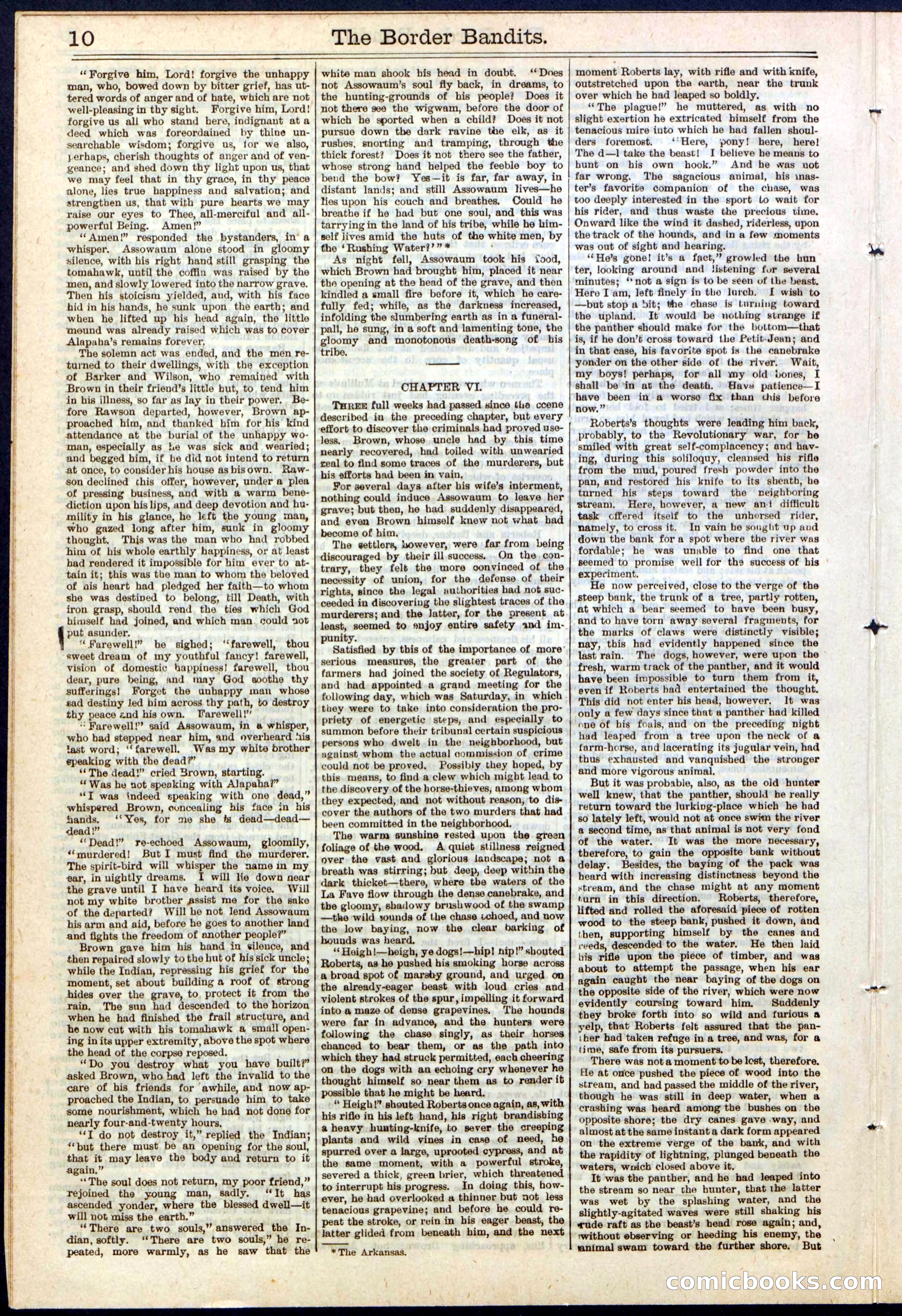
A restored page from Pulp Fiction, 1881. Page through the whole issue in the reader above.
📄 Transcribed text from this page (OCR, searchable)
Machine-transcribed from the original scan — historical spelling and the odd misread are preserved.
| | Hl 1 “Forgive him, Lord! forgive the unhappy man, who, bowed down by bitter grief, has ut- tered words of anger and of hate, which are not. well-pleasing in thy sight. Forgive him, Lord! forgive us ali who stand here, indignant ata deed which was foreordained by thine un- searchable wisdom; forgive us, for we also, perhaps, cherish thoughts of anger and of ven- geance; and shed down thy light upon us, that we may feel that in thy grace, in thy peace alone, lies true bappiness and salvation; and strengthen us, that with pure hearts we may raise our eyes to Thee, all-merciful and all- powerful Being. Amen!” “Amen!” responded the bystanders, in’ a whisper. Assowaum alone stood in gloomy silence, with his right hand still grasping the tomahawk, until the coffin was raised by the men, and slowly lowered into the narrow grave. Then his stoicism yielded, and, with his face hid in his hands, he sunk upon the earth; and when he lifted up his head again, the little mound was already raised which was to cover Alapaha’s remains forever, The solemn act was ended, and the men re- turned to their dwellings, with the exception of Barker and Wilson, who remained with Brown in their friend’s little but, to tend him in his illness, so far as lay in their power. Be- fore Rawson departed, however, Brown ap- proached him, and thanked him for his kind attendance at the burial of the unhappy wo- man, especially as he was sick and wearied; and begged him, if he did not intend to return at once, to consider his house asbisown. Raw- son declined this offer, however, under a plea of pressing business, and with a warm bene- diction upon his lips, and deep devotion and hu- mility in his glance, he left the young man, who gazed long after him, sunk in gloomy thought. This was the man who had robbed him of his whole earthly happiness, or at least had rendered it impossible for him ever to at- tain it; this was the man to whom the beloved of nis heart had pledged her faith—to whom she was destined to belong, till Death, with iron grasp, should rend the ties which God _ himself had joined, and which man. could 20t put asunder. farewell!” be sighed; ‘farewell, thou sweet dream of my youthful fancy! farewell, vision of domestic happiness! farewell, thou dear, pure being, and may God aoothe thy sufferings! Forget the anhappy man whose gad destiny Jed bim across thy path, to destroy thy peace end his own. Tarewell!’’ * Farewell!” said Assowaum, in ® whisper, who had stepped near him, and overheard ‘iis last word; “farewell. Was my white drother epeaking with the dead?” ‘*The dead!” cried Brown, starting. “Was he not speaking with Alapaha?” “T was indeed speaking with one dead,” whispered Brown, ooncealing bis face in his Hands. ‘‘Yes, for me she ts dead—dead— dead!” ‘‘Dead!” re-echoed Assowaum, gloomily, “murdered! But I must find the murderer. The spirit-bird will whis the name in my ear, in nightly dreams. will lie down near the grave until I have heard its voice. Will not my white brotber assist me for the sake of the departed? Will he not lend Assowaum his arm and aid, before he goes to another land and fights the freedom of another people?” Brown gave him his hand in silence, and then repaired slowly to the hut of his sick uncle; while the Indian, repressing his grief for the moment, set about building a roof of strong hides over the grave, to. protect it from the rain, The sun had descended to the horizon when he had finished the frail structure, and he now cut with his tomahawk a small open- ing in its upper extremity, above the spot where the head of the corpse reposed. Do you destroy what you have built?” asked Brown, who had left the invalid to the eare Of his friends for awhile, and now ap- proached the Indian, to persuade him to take some nourishment, which he had not done for nearly four-and-twenty hours, “I do not destroy it,” replied the Indian; **but there must be an opening for the soul, that it may leave the body and return to it again,” . ‘The soul does not return, my poor friend,” Tejoined the young man, sadly. “It has ascended yonder, where the blessed dwell—it will not miss the earth.” “There are two souls,” answered the In- dian, softly. ‘“‘There are two souls,” he re- peated, more warmly, as he saw that the The Border Bandits. white man shook his head in doubt. ‘* Does not Assowaum’s soul fly back, in dreams, to the hunting-grounds of his people? Does it not there see the wigwam, before the door of which he sported when a child? Does it not pursue down the dark ravine the elk, as it rushes, snorting and tramping, through the thick forest? Does it not there see the father, whose strong hand helped the feeble boy to bend the bow? Yes—it is far, far away, in distant lands; and still Assowaum lives—he lies upon his couch and breathes. Could he breathe if he had but one soul, and this was tarrying in the land of his tribe, while he him- self lives amid the huts of the white men, by the ‘Rushing Water?’” * : As night fell, Assowaum took his food, which Brown had brought him, placed it near the opening at the head of the grave, and then kindled a small fire before it, which he care- fully fed; while, as the darkness increased, infolding the slumbering earth as in a funeral- pall, he sung, in a soft and lamenting tone, the gloomy and monotonous death-song of his tribe, CHAPTER VI. THREE full weeks had passed since thea ccene described in the preceding chapter, but every effort to discover the criminals had proved use- less. Brown, whose uncle had by this time nearly recovered, had toiled with unwearied real to find some traces of the murderers, but his efforts had been in vain, Yor several days after bis wife’s interment, nothing could induce Assowaum to leave her grave; but then, he had suddenly disappeared, and even Brown himself knew not what had become of him. The settlers, Lowever, were far from being discouraged by their ill success, On the con- trary, they fels the more convinced of the necessity of union, for the defense of their rights, since the legal suthorities had not suc- ceeded in discovering the slightest traces of the murderers; and the Jatter, for the present at least, seemed to enjoy entire safety and im- punity. Satisfied by this of the importance of more’ serious measures, the greater part of the farmers had joined the society of Regulators, and had appointed a grand meeting for the following day, which was Saturday, in which they were to take into consideration the pro- priety of energetic steps, and especially to summon before their tribunal certain suspicious persons who dwelt in the neighborhood, but against whom the actual commission of crime could not be proved, Possibly they hoped, by this means, to find a clew which might lead to the discovery of the horse-thieves, among whom they expected, and not without reason, to dis cover the authors of the two murders that had been committed in the neighborhood, The warm sunshine rested upon the green foliage of the wood, A quiet stillness reigned over the vast and glorious landscape; not a breath was stirring; but deep, deep within the dark thicket—there, where tbe waters of the La Fave flow through the dense canebrake, and the gloomy, shadowy brnshwood of the swamp —the wild sounds of the chase echoed, and now the low baying, now the clear barking of hounds was heard, “ Heigh!|—heigh, ye dogs!—hip! nip!” shouted Roberts, as he pushed his smoking horse across a broad spot of marshy ground, and urged on the already-eager beast with loud cries and violent strokes of the spur, impelling it forward into a maze of dense grapevines. The hounds were far in advance, and the hunters were following the chase singly, as their horses chanced to bear them, or as the path into which they had struck permitted, each cheering on the dogs with an echoing cry whenever he thought himself so near them as to render it possible that he might be heard. _“ Heigh!” shouted Roberts once again, as, with his rifle in his left hand, his right brandisbing a heavy hunting-knife, to sever the creeping plants and wild vines in case of need, he spurred over a large, uprooted cypress, and at the same moment, with a powerful stroke, severed a thick, green brier, which threatened to interrupt his progress. In doing this, how- ever, he had overlooked a thinner but not less tenacious grapevine; and before he could re- peat the stroke, or rein in bis eager beast, the ‘latter glided from beneath him, and the next *The Arkansas. ear eee ees nee ne ee eee UaEnUEE NEE SeEnEEEEEEEEEOEEET ee moment Roberts lay, with rifle and with knife, outstretched upon the earth, near the trunk over which he had leaped so boldly. “The plague!” he muttered, as with no slight exertion he extricated himself from the tenacious mire into which he had fallen shoul- ders foremost. ‘ Here, pony! here, here! The d—1 take the beast! I believe he means to hunt on his own hook.” And he was not far wrong. The sagacious animal, his inas- ter’s favorite companion of the chase, was too deeply interested in the sport Lo wait for his rider, and thus waste the precious time. Onward like the wind it dashed, riderless, upon the track of the hounds, and in a few moments was out of sight and hearing. ‘‘He’s gone! it’s a fact,” growled the hun ter, looking around and listening fur several minutes; ‘*not a sign is to be seen of the beast, Here I am, left finely in the lureb. I wish to —but stop a bit; the chase is turning toward the upland. It would be nothing strange if the panther should make for the bottom—that is, if he don’t cross toward the Petit-Jean; and in that case, his favorite spot is the canebrake yonder on the other side of the river. Wait, my boys! perhaps, for all my old bones, I shall be ‘in at the death. Gave patience—I have been in a worso fix than this before now.” Roberts’s thoughts were leading him back, probably, to the Revolutionary war, for he smiled with great self-complacency; and hav- ing, during this soliloquy, cleansed his rifle from the mud, poured fresh powder into the pan, and restored his knife to its sheath, he turned his steps toward the neighboring stream. Here, however, a new ant difficult task cffered itself to the wunhorsed rider, namely, to cross it. In vain he sought up and down the bank fora spot where the river was fordable; he was unnble to find one that seemed to promise well for ths success of bis experiment. He now perceived, close to the verge of the steep bank, the trunk of a tree, partly rotten, at which a bear seemed to have been busy, and to have torn away several fragments, for the marks of claws were distinctly visible; nay, this had evidently happened since the last rain. The dogs, however, were upon the fresh, warm track of the panther, and it would have been impossible to turn them from it, even if Roberts had entertained the thought. This did not enter his head, however. It was only a few days since that a panther had killed ene of bis fouls, and on the preceding night had leaped from a tree upon the neck of a farm-horse, and lacerating its jugular vein, had thus exhausted and vanquished the stronger and more vigorous animal. But it was probable, also, as the old hunter well knew, that the panther, should he really return toward the lurking-place which he had so lately left, would not at once swim the river a second time, as that animal is not very fond of the water. It was the more necessary, therefore, to gain the opposite bank witbout delay. Besides, the baying of the pack was heard with increasing distinctness beyond the stream, and the chase might at any moment turn in this direction. Roberts, therefore, lifted and rolled the aforesaid piece of rotten wood to the steep bank, pushed it down, and then, supporting bimself by the canes and ceeds, descended to the water. He then laid bis rifle upon the piece of timber, and was about to attempt the passage, when his ear again caught the near baying of the dogs on the opposite side of the river, which were now evidently coursing toward him. Suddenly they broke forth into so wild and furious a yelp, that Roberts felt assured that the pan- iber had taken refuge in a tree, and was, for a time, safe from its pursuers. There was nota moment to be lest, therefore. fle at once pushed the piece of wood into the stream, and had passed the middle of the river, though he was still in deep water, when a crashing was heard among the bushes on the opposite shore; the dry canes gave way, and almost at the same instant a dark form appeared on the extreme verge of the bank, and with the rapidity of lightning, plunged beneath the waters, woich closed above it, It was the panther, and he had leaped into the stream so near the hunter, that the latter was wet by the splashing water, and the slightly-agitated waves were still shaking his wude raft as the beast’s head rose again; and, without ebserving or heeding his enemy, the animal swam toward the further shore. But Gomicboo C ‘Ss (0) (E