
Pulp Fiction, 1881 · page 3 of 32
Beadle's New York Dime Library, No. 137 — page 3: what you’re looking at
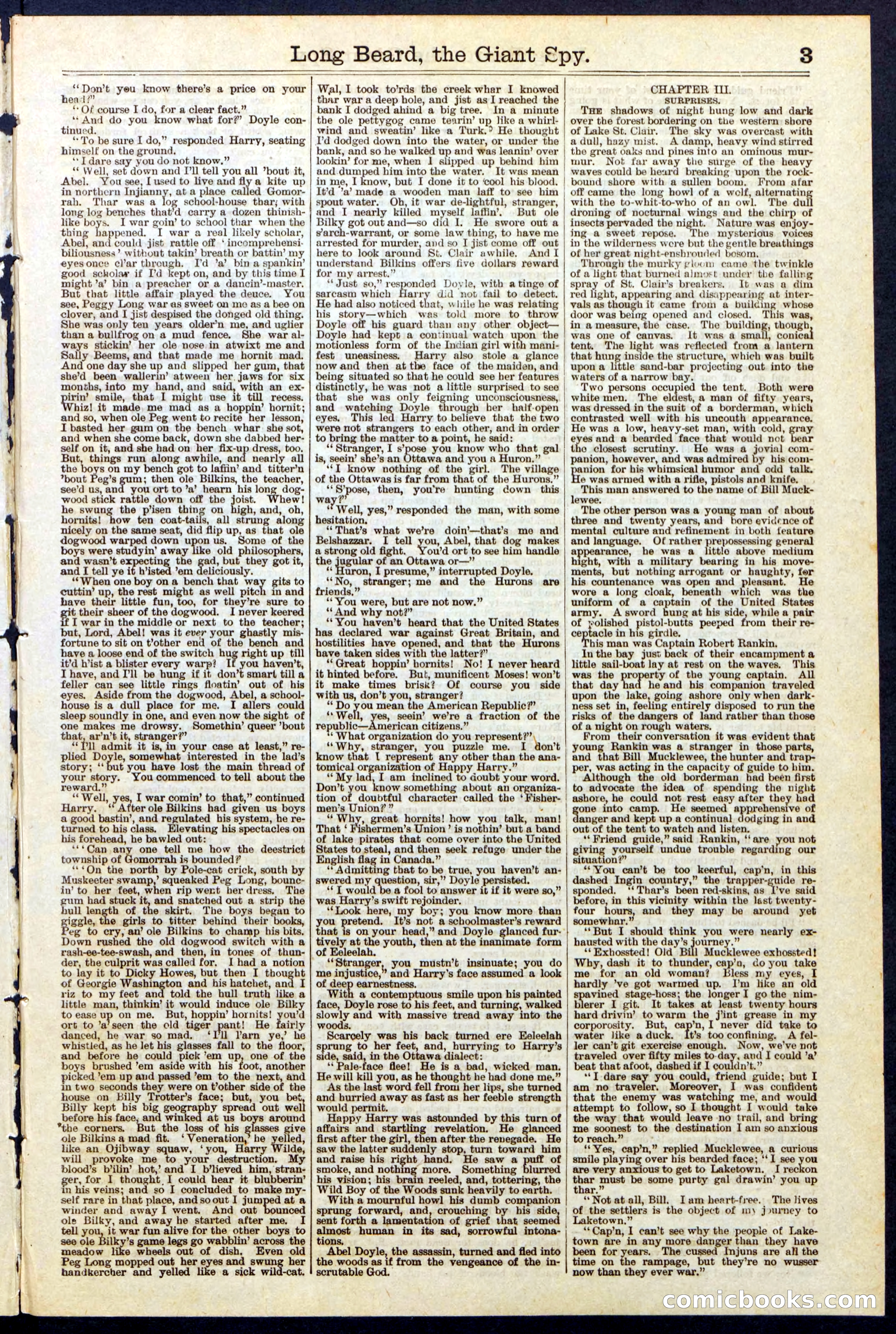
A restored page from Pulp Fiction, 1881. Page through the whole issue in the reader above.
📄 Transcribed text from this page (OCR, searchable)
Machine-transcribed from the original scan — historical spelling and the odd misread are preserved.
— —— —_____-- —_ ‘*Don’t yeu know there’s a price on your head?” ‘** Of course I do, for a clear fact.” ‘*‘And do you know what for?’ Doyle con- tinued. ‘To be sure I do,” responded Harry, seating himself on the ground, ‘‘ I dare say you do not know,” ** Well, set down and [ll tell you all ’bout it, Abel. You see, I used to live and flya kite up in northern Injianny, at a place called Gomor- rah. Thar was a log school-house thar; with long log benches that’d carry a dozen thinish- like boys. I war goin’ to school thar when the thing earned. I war a real likely scholar, Abel, and could jist rattle off ‘ incomprebhensi- biliousness’ without takin’ breath or battin’ my eyesonce cl’ar through. I'd ’a’ bin a spankin’ good scholar if Td kept on, and by this time I might ’a’ bin a preacher or a dancin’-master. But that little affair played the deuce. You see, Peggy Long war as sweet on me as a bee on clover, and I jist despised the donged old thing. She was only ten years older’n me, and uglier than a bullfrog on a mud fence, She war al- ways stickin’ her ole nose in atwixt me and Sally Beems, and that made me hornit mad. And one day she up and slipped her gum, that she’d been wallerin’ atween her. jaws for six months, into my hand, and said, with an ex- irin’ smile, that I might use it till recess. hiz! it made me mad as a hoppin’ hornit; and so, when ole Peg went to recite her lesson, I basted her gum on the bench whar she sot, and when she come back, down she dabbed her- self on it, and she had on her fix-up dress, too. But, things run along awhile, and nearly all the boys on my bench got to lafiin’ and titter’n *bout Peg’s gum; then ole Bilkins, the teacher, see’d us, and you ort to ’a’ hearn his long dog- wood stick rattle down off the joist. hew! he swung the p’isen thing on high, and, oh, hornits! how ten coat-tails, all strung along nicely on the same seat, did flip up, as that ole dogwood warped down upon us. Some of the boys were studyin’ away like old philosophers, and wasn’t expecting the gad, but they got it, and I tell ye it h’isted ’em deliciously. ‘*When one boy ona bench that way gits to cuttin’ up, the rest might as well pitch in and have their little fun, too, for they’re sure to git their sheer of the dogwood. I never keered if I war in the middle or next to the teacher; but, Lord, Abel! was it ever your ghastly mis- fortune to sit on t’other end of the bench and have a loose end of the switch hug right up till it’d hist a blister every warp? If you haven’t, Ihave, and ll be bung if it don’t smart till a feller can see little rings floatin’ out of his eyes. Aside from the dogwood, Abel, a school- house is a dull place for me. I allers could sleep soundly in one, and even now the sight of one makes me drowsy. Somethin’ queer ’bout that, ar’n’t it, stranger?” “Tl admit it is, im your case at least,” re- plied Doyle, somewhat interested in the lad’s story; ‘‘ but you have lost the main thread of your story. You commenced to tell about the reward.” ‘“ Well, yes, I war comin’ to that,” continued Harry. ‘ After ole Bilkins had given us boys a good bastin’, and regulated his system, he re- turned to his class. Elevating his spectacles on his forehead, he bawled out: ‘**Can any one tell me how the deestrict township of Gomorrah is bounded? ‘**On the vorth by Pole-cat crick, south by Muskeeter swamp,’ squeaked Peg Long, bounc- in’ to her feet, when rip wert her dress, The gum had stuck it, and snatched out a strip the bull | h of the skirt. The boys began to gigsle, girls to titter behind their books, eg to ery, an’ ole Bilkins to champ his bits, Down rushed the old dogwood switch with a rash-ee-tee-swash, and then, in tones of thun- der, the culprit was called for, to lay it to Dicky Howes, but then I thought of Georgie Washington and his hatchet, and I riz to my feet and told the bull truth like a little man, thinkin’ it would induce ole Bilky to ease up on me. But, hoppin’ hornits! you’d ort to ’a’seen the old tiger pant! He fairly danced, he war so mad, ‘Ill Varn ye,’ he whistled, as he let his glasses fall to the floor, and before he could pick ’em up, one of the boys brushed ’em aside with his foot, another picked ’em up and passed ’em to the next, and in two seconds they were on t’other side of the house on Billy Trotter’s face; but, you bet Billy kept his big geo ot a spread out w before his face, and wi at us boys around *the corners. But the loss of his g ive ole Bilkins a mad fit. ‘ Veneration,’ he yelled, like an Ojibway squaw, ‘you, Harr ilde, will provoke me your destruction. My blood’s b’ilin’ hot,’ and I b’lieved him, stran- ger, for I thought I could hear it blubberin’ in his veins; and so I concluded to make my- self rare in that place, and soout I jumped at a winder and away I went. And out ced ole Bilky, and away he started after me. I Soll | aipllnory pae atin 8 paras see ole Bilky’s game go wa across g mopped o e d sw er Reateercbas and yelled like a sick wild-cat. I had a notion | Wal, I took to’rds the creek whar I knowed thar war a deep hole, and jist as I reached the bank I dodged ahind a big tree. In a minute the ole pettygog came tearin’ up like a whirl- wind and sweatin’ like a Turk.? He thought I’d dodged down into the water, or under the bank, and so he walked up and was leanin’ over lookin’ for me, when I slipped up behind him and dumped him into the water. It was mean in me, I know, but I done it to cool his blood. It’d ’a’ made a wooden man laff to see him spout water. Ob, it war de-lightful, stranger, and I nearly killed myself laffin’. But ole Bilky got out and—so did I. He swore out a s’arch-warrant, or some law thing, to have me arrested for murder, and so | jist come off out here to look around St. Clair awhile. And I[ understand Bilkins offers five dollars reward for my arrest.” ** Just so,” responded Doyle, with a tinge of sarcasm which Harry did not fail to detect. He had also noticed that, while he was relating his story—which was told more to throw Doyle off bis guard than any other object— Doyle had kept a continual watch u motionless form of the Indian girl with mani- fest uneasiness. Harry also stole a glance now and then atthe face of the maiden, and being situated so that he could see ber features | distinctly, he was not a little surprised to see that she was only feigning unconsciousness, and watching Doyle through her half-open eyes. This led Harry to believe that the two were not strangers to each other, and in order to bring the matter to a point, he said: ‘Stranger, I s’pose you know who that gal is, seein’ she’s an Ottawa and you a Huron.” ‘‘I know nothing of the girl. The village of the Ottawas is far from that of the Hurons.” mf “4 tala then, you're hunting down this wa ce Well, yes,” responded the man, with some hesitation, “ That’s what we’re doin’—that’s me and Belshazzar. I tell you, Abel, that dog makes a strong old fight. You’d ort to see him handle the jpeuien of an Ottawa or—” ‘* Huron, I presume,” interrupted Doyle, stranger; me and the Hurons are ‘You were, but are not now.” ** And why not?” ‘*You haven’t heard that the United States has declared war against Great Britain, and hostilities have opened, and that the Hurons have taken sides with the latter?” ‘*Great hoppin’ bornits! No! I never heard it hinted before. But, munificent Moses! won’t it make times brisk? Of course you side with us, don’t you, stranger? “Do you mean the American Republic?” ‘* Well, yes, seein’ we’re a fraction of the republic— merican citizens.” ‘What organization do you represent?” ‘*Why, stranger, you puzzle me. I Yon’t know that | represent any other than the ana- tomical a Fo i of Happy Harry.” Long Beard, the Giant Cpy. | | n the | 72 ee 3 CHAPTER II. SURPRISES. THe shadows of night hung low and dark over the forest bordering on the western shore of Lake St. Clair. The sky was overcast with a dull, hazy mist. A damp, heavy wind stirred the great oaks and pines into an ominous mur- mur. Not far away the surge of the heavy waves could be heard breaking upon the rock- bound shore with a sullen boom. From afar off came the long howl of a welf, alternatin with the to-whit-to-who of an owl. The du droning of nocturnal wings and the chirp of insects pervaded the night. Nature was enjoy- ing a sweet repose. he mysterious voices in the wilderness were but the gentle breathings of her great night-enshrouded bosom, Through the murky gloom came the twinkle of a light that burned almost under the falling spray of St. Claix’s breakers. It was a dim red light, appearing and disappearing at inter- vals as though it came from a building whose door was being opened and closed. This was, in a measure, the case. The pape, « though was one of canvas. It was a small, conic tent. The light was reflected from a lantern that hung inside the structure, which was built upon a little sand-bar projecting out into the waters of a narrow bay. Two persons occupied the tent. Both were white men. The eldest, a man of fifty years, was dressed in the suit of a borderman, which contrasted well with his uncouth appearance. He was a low, heavy-set man, with cold, gray eyes and a bearded face that would not lear the closest scrutiny. He was a jovial com- panion, however, and was admired by his com- nion for his whimsical humor and odd talk. e was armed with a rifle, pistols and knife. This man answered to the name of Bill Muck- lewee. The other person was a young man of about three and twenty years, and bore evidence of mental culture and refinement in both feature and language. Of rather peeponeesag general re A age he was a little above medium hight, with a military bearing in his move- ments, but nothing arrogant or haughty, fer his countenance was open and pleasant. He wore a long cloak, beneath which was the uniform of a captain of the United States army. A sword bung at his side, while a pair of polished pistol-butts peeped from their re- ceptacle in his girdle. his man was Captain Robert Rankin, In the bay just back of their encampment a little sail-boat lay at rest on the waves, This was the ina ag of the young captain. All that day had he and his companion traveled upon the lake, going ashore only when dark- ness set in, feeling entirely disposed to run the risks of the dangers of land rather than those of a night on rough waters. From their conversation it was evident that young Rankin was a stranger in those parts, and that Bill Mucklewee, the hunter and trap- per, was acting in the capacity of guide to him. ‘*My lad, I am inclined to doubt your word. Although the old borderman had been first Don’t you know something about an organiza- | to advocate the idea of spending the night tion of doubtful character called the ‘Fisher- | ashore, he could not rest easy after they had men’s Union? ” 3 one into camp. He seemed apprehensive of “ Why, great hornits! how you talk, man! danger and kept up a continual dodging in and That ‘ Fishermen’s Union’ is nothin’ but a band of lake pirates that come over into the United States to steal, and then seek refuge under the English flag in Canada.” ‘* Admitting that to be true, you haven’t an- swered my question, sir,’”’ Doyle persisted. ‘*T would be a fool to answer it if it were so,” was Harry’s swift rejoinder. ‘*Look here, my boy; you know more than you pretend. It’s not a schoolmaster’s reward that is on your head,” and Doyle glanced fur- tively at the youth, then at the te form of Eeleelah, ‘“*Stran er, you mustn’t insinuate; you do me injustice,” and Harry’s face assumed a look of deep earnestness. With a contemptuous smile upon his painted face, Doyle rose to his feet, and turning, walked slowly and with massive tread away into the woods. Scarcely was his back turned ere Eeleelah sprung to her feet, and, hurrying to Harry’s side, said, in the Ottawa dialect: ‘Pale-face flee! He is a bad, wicked man. He will kill you, as he thought he had done me.” As the last word fell from her lips, she turned and burried away as fast as her feeble strength would permit. Happy Harry was astounded by this turn of affairs and startling revelation. He ced first after the girl, then after the renega He saw the latter suddenly stop, turn toward him and raise his right hand. He saw a of smoke, and no more. Something blurred his vision; his reeled, and, tottering, the Wild Boy of the Woods sunk heavily to earth. With : a. howe) his ears es gee sprung forw and, crouchi e sent forth a lamentation of grief that seemed almost human in its sad, sorrowful intona- tions, Abel Doyle, the assassin, turned and fled into the woods as if from the vengeance of the in- scrutable God. 7 out of the tent to watch and listen. ‘Friend guide,” said Rankin, ‘‘ are you not gi yourself undue trouble regarding our situation?” *“You can’t be too keerful, cap’n, in this dashed Ingin country,” the trapper-guide re- sponded. ‘‘Thar’s been red-skins, as I’ve said before, in this vicinity within the last twenty- four hours, and they may be around yet ewhar.’ ‘*But I should think you were nearly ex- hausted with the day’s journey.” ‘* Exhossted! Old Bill Mucklewee exhossted! Why, dash it to thunder, cap’o, do you take me for an old woman? Bless my eyes, I hardly ’ve got warmed up. I’m like an old ae stage-hoss; the longer I go the nim- erer I git. It takes at least twenty hours hard drivin’ to warm the j'int grease in my corporosity. But, cap’n, I never did take to water like a duck. It’s too confining. A fel- ler can’t git exercise enough. Now, we've not traveled over fifty miles to-day, aud I could ’a’ beat that afoot, dashed if I couldn’t.” ‘*T dare on de could, friend guide; but I am no traveler. Moreover, I was confident that the enemy was watching me, and would attempt to follow, so I thought I would take the way that would leave no trail, and bring me soonest to the destination I am so anxious to reach.” ‘* Yes, cap’n,” replied Mucklewee, a curious smile playing over his bearded face; ‘‘ I see you are very anxious to get to Laketown. I on eet must be some purty gal drawin’ you up ar. ‘*Not at all, Bill, Iam heart-free. The lives of the settlers is the object of my) journey to Gay ceeyt hy the people of Lak ‘ p’n, I can’t see why the people o e- town are in any seaberanty ay 3 than they have been for years. The TInjuns are all the time on the rampage, but they’re no wusser now than they ever war.” GEomicboo (E S) Cc (0)