
Pulp Fiction, 1881 · page 25 of 32
Beadle's New York Dime Library, No. 137 — page 25: what you’re looking at
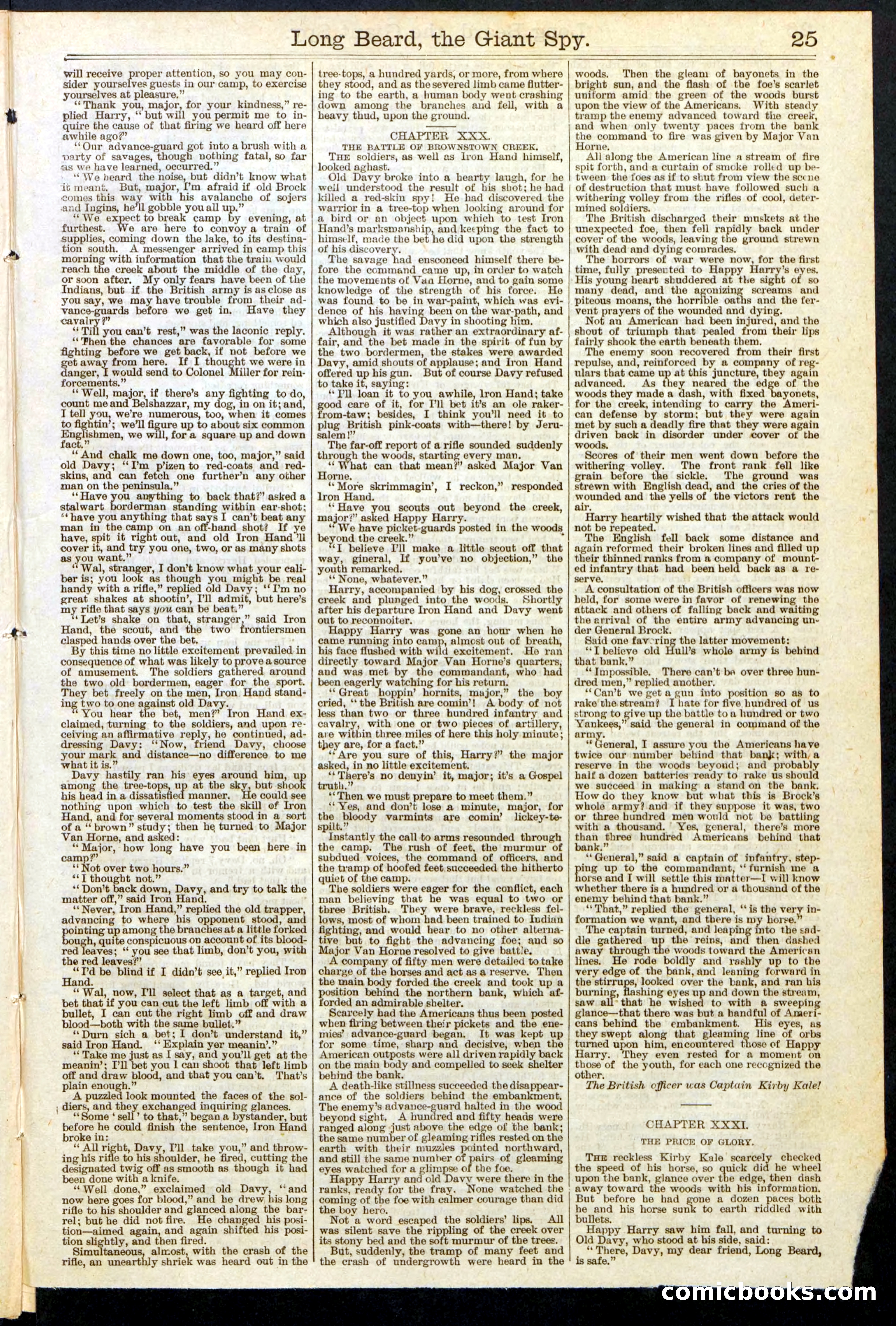
A restored page from Pulp Fiction, 1881. Page through the whole issue in the reader above.
📄 Transcribed text from this page (OCR, searchable)
Machine-transcribed from the original scan — historical spelling and the odd misread are preserved.
. diers, and the will receive proper attention, so you may con- sider yourselves guests in our camp, to exercise yourselves at pleasure,” ‘*Thank you, major, for your kindness,” re- plied Harry, ‘‘ but will you permit me to in- quire the cause of that firing we heard off here awhile ago?” ‘‘Our advance-guard got into a brush with a party of savages, though nothing fatal, so far as we have learned, oecurred.” ‘“ We heard the noise, but didn’t know what i¢ meant. But, major, [m afraid if old Brock comes this way with his avalanche of sojers and Ingins, he’ll gobble you all up.” “We expect to break camp by evening, at furthest. e are here to convoy a train of supplies, coming down the lake, to its destina- tion south. A messenger arrived in camp this morning with information that the train would reach the creek about the middle of the day, or soon after. My only fears have been of the Indians, but if the British army is as close as you say, we may have trouble from their ad- vance-guards before we get in. Have they cavalry ?” ‘Till you can’t rest,” was the laconic reply. ‘‘'Phen the chances are favorable for some fighting before we get back, if not before we et away from here. If I thought we were in ee would send to Colonel forcements.” ‘* Well, major, if there’s any fighting to do, count me and Belshazzar, my dog in on it; and, I tell you, we're numerous, too, when it comes to fightin’; we’ll figure up to about six common Eng ishmen, we will, for a square up and down ac ‘*And chalk me down one, too, major,” said old Davy; “I’m p’izen to red-coats and red- skins, and can fetch one further’n any other man on the peninsula.” ‘‘Have you anything to back that?’ asked a stalwart borderman standing within ear-shot; ‘* have you anything that says I can’t beat any man in the camp on an off-hand shot? If ye have, spit it right out, and old Iron Hand ’ll cover it, and try you one, two, or as many shots as you want.” ‘Wal, stranger, I don’t know what your cali- ber is; you look as though you might be real handy with a rifle,” replied old Davy; *‘’m no great shakes at shootin’, I'll admit, but here’s my rifle that says you can be beat.” ‘* Let’s shake on that, stranger,” said Iron Hand, the scout, and the two frontiersmen clasped hands over the bet, : By this time no little excitement prevailed in consequence of what was likely to prove asource of amusement. The soldiers gathered around the two old bordermen, eager for the sport. They bet freely on the men, Iron Hand stand- ing two to one against old Davy. ‘You hear the bet, men?’ Iron Hand ex- claimed, turning to the soldiers, and upon re- ceiving an affirmative reply, he continued, ad- dressing Davy: ‘‘Now, friend Davy, choose your mark and distance—no difference to me what it is.” Davy hastily ran his eyes around him, u among the tree-tops zp at the sky, but shoo his head in a dissatisfied manner. e could see nothing upon which to test the skill of Iron Hand, and for several moments stood in a _ sort of a “ brown” study; then he turned to Major Van Horne, and asked: f “Major, how long have you been here in camp?’ ‘* Not over two hours.” *‘T thougbt not.” ‘‘ Don’t back down, Davy, and try to talk the matter off,” said Iron Hand. , ‘** Never, Iron Hand,” replied the old trapper, advancing to where his opponent stood, and inting up among the branches at a little forked oe h, quite conspicuous ov account of its blood- red leaves; “‘ you see that limb, don’t you, with the red leaves?” “Td be blind if I didn’t see it,” replied Iron nd. “Wal, now, I'll select that as a target, and bet that if you can cut the left limb off with a bullet, I can cut the right limb off and draw blood—both with the same bullet.” ‘*Durn sich a bet; I don’t understand it,” said Iron Hand. ‘‘ Explain yer meanin’.” ‘* Take me just as I say, and you'll get at the meanin’; I’ll bet you 1 can shoot that left limb off and w blood, and that you can’t. That’s plain pe oH A puzzled look mounted the faces of the sol- exchanged inquiring glances. ‘*Some *‘ ’ to that,” began a bystander, but before he could finish the sentence, lron Hand broke in: . ** All right, Davy, Pll take you,” and throw- ing his rifle to his shoulder, he fired, cutting the designated twig off as smooth as though it had been done with a knife. ‘‘ Well done,” exclaimed old Davy, ‘‘and now here goes for blood,” and be drew his long rifle to his shoulder and glanced along the bar- rel; but he did not fire. He changed his posi- tion—aimed again and again shifted his posi- tion slightly, and then fired. Simultancoun almost, with the crash of the rifle, an unearthly shriek was heard out in the liller for rein- tree-tops, a hundred yards, or more, from where they stood, and as the severed limb came flutter- ing to the earth, a human body went crashing down among the branches and fell, with a heavy thud, upon the ground. CHAPTER XXX. THE BATTLE OF BROWNSTOWN CREEK, THE soldiers, as well as lron Hand himself, looked aghast. Old Davy broke into a hearty laugh, for he _ Long Beard, the Giant Spy. well understood the result of his shot; he had | killed a red-skin spy! He had discovered the warrior in a tree-top when looking around for a bird or an object upon which to test Iron Hand’s marksmanship, and keeping the fact to himself, made the bet he did upon the strength of his discovery. The savage had ensconced himself there be- fore the command came up, in order to watch the movements of Vana Horne, and to gain some knowledge of the strength of his force. He was found to be in war-paint, which was evi- dence of his having been on the war-path, and which also justified Davy in shooting him. Although it was rather an extraordinary af- fair, and the bet made in the spirit of fun by the two bordermen, the stakes were awarded Davy, amid shouts of applause; and Iron Hand offered up his gun. But of course Davy refused to take it, saying: ‘Pll loan it to you awhile, lron Hand; take ood care of it, for [Pll bet it’s an ole raker- rom-taw; besides, I think you'll need it to plug British pink-coats with—there! by Jeru- salem!” The far-off report of a rifle sounded suddenly through the woods, starting every man. ‘‘ What can that mean?’ asked Major Van Horne, **More skrimmagin’, I reckon,” responded lron Hand. ‘‘Have you scouts out beyond the creek, major?” asked Happy Harry. ‘** We have picket-guards posted in. the woods beyond the creek.” ; ‘I believe Pll make a little scout off that way, gineral, If you’ve no objection,” the youth remarked. ‘* None, whatever.” Harry, accompanied by his dog, crossed the creek and plunged into the woods. Shortly after his departure Iron Hand and Davy went out to reconnoiter. Happy Harry was gone an hour when he came running into camp, almost out of breath, his face flushed with wild excitement. He ran directly toward Major Van Horne’s quarters and was met by the commandant, who ha been eagerly watching for his return. ‘Great hoppin’ hornits, major,” the bo cried, ‘‘ the British are comin’! A body of not less than two or three hundred infantry and cavalry, with one or two pieces of artillery, are within three miles of here this holy minute; they are, for a fact.” ‘**Are you sure of this, Harry?’ the major asked, in no little excitement. ‘* There’s no denyin’ it, major; it’s a Gospel truth.” ‘“Then we must prepare to meet them.” ‘Yes, and don’t lose a minute, major, for oe : bloody varmints are comin’ lickey-te- ilt. Instantly the call to arms resounded through the camp. The rush of feet, the murmur of subdued voices, the command of officers, and the tramp of hoofed feet succeeded the hitherto quiet of the camp. The soldiers were eager for the conflict, each man believing that he was equal to two or three British. They were brave, reckless fel- lows, most of whom had been trained to Indian fighting, and would hear to no other alterna- tive but to fight the advancing foe; and so Major Van Horne resolved to give battle, A company of fifty men were detailed to take charge of the horses and act asa reserve. Then the main body forded the creek and took up a position behind the northern bank, which af- forded an admirable shelter. Scarcely bad the Americans thus been posted when firing between their pickets and the ene- mies’ advance-guard began. It was kept up for some time, sharp and decisive, when the American outposts were all driven rapidly back on the main body and compelled to seek shelter behind the bank. A death-like stillness succeeded the disappear- ance of the soldiers behind the embankment. The enemy’s advance-guard halted in the wood beyond sight, A hundred and fifty heads were ranged along just above the edge of the bank; the same number of gleaming rifles rested on the earth with their muzzies pointed northward, and still the same number of pairs of gleaming eyes watched fora | ta of the foe. Happy Harry and old Davy were there in the ranks, ready for the fray. None watched the coming of the foe with calmer courage than did the boy hero. : Not a word escaped the soldiers’ lips. All was silent save the rippling of the creek over its stony bed and the soft murmur of the trees. But, suddenly, the tramp of many feet and the crash of undergrowth were heard in the 25 —_—— woods. Then the gleam of bayonets in the bright sun, and the flash of the foe’s scarlet uniform amid the green of the woods burst upon the view of the Americans. With steady tramp the enemy advanced toward the creek, and when only twenty paces from the bank the command to fire was given by Major Van Horne, All along the American line a stream of fire spit forth, and a curtain of smoke rolled up be- tween the foes as if to shut from view the sccne of destruction that must have followed such a withering volley from the rifles of cool, deter- mined soldiers. The British discharged their muskets at the unexpected foe, then fell rapidly back under cover of the woods, leaving the ground strewn with dead and dying comrades. The horrors of war were now, for the first time, fully presented to Happy Harry’s eyes. His young heart shuddered at the sight of so many dead, and the agonizi screams and piteous moans, the horrible oaths and the fer- vent prayers of the wounded and dying. Not an American had been injured, and the shout of triumph that pealed from their lips fairly shook the earth beneath them. The enemy soon recovered from their first repulse, and, reinforced by a company of reg- ulars that came up at this juncture, they again advanced. As they neared the edge of the woods they made a dash, with fixed bayonets, for the creek, intending to carry the Ameri- can defense by storm; but they were again met by such a deadly fire that they were again driven back in disorder under cover of the woods. Scores of their men went down before the withering volley. The front rank fell like grain before the sickle. The ground was strewn with English dead, and the cries of the oe ges and the yells of the victors rent the if, Harry heartily wished that the attack would not be repeated. The English fell back some distance and again reformed their broken lines and filled up their thinned ranks from a company of mount- ed infantry that had been held back as a re- serve. A consultation of the British officers was now held, for some were in favor of renewing the attack and others of falling back and waiting the arrival of the entire army advancing un- der General Brock. Said one faverin “T believe old that bank.” “« Impossible. the latter movement: ull’s whole army is behind There can’t be over three hun- dred men,” replied another. *“Can’t we get a gun into position so as to rake the stream? I hate for five hundred of us strong to give up the battle to a hundred or two Yankees,” said the general in command of the army. ¥ Gesieant, I assure you the Americans have twice our number behind that bank; witha reserve in the woods beyond; and probably haifa dozen batteries ready to rake us should we succeed in making a stand on the bank. How do they know but what this is Brock’s whole army? and if they suppose it was, two or three hundred men would not be battling with a thousand. Yes, general, there’s more than three hundred Americans behind that ‘*General,” said a captain of infantry, step- ping up to the commandant, ‘‘ furnish me a orse and I will settle this matter—I will know whether there is a hundred or a thousand of the enemy behind that bank.” ‘*That,” replied the general, ‘is the very in- formation we want, and there is wy horse. The captain turned, and lea ping to the sad- die gathered up the reins, and then dashed away through the woods toward the American lines. He rode boldly and rashly up to the very edge of the bank, and leaning forward in the stirrups, looked over the bank, and ran his burning, flashing eyes up and down the stream, saw all*that he wish to with a pte! glance—that there was but a handful of Ameri- cans behind the embankment. His eyes, as they swept along that gleaming line of orbs turned pen him, encountered those of Happy Harry. They even rested for a moment on those of the youth, for each one recognized the other. The British officer was Captain Kirby Kale! CHAPTER XXXI. THE PRICE OF GLORY. THe reckless Kirby Kale scarcely checked the speed of his horse, so quick did he wheel upon the bank, glance over the edge, then dash - away toward the woods with bis information. But before be had gone a dozen paces both he and his horse sun to earth riddled with bullets. Happy Harry saw him fall, and turning to Old Davy, who stood at his side, said: ‘. he on Davy, my dear friend, Long Beard, e, COMICDOOKS.cCOm