
Pulp Fiction, 1881 · page 21 of 32
Beadle's New York Dime Library, No. 137 — page 21: what you’re looking at
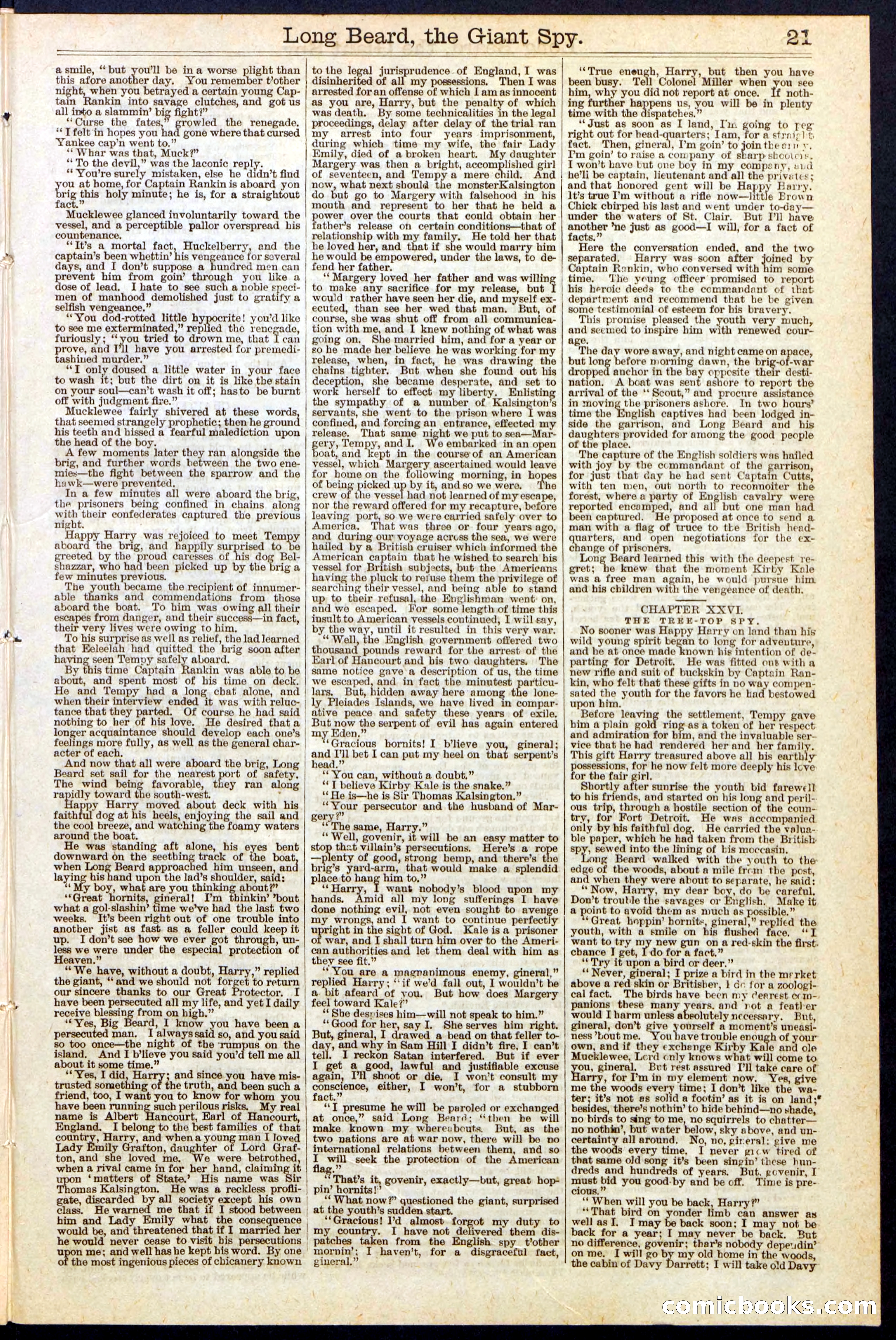
A restored page from Pulp Fiction, 1881. Page through the whole issue in the reader above.
📄 Transcribed text from this page (OCR, searchable)
Machine-transcribed from the original scan — historical spelling and the odd misread are preserved.
Long a ~~ a smile, “but you'll be in a worse plight than this afore another day. You remember t’other night, when you betrayed a certain young Cap- tain Rankin’ into savage clutches, and got us all into a slammin’ big fight?’ ‘‘Curse the fates,” growled the renegade, “*T felt in hopes you had gone where that cursed Yankee cap’n went to.” ‘* Whar was that, Muck?” ** To the devil,” was the laconic reply. *You’re surely mistaken, else he didn’t find rou at home, for Captain Rankin is aboard yon rig this holy minute; he is, for a straightout fact.” Mucklewee glanced involuntarily toward the vessel, and a perceptible pallor overspread his countenance, “It’s a mortal fact, Huckelberry, and the | captain’s been whettin’ his vengeance for several | he would be empowered, under the laws, to de- days, and I don’t suppose a hundred men can prevent him from goin’ through you like a dose of lead. I hate to see such a noble speci- men of manhood demolished just to gratify a selfish vengeance,” “You dod-rotted little hypocrite! you'd like to see me exterminated,” replied the renegade, furiously; “‘ you tried to drown me, that I can prove, and I'll have you arrested for premedi- tashiued murder.” “*T only doused a little water in your face to wash it; but the dirt on it is like the stain on your soul—can’t wash it off; hasto be burnt off with judgment fire.” Mucklewee fairly shivered at these words that seemed strangely prophetic; then he ground his teeth and hissed a fearful malediction upon the head of the boy. A few moments later they ran alongside the brig, and further words between the two ene- mies—the fight between the sparrow and the hawk—were prevented. In a few minutes all were aboard the brig, the prisoners being confined in chains along ae their confederates captured the previous night. Happy Harry was rejoiced to meet Tempy aboard the brig, and happily surprised to greeted by the proud caresses of his dog Bel- shazzar, who had been picked up by the brig a few minutes previous. The youth became the recipient of innumer- able thanks and commendations from those aboard the boat. To him was owing all their escapes from danger, and their success—in fact, their very lives were owing to him, To his surprise as well as relief, the lad learned that Eeleelah had quitted the brig soon after having seen Temvy safely aboard. By this time Captain Rankin was able to be about, and spent most of his time on deck. He and Tempy had a long chat alone, and when their interview ended it was with reluc- tance that they parted. Of course he had said nothing to her of his love. He desired thata longer acquaintance should develop each one’s feelings more fully, as well as the general char- acter of each. And now that all were aboard the brig, Long Beard set sail for the nearest port of safety, The wind being favorable, they ran along i toward the south-west. ; appy Harry moved about deck with his faithful dog at his heels, enjoying the sail and the cool breeze, and watching the foamy waters around the boat. He wus standing aft alone, his eyes bent downward on the seething track of the boat when Long Beard approached him unseen and laying bis hand upon the Jad’s shoulder, said: ‘*My boy, what are you fae about?” ‘*Great hornits, gineral! I’m thinkin’ ’bout what a gol-slashin’ time we’ve had the last two weeks. It’s been right out of one trouble into anotber jist as fast as a feller could keep it up. I don’t see how we ever got through, un- less we were under the especial protection of Heaven.” “We have, without a doubt, Harry,” replied the giant, “and we should not forget to return our sincere thanks to our Great Protector. I have been persecuted all my life, and yet I daily receive blessing from on high.” ‘Yes, Big , | know you have been a persecuted man, I alwayssaid so, and you said so too once—the night of the rumpus on the island, And I b’lieve you said you’d tell me all about it some time.” * ‘Yes, I did Harry; and since you have mis- trusted something of the truth, and been such a friend, too, I want you to know for whom you have been running such perilous risks. My real name is Albert Hancourt, Earl of Hancourt, England. I belong to the best families of that country, Harry, and whena young man I Joved Lady Emily Grafton, daughter of Lord Graf- ton, and she loved me. e were betrothed, when a rival came in for her hand, claming © n ‘matters of State.’ His name was Sir omas Kalsington, He was a reckless profli- gate, discarded by all society except his own class. He warned me that if I stood between him and Lady Emily what the consequence would be, and threatened that if 1 married her he would never cease to visit bis persecutions upon me; and well has he kept bis word. By one the most ingenious pieces of chicanery known to the legal jurisprudence of England, I was disinherited of all my possessions. Then I was arrested for an offense of which I am as innocent as you are, Harry, but the penalty of which was death. By some technicalities in the legal proceedings, delay after delay of the trial ran my arrest into four years imprisonment, during which time my wife, the fair Lady Emily, died of a broken heart. My daughter Margery was then a bright, accomplished girl of seventeen, and Tempy a mere child. And now, what next should the monsterKalsington do but go to Margery with falsehood in his mouth and represent to her that he held a power over the courts that could obtain her father’s release on certain conditions—that of relationship with my pe He told her that he loved her, and that if she would marry him fend her father. ‘Margery loved her father and was willing to make any sacrifice for my release, but I would rather have seen her die, and myself ex- ecuted, than see her wed that man. But, of course, she was shut off from all communica- tion with me, and I knew nothing of what was going on, She married him, and for a year or s0 he made her believe he was working for my release, when, in fact, he was drawing the chains tighter. But when she found out his deception, she became desperate, and set to work herself to effect my liberty. Enlisting the sympathy of a number of Kalsington’s servants, she went to the prison where I was confined, and forcing an entrance, effected my release. That same night we put to sea—Mar- ery, Tempy, andl. Weembarked in an open 20at, and kept in the course of an American vessel, which ney. ascertained would leave for home on the following morning, in hopes of being picked up by it, andso we were. ‘Th crew of the vessel had not learned of my escape, nor the reward offered for my recapture, before leaving port, so we were carried safely over to America, That was three or four years ago, and during our voyage acruss the sea, we were hailed by a British cruiser which informed the American captain that he wished to search his vessel for British subjects, but the Americans having the pluck to refuse them the privilege of searching their vessel, and being able to stand up to their refusal, the Englishman went: on, and we escaped. For some length of time this insult to American vessels continued, I wiil say, by the way, until it resulted in this very war. “Well, the English government offered two thousand pounds reward for the arrest of the Earl of Hancourt and bis two daughters. The same notice gave a description of us, the time we escaped, and in fact the minutest particu- lars. But, hidden away here among the lone- ly Pleiades Islands, we have lived in compar- ative peace and safety these years of exile. But now the serpent of evil has again entered my Eden.” ‘*Gracious hornits! I b’lieve you, gineral; ond, Vil bet I can put my heel on that serpent’s ead. ** You can, without a doubt,” **T believe Kirby Kale is the snake.” ‘He is—he is Sir Thomas Kalsington.” ‘Your persecutor and the husband of Mar- gery?’ ‘“* The same, arg! of “Well, govenir, it will be an easy matter to stop that villain’s persecutions. Here’s a ro —plenty of good, strong hemp, and there’s the brig’s yard-arm, that would make a splendid nigeesto nang him to,” ‘‘Harry, | want nobody’s blood upon my hands. Amid all my long sufferings I have done nothing evil, not even sought to avenge my wrongs, and I want to continue perfectly npeight in the sight of God. Kale isa prisoner of war, and I sball turn him over to the Ameri- can authorities and let them deal with him as they see fit.” ‘You are a magnanimous enemy, gineral,” Neg Harry; ‘if we'd fall out, I wouldn’t be a bit afeard of you. But how does Margery feel toward Kale?” “She despises him—will not speak to him.” ‘Good for her, say I. She serves him right. But, gineral, I drawed a bead on that feller to- day, and why in Sam Hill I didn’t fire, I can’t tell, I reckon Satan interfered. But if ever I get a good, lawful and justifiable excuse again, I'l shoot or die, I won’t consult my aanecirnae either, I won’t, for a stubborn fac “IT presume he will be paroled or exchanged at once,” said Long Beard; “then he will make known my whereubouts. But, as the two nations are at war now, there will be no international relations between them, and so I will seek the protection of the American _* That’s it, govenir, exactly—but, great hop+ pin’ hornits!’ ** What now?” questioned the giant, surprised at the youth’s sudden start. ‘‘Gracious! I’d almost forgot my duty to my country. I have not delivered them dis- patches taken from the English spy t’other mornin’; I haven’t, for a disgraceful fact gineral.” Beard, the Giant Spy. cae ee ———— “True eneugh, Harry, but then you have been busy. Tell Colonel Miller when you see him, why you did not report at once. If noth- ing further happens us, you will be in plenty time with the dispatches.” “Just as soon as I land, I'm going to peg right out for head-quarters; Iam, for a straip) t fact. Then, gineral, I’m goin’ to jointhea:1 v. I’m goin’ to raise a company of sbarp shooins. I won’t have but one boy in my compeny, wud he’li be captain, lieutenant and all the privetcs; and that honored gent will be Happy Harry. it’s true I'm without a rifle now—little Brown Chick cbirped his last and went under to-day— under the waters of St. Clair. But Ill have another ’ne just as good—I will, for a fact of facts.” Here the conversation ended, and the two separated. Harry was soon after a by Captain Rankin, who conversed with him some time. ‘The yeung officer promised to report his heroic deeds to the commandant of that department and recommend that he be given some testimonial of esteem for bis bravery. This promise pleased the youth very much, and seemed to inspire him with renewed cour- age. The day wore away, and night came on apace, but long before morning dawn, the brig-of-war dropped anchor in the bay opposite their desti- nation. A boat was sent ashore to report the arrival of the ‘‘ Scout,” and procure assistance in moving the prisoners ashore. In two hours’ time the English captives had been lodged in- side the garrison, and Long Beard and his daughters provided for among the good people of the place. The capture of the English soldiers was hailed with joy by the commandant of the garrison, for just that day he had sent Captain Cutts, with ten men, out north to reconnoiter the forest, where a party of English cavalry were reported encamped, and all but one man had been captured. He proposed at once to send a man with a flag of truce to tke British head- je hai and open negotiations for the ex- change of prisoners. —— Beard learned this with the deepest re- gret; he knew that the moment Kirby Kale was a free man again, he would pursue him and his children with the vengeance of death. CHAPTER XXVI. THE TREE-TOP SPY, No sooner was Happy Herry on land than his wild young spirit began to long for adventure, and he at once made known his intention of de- parting for Detroit. He was fitted out witha new rifle and suit of buckskin by Captain Ran- kin, who felt that these gifts in no way compen- sated the youth for the favors he had bestowed upon him. Before leaving the settlement, Tempy gave bim a plain gold ring as a token of ber respect and admiration for bim, and the invaluable ser- vice that he had rendered her and her family. This gift Harry treasured above all his earthly possessions, for he now felt more deeply his love for the fair girl. Shortly after sunrise the youth bid farewell to his friends, and started on bis long and peril- ous trip, through a hostile section of the coun- try, for Fort Detroit. He was accompanied only by his faithful dog. He carried the valua- ble paper, which he had taken from the British spy, sewed into the lining of bis moccasin. mg Beard walked with the youth to the edge of the woods, about a mile frem the post, and when they were about to separate, he said: ** Now, Harry, my dear boy, do be careful, Don’t trouble the savages or English. Make it a point to avoid them as much as possible.” ‘Great, hoppin’ hornits, gineral,” replied the youth, with a smile on his flushed face, “TI want to try my new gun on a red-skin the first. chance I get, I do for a fact.” ‘Try it upon a bird or deer.” ‘‘ Never, gineral; I prize a bird in the mrrket above a red skin or Britisber, | de for a zoologi- cal fact. The birds have been my Cearest ecm-. panions these many years. and not a feather would I harm unless absolutely necessary. But, gineral, don’t give yourself a moment’s uneasi- ness bout me. You have trouble enough of your own, and if they exchenge Kirby e and ole Mucklewee, Lerd only knows what will come to ou, gineral, Bvt rest assured I'll take care of arry, for ’m in my element now. Yes, give me the woods every time; I don’t like the wa- ter; it’s not es solid a footin’ as it is on land;* besides, there’s nothin’ to hide behind—no shade, no birds to sing to me, no squirrels to chatter— no nothin’, but water below, sky above, and un- certainty all around, No, no, pireral: give me the w every time. I never gicw tired of that same old song it’s been singin’ these hun- dreds and hundreds of years. But. govenir, I _— bid you good-by and be off. Time is pre- ous. ‘* When will you be back, Harry?” “That bird on yonder limb can answer as well asI. I may be back soon; I may not be. for a year; I may never be back. But no difference, govenir; thar’s nobody depeudin? on me. I will go by my old home in the woods, the cabin of Davy Darrett; I will take old Davy (e(6) JOO (C <S (E(0) m