
Pulp Fiction, 1881 · page 8 of 32
Beadle's New York Dime Library, No. 136 — page 8: what you’re looking at
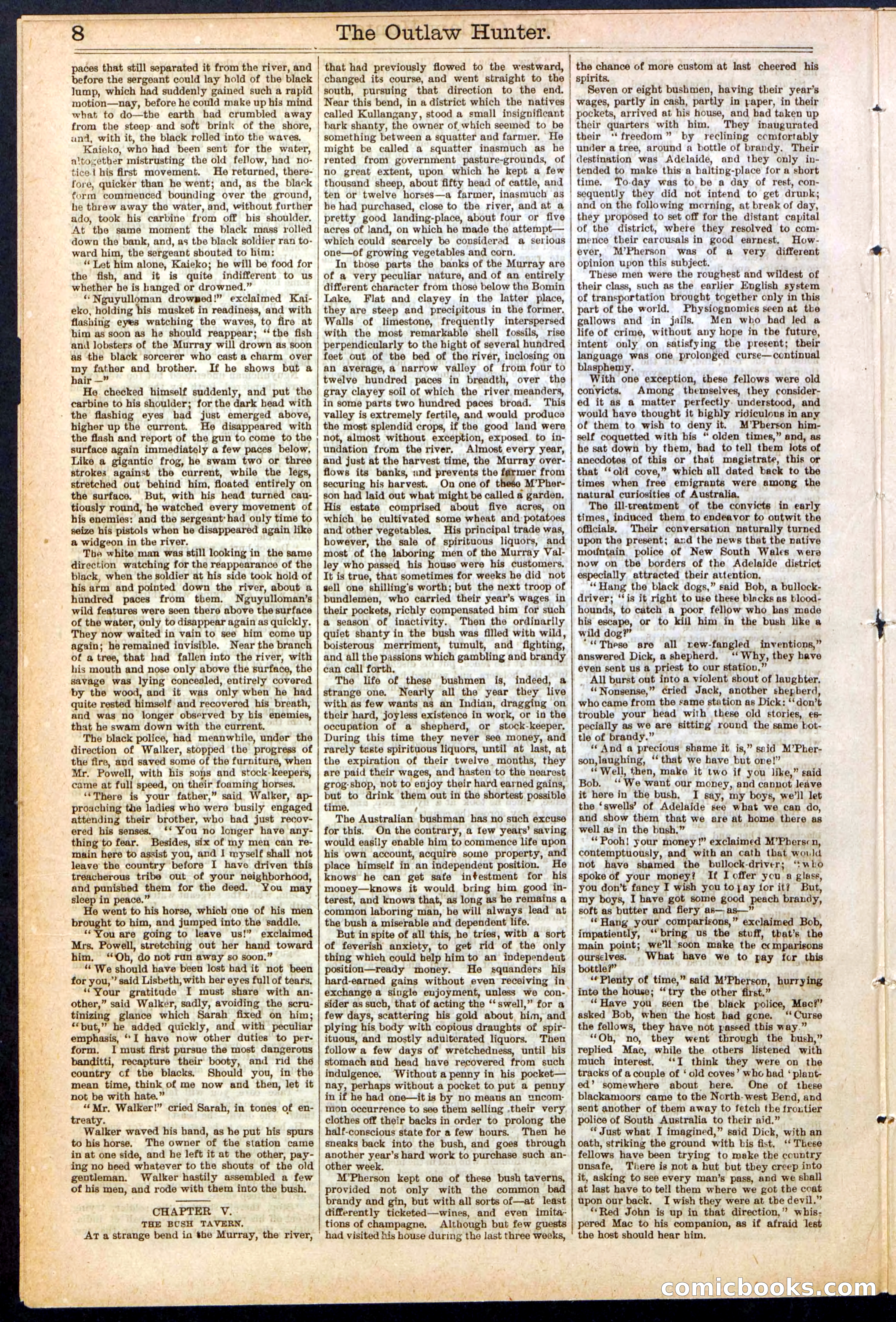
A restored page from Pulp Fiction, 1881. Page through the whole issue in the reader above.
📄 Transcribed text from this page (OCR, searchable)
Machine-transcribed from the original scan — historical spelling and the odd misread are preserved.
were ~The Outlaw Hunter. } ES ; rs ls : i} —SS s — : paces that still separated it from the river, and before the sergeant could lay hold of the black lump, which had suddenly gained such a rapid motion—nay, before he could make up his mind what to do—the earth had crumbled away from the steep: and soft brink of the shore, und, with it, the black rolled into the waves, Kaieko, who had been sent for the water, altoxetber mistrusting the old fellow, had no- tice. his first movement. He returned, there- fore, quicker than he went; and, as the black form commenced bounding over the ground, he threw away the water, and, without further ado, took his carbine from off his shoulder. At the same moment the black mass rolled down the bank, and, as the black soldier ran to- ward him, the sergeant sbouted to him: “ Let him alone, Kaieko; he will be food for the fish, and it is quite indifferent to us whether he is banged or drowned.” “ Nguyulloman drowmped!” exclaimed Kai- eko, holding his musket in readiness, and with flashing eyes watching the waves, to fire at him as soon as he should reappear; “the fish and lobsters of the Murray will drown as soon as the black sorcerer who cast a charm over my father and brother. If he shows but a hair —” He checked himself suddenly, and put the carbine to his shoulder; for the dark head with - the flashing eyes bad just emerged above, higher up the current. He disappeared with the flash and report of the gun to come to the surface again immediately a few paces below, Like a gigantic frog, he swam two or three strokes against the current, while the legs, stretched out behind him, floated entirely on the surface. But, with his head turned cau- tiously round, he watched every movement of his enemies: and the sergeant’ had ouly time to seize his pistols when he disappeared again like a widgeon in the river. The white man was still looking in the same direction watching for the reappearance of the black, when the soldier at his side took hold of his arm and pointed down the river, about a hundred paces from them. Nguyulloman’s wild features were seen there above the surface of the water, only to disappear again as quickly. They now waited in vain to see him come up again; he remained invisible. Near the branch of a tree, that had fallen into the river, with his mouth and nose only above the surface, the savage was lying concealed, entirely covered by the wood, and it was only when he had quite rested himself and recovered his breath, and was no longer observed by bis enemies, that he swam down with the current. The black police, had meanwhile, under the direction of Walker, stopped the progress of the fire, and saved some of the furniture, when Mr. Powell, with his sons and stock-keepers, came at full speed, on their foaming horses. “There is your father,” said Walker, ap- proaching the ladies who wero busily engaged attending their brother, who bad just recov- ered his senses. ‘* You no longer have any- thing to fear. Besides, six of my men can re- main here to assist you, and I myself shall not leave the country before I have driven this treacherous tribe out of your neighborhood, and punished them for the deed. You may eo peace.” He went to his horse, which one of his men brought to him, and jumped into the saddle. ‘*You are going to leave us!” exclaimed Mrs, Powell, stretching out her hand toward him. “Ob, do not run away so soon.” ‘We should have been lost bad it not been for you,” said Lisbeth, with her eyes full of tears, “Your gratitude I must share with an- other,” said Walker, sadly, avoiding the scru- eS a that had previously flowed to the westward, the chance of more custom at last cheered his changed its course, and went straight to the | spirits. south, pursuing that direction to the end. Near this bend, in a district which the natives called Kullangany, stood a small insignificant bark shanty, the owner of, which seemed to be something between a squatter and farmer. He might be called a squatter inasmuch as he rented from government pasture-grounds, of no great extent, upon which he kept a few thousand sheep, about fifty head of cattle, and ten or twelve horses—a farmer, inasmuch as he had purchased, close to the river, and at a pretty good landing-place, about four or five acres of land, on which he made the attempt— which could scarcely be considered a serious one—of growing vegetables and corn. In those parts the banks of the Murray are of a very peculiar nature, and of an entirely different character from those below the Bomin Lake, Flat and clayey in the latter place, they are steep and precipitous in the former. Walls of limestone, frequently interspersed with the most remarkable shell fossils, rise perpendicularly to the hight of several hundred feet out of the bed of the river, inclosing on an average, a narrow yalley of from four to twelve hundred paces in breadth, over the gray clayey soil of which the river meanders, in some parts two hundred paces broad. This valley is extremely fertile, and would produce the most splendid crops, if the good land were not, almost without exception, exposed to in- undation from the river. Almost every year, and just at the harvest time, the Murray over- flows its banks, and prevents the f@rmer from securing his harvest. On one of these M’Pher- son had laid out what might be called a garden, His estate comprised about five acres, on which he cultivated some wheat and potatoes and other vegetables. His principal trade was, however, the sale of spirituous liquors, and most of the laboring men of the Murray Val- ley who passed his house were his customers, It is true, that sometimes for weeks he did not sell one shilling’s worth; but the next troop of bundlemen, who carried their year’s wages in their pockets, richly compensated him for such a season of inactivity. Then the ordinarily quiet shanty in the bush was filled with wild, boisterous merriment, tumult, and fighting, and all the passions which gambling and brandy can call forth, The life of these bushmen is, indeed, a strange one. Nearly all the year they live with as few wants as an Indian, dragging on their hard, joyless existence in work, or in the occupation of a shepherd, or stock-keeper. During this time they never see money, and rarely teste spirituous liquors, until at last, at the expiration of their twelve, months, they are paid their wages, and hasten to the nearest grog-shop, not to enjoy their hard earned gains, but to drink them out in the shortest possible time, ‘ The Australian bushman has no such excuse for this. On the contrary, a tew years’ saving would easily enable him to commence life upon his own account, acquire some property, and place himself in an independent position. He knows he can get safe intestment for his mouey—knows it would bring bim good in- terest, and knows that, as long as he remains a common laboring man, be will always lead at the bush a miserable and dependent life. But in spite of all this, he tries, witb a sort of feverish anxiety, to get rid of the only thing which could help him to an independent position—ready money. He squanders his hard-earned gains without even receiving in exchange a single enjoyment, unless we con- sider as such, that of acting the ‘‘swell,” for a ce a ea Seven or eight bushmen, having their year’s wages, partly in cash, partly in paper, in their pockets, arrived at his house, and had taken up their quarters with him, They inaugurated their ‘“‘freedom” by reclining comfortably under a tree, around a bottle of brandy. Their destination was Adelaide, and they only in- tended to make this a halting-place for a short time. To-day was to be a day of rest, con- sequently they did not intend to get drunk; and on the following morning, at break of day, they proposed to set off for the distant capital of the district, where they resolved to com- mence their carousals in good earnest. How- ever, M’Pherson was of a very different opinion upon this subject. These men were the roughest and wildest of their class, such as the earlier English system of transportation brought together only in this part of the world. Physiognomies seen at the gallows and in jails. Men who had led a life of crime, without any hope in the future, intent only on satisfying the present; their language was one prolonged curse—continual blasphemy. With one exception, these fellows were old conyicts. Among themselves, they consider- ed it as a matter perfectly. understood, and would have thought it bighly ridiculous in any of them to wish to deny it. M’Pbherson him- self coquetted with bis “ olden times,” and, as he sat down by them, bad to tell them lots of anecdotes of this or that magistrate, this or that “old cove,” which all dated back to the times when free emigrants were among the natural curiosities of Australia. The ill-treatment of tbe convicts in early times, induced them to endeavor to outwit the officials, Their conversation naturally turned upon the present; and the news that the native mountain police of New South Wales were now on tbe borders of the Adelaide district especially attracted their attention. “Hang the black dogs,” said Bob, a bullock- driver; ‘‘is it right to use these blacks as blood- hounds, to catch a poor fellow who has made his escape, or to kill him in the bush like a wild dog?’ ‘These sare all rew-fangled inventions,” answered Dick, a shepherd, ‘‘ Why, they have even sent us a priest to our station,” 7 - All burst out into a violent sbout of laughter. ‘‘ Nonsense,” Cried Jack, another shepherd, who came from the same station as Dick: “don’t trouble your head with these old stories, es- pecially as we are sitting round the same bot- tle of brandy.” * And a precious shame it is,” said M’Pher- son,laughing, ‘‘ that we have but one!” Well, then, make it two if you like,” said Bob. ‘‘We want our money, and cannot leave it here in the bush, I say, my boys, we’ll let the ‘swells’ of Adelaide see what we can do, and show them that we are at home there as well as in the bush.” : “Pooh! your money!” exclaimed M’Pherscn, contemptuously, and with an cath that would not have shamed the bullock-driver; “:who spoke of your money? If I offer you a glass, you don’t fancy I wish you tojay tor it? But, my boys, I have got some good peach brandy, soft as butter and fiery as— as—” ‘Hang your comparisons,” exclaimed Bob, impatiently, “bring us the stuff, that’s the main point; we'll soon make the ccmparisons ourselves. . What have we to pay for this bottle?” Tr. ‘Plenty of time,” said M’Pherson into the house; “try the other rst.” gil er “Have you seen the black police, Mac?” * ti glance which Sarah fixed on him; | few days, scattering his gold about him, and | asked Bob, when the host bad gone. ‘“‘Curse a7 “but,” he added quickly, and with peculiar | plying his body with copious draughts of spir- | the fellows, they have not passed this way.” A emphasis, “I have now other duties to per- | ituous, and mostly adulterated liquors. Then “Oh, no, they went through the bush,” af form. I must first pursue the most dangerous | follow a few days of wretchedness, until his | replied Mac, while the others listened with is tti, recapture their booty, and rid thé | stomach and head have recovered from such | much interest, ‘I think they were on the Bis" country cf the blacks. Should you, in the | indulgence, ‘Without a penny in his pocket— | tracks of a couple of ‘ old coves’ who had ‘plant- mean time, think of me now and then, let it | nay, perhaps without a pocket to put a penny | ed’ somewhere about here. One of these not be with hate.” in if he had one—it is by no means an wncom- | blackamoors came to the North-west Bend, and “Mr, Walker!” cried Sarah, in tones of en- | mon occurrence to see them selling .their very | sent another of them away to fetch the froxutier treaty. clothes off their backs in order to prolong the | police of South Australia to their aid.” Walker waved his hand, as he put his spurs | half-conscious state for a few hours. Then he “‘ Just what I imagined,” said Dick, with an os to his horse, The owner of the station came | sneaks back into the bush, and goes through | oath, striking the ground with bis fist. ‘ These 4 in at one side, and he left it at the other, pay- | another year’s hard work to purchase such an- | fellows have been trying to make the country ing no heed whatever to the shouts of the old | other week. unsafe, There is not a hut but they creep into : gentleman. Walker hastily assembled a few M’Pherson kept one of these bush taverns, | it, asking to see every man’s pass, and we shall Y, of his men, and rode with them into the bush. | provided not only with the common bad | at last have to tell them where we got the coat brandy and gin, but with all sorts of—at least | upon our back. I wish they were at the devil.” CHAPTER V.. differently ticketed—wines, and even imita- ‘‘Red John is up in that direction,” whis- , THE BCSH TAVERN, 7 tions of champagne. Although but few guests | pered Mac to his companion, as if afraid lest At a strange bend in the Murray, the river, ' had visited his house during the last three weeks, ' the host should hear him. | \ Pen te ene ©) 100 m f t : |