
Pulp Fiction, 1881 · page 6 of 32
Beadle's New York Dime Library, No. 136 — page 6: what you’re looking at
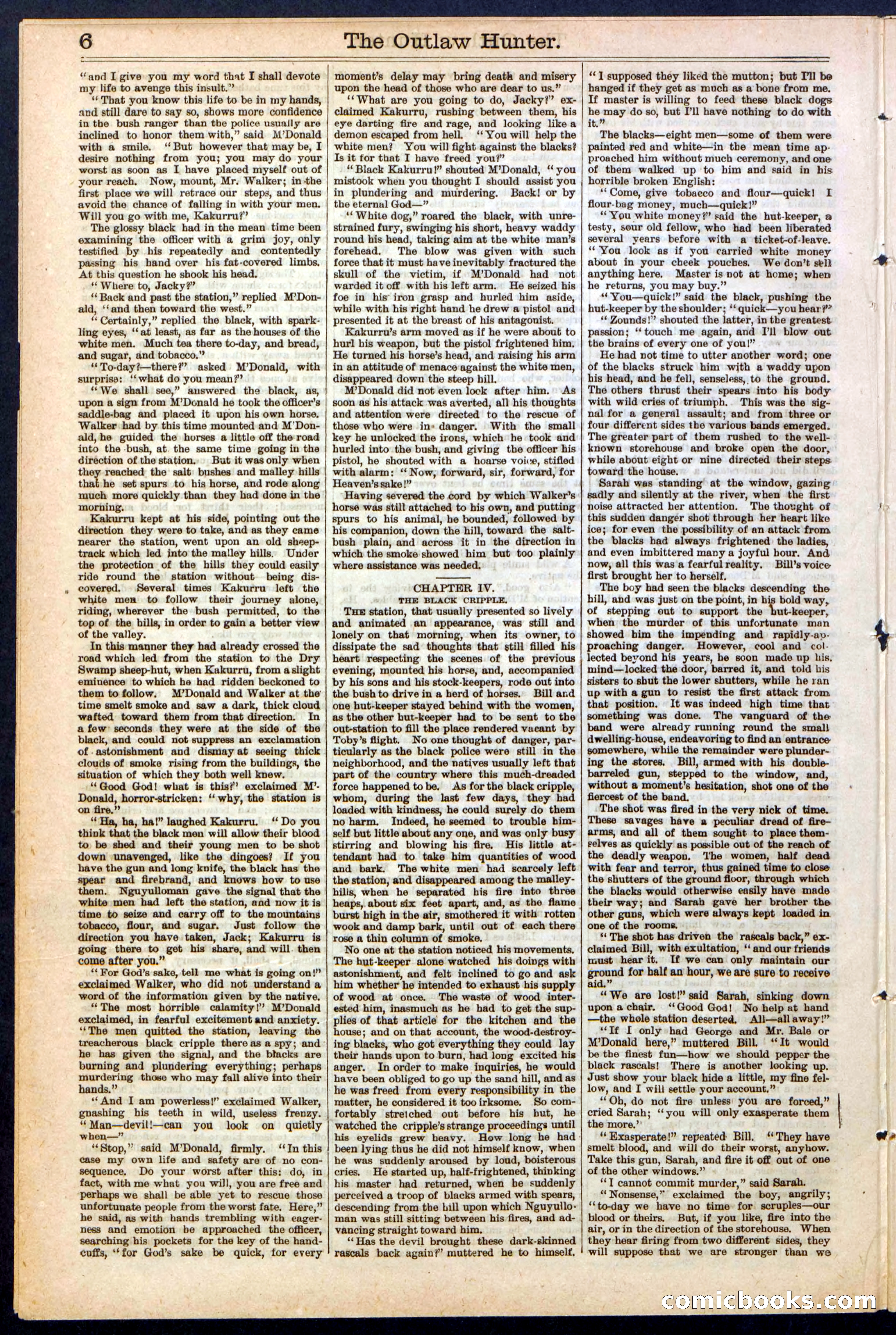
A restored page from Pulp Fiction, 1881. Page through the whole issue in the reader above.
📄 Transcribed text from this page (OCR, searchable)
Machine-transcribed from the original scan — historical spelling and the odd misread are preserved.
—- 2 ee a a St ate + ee ee ow a ——_—_———— as a ee a ee LK ee ——> Ca a a = - a nn oe “and I give you my word that I shall devote my life to avenge this insult.” ‘* That you know this life to be in my hands, and still dare to say so, shows more confidence in the bush ranger than the police usually are inclined to honor them with,” said M’Donald with a smile. ‘But however that may be, I desire nothing from you; you may do your worst as soon as I have placed myself out of your reach, Now, mount, Mr. Walker; in the first place we will retrace our steps, and thus avoid the chance of falling in with your men. Will you go with me, Kakurru?” The glossy black had in the mean time been examining the officer with a grim joy, only testified by his repeatedly and contentedly passing his hand over his fat-covered limbs, At this question he shook his head. ‘* Where to, Jacky?’ ‘* Back and past the station,” replied M’Don- ald, ‘‘and then toward the west.” “ Certainly,” replied the black, with spark- ling eyes, ‘‘at least, as far as the houses of the white men. Much tea there to-day, and bread, and sugar, and tobacco,” ‘*To-day?—there?’ asked M’Donald, with surprise: ‘‘what do you mean?’ “We shall see,” answered the black, as, upon a sign from M’Donald he took the officer’s saddle-bag and placed it upon his own horse. Walker had by this time mounted and M’Don- ald, he guided the horses a little off the road into the bush, at. the same time going in the direction of the station. But it was only when they reached the salt bushes and malley hills that he set spurs to his horse, and rode along much more quickly than they had done in the morning. : Kakurru kept at his side, pointing out the direction they were to take, and as they came nearer the station, went upon an old sheep- track which led into the malley hills. Under the protection of the hills they could easily ride round the station without being dis- covered, Several times Kakurru left the white men to follow their journey alone, riding, wherever the bush permitted, to the top of the hills, in order to gain a better view of the valley. In this manner they had already crossed the road which led from the station to the Dry Swamp sheep-hut, when Kakurru, from aslight eminence to which he had ridden beckoned to them to follow. M’Donald and Walker at the time smelt smoke and saw a dark, thick cloud wafted toward them from that direction. In a few’ seconds they were at the side of the black, and could not suppress an exclamation of.astonishment and dismay at seeing thick clouds of smoke rising from the buildings, the situation of which they both well knew. “Good God! what is this?’ exclaimed M’- Donald, horror-stricken: ‘‘ why, the station is on fire.” , ‘Ha, ha, ha!” laughed Kakurru. ‘ Do you think that the black men will allow their blood to be shed and their young men to be shot down unavenged, like the dingoes? If you have the gun and long knife, the black has the spear and firebrand, and knows how to use them. Nguyulloman gave the signal that the white men had left the station, and now it is time to seize and carry off to the mountains tobacco, flour, and sugar. Just follow the direction you have taken, Jack; Kakurru is going there to get his share, and will. then come after you.” ** For God’s sake, tell me what is going on!” exclaimed Walker, who did not understand a word of the information given by the native. “The most horrible calamity!’ M’Donald exclaimed, in fearful excitement and anxiety. ‘‘The men quitted the station, leaving the treacherous black cripple there as a spy; and he has given the signal, and the blacks are burning and plundering everything; perhaps murdering those who may fall alive into their hands.” ‘And I am powerless!” exclaimed Walker, gnashing his teeth in wild, useless frenzy. “ Man—devil!—can you look on quietly when—” “Stop,” said M’Donald, firmly. ‘In this case my own life and safety are of no con- sequence. Do your worst after this: do, in fact, with me what you will, you are free and ‘perhaps we shall be able yet to rescue those unfortunate people from the worst fate. Here,” he said, as with hands trembling with eager- ness and emotion be approached the officer, searching his pockets for the key of the hand- cuffs, ‘‘for God’s sake be quick, for every SP a Ne Ah SN The Outlaw Hunter. moment’s delay may bring death and misery upon the head of those who are dear to us.” ‘What are you going to do, Jacky?” ex- claimed Kakurru, rushing between them, his eye darting fire and rage, and looking likea demon escaped from hell, ‘‘ You will help the white men? You will fight against the blacks? Is it for that I have freed you?’ “Black Kakurru!” shouted M’Donald, ‘‘ you mistook when you thought I should assist you in plundering and murdering. Back! or by the eternal God—” ‘“ White dog,” roared the black, with unre- strained fury, swinging his short, heavy waddy round his head, taking aim at the white man’s forehead. The blow was given with such force that it must have inevitably fractured the skull of the victim, if M’Donald had not warded it off with his left arm. He seized his foe in his iron grasp and hurled him aside, while with his right hand he drew a pistol and presented it at the breast of his antagonist. Kakurru’s arm moved as if he were about to hurl his weapon, but the pistol frightened him, He turned his horse’s head, and raising his arm in an attitude of menace against the white men, disappeared down the steep hill. M’Donald did not even lock after him. As soon as his attack was averted, all his thoughts and attention were directed to the rescue of those who were in» danger. With the small key he unlocked the irons, which he took and hurled into the bush, and giving the officer his pistol, he shouted with a hoarse voive, stifled with alarm: ‘‘ Now, forward, sir, forward, for Heaven’s sake!” | Having severed the cord by which Walker’s horse was still attached to his own, and putting spurs to his animal, he bounded, followed by his companion, down the hill, toward the salt- bush plain, and across it in the direction in which the smoke showed him but too plainly where assistance was needed, CHAPTER IV. THE BLACK CRIPPLE. TxeE station, that usually presented so lively and animated an appearance, was still and lonely on that morning, when its owner, to dissipate the sad thoughts that still filled his heart respecting the scenes of the previous evening, mounted his horse, and, accompanied by his sons and his stock-keepers, rode out into the bush to drive in a herd of horses. Bill and one but-keeper stayed behind with the women, as the other but-keeper had to be sent to the out-station to fill the place rendered vacant by Toby’s flight. No one thought of danger, par- ticularly as the black police were still in the neighborhood, and the natives usually left that part of the country where this much-dreaded force happened tobe. As for the black cripple, whom, during the last few days, they had loaded with kindness, he could surely do them no harm, Indeed, he seemed to trouble him- self but little about any one, and was only busy stirring and blowing his fire. His little at- tendant had to take him quantities of wood and bark. The white men had scarcely left the station, and disappeared among the malley- hilis, when he separated his fire into three heaps,. about six feet apart, and, as the flame burst high in the air, smothered it with rotten wook and damp bark, until out of each there rose a thin column of smoke, No one at the station noticed his movements, The hut-keeper alone watched his doings with astonishment, and felt inclined to go and ask him whether he intended to exhaust his supply of wood at once. The waste of wood inter- ested him, inasmuch as he had to get the sup- plies of that article for the kitchen and the house; and on that account, the wood-destroy- ing blacks, who got everything they could lay their hands upon to burn, had long excited his anger. In order to make inquiries, he would have been obliged to go up the sand hill, and as he was freed from every responsibility in the matter, he considered it tooirksome. So com- fortably stretched out before his but, he watched the cripple’s strange proceedings until his eyelids grew heavy. How long he had: been lying thus he did not himself know, when he was suddenly aroused by loud, boisterous cries. He started up, half-frightened, thinking his master had returned, when be suddenly perceived a troop of blacks armed with spears, descending from the bill upon which Nguyullo- man was still sitting between his fires, and ad- vancing straight toward him. ‘Has the devil brought these dark-skinned rascals back again?’ muttered he to himself, ‘1 supposed they liked the mutton; but Tl be hanged if they get as much as a bone from me. If master is willing to feed these black dogs he may do so, but I'll have nothing to do with it.” The blacks—eight men—some of them were painted red and white—in the mean time ap- proached him without much ceremony, and one of them walked up to him and said in his horrible broken English: ‘*Come, give tobaeco and flour—quick! I flour-bag money, much—quick!” “You white money?” said the hut-keeper, a testy, sour old fellow, who had been liberated several years before with a ticket-of-leave. ‘You look as if you carried white money about in your cheek pouches. We don’t sell anything here. Master is not at home; when he returns, you may buy.” “* You—quick!” said the black, pushing the hut-keeper by the shoulder; *‘ quick—you hear?” ** Zounds!” shouted the latter, in the greatest passion; “touch me again, and [ll blow out the brains of every one of you!” He had not time to utter another word; one of the blacks struck him with a waddy upon his head, and he fell, senseless, to the ground. The others thrust their spears into his body with wild cries of triumph. This was the sig- nal for a general assault; and from three or four different sides the various bands emerged. The greater part of them rushed to the well- known storehouse and broke open the door, while about eight or nine directed their steps toward the house. Sarah was standing at the window, gazing sadly and silently at the river, when the first noise attracted her attention. The thought of this sudden danger shot through her heart like ice; for even the possibility of an attack from the blacks had always frightened the ladies, and even imbittered many a joyful hour. And now, all this was a fearfulreality. Bill’s voice first brought her to herself. The boy had seen the blacks descending the hill, and was just on the point, in his bold way, of stepping out to support the but-keeper, when the murder of this unfortunate man showed him the impending and rapidly-av- proaching danger. However, cool and col- lected beyond his years, he soon made up his, mind—locked the door, barred it, and told bis sisters to shut the lower shutters, while he ran up with a gun to resist the first attack from that position. It was indeed high time that something was done. The vanguard of the band were already running round the small dwelling-house, endeavoring to find an entrance somewhere, while the remainder were plunder- ing the stores. Bill, armed with his double- barreled gun, stepped to the window, and, without a moment’s hesitation, shot one of the fiercest of the band. The shot was fired in the very nick of time. These savages have a peculiar dread of fire- arms, and all of them sought to place them- relves as quickly as possible out of the reach of the deadly weapon. ‘The women, half dead with fear and terror, thus gained time to close the shutters of the ground floor, through which the blacks would otherwise easily have made their way; and Sarah gave her brother the other guns, which were always kept loaded in. one of the rooms. ‘‘' The shot has driven the rascals back,” ex- claimed Bill, with exultation, “ and our friends must hear it. If we can only maintain our ground for half an hour, we are sure to receive aid. “We are lost!” said sinking down upon a chair. ‘‘Good God! No help at hand —the whole station deserted, All—all away!” “Tf I only had George and Mr. Bale or M’Donald here,” muttered Bill, “It would be the finest fun—how we should pepper the black rascals! There is another looking up. Just show your black hide a little, my fine fel- low, and I will settle your account,” “Ob, do not fire unless: you are forced,” cried Sarah; “you will only exasperate them the more,’' ! ‘* Exasperate!” repeated Bill. ‘They have smelt blood, and will do their worst, anyhow. Take this gun, Sarah, and fire it off out of one of the other windows.”’ “‘T cannot commit murder,” said Sarah. “Nonsense,” exclaimed the boy, angrily; ‘to-day we have no time for scruples—our blood or theirs, But, if you like, fire into the air, or in the direction of the storehouse. When they hear firing from two different sides, they will suppose that we are stronger than we Eomicboo 7 ~ “ ¢ : u | V >) eS a Py } | | r ; 7A | iF ro lone =e