
Pulp Fiction, 1881 · page 4 of 32
Beadle's New York Dime Library, No. 136 — page 4: what you’re looking at
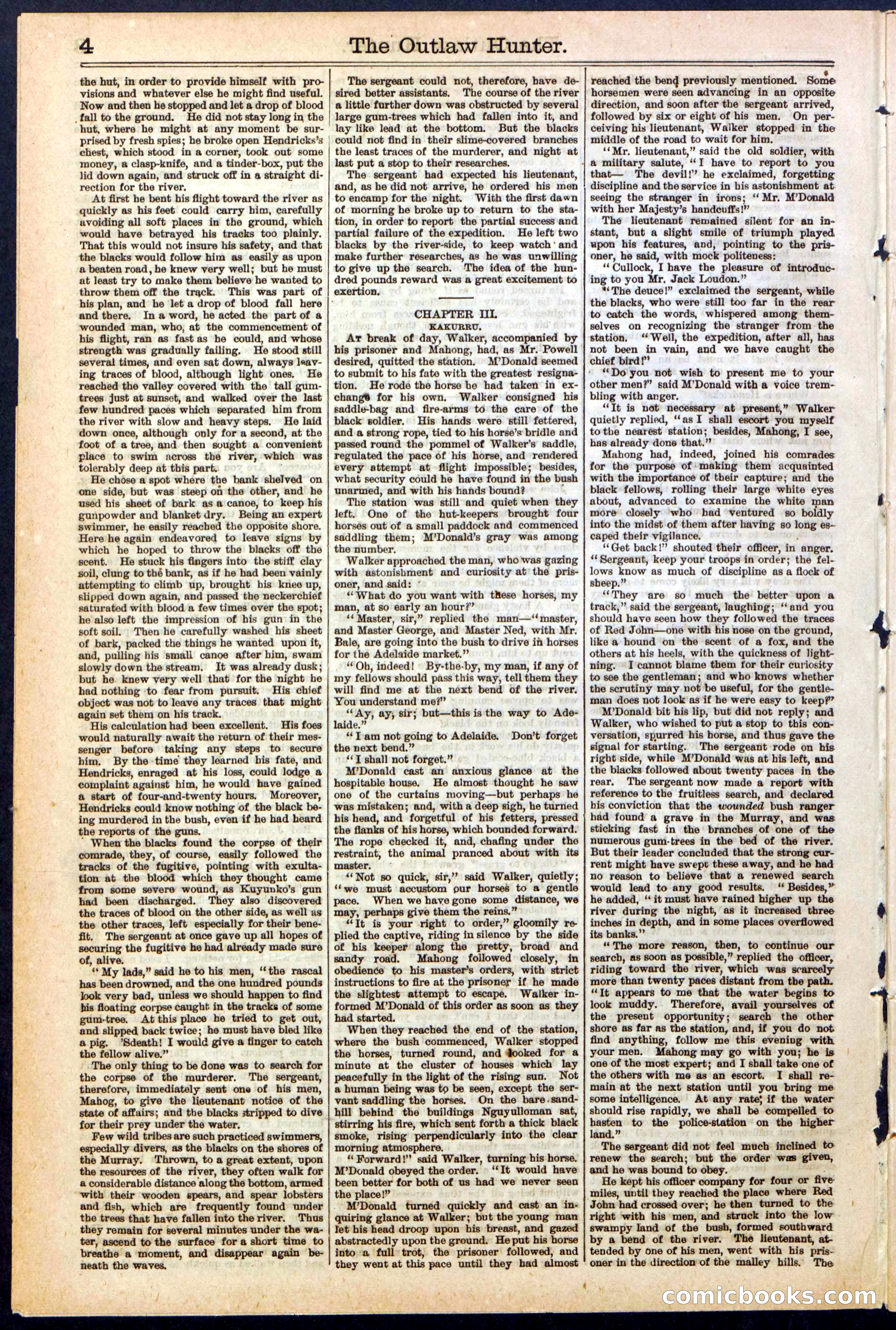
A restored page from Pulp Fiction, 1881. Page through the whole issue in the reader above.
📄 Transcribed text from this page (OCR, searchable)
Machine-transcribed from the original scan — historical spelling and the odd misread are preserved.
ED cata EN a ho” a “b the hut, in order to provide himself with pro- visions and whatever else he might find useful. Now and then he stopped and let a drop of blood _fall to the ground. He did not stay long in the hut, where he might at any moment be sur- prised by fresh spies; he broke open Hendricks’s | chest, which stood in a corner, took out some money, @ clasp-knife, and a tinder-box, put the lid down again, and struck off in a straight di- rection for the river. At first he bent his flight toward the river as quickly as his feet could carry him, carefully avoiding all soft places in the ground, which would have betrayed his tracks too plainly. That this would not insure his safety, and that the blacks would follow him as easily as upon a beaten road, he knew very well; but be must at least try to make them believe he wanted to throw them off the track. This was part of his plan, and he let a drop of blood fall here |’ and there. In a word, he acted the part of a wounded man, who, at the commencement of his flight, ran as fast as he could, and whose strength was gradually failing. He stood still several times, and even sat down, always laav- ing traces of blood, although light ones. He reached the valley covered with the tall gum- trees just at sunset, and walked over the last few hundred paces which separated him from the river with slow and heavy steps. He laid down once, although only for a second, at the foot of a tree, and then sought a convenient place to swim across the river, which was tolerably deep at this part, . He chose a spot where the bank shelved on one side, but was steep on the other, and he used his sheet of bark as a canoe, to keep his gunpowder and blanket dry. Being an expert swimmer, he easily reached the opposite shore. Here he again endeavored to leave signs by which he hoped to throw the blacks off the scent. He stuck his fingers into the stiff clay soil, clung to thé bank, as if he had been vainly attempting to climb up, brought his knee up, slipped down again, and passed the neckerchief saturated with blood a few times over the spot; he also left the impression of his gun in the soft soil. Then he carefully washed his sheet of bark, packed the things he wanted upon it, and, pulling his small canoe after him, swam slowly down the stream. It was already dusk; but he. knew very well that for the night he had nothing to fear from pursuit. His chief object was not to leave any traces that might again set them on his track. His calculation had been excellent. His foes would naturally await the return of their mes- senger before taking any steps to secure him, By the time they learned bis fate, and Hendricks, enraged at his loss, could lodge a complaint against him, he would have gained a start of four-and-twenty hours. Moreover, Hendricks could know nothing of the black be- ing murdered in the bush, even if he had heard the reports of the guns. When the blacks found the corpse of their comrade, they, of course, easily followed the tracks of the fugitive, pointing with exulta- tion at the blood which they thought came from some severe wound, as Kuyunko’s gun had been discharged. They also discovered the traces of blood on the other side, as well as the other traces, left especially for their bene- fit. The sergeant at once gave up all hopes of securing the fugitive he had already made sure of, alive. ** My lads,” said he to his men, “‘the rascal has been drowned, and the one hundred pounds look very bad, unless we should happen to find his floating corpse caught in the tracks of some gum-tree. At this place he tried to get out, and slipped back twice; he must have bled like a pig. ‘Sdeath! I would give a finger to catch the fellow alive.” The only thing to be done was to search for the corpse of the murderer. The sergeant, therefore, immediately sent one of his men, Mahog, to give the lieutenant notice of the state of affairs; and the blacks stripped to dive for their prey under the water. Few wild tribes are such practiced swimmers, especially divers, as the blacks on the shores of the Murray. Thrown, to a great extent, upon the resources of the river, they often walk for a considerable distance along the bottom, armed with their wooden spears, and spear lobsters and fish, which are frequently found under the trees that have fallen into the river. Thus they remain for several minutes under the wa- ter, ascend to the surface for a short time to breathe a moment, and disappear again be- neath the waves. The Outlaw Hunter. The sergeant could not, therefore, have de- sired better assistants. The course of the river a little further down was obstructed by several large gum-trees which had fallen into it, and lay like lead at the bottom. But the blacks could not find in their slime-covered branches the least traces of the murderer, and night at last put a stop to their researches. The sergeant had expected his lieutenant, and, as he did not arrive, he ordered his men to encamp for the night. With the first dawn of morning he broke up to return to the sta- tion, in order to report the partial success and partial failure of the expedition. He left two blacks by the river-side, to keep watch‘ and make further researches, as he was unwilling to give up the search. The idea of the hun- dred pounds reward was a great excitement to exertion, CHAPTER IIL KAKURRU. At break of day, Walker, accompanied by his prisoner and Mahong, had, as Mr. Powell desired, quitted the station. M’Donald seemed to submit to his fate with the greatest resigna- tion. He rode the horse he had taken in ex- changé for his own. Walker consigned his saddle-bag and fire-arms to the care of the black soldier. His hands were still fettered, and a strong rope, tied to his horse’s bridle and passed round the pommel of Walker’s saddle, regulated the pace of his horse, and rendered every attempt at flight impossible; besides, what security could he have found in the bush unarmed, and with his hands bound? The station was still and quiet when they left. One of the hut-keepers brought four horses out of a small paddock and commenced saddling them; M’Donald’s gray was among the number. Walker approached the man, who was gazing with astonishment and curiosity at the pris- oner, and said: ° “What do you want with these horses, my man, at so early an hour?” ‘¢ Master, sir,” replied the man—‘‘ master, and Master George, and Master Ned, with Mr. Bale, are going into the bush to drive in horses for the Adelaide market.” “Oh, indeed! By-the-by, my man, if any of my fellows should pass this way, tell them they will find me at the next bend of the river. You understand me?” “Ay, ay; sir; but—this is the way to Ade- laide.” “Tam not going to Adelaide. Don’t forget the next bend.” ‘‘T shall not forget.” M’Donald cast an anxious glance at the hospitable house. He almost thought he saw one of the curtains moving—but perhaps he was mistaken; and, with a deep sigh, he turned his head, and forgetful of his fetters, pressed the flanks of his horse, which bounded forward. The rope checked it, and, chafing under the restraint, the animal pranced about with its master, — ‘‘Not so quick, sir,’’ said Walker, quietly; ‘““we must accustom pur horses to a gentle pace. When we have gone some distance, we may, perhaps give them the reins,” “Tt is your right to order,” gloomily re- plied the captive, riding in silence by the side of his keeper along the pretty, broad and sandy road. Mahong followed closely, in obedience to his master’s orders, with strict instructions to fire at the prisoner if he made the slightest attempt to escape. Walker in- formed M’Donald of this order as soon as they had started. When they reached the end of the station, where the bush commenced, Walker stopped the horses, turned round, and @ooked for a minute at the cluster of houses which lay peacefully in the light of the rising sun. Not a human being was to be seen, except the ser- vant saddling the horses. On the bare.sand- hill behind the buildings Nguyulloman sat, stirring his fire, which sent forth a thick black smoke, rising perpendicularly into the clear morning atmosphere. “ Forward!” said Walker, turning his horse. M’Donald obeyed the order. ‘‘It would have been better for both of us had we never seen the place!” : 7 M’Donald turned quickly and cast an in- quiring glance at Walker; but the young man let his head droop upon his breast, and gazed abstractedly upon the ground. He put his horse into a full trot, the prisoner followed, and they went at this pace until they had almost ——— ee eee a eee rr ~ mney reached the bend previously mentioned. Some horsemen were seen advancing in an opposite direction, and soon after the sergeant arrived, followed by six or eight of his men. On per- ceiving his lieutenant, Walker stopped in the middle of the road to wait for him. ‘*Mr. lieutenant,” said the old soldier, with a military salute, ‘‘I have to report to you that— The devil!’ he exclaimed, forgetting discipline and the service in his astonishment at seeing the stranger in irons; ‘‘ Mr, M’Donald with her Majesty’s handcuffs!” The lieutenant remained silent for an in- stant, but a slight smile of triumph played upon his features, and, pointing to the pris- oner, he said, with mock politeness: ‘“Cullock, I have the pleasure of introduc- ing to you Mr, Jack Loudon.” “*The deuce!” exclaimed the sergeant, while the blacks, who were still too far in the rear to catch the words, whispered among them- selves on recognizing the stranger from the station. ‘Well, the expedition, after all, has not been in vain, and we have caught the chief bird!” “Do you not wish to present me to your other men?” said M’Donald with a voice trem- bling with anger. “Tt is not necessary at present,” Walker quietly replied, ‘‘as I shall escort you myself tothe nearest station; besides, Mahong, I see, has already done that.” Mahong had, indeed, joined his comrades for the purpose of making them acquainted with the importance of their capture; and the black fellows, rolling their large white eyes about, advanced to examine the white man more closely ‘who had ventured so boldly into the midst of them after having so long es- caped their vigilance. , “Get back!” shouted their officer, in anger. ‘Sergeant, keep your troops in order; the fel- lows know as much of discipline as a flock of sheep.” ‘“‘They are so much the better upon a track,” said the sergeant, laughing; ‘‘and you should have seen how they followed the traces of Red John—one with his nose on the ground, like a hound on the scent of a fox, and the others at his heels, with the quickness of light- ning. I cannot blame them for their curiosity to see the gentleman; and who knows whether the scrutiny may not be useful, for the gentie- man does not look as if he were easy to keep?’ M’Donald bit his lip, but did not reply; and Walker, who wished to put a stop to this con- versation, spurred his horse, and thus gave the signal for starting. The sergeant rode on his right side, while M’Donald was at his left, and the blacks followed about twenty paces in the rear. The sergeant now made a report with reference to the fruitless search, and declared his conviction that the wounded bush ranger had found a grave in the Murray, and was sticking fast in the branches of one of the numerous gum-trees in the bed of the river. But their leader concluded that the strong cur- rent might have swept these away, and he had no reason to believe that a renewed search would lead to any good results. ‘ Besides,” he added, “it must have rained higher up the river during the night, as it increased three inches in depth, and in some places overflowed its banks.” ‘““The more reason, then, to continue our search, as soon as possible,” replied the officer, riding toward the river, which was more than twenty paces distant from the path. “Tt appears to me that the water begins to look muddy. Therefore, avail yourselves of the present opportunity; search the other shore as far as the station, and, if you do not find anything, follow me this evening with your men. Mahong may go with you; he is one of the most expert; and I shall take one of the others with me as an escort. I shall re- main at the next station until you bring me some intelligence. At any rate} if the water should rise rapidly, we shall be compelled to oe to the police-station on the higher and.” ee, The sergeant did not feel much inclined to renew the search; but the order was given, and he was bound to obey. pa wvageik He kept his officer company for four or five: miles, until they reached the place where Red John had crossed over; he then turned to the right with his men, and struck into the low swampy land of the bush, formed southward by a bend of the river. ‘The lieutenant, at- tended by one of his men, went with his pris- oner in the direction of the malley hills. The micboo!l , oe Cco S.C!