
Pulp Fiction, 1881 · page 28 of 32
Beadle's New York Dime Library, No. 136 — page 28: what you’re looking at
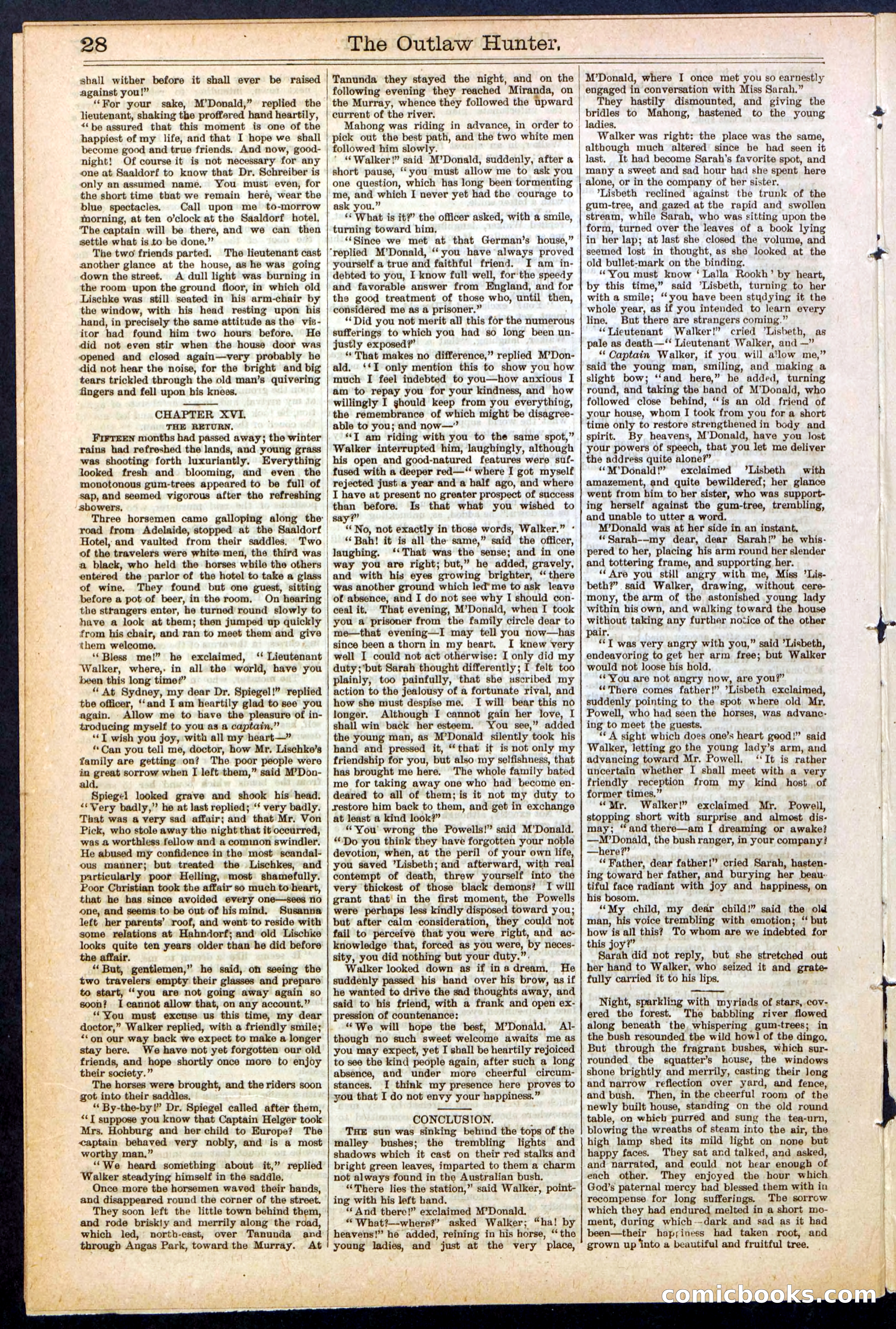
A restored page from Pulp Fiction, 1881. Page through the whole issue in the reader above.
📄 Transcribed text from this page (OCR, searchable)
Machine-transcribed from the original scan — historical spelling and the odd misread are preserved.
= > ia hu. A ce 28 2 eee "4 The Outlaw Hunter, shall wither before it shall ever be raised | Tanunda they stayed the night, and on the | M’Donald, where I once met you so earnestly following evening they reached Miranda, on | engaged in conversation with Miss Sarah,” against you!” ‘‘For your sake, M’Donald,” replied the lieutenant, shaking the proffered hand heartily, “be assured that this moment is one of the happiest of my life, and that I hope we shall become good and true friends. And now, good- night! Of course it is not necessary for any one at Saaldorf to know that Dr. Schreiber is only an assumed name. You must even, for the short time that we remain here, wear the blue spectacles. Call upon me to-morrow tmorning, at ten o’clock at the Saaldorf hotel, ‘The captain will be there, and we can then settle what is to be done.” The two friends parted. The lieutenant cast another glance at the house, as he was going down the street. A dull light was burning in the room upon the ground floor, in which old Lischke was still. seated in his arm-chair by the window, with his head resting upon his hand, in precisely the same attitude as the vis- itor had found him two hours before. He did not even stir when the house door was opened and closed again—very probably he did not hear the noise, for the bright and big tears trickled through the old man’s quivering fingers and fell upon bis knees. CHAPTER XVI THE RETURN. Firtren months had passed away; the winter rains had refreshed the lands, and young grass was shooting forth luxuriantly. Everything looked fresh and blooming, and even the monotonous gum-trees appeared to be full of sap, and seemed vigorous after the refreshing ‘showers. Three horsemen came galloping along the road from Adelaide, stopped at the Saaldorf Hotel, and vaulted from their saddles. Two of the travelers were white men, the third was a black, who held the horses while the others entered the parlor of the hotel to take a glass of wine, They found but one guest, sitting before a pot of beer, in the room. On hearing the strangers enter, he turned round slowly to have a look at them; then jumped up quickly from his chair, and ran to meet them and give them welcome. ‘* Bless me!” he exclaimed, ‘ Lieutenant ‘Walker, where, in all the world, have you been this long time?” “At Sydney, my dear Dr. Spiegel!” replied the officer, ‘‘and I am heartily glad to see you again. Allow me to have the pleasure of in- troducing myself to you as a captain,” ‘T wish you joy, with all my heart—’ ‘*Can you tell me, doctor, how Mr. Lischke’s family are getting on? The poor people were in great sorrow when I left them,” said M’Don- ald. Spieg+l looked grave and shook his head. “*Very badly,” he at last replied; ‘“‘ very badly. That was a very sad affair; and that Mr. Von Pick, who stole away the night that it occurred, was a worthless fellow and a common swindler. He abused my confidence in the most scandal- ous manner; but treated the Lischkes, and particularly poor Helling, most shamefully. Poor Christian took the affair so much to heart, that he has since avoided every one—sees no one, and seems to be out of his mind. Susanna left her parents’ roof, and went to reside with some relations at Hahndorf; and old Lischke looks quite ten years older than he did before affair “ But, gentlemen,” he said, on seeing the two travelers empty their glasses and prepare to start, ‘you are not going away again so soon? I cannot allow that, on any account.” ‘* You must excuse us this time, my dear doctor,” Walker replied, with a friendly smile; *‘on our way back we expect to make a longer stay here. We have not yet forgotten our old friends, and hope shortly once more to enjoy their society.” The horses were brought, and the riders soon got into their saddles. “« By-the-by!” Dr. Spiegel called after them, ‘**T suppose you know that Captain Helger took Mrs. Hohburg and her child to Europe? The captain behaved very nobly, and is a most worthy man,” ‘““We heard something about it,” replied Walker steadying himself in the saddle. Once more the horsemen waved their hands, and disappeared round the corner of the street. They soon left the little town behind them, and rode briskly and merrily along the road, which led, north-east, over Tanunda and through Angas Park, toward the Murray. At / ——_= — - : > 6 - »'* nd 1 - Pe. wa? . peel Wink ee es on a eee the Murray, whence they followed the Upward current of the river. Mahong was riding in advance, in order to pick out the best path, and the two white men followed him slowly. ‘‘Walker!” said M’Donald, suddenly, after a short pause, “‘ you must allow me to ask you one question, which has long been tormenting me, and which I never yet had the courage to ask you.” ‘* What is it?” the officer asked, with a smile, turning toward him, ‘‘Since we met at that German’s house,” replied M’Donald, “you have always proved yourself a true and faithful friend. I am in- debted to you, I know full well, forthe speedy and favorable answer from England, and for the good treatment of those who, until then, considéred me as a prisoner.” ‘‘Did you not merit all this for the numerous sufferings to which you had so long been un- justly exposed?” ‘That makes no difference,” replied M’Don- ald. ‘‘I only mention this to show you how much I feel indebted to you—how anxious I am to repay you for your kindness, and how willingly I ghould keep from you everything, the remembrance of which might be disagree- able to you; and now—” “T am riding with you to the same spot,” Walker interrupted him, laughingly, although his open and good-natured features were suf- fused with a deeper red—‘“‘ where I got myself rejected just a year and a half ago, and where I have at present no greater prospect of success than before. Is that what you wished to say?” “No, not exactly in those words, Walker.” ° ‘‘ Bah! it is all the same,” said the officer, laughing. ‘‘That was the sense; and in one way you are right; but,” he added, gravely, and with his eyes growing brighter, “there was another ground which led*me to ask leave of absence, and I do not see why I should con- ceal it. That evening, M’Donald, when I took you a prisoner from the family circle dear to me—that evening—I may tell you now—has since been a thorn in my heart. I knew Very well I could not act otherwise: I only did my duty ;"but Sarah thought differently; I felt too plainly, too painfully, that she uscribed my action to the jealousy of a fortunate rival, and how she must despise me. I will bear this no longer. Although I cannot gain her love, I shall win back her esteem. You see,” added the young man, as M’Donald silently took his hand and pressed it, “that it is not only my friendship for you, but also my selfishness, that has brought me here. The whole family bated me for taking away one who bad become en- deared to all of them; is it not my duty to restore him back to them, and get in exchange at least a kind look?” “You wrong the Powells!” said M’Donald. “Do you think they have forgotten your noble devotion, when, at the peril of your own life, you saved ‘Lisbeth; and afterward, with real contempt of death, threw yourself into the very thickest of those black demons? I will grant that in the first moment, the Powells were perhaps less kindly disposed toward you; but after calm consideration, they could not fail to perceive that you were right, and ac- knowledge that, forced as you were, by neces- sity, you did nothing but your duty.”. Walker looked down as if inadream, He suddenly passed his hand over his brow, as if he wanted to drive the sad thoughts away, and said to his friend, with a frank and open ex- pression of countenance: “We will hope the best, M’Donald, Al- though no such sweet welcome awaits me as you may expect, yet I shall be heartily rejoiced to see the kind people again, after such a long absence, and under more cheerful circum- stances. I think my presence here proves to you that I do not envy your happiness.” CONCLUSION. " THE sun was sinking behind the tops of the malley bushes; the trembling lights and shadows which it cast on their red stalks and bright green leaves, imparted to them a charm not always found in the Australian bush. “There lies the station,” said Walker, point- ing with his left band. ** And there!” exclaimed M’Donald. | “What?—-where?” asked Walker; “ha! by heavens!” he added, reining in his horse, ‘the young ladies, and just at the very place, ! 7 i - } ™ is . : ‘ ; ’ 4 > ae - wo | erty" te They hastily dismounted, and giving the bridles to Mahong, hastened to the young | ladies, Walker was right: the place was the same, | although much altered since he had seen it last. It had become Sarah’s favorite spot, and many a sweet and sad hour had she spent here alone, or in the company of her sister. Lisbeth reclined against the trunk of the gum-tree, and gazed at the rapid and swollen stream, while Sarah, who was sitting upon the form, turned over the leaves of a book lying in her lap; at last she closed the volume, and seemed lost in thought, as she looked at the old bullet-mark on the binding. ‘You must know ‘ Lalla Rookh’ by heart, by this time,” said "Lisbeth, turning to her with a smile; “ you have been studying it the whole year, as if you intended to learn every line. But there are strangers coming.” ‘Lieutenant Walker!” cried "Lisbeth, as pale as death—‘“‘ Lieutenant Walker, and —” ‘Captain Walker, if you will allow me,” said the young man, smiling, and making a slight bow; ‘‘and here,” he added, turning round, and taking the hand of M’DonalJd, who followed close behind, ‘is an old friend of your house, whom I took from you for a short time only to restore strengthened in body and spirit. By heavens, M’Donald, have you lost your powers of speech, that you let me deliver the address quite alone?” “M’Donald!” exclaimed ‘Lisbeth with amazement, and quite bewildered; her glance went from him to her sister, who was support- ing herself against the gum-tree, trembling, and unable to utter a word. M’Donald was at her side in an instant, ‘*Sarah-—my dear, dear Sarah!” he whis- pered to her, placing his arm round her slender and tottering frame, and supporting her. ‘Are you still angry with me, Miss ’Lis- beth?” said Walker, drawing, without cere- mony, the arm of the astonished young lady within his own, and walking toward the house without taking any further notice of the other pair. ‘*T was very angry with you,” said "Lisbeth, endeavoring to get her arm free; but Walker would not loose his hold, ‘You are not angry now, are you?” “There comes father!” "Lisbeth exclaimed, suddenly pointing to the spot where old Mr, Powell, who had seen the horses, was advanc- ing to meet the guests. ‘* A sight which does one’s heart geod!” said Walker, letting go the young lady’s arm, and advancing toward Mr. Powell, ‘It is rather uncertain whether I shall meet with a very friendly reception from my kind host. of former times,” “Mr, Walker!” exclaimed Mr. Powell, stopping short with surprise and almost dis- may; “and there—am I dreaming or awake? —M’Donald, the bush ranger, in your company? —here?” ‘Father, dear father!” cried Sarah, hasten- ing toward ber father, and burying her beau- tiful face radiant with joy and happiness, on his bosom. “My child, my dear child!” said the old man, his voice trembling with emotion; ‘ but how is all this? To whom are we indebted for this joy?” Sarah did not reply, but she stretched out her hand to Walker, who seized it and grate- fully carried it to his lips. Night, sparkling with myriads of stars, cov- ered the forest. The babbling river flowed along beneath the, whispering gum-trees; in the bush resounded the wild how] of the dingo, But through the fragrant bushes, which sur- rounded the squatter’s house, the windows shone brightly and merrily, casting their long and narrow reflection over yard, and fence, and bush. Then, in the cheerful room of the newly built house, standing on the old round table, on which purred and sung the tea-urn, blowing the wreaths of steam into the air, the high lamp shed its mild light on none but happy faces. They sat and talked, and asked, and narrated, and could not hear enough of each other. They enjoyed the hour which God’s paternal mercy had blessed them with in recompense for long sufferings. The sorrow which they bad endured melted in a short mo- ment, during which--dark and sad as it had been—their hap;yiness had taken root, and grown up ‘into a beautiful and fruitful tree. . ¢ ma ¥ eco) aa} | | | |