
Pulp Fiction, 1881 · page 32 of 32
Beadle's New York Dime Library No. 125 — page 32: what you’re looking at
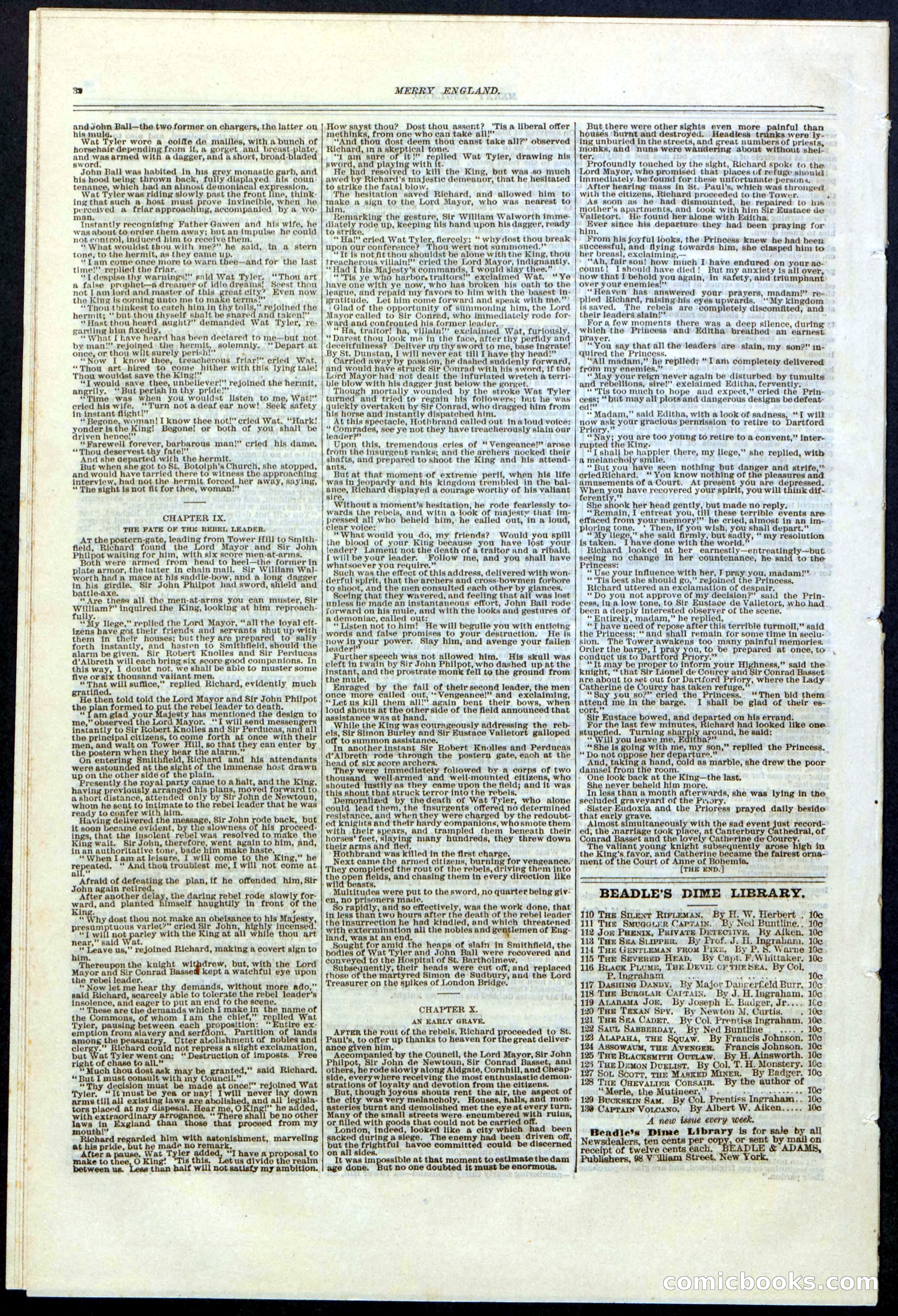
A restored page from Pulp Fiction, 1881. Page through the whole issue in the reader above.
📄 Transcribed text from this page (OCR, searchable)
Machine-transcribed from the original scan — historical spelling and the odd misread are preserved.
= etter alent tee ; sn SE ~ — -- = - — a ete tine ahsivailineme einen ee a ~- et Es — ane lone Ball—the two former on chargers, the latter on s mule, Wat Tyler wore a colilfe de mailles, with a bunch of horsehair depending from It, a gorget and breast-plate, and Mn armed with a dagger, and a short, broad-bladed sword, John Ball was habited in his grey monastic garb, and his hood being thrown back, fully displayed hls coun- tenance, which had an alinost demoniacal expression. Wat Tyler was riding slowly past the front line, think- ing that such a host must prove invincible, when he perceived a friar approaching, accompanied by a wo- man. Instantly recognizing Father Gawen and his wife, he was about to order them away; but an impulse he could not control, induced him to receive them. * What wouldst thou with me?” he said, tone, to the hermit, as they came up. “Tam come once more to warn thee—and for the last time!"’ rephed the friar. “T despise thy warnings!" snid Wat Tyler. ‘Thou art a false prophet—a dreamer of idledreams! Seest thou not [am lord and master of this great city? Even now the King Is coming unto me to make terms!” Thou thinkest to catch him in thy tolls,” rejoined the hermit; “ but thou thyself shalt be snared and taken!” “Hast thou heard aught?” demanded Wat Tyler, re- garding him fixedly. “What [have heard has been declared to me—but not by man!" rejoined the hermit, solemnly. * Depart at onee, or thou wilt surely perish!” ‘ “Now I know thee, treacherous friar!" cried Wat. “Thou art hired to come hither with this lying tale! Thou wouldst save the King!” , , “T would save thee, unbellever!” rejoined the hermit, angrily. ‘* But perish in thy pride!” “Time was when you wouldst listen to me, Wat!" cried his wife. “Turn not adeaf ear now! Seek safety in instant flight!” “ Begone, woman! I know thee not!” cried Wat. “Hark! yonder is the King! Begone! or both of you shall be driven hence!” * Farewell forever, barbarous man!” cried his dame. “Thou deservest thy fate!” And she departed with the hermit. But when she got to St. Botolph's Church, she stopped, and would have tarried there to witness the approaching interview, had not.the hermit forced her away, saying, “ The sight is not fit for thee, woman!” in a stern CHAPTER IX, THE FATE OF TH REBEL LEADER, At the postern-gate, leading from Tower Hill to Smith- field, Richard found the Lord Mayor and Sir John Philpot waiting for him, with six score men-at-arms. Both were armed from head to heel—the former in plate armor, the tatter in chain mail. Sir Wiliam Wal- worth had a mace at his saddle-bow, and a long dagger in his girdle. Sir John Philpot had sword, shield and battle-axe. “Are these all the men-at-arms you can muster, Str William?” inquired the King, looking at him repreach- fully. “iy liege,” replied the Lord Mayor, “all the loyal cit- izens have got their friends and servants shut up with them in thelr houses; but they are prepared to sally forth instantly, and hasten to Smithfield, should the alarm be given. Sir Robert Knolles and Sir Perducas d’Albreth will each bring six score good companions. In this way, I doubt not, we shall be able to muster some five or six thousand valiant men. “That will suffice,” replied Richard, evidently much gratified. He then told told the Lord Mayor and Sir John Philpot the plan formed to put the rebel leader to death. “Tam glad your esty has mentioned the design to me,” observed the Lord Mayor. ‘I will send messengers instantly to Sir Robert Knolles and Sir Perducas, and all the principal citizens, to come forth at once with their men, and waiton Tower Hill, so that they can enter by. the postern when they hear the alarm.” On entering Smithfield, Richard and his attendants were astounded at the sight of the immense host drawn up on the other sidé of the plain, Presently the royal party came to a halt, and the King, having previously arranged his plans, moved forward to a short distance, attended only by Sir John de Newtoun, whom he sent to intimate to the rebel leader that he was ready to confer with him. Having delivered the message, Sir John rode back, but it soon became evident, by the slowness of his proceed- ings, that the Iusolent rebel was resolved to make the King wait. Sir John, therefore, went again to him, and, in an authoritative tone, bade him make haste, “When Lam at leisure, I will come to the King,” he re ented, “ And thot troublest me, I will not come at Afraid of defeating the plan,if he offended him, Sir John again retired, After another Geiax the daring rebel rode slowly for- ward, and planted imself haughtily in front of the ing. , * Why dost thou not make an obeisance to his Majesty, presumptuous varlet?” cried Sir John, highly incensed. oF | will not parley with the King at all while thou art near,” said Wat. “ Leave us,” rejoined Richard, making a covert sign to him. Thereupon the knight withdrew, but, with the rd Mayor and Sir Conrad Basse® kept a watchful eye iene the rebel leader, * Now let me hear thy demands, without more ado,” said Richard, scarcely able to tolerate the rebel leader's insolence, and eager to put an end to the scene. “ These are the demands which I make in the name of the Commons, of whom Iam the chief,” replied Wat Tyler, pausing between each proposition: ‘Entire ex- emption from slavery and serfdom. Partition of lands among the peasantry. Utter abolishment of nobles and clergy.” Richard could not repress a slight exclamation, but Wat Tyler wenton; “Destruction of imposts. Free right of chase to all.” ‘Much thou dost ask may be granted,” said Richard, “But I must consult with my Council.” “ on must be made at once!” rejoined Wat Tyler. “It must be yea or nay! Iwill never lay down arms till all existing laws are anolished, and all legisla- ‘thee ; wdinasy a¢ ~ ce. "there sha Thee oeher with ex : ere laws in land than that proceed from my mee, ed him with astonishment, marveling we eo or Wat 7 ler ad ty have a proposal to wianets ¢ ee, O King! Iris iis tater divide the realm between us. Less than half will not satisfy my ambition. ee —— —— — — ———— ———— —— ———— on an ——EE——————— ee NE SS ee a . a MERRY ENGLAND. How sayst thou? Dost thou assent? ‘Tis a liberal offer methinks, from one who can take all!” “And thou dost deem thou canst take all?” observed Richard, in a skeptical tone. ‘“) am sure of it!” replied Wat Tyler, drawing his sword, and playing with it. He had resolved to kill the King, but was.so much awed by Richard's majestic demeanor, that he hesitated to strike the fatal blow, The hesitation saved Richard, and allowed him to i au sign to the Lord Mayor, who was nearest to m. Remarking the gesture, Sir Willlam Walworth imme- diately rode up, keeping his hand upon his dagger, ready to strike. “Hal” cried Wat Tyler, flercely; “ why dost thou break upon our conference? Thou wert not summoned.” “Tt is not fit thou shouldst be alone withthe King, thou treacherous villain!” cried the Lord Mayor, indignantly, ‘Had I his Majesty’s commands, I would slay thee.” “Ts ye who harbors traitors!” exclaimed Wat. “Ye have one with ye now, who has broken his oath to the league, and repaid my favors to him with the basest in- gratitude, Let him come forward and speak with me.,’”’’ -Glad of the opportunity of stnmoning him, the Lord Mayor called to Sir Conred, who immediately rode for- ward and confronted his former leader. ‘Ha, traitor! ha, villain!’ exclaimed Wat, furiously. “Darest thou look me In the face, after thy perfidy and deceitfulness? Deliver up thy sword to me, base Ingrate! By St. Dunstan, I will never eat till [have thy head!” Carried awey by passion, he dashed suddenly forward, and would have struck Sir Conrad with his sword, if the Lord Mayor had not dealt the infuriated wretch a terri- ble blow with his dagger just below the gorget. Though mortally wounded by the stroke Wat Tyler turned and tried to regain his followers; but he was quickly overtaken by Sir Conrad, who dragged him from his horse and instantly dispatched him, At this spectacle, Hothbbrand called out ina loud voice: i piso ete see ye not they have treacherously slain our eader?” Upon this, tremendous cries of “ Vengeance!” arose from the insurgent ranks; and the archers nocked their shafts, and prepared to shoot the King and his attend- ants, But at that moment of extreme peril, when his life was in jeopardy and his kingdom trembled in the bal- one Richard displayed a courage worthy of his valiant sire, Without a moment’s hesitation, he rode fearlessly to- wards the rebels, and with a look of majesty that Im- pressed all who beheld him, he called out, in a loud, clear voice: “What would you do, my friends? Would you spill the blood of your King because you have lost your leader? Lament not the death of a traitor and a ribald. [ will be your leader. Follow me, and you shall have whatsoever you require.” Such was the effect of this addreas, delivered with won- derful spirit, that the archers and cross-bowmen forbore to shoot, and the men consulted each other by eee. Sceing that they wavered, and feeling that all was lost unless he made an instantaneous effort, John Ball rode forward on his mule, and with the looks and gestures of a demoniac, called out: * Listen not to him! He will beguile you with enticing words and false promises to your destruction. He is now in your power. Slay him, and avenge your fallen leader!’ Further speech was not allowed him. His skull was cleft in twain by Sir John Philpot, who dashed up at the i nee and the prostrate monk fell to the ground from the mule. Enraged by the fall of their second leader, the men once more Called out, ** Vengeance!” and exclaiming, “Let us kill them all!” again bent their bows, when loud shouts at the other side of the fleld announced that assistance was at hand. While the King was couregeously addressing the reb- els, Sir Simon Burley and Sir Eustace Valletort galloped off to summon assistance. In another instant Sir Robert Knolles and Perducas d’Albreth rode through the postern gate, each at the head of six score archers. They were immediatety followed by a corps of two thousand well-armed and well-mounted citizens, who shouted lustily as they came upon the fleld; and it was this shout that struck terror into the rebels. Demoralized by thedeath of Wat Tyler, who alone could lead them, the Insurgents offered no determined resistance, and when they were charged by the redoubt- ed knights and their hardy companions, whosmote them with thelr spears, and trampled them beneath their horses’ feet, slaying many hundreds, they threw down their arms and fled. ‘Hothbrand was killed in the first charge. Next came the armed citizens, burning for vengeance. They completed the rout of the rebels, driving them into the open flelds, and chasing them in every direction like wild beasts. Multitudes were put to the sword, no quarter being giv- en, no prisoners made. So ra idly, and so effectively, was the work done, that in less than two hours after the death of the rebel leader the insurrection he had kindled, and which threatened with extermination all the nobles and gentlemen of Eng- land, was at an end, Sought for amid the heaps of slain in Smithfield, the bodies of Wat Tyler and John Ball were recovered and conveyed to the Hospital of St. Bartholmew. Subsequently, their heads were cut off, and replaced those of the martyred Simon de Sudbury, and the Lord Treasurer on the spikes of London Bridge. CHAPTER X. AN EARLY GRAVE. A¥YTeER the rout of the rebels, Richard proceeded to St. Paul's, to offer up thanks to heaven for the great deliver- ance given him. Accompanied by the Council, the Lord Mayor, Sir John Philpot, Sir John de Newtoun, Sir Conrad Basset, and others, he rode slowly along Aldgate, Cornhill, and Cheap- side, every where receiving the most enthusiastic demon- strations of oyalty and devotion from the citizens. But, though joyous shouts rent the air, the aspect of the city was very melancholy. Houses, halls, and mon- asteries burnt and demolished met the eye at every turn. Many of the small streets were encumbered with ruins, or filled with goods that could not be carried off. London, indeed, looked like a city which had been sacked during a siege. The enemy had been driven off, but the frightful havoc committed could be discerned on all sides. sible at that moment to estimate the dam It was im age done. But no one doubted it must be enormous. a ere ee ee ee ee But there were other sights even more painful than houses ‘burnt and destroyed. Headless t ks were ly- ing unburied in the streets, and great numbers of priests, oon and nuns were wandering about without shel- er. Profoundly touched by the sight, Richard spoke to the Lord Mayor, who promised that places of refuge should Immediately. be‘found for these unfortunate persona, After hearing mass in St. Paul's, which was thronged with the citizens, Richard proceeded to the Tower. As soon as he had dismounted, he repaired to bias mother's apartments, and took with him Sir Eustace de Valtletort. He found her alone with Editha. + ms since his departure they had been praying for ulm, From his joyful looks, the Princess knew he had been successful, and flying towards him, she clasped him to her breasl, exclaiming,— “Ah, fair son! how much I have endured on your ac- count! Ishould have died! But my anxiety Is all over, now that I behold you again, In safety, and triumphant over your enemies!’ “Heaven has answered your prayers, madam!” re- lied Richard, raising his eyes + dene g “My kingdom ssaved. The rebels are completely discomfited, and their leaders slain!” For a few moments there was a deep silence, during which the Princess and Editha breathed an earnest pruver. “You say that all the leaders are slain, my son?” in- quired the Princess. “All madam,” he replled; “TI arn completely delivered from my enemies.” “ May your reign never again be disturbed by tumults and rebellions, sire!’ exclaimed Editha, fervently. “"Tis too much to hope and expect,” cried the Prin- cess; “but may all plots and dangerous designs be defeat- ed!’ ** Madam,” said Editha, with a look of sadness, “I will sy ask your gracious pernrission to retire to Dartford riory. - vay’ you are too young to retire to a convent,” Inter- rupted the King. “T shall be happier there, my liege,” she replied, with a melancholy smile. “But you have seen nothing but danger and strife,” criedRichard. ‘ You know nothing of the pleasures and amusements of a Court. At present you are depressed. When fon have recovered your spirit, you will think dif- ferent oe She shook her head gently, but made no reply. “Remain, I entreat you, till these terrible events are effaced from your memory!” he cried, almost in an im- ploring tone. ‘* Then, if you wish, you shall depart.” “My liege,” she said firmly, but sadly, “ my resolution is taken. I have done with the world.” Richard looked at her earnestly—entreatingly—but. seeing no change in her countenance, he waid to the Princess: “Use your influence with her, JT pray you, madam!” “Tis best she should go,” rejoined the Princess. Richard uttered an exclamation of despair. *Do you not approve of my decision?” said the Prin- cess, Ina low tone, to Sir Eustace de Valletort, who had been a deeply interested observer of the scene. “ Entirely, madam,” he replied, “T have need of repose after this terrible turmoil,” said the Princess; “‘and shall remain for some time in seclu- sion. The Tower awakens too many painful memories. Order the bere, I pray por to be prepared at once, to conduct us to Dartfo 1ory.”” “It may be proper to inform your Highness,” said the knight, “ that Sir Lionel de Courey and Sir Conrad Basset are about to set out for Dartford riory, where the Lady Catherine de Courcy has taken refuge.” “Say you so?” cried the Princess. “Then bid them attend me in the barge. I shall be glad of their es- vort,”” Sir Eustace bowed, and departed on his errand. For the last few minutes, ichard had looked like one stupefied. Turning shar By aroun he said: ** Will you leave me, Editha?’”’ “She is going with me, my son,” replied the Princess. “Do not oppose her departure.” And, taking a hand, Cold as marble, she drew the poor damsel from the room. » One look back at the King—the last. She never beheld him more, In less than a month afterwards, she was lying in the secluded graveyard of the Priory. Sister Eudoxia and the Prioress prayed daily beside that early grave. Almost simultaneously with the sad event just record- ed, the marriage took place, at Canterbury Cathedral, of Conrad Basset and the lovely Catherine heen & The valiant young knight subsequently arose high in the King’s favor, and Catherine became the fairest orna- ment of the Court of Anne of Bohemia, [THE END.] BEADLE’S DIME LIBRARY. 110 Tue Sttenr RIFLEMAN, PEs, W. Herbert . 10c 111 THe Savaeurr Capra. By Ned Buntline., 10¢ 112 Jom Paenrx, Private Detecitve. Ky Aiken. 10¢ 113 Tae Sxa Suuprar. By Prof. J, H. Ingraham. 10¢ 114 THe GenTLEMAN FROM Pixs, By P. 5. Warne 10¢ 115 Tur Severep Heap. By Capt. F. Whittaker, 10c 116 Buack PLumn, Tee DEVIL OF THE SEA, By Col, P. Ingraham at wh a a wi 117 Dasuine Danny. By Major Dangerfeld Burr. 118 Tue Buretar Carrain. By J. H. Ingraham. 119 AcAnAMA JOE, By Joseph E. Badger, Jr.... 120 Tue Texan Spy. By Newton M. Curtis. ; 121 THe Sea Caper. By Col. Prentiss Ingraham. 122 SavL Sapperpay, By Ned Buntline...... . 123 ALAPAHA, THE Squaw. By Francis Johnson. 124 ASSOWAUM, THE AveNarrR, Francis Johnson, 125 THe Buacksurrn Ourtaw. By H. Ainsworth. 125 Tuk Demon Dugtist. By Col, T. H, Monstery. 10c 127 Sou Scorr, tur Maskep Miner. By Badger, 10c 128 ots ale Pann By the author of one ‘Merle, the Mutineer,”_ . Po tung ee nee 129 Buonsxin Sam. By Col. Prentiss Ingraham... 10c 13@ Caprarn Voitcano, By Albert W. Aiken..... 10c A new tssue every week, | Beadle’s Dime Library is for sale by all Newsdealers, ten cents per copy, or sent by mail on receipt of twelve cents each. EADLE & ADAMB, Publishers, 98 V"illiam Street, New (E) 0)(0 (0) (Cc (E(0)