
Pulp Fiction, 1881 · page 29 of 32
Beadle's New York Dime Library No. 125 — page 29: what you’re looking at
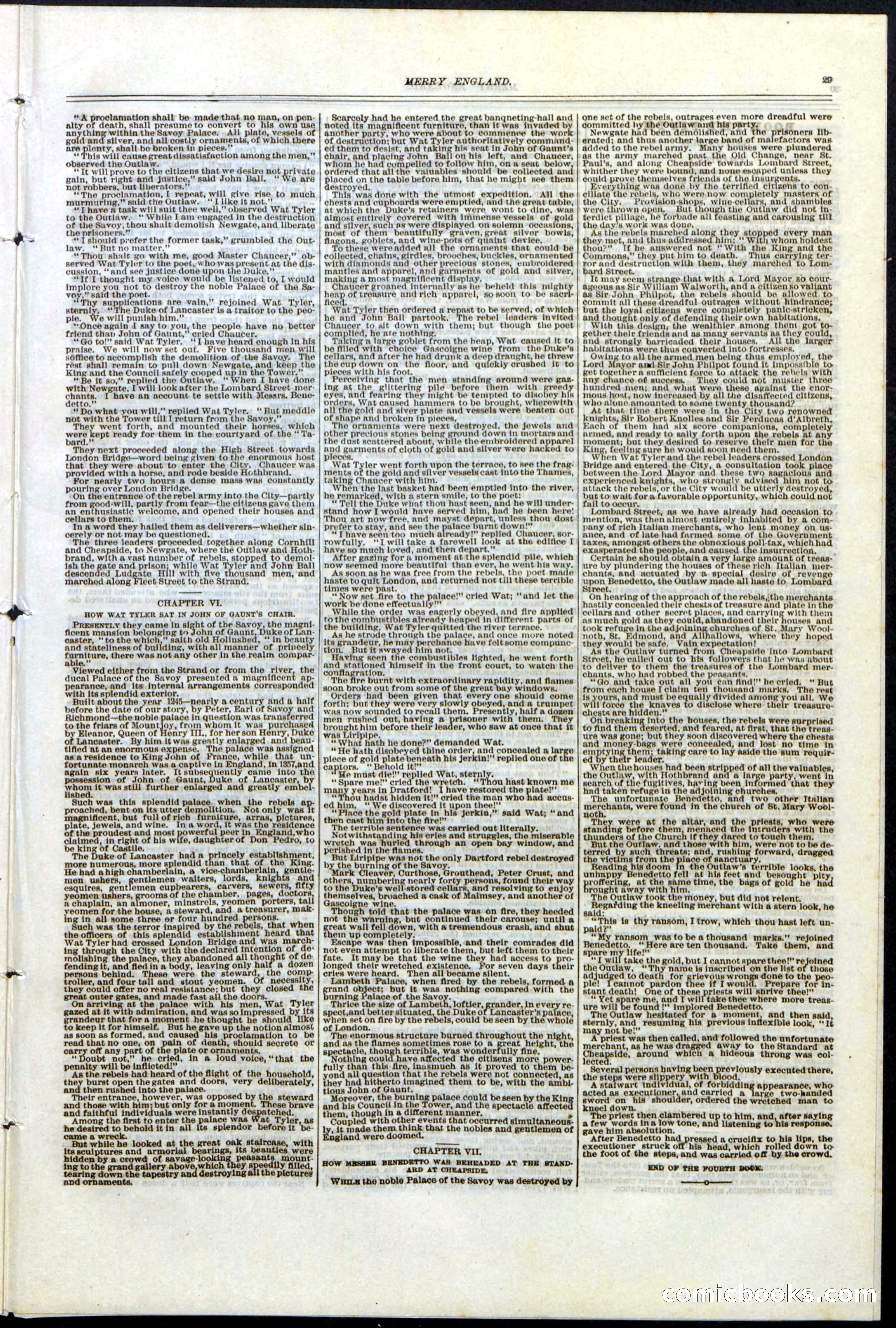
A restored page from Pulp Fiction, 1881. Page through the whole issue in the reader above.
📄 Transcribed text from this page (OCR, searchable)
Machine-transcribed from the original scan — historical spelling and the odd misread are preserved.
ys MERRY ENGLAND. “A proclamation shall be made that no man, on pen. alty of death, shall presumeto convert to his own use i within the Savoy Palace. All plate, vessels of gold and silver, and all costly ornaments, of which there are plenty, shall be broken in pieces.” “This will cause great dissatisfaction among the men,” observed the Outlaw. **It will prove to the citizens that we desire not private gain, but right arid justice,” said John Ball, “ We are not robbers, but berators."’ “The proclamation, [| repeat, will give rise to much murmuring,” said the Outlaw. “LT like it not,” “T have a task will suit thee well,” observed Wat Tyler to the Outlaw. “ While Lam engagee in the destruction of the Savoy, thou shalt demolish Newgate, and liberate the prisoners.” “TIT should prefer the former task,” grumbled the Out- law. “But no matter,” “Thou shalt go with me, good Master Chaucer,” ob- served Wat Tyler to the poet, who was present at the dis- cussion, “and see justice done upon the Duke.” “If I thought my voice would be listened to, I would implore you not to destroy the noble Palace of the Sa- voy,” said the poet. “Thy supplications are vain,” rejoined Wat Tyler, sre “The Duke of Lancaster is a traitor to the peo- ple. e will punish him.” “Once again 1 say to you, the friend than John of Gaunt,” eried Chaucer. “Go to!” said Wat Tyler. ‘*I bave heard enough In his praise. We will now set out. Five thousand men will sOffice to accomplish the demolition of the Savoy. The rést shall remain to pull down Newgate, and keep the King and the Council safely cooped in the Tower.” * Be it so,” replied the Outlaw. ‘“ When I have done with Newgate, I will look after the Lombard Street _mer- Prep have an account te settle with Messrs, Bene- etto.” “Do what you will,” replied Wat Tyler. not with the Tower till I return from the Savoy,” They went forth, and mounted their horses, which wa ept ready for them in the courtyard of the “ Ta- ard.” They next proceeded along the High Street towards London Bridge—word being given to the enormous host that they were about to enter the City. Chaucer was provided with a horse, and rode beside Hothbrand. For nearly two hours a dense mass was constantly pouring over London Bridge. -On the entrance of the rebel army into the City—partly from -will, partly from fear—the citizens gave them an enthusiastic welcome, and opened their houses and cellars to them. In a word they hatled them as deliverers—whether sin- cerely or not may be questioned. The three leaders proceeded together along Cornhill and Cheapside, to Newgate, where the Outlaw and Hoth- brand, with a vast number of rebels, stopped to demol- ish the gate and prison; while Wat Tyler and John Ball descended Ludgate Hill with five thousand men, and marched along Fleet Street to the Strand. ple have no better CHAPTER VL HOW WAT TYLER SAT IN JOHN OF GAUNT'S CHAIR. PRESENTLY they came In sight of the Savoy, the magni- ficent mansion belonging to John of Gaunt Duke of Lan- caster, “to the which,” saith old Holinshed, “ in beauty and stateliness of building, with all manner of princely ae there Was not any other in the realm compar- e.”" Viewed either from the Strand or from the river, the ducal Palace of the Savoy_ presented a magnificent ap- pearance, and its internal arrangements corresponded with its splendid exterior, Built about the year 1245—nearly a century and a half before the date of our story, by Peter, Earl of Savoy and Richmond—the noble palace in question was transferred to the friars of Mount{oy, from whom it was purchased by Eleanor, Queen of Henry IIL, for her son Henry, Duke ot Lancaster. By him it was greatly enlarged and beau- tified at an enormous expense. The palace was assigned as a residence to King John of France, while that un- fortunate monarch was a captive in England, In 1357,and again six years later. It su uently came into the possession of John of Gau uke of Lancaster, b yore it was still further e and greatly embe Such was this splendid palace. when Bg rebels a proached, bent on its utter de ition. Not only was it ificent, but fullofrich furniture, arras, pictures, plate, jewels, and wine. Ina word, it was the r f the udest and most powerful and,who Siaimed, 4n right of his e, pride mre ponent. to Oehe be eee caster hada neely establishment Sa acmmnene that of the King. more bh enema. shane 9 lendid t 7 He had ahigh e ambowaln, a vice-chamnberialn, gentle- ushe ntlemen walters, lords, knights and soquires, rentlemem oun ‘carvers, sewers, fifty rs, ms of the chamber, pages, doctors men wobaplain, an almoner, minstrels, yeomen_ porters, tall yeomen for the house, a steward, and a treasurer, mak- ing in all some three er four hundred persons. was the terror inspired by the rebels, that when the rs of this splendid establishment heard that Wat Tyler had crossed London Bridge and was march- ing through the City with the declared tntention of de: molishing the palace, they abandoned all thougat of de. ding it, and fled in a body, leaving only half a dozen persons behind. were the steward, the comp troller, and four tall and stout yeomen. ty, they could offer no real resistance; but they closed the great outer gates, and made fast all the doors. On arziving: sf the palace with his men, Wat Tyler gazed at it with admiration, and was soimpressed by its ay ery that for a moment he thought he should like keep it for himself. But he gave up the notion almost as soon as formed, and caused his proclamation to be read that no one, on of death, should secrete or of the plate or ents, he cried, in a loud voice,“ that the As the rebels had heard of the flight of the household, they burst open the gates and doors, very deliberately, then rushed into the pal ace. Their entrance, however, was opposed Ms | the steward and those with him; but only for a momen brave and faithful individuals were instantly despatched. Among the first to enter was Wat Tyler, as he desired to behold it in all splendor before it ‘be- came a wreck. But while he looked at great with scul and tne oan were Sait motote wee ‘they * But meddle | Searcely had he entered the great banqneting-hall and noted its magnificent furniture, than it was invaded b another party, who were about to commence the wor of destruction; but Wat Tyler authoritatively command- ed them to desist, and taking hia seat In John of Gaunt’s chair, and placing John Ballon his left, and Chaucer, whom he had cumpelled to follow him, on a seat below ordered that allthe vaiuables should ‘be collected and laced on the table before him, that he might see them eatroyed, This was done with the utmost expedition. All the chests and ig peg were emptied, and the great table, at which the Duke's retainers were wont to dine, was almost entirely covered with Immense vessels of gold and silver, such as were displayed on solemn occasions, most of them beautifully graven, great silver bowls, flagons, goblets, and wine-pots of quaint device. o these were added all the ornaments that conld be collected, chains, girdles, brooches, buckles, ornamented with diamonds and other precious stones, embroidered mantles and apparel, and garments of gold and silver, making &@ most magnificent display. Chaucer groaned internally as he beheld this paleuty heap of treasure andrich apparel, so soon to be sacri- eed. Wat Tyler then ordered a repast to be served, of which he and John Ball partook, The rebel leaders invited Chaucer to ait down with them; but though the poet ig 8 ae he ate nothing, Taking a large goblet from the heap, Wat caused it to be filled with choice Gascoigne wine from. the Duke's cellars, and afcer he had drunk a deep draught, he threw thecup down on the floor, and quickly crushed it to pieces with his foot. Perceiving that the men a around were gaz- ing at the glittering pile before them with greed eyes, and fearing they might be tempted to disobey his orders, Wat caused hammers to be brought, wherewith all the gold and siver plate and vessels were beaten out of shape and broken in pieces, The ornaments were next destroyed, the jewels and other previous stones being ground down in mortars and the dust scattered about, while the embroidered apparel apd garments of cloth of gold and silver were hacked to pleces, Wat are went forth upon the terrace, to see the frag- ments of the gold and silver vessels cast Into the Thames, taking Chaucer with him. When the last basket had been emptied into the river, he remarked, with a stern smile, to the poet: “Tell the Duke what thou hast seen, and he will under- stand how I would have served him, had he been here! Thou art now free, and mayst depart, unless thou dost prefer to stay, and see the palace burnt down!” . “T have seen too much already!” replied Chaucer, sor- rowfully, “I will take a farewell look at the edifice I have so much loved, and then ee ges After gazing for a moment at the splendid pile, which now seemed more beautiful than ever, he went his bay: p As soon as he was free from the rebels, the poet made haste to quit London, and returned not till these terrible times were past. “ Now set fire to the palace!" cried Wat; “and let the work be done effectually’ While the order was eagerly obeyed, and fire applied to the combustibles already heaped in different parts of the building, Wat Tyler quitted the river terrace. As he strode through the palace, and once more noted its grandeur, he may perchance have felt some compunc- tion. But it swayed him not. eyes seen the combustibles lighted, he went forth i oped himself in the front court, to watch the con on. The fire burnt with extraordinary rapidity, and flames soon broke out from some of the great bay windows, Orders had been given that every one should come forth: but they were very slowly obeyed, and a trumpet was now sounded to recall them. Presently, half a dozen men rushed out, having a ee with them. The brought him before their leader, who saw at once that it was Liripipe. “What hath he done?” demanded Wat. “He hath disobeyed thine order, and concealed a plece of gold plate beneath his jerkin!”" replied one of t captors. “ Behold it!’ He must die!" replied Wat, sternly. “Spare me!” cried the wretch. ‘Thou hast known me many years in Dratford! I have restored the plate!’’ “Thou hadst hidden it!" cried the man who had accus- edhim, “ We discovered it upon thee!” “Place the gold plate In his jerkin,” said Wat; “and then cast him into the fire!” The terrible sentence was carried out literally. Notwithsta ging cries and struggles, the miserable wretch was hurled through an open bay window, and perished in the flames. But Liripipe was not the only Dartford rebel destroyed by the beh ng of the paver. F rk: a ee Sereneeey. io gan ee pel and others, numbering nearly fo raons, found their w to the Duke's well-stored ostars, and resolving to eutoy themselves, broached a cask of Malmsey, and another of Ono nid that the palace was on fire, hey heeded not the warning, but continued their carouse; until a at wall fell down, with a tremendous erash, and shut em up completely. Escape was then impossible, and their comrades did not even attempt to liberate them, but left them to their fate. It may be that the wine they had access to pro- longed their wretched existence, For seven days their cries were heard. Then all became silent. Lambeth Palace, when fired the rebels, formed a — oO t; but it was nothing com with the urning Palace of the paver. Thrice the size of Lambeth, loftier, der, in Every re- spect,and better situated, the Duke of Lancaster's palace, when set on fire by the rebels, could be seen by the whole of London. The enormous structure burned throughout the t, and as the flames sometimes rose to S gcee height, the spectacle, mong terrible, was wonderfully fine, Nothing coul ve affected the citizens more power- fully than this inasmuch as it proved to them be- ond all question that the rebels were not connected, as they had hitherto imagined them to be, with the ambi- tious John of Gaunt. Moreover, the burning palace could be seen by the xing © aff his Council in the Tower, and the spectac them, SAO Pocher poder that Fe simultaneous. “{t made them think that the nobles and gentlemen of d were doomed. CHAPTER VII. HOW MESSHR BENEDETTO WAS BEHEADED AT THE 8TAXND- ARD AT CHEAPSIDE, Wruzx the noble Palace of the Savoy was destroyed by one set of the rebels, outrages even more dreadful were committed by the Outlaw and his partys CF Newgate had been démolished, and the prisoners lib- erated; and thus another large band of malefactors was added to the rebel army. Many houses were plundered as the army marched past the Old Change, near St. Paul's, and along Cheapside towards Lombard Street, whither they were bound, and none escaped unless they could prove themselves friends of the insurgents. Everything was done by the terrified citizens to con- ciliate the rebels, who were how completely mastera of the City. Provision-shops, wine-cellars, and shambles were thrown open, But though the Outlaw did not tn- terdict pillage, he forbade all feasting and carousing till the day's work was done, As the rebels marched along they mopped every man they met, and thus addressed him; '* With whom holdest thou?” If he answered not “With the King and the Commons,” they put him to death. Thus carrying ter- ror and destruction with them, they marched to Lom- bard Street. : It may seem strange that with a Lord Mayor so cour- ageous as Sir Willlam Walworth, and a citizen s0 valiant as Sir John Philpot, the rebels should be allowed to commit all these dreadful outrages without hindrance; but the loyal citizens were completely panic-stricken, and thought only of defending their own habitations, — With this design, the wealthier among them got gether their friends and as many servants as they could, and strongly barricaded their houses, All the larger habitations were thus converted into fortresses. Owing to all the armed men being thug employed, the Lord Mayor ami Sir John Philpot found it Impossible to get together a sufficient force to attack the rebels with any chance of success. They could not muster three hundred men; and what were these against the enor- mous host, now inereased by all the disaffected citizens, who alone amounted to some twenty thousand? At that time there were In the City two renowned knights, Sir Robert Knolles and Sir Perducas d’Albreth, Each of them had six score companions, completely armed, and ready to sally forth upon the rebels at any moment; but they desived to reserve thelr men for the King, feeling sure he would soon need them. When Wat Tyler and the rebel leaders crossed London Bridge and entered. the City, a consultation took place between the Lord Mayor and these two sagacious and cxperienced knights, who strongly advised him not to attack the rebels, or the City would be utterly destro ed, but to wait fora favorable opportunity, which could not fail to occur. Lombard Street, as we have already had occasion to mention, was then almost entirely inhabited by a com- pany of rich Italian merchants, who lent money on us- ance, and of late had farmed some of the Government taxes, amongst others the obnoxious poll-tax, which had exasperated the people, and caused the insurrection, Certain he should obtain a very ure by plundering the houses of these rich Italian mer- chants, and actuated by a special desire of revenge sapens Benedetto, the Outlaw made all haste to Lombard ree t. On hearing of the approach of the rebels,ithe merchants hastily concealed their chests of treasure and plate in the cellars and other secret places, and carrying with them as much gold as they could, abandoned their houses and took refuge in the adjoining opurches of St. Mary Wool- noth, St. mond, and Allhallows, where they hoped they would be safe, Vain expectation! As the Outlaw turned from Cheapside into Lombard Street, he called out to his followers that he was about to deliver to them the treasures of the Lombard mer- chants, who had robbed the peasants. “Go and take out all you ean find!" heerled. “ But from each house I claim ten thousand marks, Pol and must be equally divided among you all, We | foree 2 Bye disclose where thelr treasure- SAD ron Into the houses, the rebels n n e were pormiaed to find them deserted, and feared, at first, that the treas- ure was gone; but they soon discovered where the cheste Srnutring thems tebing onre to lay aeide tue sum nero e em; e sum ed by thelr ader. ~~ When the houses had been strip of all the valuables, the Outlaw, with Hothbrand and a la party, went in search of the fugitives, having been informed that they had taken refuge in the adjoining churches. The unfortunate Benedetto, and two other Italian Lo uyobag were found In the church of 8t, Mary Wool- no They were at the al and the priests, who were standing before them inoed e querad with the rs of the Church If they dared to to them. t the Outlaw, and those with him, were not to be de- eoobgac' y suet threats; and Be tantra dragged i doom fn the Outlaw's terrible looks, t dukepne Weneaeten en at his feet and beso yim proffering, at the same time, the bags of gold he had "The Outha ay took th om but did not ret e aw e money, bu not relent. Ps eames the kneeling merchant with a stern look, he this is thy ransom, I trow, which thou hast left un- “9g ransom was to be a thousand marks." rejoined Ben my ie - Here are ten thousand. Take them, and spare 'e ” “I will take the gold, but I cannot spare thee!" rejoined the Outlaw, “ Thy naine is Inacribed on the list of those to death for Fina A wrongs done to the ple! Tecannot pardon thee if I would. Prepare for in- aia). Seetn! One of Sheen Be taken — Aes on na i! 8 me, and I w 2 ore treas- te iy be Cound | tas to S esaanee and then said w r sternly, and resuming his previous inflexible look, “It no yg PP was then called, and followed the unfortunate merchant, as he wie ONE ran to the Standard at Ch ide, around which a hideous throng was col- ected. Several persons baying beet viousl ere, the st re al pery wi Blood. Te subi an nxcematinar ate cater 2 ee teen acted 8 eee aes ocdaned ail, wate, eon to xy our then clambered up to him after saying a few words in 8 ow tone, anh \iseeding tokas response, After Benedetto pad p a crucifix to his lips, the his faa which rolled down to oot of the steps, and was carried off by the crowd, END OF THE FOURTH BOOK. —_-—O-—— large amount of treas- NOVO] KS (C@) (EO)