
Pulp Fiction, 1881 · page 24 of 32
Beadle's New York Dime Library No. 125 — page 24: what you’re looking at
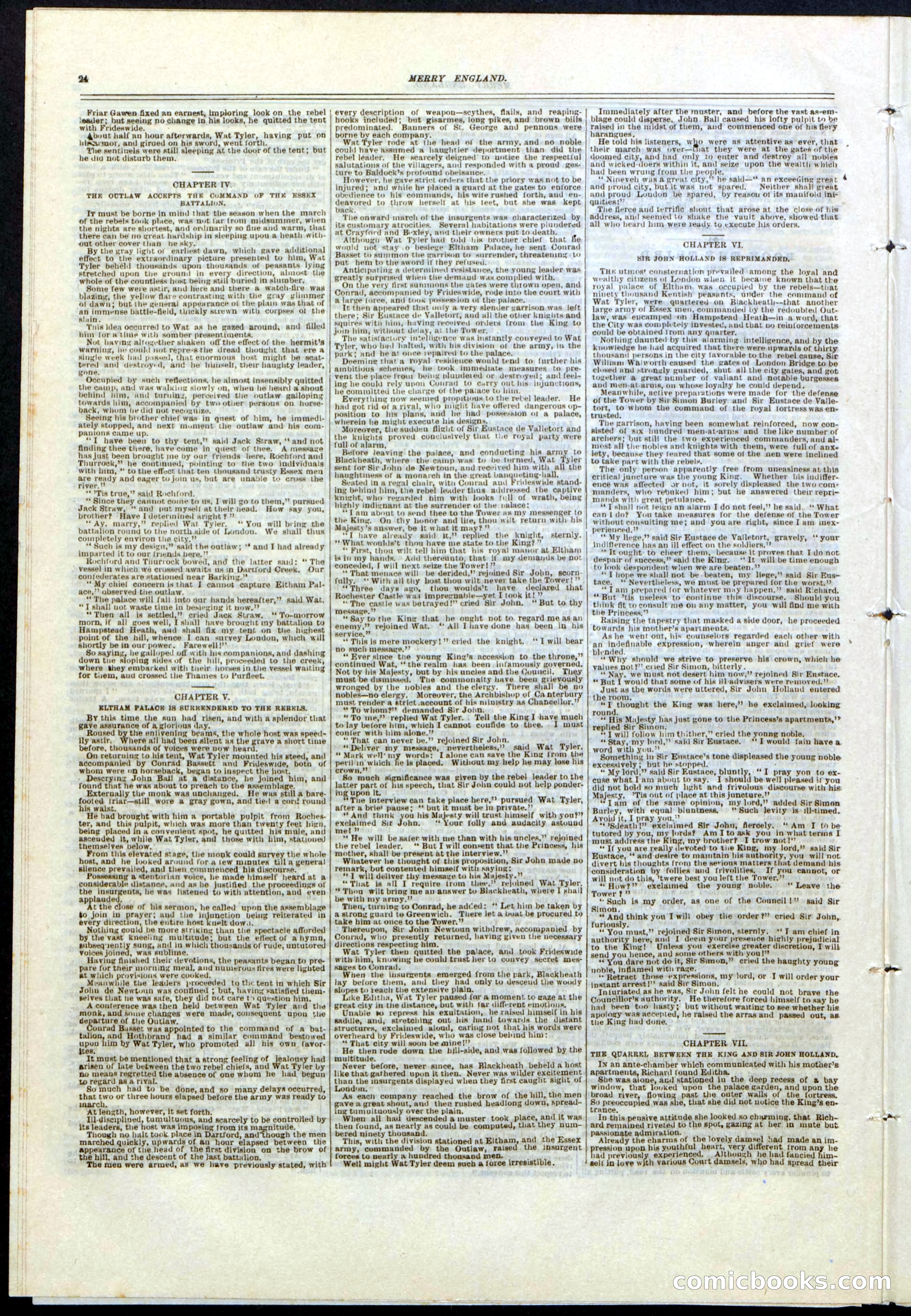
A restored page from Pulp Fiction, 1881. Page through the whole issue in the reader above.
📄 Transcribed text from this page (OCR, searchable)
Machine-transcribed from the original scan — historical spelling and the odd misread are preserved.
-—~ ——s At 24 MERRY ENGLAND. Friar Gawen fixed an earnest, imploring look on the rebel | every description of weapon—scythes, flailx, and reaping- | lomler; but seeing no change in his looks, he quitted the tent with Frideawide. ; About half av hour afterwards, Wat Tyler, having put on hissemor, and giraed on his sword, went forth. The sentinels were atill sleeping at the door of the tent; but he did not disturb them, CHAPTER IV. THE OUTLAW ACCEPTS THE COMMAND OF THK ESSEX BATTALION, Tr must be borne in mind that the season when the march of the rebels took place, was net tar from midsummer, when the nights are shortest, and ordinarily so fue and warm, that there can be no creat hardship in sleeping upou a heath with- out other cover than he sky. : By the gray light of earliest dawn, which gave additional effect to the extraordinary picture presented to him, Wat Tyler behéld thousands upon thousands of peasants lying stretched upon the ground in every direction, almost the whole of the countless hoxt being still buried in slumber, Some few were astir, and here and there @ Watch-lire was blazing, the yellow flare contrasting with the gray ylimmer of dawn; but the general appewrance of the pltin was that of an immense battle-fleld, thickly strewn with corpses of the siuin. Tis idea occurred to Wat as he gazed around, and filled him fora thne with somber presentiments, Not having altogether shaken off the effect of the hermit’s warning, it could not represathe dread thought that ere a single week lind passed, that enormous host might be seat- tered and destroyed, and he hiaselt, their haughty leader, gone, Occupied by such reflections, he almost insensibly quitted the camp, and was walking slowly on, when he henrd a shout behind him, «and turuine, perceived the outlaw galloping towards liim, accompanied by two other persons on horse- back, Whom lie did not recognize, Seeing his brother chief was in qnest of him, he immedi- ately stopped, and next mument the outlaw and his com- panions came up. “T have been to thy tent,” said Jack Straw, *t and not finding thee there, have come In quest of thee. A message has just been brought me by oar friends here, Rochford and Thurrock,” he coutinued, pointing to te two individuals with him, “ to the effect that ten thousand trusty Exsex men are ready and eager to join us, but are unable to cross the river. ** Tis true,” said Rochford. * Since they cannot coine to us, I will go to them,” pursued Jack Straw, “and put myseli at their head. How say you, brother? Have [determined aright?” “Ay, marry,” replied Wat Tyler. ‘“ You will bring the battalion round to the north side of London. We shall thus completely environ the city,” ** Such is my design,” said the outlaw; “* and I had already imparted it to our (friends here.” ochford and Thurrock bowed, and the latter said: “ The veasel in whieh wé crossed awaits us in Dartlord Creek. Our confederates are stationed near Barking.” *“My chief concern is that J cannot capture Eitham Pal- ace,’’ abserved the outlaw, * The palace will fall into our hands hereafter,” said Wat. “T shall uot waste time in besieging it now.’ “Then all is settled,” cried Juck Straw, “ To-morrow morn, if all gcoes well, Tshall have brought my battalion to Hampstead Heath, and shall fix my tent on the highest point of the hill, whence I can survey London, which will shortly be in our power. Farewell!’ So saying, he galloped off with his companions, and dashing down the sloping sides of the hill, proceeded to the creek, where they embarked with their lorses in the vessel waiting for tuem, aud crossed the Thames to Purfleet. CHAPTER V. ELTHAM PALAOE IS SURRENDERED TO THE REBKLS. By this time the sun had risen, and with a splendor that Gave assurance of a glorious day. Roused bs Rese enlivening beams, the whole host was speed- ily aatir, here all had been silent as the grave a short time before, thousands of yolces were now heard, On returuing to his tent, Wat Tyler mounted his steed, and accompanied by Conrad Bassett and Frideswide, botn of whom were on horseback, began to inspect the host. ' Doserying. John Ball at a distunce, be joined him, and found that he was about to preach to the assemblage. Externally the monk was unchanged. He was still a bare- ee Ben wes wore a gray gown, and tie! a cord round w : He bad brought with him a portable pulpit from Roches- ter, and this pulpit, which was more than twenty feet high, being placed in a convenient spot, he quitted his male, and ascended it, while Wat Tyler, and those with him, stationed themselves below,’ From this elevated stage, the monk could survey the whole host, and he looked around fora tew minutes till a genera! silence prevailed, and then commenced his discourse. ne a stentorian voice, he made himself heard at a considerable distance, and as he justified the proceedings of the ins nts, he was listened to with uttention, and even epplend . t the close of his sermon, he called upon the assemblage to join in prayer; aud the injunction beiug reiterated in every direction, the entire host kuelt dow. Nothing could be more striking than the speetacie afforded by the vast Kneeling multitude; but the eflect of a hymn subsequently sung, and in which thousands of rude, untutor voices joined, was sublime. Having flnished their devotions, the peasants began to pre- pare for their morning meal, and numerous tres were lighted at which provisions were cooked, Meanwhile the leaders proceeded to the tent in which Sir John de Newtoun was contined ; but, haviny satisfied them- selves Cliat he was safe, they did not care to question him. A conterence was then beld between Wat Tyler and the monk, and sone changes were made, consequent upon the de re of the Outlaw. urad Basset was appointed to tlle command of a bat- and Hothbrand had a similar command bestowed upen him by Wat Tyler, who promoted all his own favor- It must be mentioned that a strong feeling of dpalons had arisen of late between the two rebel chiefs, and Wat Tyler by no means regretted the absence of one whom he had begun to regard asa rival. So much had to be done, and so many delays occurred, that two or three hours elapsed before the army was ready to inarch, At length, however, it set forth. Iil-disciplined tumultuous, and scarcely to be controlled by its leaders, the host was imposing trom its magnitude. Though no halt took place in Dartford, and‘though the men marched quickly, upwards of @o hour elapsed between the A are of the head of the first division on the brow of hill, and the descent of the Jast battulion. ‘ The menu were armed, a8 we have previously stated, with hooks included; but gisarmes, long pikes, and brown bills predominated. Banners of St. George and pennons were borne by each company. Wat Tyler rode at the head of the army, and. no noble could have assumed a haughtier deportment than did the rebel lender, He searcely deigned to untice the respectiul salutations of the villagers, and responded with a proud ges- ture to Baldock’s profound obelsance. However, he cave strict orders that the priory was not to be injured; and while he placed a guard at the gates to entorce obedience to his commands, his wite rushed forth, and en- deavored to throw herself at his leet, but she was kept ’ back. The onward march of the insurgents was characterized by its customary atrocities. Several habitations were plundered at Crayford and Bexley, and their owners put to death, Although) Wat Tyler bad told his brother chief that Ie would not stay .o besiege Eltham Palace, he sent Conrad Basset to summon the garrison to surrender, threatenimmg Lo put hem to the aword if they refused, Anticipating a determined resistance, the young leader was greatly surprised when the demaud wax complied with, On the very first summons the cates were thrown open, and Conrad, accompanied by Frideswide, rode into the court with a large foree, and took possession of the palace. It then appeared that only a very slender garrison was left there; Sir Rlataoe de Valletort, and all the other knights and squires with him, huVing received orders from the King to join him, without delay, at the Tower, The satisfactury intelligence was instantly conveyed to Wat Tyler, who lad halted, with bis division of the army, iu the park; and he at once repaired to the palace. Deeming that a royal residence would tend to further his amnbitious schemes, he vwook immediate measures to pre- vent the place frou beng plaudered or destroyed; and feel- ing he coulu rely upon Courad to carry out his) injunctions, he cominitted the charge of the palace to hii. Everything now seemed propitious to the rebel leader. He had got rid of a rival, who might have offered dangerous op- position to his plans, and he had possession o: a palace, wherein he might execute his designs. Moreover, the sudden fliait of Sir Eustace de Valletort and the knights proved conclusively that tie royal party were full of alarm, Before leaving the palace, and conducting his army to Blackheath, where the camp was to be tormed, Wat Tyler sent for Sir John de Newtoun, and received him with all the haoghtmess of &@ monarch in the great Lanqueting-hall, Seated in a regal chair, wit Conrad aud Frideswide stand- ing behind him, the rebel leader thus addressed the captive knight, who regarded him with looks full of wrath, being highly indienant at the surrender of the palace: “Tam about to send thee to the Tower as my messenger to the King. On thy honor and lite, thou wilt return with bis Majesty’s answer, be it what it may?” “TI have already said it,” veplied the knight, ** What wonlds’t thon have me state to the King?” © First, thou wilt tell him that bis royal manor at Eltham ik in my hands. Add thereunto, that it my demands be not conceded, T will next seize the Tower!” * That menace will be derided,” rejoined Sir Jobn, scorn- fully. ** With all thy host thou wilt never take the Tower!” “Three days ago, thou woulds’t have declared that Rochester Castle waa imprecnable—yet I took it!” “The castle was betrayed!” cried Sir Jobn. “ But to thy message.” “Say tothe King that he oauee not to, regard me as an enemy,”’ rejoined Wat. “ All Ihave done has been in his service,” “ This is mere mockery!” cried the knight. no such meéssae.’’ “ Ever since the young King’s accession to the throne,” continued Wat, ‘the realm has been. infamously governed. Not by his Majesty, but by his uncles and the Council, They must be dismissed. The commonalty have been grievously wronged by the nobles and the clergy. There shall be no nobles—no e¢lergy. Moreover, the Archbishop of Ca pterbur must render a strict account of his niniwstry as Chancellor,’ “To whom?” demanded Sir Join. “To me,” replied Wat Tyler. . Tell the King I have much to lay before him, which I cannot coufide to thee. must econter with him alone.” “ That can never be.” rejoined Sir John, ‘‘Deliver my message, nevertheless,’ said Wat Tyler. “ Mark well’ may words: [alone can save the King from the peril in which ie is placed. Without my help he may lose his crown, So much significance was given by the rebel leader to the laee part. at 118 speech, that Sir John could uot help ponder- upon ar 1@ Interview can take place here,” pursued Wat Tyler, after a brie’ pause; ** but it must be in private.”’ “and think you his 177 i will trust himself with youf’? “bop Sir John. ‘ Your folly and audacity astound me “He will be safer with me than with his uncles,” rejoined the rebel leader, “ But I will consent that the Princess, his mother, shall be present at the interview.” Whatever he thought of this proposition, Sir John made no remark, but contented himaeif with saying: 7 will deliver thy message to bis Majest Pe “That is all I require irom thee,” rejoined Wat Tyler, “Thou wilt bring me ap answer to Blackheath, where I shail be with my army.” ' Then, turning to Conrad, he adced: ** Let him be taken by a strony guard to Greenwich. There jet a buat be procured to take him at once to the Tower,” ’ Thereupon, Sir John Newtoun withdrew, accompanied by Conrad, who presently returned, having given the necessary directions respecting him. Wat Tyler then quitted the palace, and took Frideswide with him, knowing he conld trust her to convey secret mes- sages to Conrad. When the insurgents emerged from the park, Blackheath lay before them, and they had only tu desceud the woody slopes to reach: the extensive plain. Like Editha, Wat Tyler paused for a moment to gaze at the great city in the distance, but with far different emotions, Unable so repress his exultation, he raised himself in bis saddle, and, stretching out his hand towards the distant structures, exclaimed aloud, caring not that his words were overheard by Frideswide, who was close bebind him: “ That city will soon be mine!’ He then rode down the bill-side, and was followed by the multitude. Never before, never since, has Blackheath. bebeld a host like that gathered upon it then. Never was wilder excitement phan the insurgents displayed when they first caught sight of odon, © As each company reached the brow of the hill, the men pare a great shout, and ther rushed headlong down, spread- oy Sarl wr over the plain. nen all had descended a muster took place, and it was then found, as nearly as could be. computed, that they num- bered ninety thousand. This, with the division stationed at Eltham, and the Essex army, communded by the Outlaw, raised the jnsurgent forces to nearly « bundred thousand men. . Well might Wat Tyler deem such a force irresistible. sternly. **T will bear ——— a a ee lc eg se 8 I ~ Immediately after the muster, and before the vast as-em- blage could disperse, John. Bal) caused his lofty pulpit to be raised in the midst of them, aud commenced one of his flery harangues, He told his listeners, wyo were as attentive as ever, that their march was vovyer—Chat they were at the gates of the doomed city, and had only to enter and destroy ail nobles and wicked-doers within it, and seize upon the wealth whiel had been wrung from the people. ** Nineveh: wis a greut city,” he said—“ an exceeding creat and proud city, but it was not spared. Neither shall creat and proud Loudon be spared, by reasou ot its manifold ini- quitiea!’? The fierce and terrific shout that arose at the close of his address, und seemed to shuke the vault above, showed that all who beard him were ready. to execute his orders. CHAPTER VI, SIR JOHN HOLLAND IS REPRIMANDED, THK utmost consternation prevailed among the loyal and wealthy citizens of London when it became known that the royal palace of Eltham, was occupied by the rebels—tiat ninety thousand Kentish peasants, under the command of Wat Tyler, were quartered on Blackheath--that another large army of Essex nen, commanded by the redoubted Out- law, was encamped on Hampstead Heath—in a word, that the City was completely invested, und that vo reinforcements could be obtained Irom any quarter. Nothing daunted by this alarming intelligence, and by the knowledge he had acquired that there were upwards of thirt thousand persons in the city tavorable to the rebel cause, Sir Willinm Walworth caused the gates of London Bridge to be closed and stronuly guarded, shut all the city gates, and got together @ great number of valiant and notable burgesses and Men-atarms, on whose loyalty be could depend, Meanwhile, active preparations were made for the defense of the Tower by Sir Simon Buriey and Sir Eustace de Vatle- tort, lo whom the command of the royal fortress was en- trusted, The garrison, having been somewhat reinforced, now con- fisted of six hundred men-at-arms and the like number of archers; but still the two experienced commanders, and al- most all the nobles and knights with them, were full of anx- jety, because they fenred that some of the nen were inclined to take part with the rebels. The only person apparently free from uneasiness at this critical juncture was the young King. Whether lis indiffer- ence was affected or not, it sorely displeased the two com- manders, who reonked him; but he answered their repri- mands with great petulance. “T shall not fen an alarm I do not feel,” he said. “ What can ido? You take measures for the defense of the Tower without consulting me; and you are right, since lam inex- perienced,” ‘* My liege,’ said Sir Eustace de Valletort, gravely, ‘ your indiflerence has an ill effect on the soldiers,” “Tt ought to cheer them, because it proves that Ido not despair of success,” said the King. *‘ It will be time enough to look despondent when we are beaten.” * Thope we shall not be. beaten, my lege,” said Sir Eus- tace. “ Nevertheless, we must be prepared for the worst.” “Tam prepared for whatever al happen.” said Richard, “But ‘tis useless to continue this discourse. Should you think fit to consult me on any matter, you will find me with the Princess,” Raising the tapestry that masked a side door, he proceeded towards his mother’s apartments. Ashe went ont, his counselors regarded each other with an cen expression, wherein anger and grief were blended. “Why should we strive to preserve his crown, which he values not?” cried Sir Simon, bitterly. ‘Nay. we must not desert him now,” rejoined Sir Enstace. * But I would that some of his il-advisers were removed.” Just as the words were uttered, Sir John Holland entered the room. “T thought the King was here,’’? he exclaimed, looking ound. ** His Miujesty has just gone to the Princess’s apartments,’’ replied Sir Simon. ** I wil! follow him thither,” cried the young noble, “Stay, my lord,” said Sir Eustace. ‘I would fain havea word with you.” Something in Sir Enstace’s tone displeased the young noble excessively; but he stopped. . “ My lord,” sald Sir Eustace, pate “T pray yon to ex- cuse what Iam about to say, I shou be well pleased if you Majesty. °Tis out of place at this juncture,” “Tam of the same opinion, my lord,” added Sir Simon Burley, with equal bluntness, “Such Jevity is: ill-timed. Avoid jt, I pray you,” . “'Sdeath!? exelaimed Sir John, flercely. “Am TI to be tutored by you, my lords? Am Ito ask you in what terms I must address the ing my brother? T trow not!” “Tf you ave really devoted to tive King, my lord,” said Sir Eustace, “ and desire to maintain his authority, you will not divert his thoughts from the serious matters that demand his consideration by follies and frivolities, If you cannot, or will not do this, *twere best you left the Tower,” * Leave the “How?” exelaimed the young noble. Tower?” “Such is my order, as one of the Council!” said Sir imon. ' nae think you I wili obey the order?” cried Sir John,. uriously, “You must,” rejoined Sir Simon, sternly. ** T am chief in authority here, and I deem your preseuce highly prejudicial to the King! Unless you exercise greater discretion, T wilh send you hence, and some others with you!” — You dare not do it, Sir Simon,” cried the haughty young nobdle, inflame with rage. * Retract those expressions, my lord, or I will order your instant arrest!’’ said Sir Simon. Inturiated as he was, Sir John felt he could not brave the Councillor's authority, He therefore forced himself to say he had been too hasty; but without waiting to see whether his apology was accepled, he raised the arras and passed out, as the King hud dune. CHAPTER VIL THE QUARREL BETWEEN THE KING AND SIR JOHN HOLLAND, IN an ante-chamber which communicated with his mother’s apartments, Richard found Editha, She was alone, and stationed in the deep recess of a bay window, that looked upon the palace garden, and upon the broad river, flowing past the outer walls of the fortress. Sv preoccupied was she, that she did not notice the King’s en- trance, In this pensive attitude she looked so charming, that Rich- ard rema ea vale to the spot, gazing at ber in mute but passion miration. Already the charms of the lovely damsel had made an im- ression upon bis youthfnl heart, very different trom any he ad previously experienced, Althongh he had fancied * Belt